Posted June 21, 2012 by Michael @ Knowledge Lost in Literary News / 0 Comments
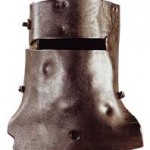 The Ned Kelly Awards are closely associated with the Melbourne Writers Festival and recognises Crime fiction within Australian Literature. The 2012 long list was recently announced.
Best First Fiction
- Boyd Anderson Ludo
- Allan Barbeler An Absence of Discretion
- Andrez Bergen Tobacco Stained Mountain Goat
- Claire Corbett When We Have Wings
- Virginia Duigan The Precipice
- Y.A. Erskine The Brotherhood
- Maggie Groff Mad Men, Bad Girls and the Guerrilla Knitter’s Institute
- Sylvia Johnson Watch Out For Me
- Melanie Joosten Berlin Syndrome
- Stuart Littlemore Harry Curry: Counsel of Choice
- Noel Mealey Murder and Redemption
- Daniel O’Malley The Rook
- Alastair Sarre Prohibited Zone
- Peter Twohig The Cartographer
- Kim Westwood The Courier’s New Bicycle
- Gas Wylde Casino Kurnell
Best Fiction
- Lenny Bartulin De Luxe
- A.A. Bell Hindsight
- Honey Brown After The Darkness
- J.C. Burke Pig Boy
- Peter Corris Comeback
- Miranda Darling Siren’s Sting
- Garry Disher Whispering Death
- Jaye Ford Scared Yet?
- Kerry Greenwood Cooking the Books
- Brett Hoffmann The Race
- Katherine Howell Silent Fear
- Stephen M Irwin The Broken One
- Malcolm Knox The Life
- Adriana Koulias The Sixth Key
- Nansi Kunze Dangerously Placed
- Tobsha Learner The Map
- Stuart Littlemore Harry Curry: Counsel of Choice
- Colleen McCullough The Prodigal Son
- Barry Maitland Chelsea Mansions
- Kel Robertson Rip Off
- Michael Robotham The Wreckage
- Jennifer Rowe Love, Honour & O’Brien
- Kirsten Tranter A Common Loss
- Peter Twohig The Cartographer
- Kim Westwood The Courier’s New Bicycle
- Felicity Young A Dissection of Murder
Best True Crime
- Hilary Bonney The Double Life of Herman Rockefeller
- Peter Corris Mad Dog
- Eamonn Duff Sins of the Father
- Michael Duffy Call Me Cruel
- Lucy Frost Abandoned Women
- Fiona Harari A Tragedy in Two Acts
- Rochelle Jackson Partners and Crime
- Rachael Jane Chin Nice Girl
- Kevin Morgan Detective Piggot’s Casebook
- Kevin Morgan Gun Alley
- James Morton and Susanna Lobez Gangland Melbourne
- James Morton and Susanna Lobez Gangland Sydney
- Stephen Orr The Cruel City
- Liz Porter Cold Case File
- Mark ‘Chopper’ Read Road To Nowhere
- Kay Schubert Perfect Stranger
- Adam Shand Outlaws
- David Spiteri The Prez
Posted June 21, 2012 by Michael @ Knowledge Lost in Gothic, Historical Fiction, Horror / 0 Comments
 Title: Dark Matter (Goodreads)
Author: Michelle Paver
Published: Orion, 2010
Pages: 256
Genres: Gothic, Historical Fiction, Horror
My Copy: Library Book
Buy: Amazon, Book Depository (or visit your local Indie bookstore)
Dark Matter by Michelle Paver is a slow burning ghost story; slowly the tension builds and builds until… The story kicks off on 7th January 1937, the first entry being written in the journal of Jack Miller who is preparing for an expedition to Gruhuken. This uninhabited location in Arctic is the back drop of this chilling story, the atmosphere and solitude all playing a role in building the tension within this story. The relationship between Jack and his companions Gus, Algie, Hugo and Teddy are one of the key aspects that hold this book together.
It’s really hard to review a book like this as I don’t want to give too much of this book away, but I’ll try my best. The story was a very basic one, the isolations, feeling of being completely alone works rather well in the book. The plot and surroundings all slowly build the tension that Jack is feeling. I started off reading this book feeling a little distracted but the further I got in the book the more absorbed in the story I found myself. It’s one of those books you want to read on a cold winter night; the snow outside and nothing but the creaking of the house to keep you company. Unfortunately it never snows and never gets cold here but I can just imagine reading this book in that situation and enjoying it a lot more.
The novel is a well polished ghost tale, reminding me of the old gothic novels of the 19th century; building the tension and characters as you read. While it’s a short book it did a great job at capturing all the key elements to haunt the reader. I’m reminded a bit of The Turn of the Screw by Henry James and even to a less extent The Woman in Black by Susan Hill in the way they can build tension in such a short time. I really love the chilling gothic styles of a book like this, I would love to read some more books similar to this one and compare it to the ones I’ve already read. While I really enjoy this novel I can’t see myself rating this book higher than three and a half stars, but I can’t tell you what was missing in this novel.
Posted June 20, 2012 by Michael @ Knowledge Lost in Historical Fiction / 0 Comments
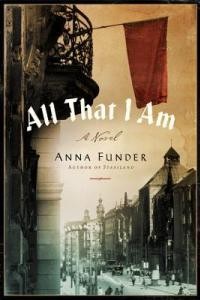 Title: All That I Am (Goodreads)
Author: Anna Funder
Published: Harper Collins, 2011
Pages: 384
Genres: Historical Fiction
My Copy: Personal Copy
Buy: Amazon, Book Depository (or visit your local Indie bookstore)
I wanted to read this book before the Mile’s Franklin award for 2012 is announced as I’m predicting this book will win. All That I Am by Anna Funder is told from the perspective of Ruth Becker and Ernst Toller in alternate chapters. Both Ruth and Toller are remembering life in 1930’s Germany as political activists. Both characters, along with Ruth’s husband Hans and Toller’s lover Dora, publically speak out against Hitler and everything he stands for, advocating independence and freedom of speech for Germany.
This book starts out very heavy; trying to cover all the relevant back story of Germany in the 1930’s while still trying to drive the story along. This is a delicate balance to manage but I think Anna Funder did a good job at managing this. I know people may disagree with me but I think with the subject matter and the back story that needs to be covered, the author still manages to keep the reader turning the page, and for me, that never felt boring. I love the fact that this story is more about the politics and the effect Hitler’s rise to power will have on the German people rather than dealing with the holocaust.
The simple fact that this book tries to deal with the social impacts of the changing Germany has been the biggest contributing factor to my enjoyment of the book. I couldn’t care less about Toller who is writing his autobiography or Ruth, who after reading Toller’s writing, is remembering her side of the story. I know they risk a lot to speak out and I knew Hitler’s regime were actively trying to stop political opposition so I probably should care more for the characters, but the fictionalised German history was more interesting for me.
All That I Am would be a tough book to write and while at times it was heavy and at other time I might not have cared too much of the story; Anna Funder did do an excellent job at writing this novel. The book reminded me of the 2002 movie Max for some weird reason; mainly because it also was a fictionalised account of Hitler rising to power and how he dealt with the political opposition. For those who don’t know the movie Max starred John Cusack as a fictional Jewish art dealer and a young Austrian painter, Adolf Hitler (Noah Taylor). The interesting thing about the movie was it explores Hitler and the view’s that shaped Nazi ideology, while also taking a look at the artistic designs of the Third Reich.
Anna Funder must have done a lot of research in preparing to write this book. I know she has a non-fiction book called Stasiland: Stories from Behind the Berlin Wall but I think that was more about East Germany, but in the course of researching that book she might have gotten all the information needed for All That I Am. I’m glad to have read this novel; I think it offers an interesting insight into a world I was never a part of. It is an interesting piece of history and sociology. Anna Funder has won the Australian Independent Booksellers Indie Book Award for Literary Fiction and has been shortlisted for Miles Franklin Award for this book. I’d be interested to see if this book will stand the test of time.
Posted June 19, 2012 by Michael @ Knowledge Lost in Question Tuesday / 0 Comments
 I don’t really remember learning to read, but I do remember being read to a lot when I was young, there were books that I knew all the words from repetitive reading. When I was a little boy, my favourite book was There’s a Hippopotamus on Our Roof Eating Cake by Hazel Edwards about an imaginary Hippo on the roof eating cake, it turned out to be ‘special’ cake (whatever that means). This seemed to progress and my father use to always read books to the kids and as we grow up the books got more complicated and more interesting stories. I think this might have started my love of audiobooks; I just love being told a story, it’s very relaxing. My father read us the Spirit Flyer Series by John Bibee and The Cooper Kids Adventures by Frank Peretti. Even during primary school I remember story time and listening to Roald Dahl books.
These were my first memories of books, but I don’t really remember reading much back then. I do remember when my little brother and sister been born and reading children’s books with them, I remember In the Night Kitchen by Maurice Sendak seemed to be a favourite of my little brother. To this day I remember the entire story of There’s a Hippopotamus on Our Roof Eating Cake and In the Night Kitchen, that I probably could recite the entire books by heart. Given the fact that I loved books and stories back then, I’m really surprised how long it took me to become a reader. I remember starting off as a very slow reader but I think I read at a decent speed now. Sometimes I wish I could read faster and retain more of the information but I’m happy that I found joy in reading. I really wish I knew more about learning how to read, I might have to ask my parents about that.
Posted June 18, 2012 by Michael @ Knowledge Lost in Historical Fiction / 0 Comments
 Title: Wolf Hall (Goodreads)
Author: Hilary Mantel
Series: Wolf Hall #1
Published: Harper Collins, 2009
Pages: 651
Genres: Historical Fiction
My Copy: Personal Copy
Buy: Amazon, Book Depository (or visit your local Indie bookstore)
Told through the eyes of Thomas Cromwell, Wolf Hall is a wonderful take on Tudor history. Hilary Mantel sets out to write a fictionalised biography of the rise to power of Cromwell, as well as the fall of Cardinal Thomas Wolsey, Henry VIII’s desire to divorce and the opposition of Thomas More. Mantel puts her take on the characterisation of these historical figures and went to painstaking lengths to make sure her version of the story lines up with the historical events as accurately as possible.
Just for the sake of understanding the history behind the book, I did a bit of research before reading this book. I believe this book is set between 1500 and 1535; King Henry VIII has no heir and his chief advisor Cardinal Wolsey is trying to secure his divorce which the Pope refuses to grant. Thomas Cromwell, the son of a blacksmith rises to power by becoming Cardinal Wolsey’s clerk and then later his successor. Wolf Hall takes a look at the history and the morality behind the English Reformation; the English church’s break with the Catholic Church in Rome.
With the success of The Tudors TV show and The Other Boleyn Girl by Philippa Gregory, I’m not surprised how popular this book was but I’m a little surprised that it ended up winning the Man Booker prize in 2009. However, this book is a beautiful read and I found it fascinating that Hilary Mantel gave Thomas Cromwell a real sense of humanity when most recordings seem to vilify him. I’m a little confused why this book was called Wolf Hall when Wulfhall was the manor that was the seat of the Seymour family and yet there wasn’t much in this novel to do with Jane Seymour.
Fans of historical fiction, especially of this period of history, this is the book for you. Don’t be too worried about the sheer size of this novel, you won’t be disappointed. For anyone that has no interest in the period then, I’m not sure if you would want to read this. Personally I don’t have much of an interest in the Tudor’s dynasty but I’m interested in books that tackle morality and that drove me through this book but I did end up developing an interest in the history. I’m keen to read the next book in this planned trilogy; Bring Up the Bodies which only covers 1535 to 1556 and centres around the downfall of Anne Boleyn.
Posted June 16, 2012 by Michael @ Knowledge Lost in Young Adult / 0 Comments
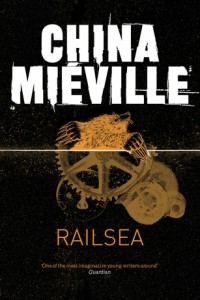 Title: Railsea (Goodreads)
Author: China Miéville
Published: Random House, 2012
Pages: 448
Genres: Young Adult
My Copy: Personal Copy
Buy: Amazon, Book Depository (or visit your local Indie bookstore)
I’ve only really enjoyed one China Miéville novel (The City & The City) but I am a fan of what he does for literature and speculative fiction. His latest novel Railsea is his second attempt at a YA novel and while I’ve not read his other YA novel Un Lun Dun I must say I wasn’t really impressed with this one. I really loved the complexity of The City & the City so I was looking forward to see Miéville’s take on Moby Dick. Granted I should have read Moby Dick before this book but I found this book was too simplified and weird; writing without some intelligent plotting just ends up making the book weird.
Set in a dying dystrophic world that is now desert, Railsea is an adventure novel that tells the tale of three young orphans joining the train to hunt for Mocker-Jack; the giant Mole. The book mixes adventure elements that remind me of Treasure Island with Miéville’s own genre; which he calls ‘weird’ and is a mix of fantasy and steampunk. The main protagonist, Sham, was pretty average in this book but the train captain Abacat Naphi peaked my interest. I think she was the Ishmael in this book; even considering Mocker-Jack as her nemesis.
I thought this book might be more of a children’s book rather than a YA novel; io9 said it best when they said this book was for “kids who cut their teeth on Thomas the Tank Engine, then Lemony Snicket”. It just felt odd and too simplified but a twelve or thirteen year old would probably enjoy it as a gateway into the YA fantasy/steampunk genre. The main issue I had with this book was the overuse of the ampersand. There is way too many in the book; even a large amount of sentences starting with ‘&’. It just never looked or felt write when reading it and I found I got really annoyed with it.
This book is for young teenagers and China Miéville fans, anyone else interested in trying this author might want to look elsewhere. I’m a little disappointed with this book but would be interested to see how my other friends find it, if they read it. There are some interesting elements in this book but for me I felt more frustrated by it. I hope others love and enjoy this book more than I did. Miéville has a lot to offer the literary world but I personally think skip this one and go read The City & The City.
Posted June 15, 2012 by Michael @ Knowledge Lost in Culture / 1 Comment
 I wanted to do an overview of my first subject at university but I’m finding that very hard to do. The whole thing was on the concept of Truth and trying to understand how to think of things critically and determine what truth really is. My last post on the encyclopaedia was also a result of this subject; it was actually one of my assignments. The basic concept of the subject was trying to get the students to work out if Truth is subjective or objective, relative or absolute.
I was surprised what topics were covered when talking about the concept of Truth, including Literature, Myths, Philosophy, Political Ideologies, Religion, Science & the Media. I guess I never really thought about it but everyone’s personal concept of what the truth really is would cover their personal views on politics, religion, and science.
Apart from personal views of what is true, there are the proven facts that we consider to be true. But what would happen if these truths are proven to be incorrect? This is called a paradigm shift; and while when I think of these shifts, I normally I think of science, i.e.: The discovery the world is round, the world revolves around the sun and so on. It is interesting to be able to think more about paradigm shifts in other forms as well; shifts in social thinking. For example, witches went from being spiritual people, to heretics, to someone that you should fear all the way back to a spiritual person again.
While this isn’t really a traditional blog post for me, I just wanted to share my thoughts on the subject and maybe give you some food for thought. I know this subject seems like a very basic and general Bachelor of Arts subject but it was a nice way to explore a concept and give the students of the different fields you can take within the course. I would love to know any thoughts you might have on the whole concept of truth.
Posted June 14, 2012 by Michael @ Knowledge Lost in Contemporary / 0 Comments
 Title: The Mountain (Goodreads)
Author: Drusilla Modjeska
Published: Random House, 2012
Pages: 448
Genres: Contemporary
My Copy: Personal Copy
Before reading this book, I must admit that I’d never heard of Drusilla Modjeska so I thought I would look her up and find out a bit about this book before starting The Mountain. I would never have picked up this book if it wasn’t for the fact that I needed to read this book for my local bookclub. Yes, this was the same book club that made me read A Perfectly Good Man by Patrick Gale and The Hanging Garden by Patrick White so I was prepared not to enjoy, or even hate, this book. Modjeska is an award winning Australian author known for blurring the lines between Non-Fiction and Fiction. She has written three books in the past; Poppy (1990), The Orchard (1997) and Stravinsky’s Lunch (1999); all three books won the NSW Premier’s Literary Award for Non-Fiction.
The Mountain I believe was her first attempt at a purely fiction novel, but even this book has a lot of elements that might be considered non-fiction. I do like a book that uses real events and builds a story around them and I think Drusilla Modjeska did a decent job at doing just that. The first part of this book is a real coming of age story in Papua New Guinea during a time of colonialism. While there seemed to be a handful of characters this story covers (including Rika, Leonard, Jacob, Martha and Laedi) the books does a nice job of introducing each of the characters in this part of the book. The second part of the novel deals with a new generation who are dealing with the effects of everything that has happened. This generation is questioning their identity and the fallout of independence.
I really enjoyed learning more about Papua New Guinea’s history, featuring Whitlam government granting them independence and his dismissal. It was also nice to see the book revolving around other aspects of Papua New Guinea other than the Kokoda Track; which does feature but not in a huge way. Drusilla Modjeska took an interesting approach of making The Mountain the centre of this novel and almost took it to a point where she was making The Mountain a central character. This tactic helped drive the story a little for me; it was almost like the mountain has some secrets it didn’t want to tell.
I really wanted to enjoy this book more than I did but I felt the book ended up being too nice. While there are a lot of bad things happening during this book, the story itself felt too cutesy for me to enjoy properly. I think the characters were decent but I never felt like I knew them well enough to care about the struggles that they faced. I read this book right after reading another character driven book, The Red House by Mark Haddon, and I think Modjeska’s story was nice, but Haddon’s The Red House seemed to outshine The Mountain in terms of characters and exploring their personal struggles.
Posted June 13, 2012 by Michael @ Knowledge Lost in Literature / 0 Comments
I’m not sure how I feel about re-reading books; as a book lover I have to face the facts that I’m never going to read all the books I want to read. So why would I waste time re-reading a book? Sometimes there are books with so many layers that you need to re-read them just to explore the plot and the themes deeper and sometimes it’s just a matter of comfort. For the past three years I’ve been re-reading Frankenstein ever year; simply because I love this book and yet there is still so much in the book to discover. This year I haven’t felt the need to re-read it, yet. So I’ve been questioning the idea of ‘to re-read or not to re-read?’
There are some books I still would like to re-read; The Shadow of the Wind by Carlos Ruiz Zafón and Slaughterhouse-Five by Kurt Vonnegut come to mind but sometimes I think there are too many books worth reading to go back to a book. I know there will always be books I will want to re-read and some I will read again but I’m not sure how I feel about the whole concept. I’ve never understood the idea of people completing a book then going back to the same book again straight away. Having said that, I often try to read in a different genre or style after a reading a book because I worry I would get bored with an author or genre if I fully entrench myself. I would love to hear other people’s thoughts on re-reading.
Posted June 12, 2012 by Michael @ Knowledge Lost in Question Tuesday / 0 Comments
Yes.
For the sake of a blog post, I better expand on this answer. I think the government should set money aside for the arts and when they get neglected, I get very upset. See my post about the Queensland Government Cutting Literary Award in order to save $244,000 of a $47,000,000,000 budget. I don’t think taxpayers should be subsidising every writer but I do believe there is a need for state and national writer awards that would bestow unpublished authors with a publishing contract and publicity.
I think that Australia does a great job in helping writers get a start in the industry. With programs like state writing centres which helps train writers into refining their arts, and the Australian/Vogel Literary Award which recognises writers under the age of 35 with unpublished manuscripts. Even though the Queensland government has cut funding to the Queensland Literary Awards, this award will continue to run, even if they are unable to give some prize money to the winners.
I’m sure there is more money being put in to developing writers within Australian that I haven’t mentioned. It does surprise me just how much our government does for the arts. Sure, I would like to see more money put into the arts but I’m sure many people within Australian would object to that. I’m not sure what it’s like for writers in other countries but I think I truly live in a great country.
There’s no money in poetry, but then there’s no poetry in money either.” — Robert Graves

