
My final “best of” list for the year and my most important one. I am reflecting on the books I have read, and it seems that my favourites are older books. I spend time reading new books and this year it was the classics I enjoyed the most. I think this will be a focus next year, as I am still working on my reading challenge. I do remember when I was reading over 100 books a year and I am jealous of that now, but life has other plans for me.
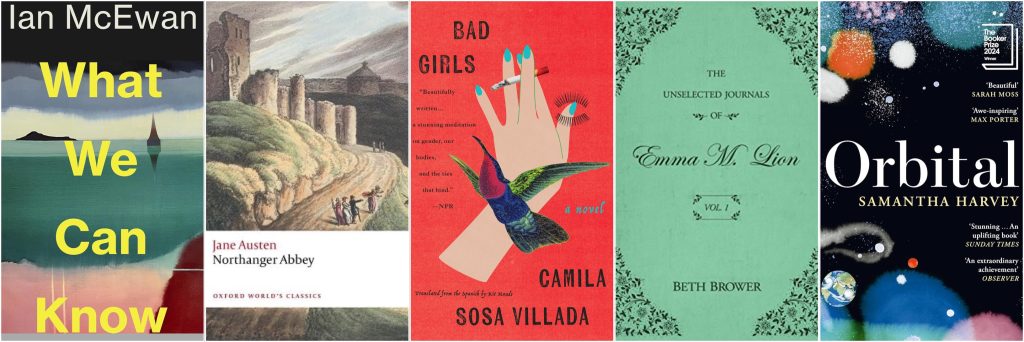
10. What We Can Know by Ian McEwen – 2025
You know when you read a book and you immediately want to start reading it again; I felt that way about What We Can Know. I think after reading part 2 of this novel, I wanted to go back and remind myself of the first part. I did read most of this on a plane; not being distracted by my phone could have been why enjoyed this novel so much. My first Ian McEwen and not my last, I found the prose so beautiful, engaging and yet so easy to read. I found myself comparing the style with Julian Barnes (another author I need to read more from) in the way it felt elegant to read and yet their style kept me engaged. Set in two parts, starting on 2119 where a scholar is looking of the archives of the twenty first century, in particular a long-lost poem. The second part is set in 2014 and the events that lead to the poem being written. It was an interesting exploration into how we engage with history verses what happened in these people’s lives to create this piece of writing.
9. Northanger Abbey by Jane Austen – 1818
My wife and I decided to do a buddy read of this Jane Austen novel and I found it interesting to have a book to discuss with her. I think in 2026 there will be more buddy reads together (Chosen Family by Madeleine and another Austen, possibly Sense and Sensibility). What I loved about this novel is the exploration of gothic fiction and Catherine ‘fan-girling’ over an abbey. There are so many types of novels happening here; it is a satire, it is a gothic novel, it is a bildungsroman and a social critique. I find it hard to believe that this was written before all Austen’s major works and remained unpublished in her life. While I do prefer Pride and Prejudice (the only other Austen book I have read) I was impressed with everything happening in this novel…maybe I should write a review for this book.
8. Bad Girls by Camila Sosa Villada (translated by Kit Maude) – 2019
Camila Sosa Villada is a transgender actress, writer and singer from Argentina and this a semi-autobiographical novel around her time as a sex worker. Sometimes published in English under the name The Queens of Sarmiento Park, this novel explores a group of trans women on the streets around Sarmiento Park and the tales of their encounters with people. As it is a South American novel expect a little magical realism and be warned these experiences are horrifying. I love the way this novel explores the social divide, not just of economic classes but with the transgender community as well. This novel does not hold back, but I think the use of magical elements is used to blur lines of reality and still be informative about the dark sides of sex work.
7. The Unselected Journals of Emma M Lion: Vol 1 & 2 by Beth Brower – 2019
Technically two novels (and I still have six more to read) but I am invested in this series. Set in 1883, Emma M Lion is a young woman who is returning to St. Crispian to take her inheritance, Lapis Lazuli House. The house has been managed by her eccentric cousin Archibald who is not too keen on returning the property to the heir. The journals document the life of this very young woman and the interesting people she meets in St. Crispian. I found these books so charming and a delight. While the writing style is trying to be suggestive of authors like Oscar Wilde or maybe Jane Austen, I think there are choices made hrere to make it accessible to today’s readers. I had to force myself to not pick up more of these novels just so I did not spend the entire year only reading these books.
6. Orbital by Samantha Harvey – 2023
If it was not for book club, I do not think I would have read this novel at all; even if it did win the Booker, it was not the Booker prize I follow. I am never too sure if I should describe this as science fiction, maybe it is more a science than sci-fi or a philosophical novel. Orbital follows six astronauts on the international space station orbiting earth in a period of 24 hours. This is a contemplation of earth, our environment; the beauty and problems we see and if we have the ability to change or help our world. This was a novel that I read through quickly but remained on my mind for the rest of the year.
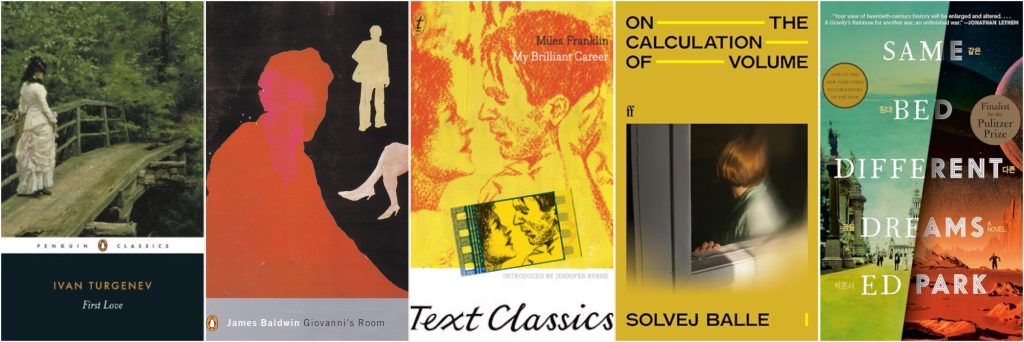
5. First Love by Ivan Turgenev (translated by Isaiah Berlin) – 1860
There was something so fascinating about the way this explored first love, and the complexities of romance as an adult. This follows Vladimir Petrovich who, much like most young men bidding for the affection of Princess Zasyekin who lived next door. Vladimir is only 16 years old and the way Turgenev explores the growth and understanding of his heart and emotions was stunning and as this is Russian literature you can expect a lot of angst and heartbreak; but I think that is expected with first loves.
4. Giovanni’s Room by James Baldwin – 1956
This novel follows a young American in Europe who starts an affair with an Italian man, Giovanni. When Baldwin was asked if this novel is autobiographical, he as often stated this was not shaped by his own experiences in Paris; but I do suspect there were similar experiences between David and author. When thinking about how to describe this novel, I feel like I start listing the dozens of themes that play out in these pages. There is social alienation, exploration of bisexuality and homosexuality, masculinity, depression, racism, homophobia and so much more. I think I love Giovanni’s Room because there is a lot going on here and all around 150 pages. I need to read more James Baldwin but part of me also wants to reread this one next year.
3. My Brilliant Career by Miles Franklin – 1901
I am not sure why it had taken me so long to read this novel, but thanks to the reading challenge my wife created for my birthday, I read and fell in love with My Brilliant Career. This is an autobiographical novel by Stella Miles Franklin who was only 21 when the novel was released and it is surprisingly feminist to the time. The heroine Sybylla Melvyn is a headstrong woman who refuses to confirm to social pressures, such as marriage. She wanted to achieve what she considered to be her dream career, to be an author. The questions about social pressures put on women remains relevant today as when this novel was written, which is disappointing but probably why this novel remains so applicable now.
2. On the Calculation of Volume I-III by Solvej Balle (I and II translated by Barbara J. Haveland, III translated by Sophia Hersi Smith and Jennifer Russell) – 2020-2021
It is 18th of November again and Tara Selter seems to be stuck in time. Many people compare these books to Groundhog Day, which is fair, but I think they offer so much more. I remember going into the first book wondering how can Balle keep this up for the intended seven books. It is hard to separate these as separate books as we all wait for the new translation of the next book to be translated into English (April 14, 2026, if you are wondering). While the focus is the time loop, I think each books seems to focus on an aspect of being stuck in a day. For example, book 1 focuses on Tara’s relationship with her husband who is not stuck in November 18, book 2 she discovers a new person and what it is like to realise you are not alone, while book 3 there are even more people trying to build a community together. I have no idea what is going to happen in book 4 or any of the other books but I cannot wait to find out.
1. Same Bed Different Dreams by Ed Park – 2023
In 2015 a Korean American author got an ARC or a book called Same Bed, Different Dreams by Echo; the novel explores the sinister and secretive history of the Korean Provisional Government. This novel Same Bed Different Dreams (the one written by Ed Park) is a weird metafictional novel about a fictional novel, the Korean War, the division of North and South Korea and writing. It is so hard to categorise this novel, it is alternative history, science fiction, historical fiction and literary fiction all at the same time. I really wish I had the skills to describe this novel, it is complex, but it takes you one a weird postmodernist journey.



Interesting selections, thanks for sharing your favourites
This is a great list. I remember I also enjoyed Northanger Abbey, much more than I thought I would. I love Turgenev’s First Love as well. If you haven’t seen it yet, I recommend short animation My Love by Aleksandr Petrov. It is based on Ivan Shmelyov’s story, but that one in turn was inspired by Turgenev’s story.
I’ve not seen it, I must go looking for it
Lovely! I have only read Orbital, so good.
Here are my favorites, with a bunch of classics as well: https://wordsandpeace.com/2026/01/06/year-of-reading-2025-part-1-my-top-23-books/