Author: Michael @ Knowledge Lost

Fifty Shames of Earl Grey by Andrew Shaffer

Posted September 26, 2012 by Michael @ Knowledge Lost in Humour / 0 Comments

Fifty Shames of Earl Grey by Andrew ShafferTitle: Fifty Shames of Earl Grey (Goodreads)
Author: Andrew Shaffer
Series: Fifty Shames #1
Published: Da Capo Press, 2012
Pages: 224
Genres: Humour
My Copy: Paperback

Buy: AmazonBook Depository (or visit your local Indie bookstore)

I’ve not read many parodies before but Andrew Shaffer is mildly amusing on twitter so I thought I’d give his book a go. Fifty Shames of Earl Grey is an obvious dig at Fifty Shades of Grey but it also has fun with the Twilight fanfic elements as well; clearly pointing out the similarities of the two books with lines like; “I’m Edward Cullen. I mean, ‘Earl Grey.’ Have a seat?” This novel reminds me of a Leslie Nielsen style parody with the farfetched and over done humour, but that’s what makes it so much fun to read. Earl Grey is a billionaire with fifty secret shames; some of them involve his love of BDSM (Bards, Dragons, Sorcery, and Magick) while others are even worse, like his love of Nickelback.

Obviously this is never going to be high literature with lines like “Moan,” I moan. “Moan, moan, moooooooan.” but is this book supposed to reflect the literary flaws of 50 Shades and Twilight or is this just meant to be a fun read? I’m not going to think too much about it, I went into this book for a fun read and that is how I will review it. I’ve heard people claim that Edward Cullen and Christian Grey are hot but none come close to Earl Grey because “HOLY MOTHER EFFING SPARKLY VAMPIRES IS HE HOT”.

Let’s face it Andrew Shaffer had a lot of fun with this book, from the pseudonym (Fanny Merkin) to the cover and everything in between. It was awkward and unexpected; I had so much fun reading this book. I don’t normally highlight but my kindle version of this book has over thirty different highlighted passages in it. I really enjoyed what Shaffer did with this book; highlights for me included the Spanking scene with the Count from Sesame Street and the Cleo sex quiz (which I really want to read the other 200 pages of). They are making a movie of Fifty Shades, and if they ever decided to make a parody I really hope they consult Andrew Shaffer. This was a fun read and I’m looking forward to Fifty Shames in Space but right now I need a sandwich.

If you don’t believe me check out what Tiffany Reisz, author of the BDSM erotica series, The Original Sinners says about this book; “I’m not telling you to buy Fifty Shames of Earl Grey because I’m banging the author. I’m telling you to buy Fifty Shames of Earl Grey AND I’m banging the author.”

Read More


Now You See Me by S.J. Bolton

Posted September 24, 2012 by Michael @ Knowledge Lost in Crime / 0 Comments

Now You See Me by S.J. BoltonTitle: Now You See Me (Goodreads)
Author: S.J. Bolton
Series: Lacey Flint #1
Published: Bantam Press, 2012
Pages: 432
Genres: Crime
My Copy: Personal Copy

Buy: AmazonBook DepositoryKindle (or visit your local Indie bookstore)

Lacey Flint is a young detective constable in London with a secret past.  When she finds a woman stabbed right by her car everything changes for her. The killer has a special interest in Lacey and with her special knowledge on serial killers she finds herself a part of the terrifying murder hunt to catch this copy cat killer. Is this killer’s interest in Lacey personal or professional? Can Lacey continue to keep her past hidden when she is pushed further and further into the spot light? Read Now You See Me by S.J. Bolton to find out.

I found it interesting that the struggles of Lacey Flint seemed to be the main focus of this novel while the Jack the Ripper copy cat killer serves as a way to build the characters. It is a fine balance to get right but I tend to feel like Bolton didn’t focus on catching the killer as I would like. I love the idea of a Ripper copy cat and the killer known as Joesbury went to great lengths to attack Lacey, but in the end I never really felt like it was a balanced novel. Lacey is a great character and everything felt like an attack on her,; both from the killer and the other detectives, which in the end helped give us a better perspective of this character.   However the hunt and the killer side of this book just become formulaic back story. I just think it never really seemed to come together in the end; sure there is closure in the book but it felt a little messy.

One of my major problems with Crime novels like this is the fact that everything all feels predictable and everyone writing bestseller novels are following the same outline and formula. I would have loved something a bit more dark and gritty. There were some good elements in this novel but as I said before the balance wasn’t there. I think Bolton really let the reader down in that aspect; especially in the end of the book where it all felt rushed and never ended neatly. I know it was an attempt to setup the second book in the series but it never really worked.


Billy Lynn’s Long Halftime Walk by Ben Fountain

Posted September 22, 2012 by Michael @ Knowledge Lost in Literary Fiction / 0 Comments

Billy Lynn’s Long Halftime Walk by Ben FountainTitle: Billy Lynn's Long Halftime Walk (Goodreads)
Author: Ben Fountain
Published: Canongate, 2012
Pages: 308
Genres: Literary Fiction
My Copy: Paperback

Buy: AmazonBook DepositoryKindle (or visit your local Indie bookstore)

Billy Lynn is a 19 year old Iraq War hero on a P.R. tour for the Army. The team “the Bravos” are on a two week “Victory Tour” stateside that was filmed and widely viewed on TV due to acts of valour in Iraq. Billy Lynn’s Long Halftime Walk is a satirical look at Americans and how they treat and view the war on terror.

I’ve often heard that this book is a satirical book in the vein of Slaughterhouse-Five and Catch 22 and this was the primary reason I read this book. While there were some satirical elements in the book, I found this book a little heartbreaking; in the sense that these soldiers fight for their country and the Americans love them for it, as long as it doesn’t interrupt their football or cost them anything. This was the overall message I got from this book; people will support their troops as long as it takes no effort and doesn’t interrupt their lives.

I wanted to like this book and sure there is a lot to think about in this book but I think leaving me so feeling so bad doesn’t really help with the enjoyment element of this book. There were some literary issues I had, but they could be narrowed down to the fact I’m not an American and I don’t fully understand the American lifestyle.

The entire book really showed the disconnection between the military and civil life in this modern day. Americans wants revenge for 9/11 but they are not willing to sacrifice their Thanksgiving football game. This was a powerful book and while it’s not as funny as Catch 22 it does leave you pondering life like Slaughterhouse-Five did for me. As I’ve stated I’m not expert in American life or politics but this did leave me pondering many aspects of this War on Terror.


The Yellow Birds by Kevin Powers

Posted September 20, 2012 by Michael @ Knowledge Lost in Literary Fiction / 8 Comments

The Yellow Birds by Kevin PowersTitle: The Yellow Birds (Goodreads)
Author: Kevin Powers
Published: Hachette, 2012
Pages: 226
Genres: Literary Fiction
My Copy: Personal Copy

Buy: AmazonBook DepositoryKindle (or visit your local Indie bookstore)

Haunted by Murph, The Yellow Birds follows the story of Private Bartle and his time served in Al Tafar, Iraq, the loss of a friend and the aftermath. Every war there seems to be one powerful book that is so heartbreaking but helps readers get an idea of the tragic nature of war; I’m thinking All Quiet on the Western Front, The Diary of a Young Girl, The Things They Carried, and now The Yellow Birds could quite possibly be the one to reflect the harsh reality of the Iraq War.

This is a book of friendship and loss; the novel is broken into two parts which are woven together. First there is the story of the friendship and serving together in the war and the other is of Private Bartle struggling to deal with the loss of his friend and returning from the war. There is a real beauty in the way Kevin Powers has melded the two together and the way he tries to help the reader understand the psychological mindset of a soldier turning from war. There is a wonderful part in the book where a bartender refers to Bartle as a hero and his reaction was basically ‘how can I be considered a hero if all I did was survive.’

I don’t want to sound to cliched with using words like beautiful, stunning, haunting and heart breaking but these words do seem very appropriate for this book. This is a debut novel for Kevin Powers and with his experience serving in the Iraq War and his poetry background, The Yellow Birds comes together for an emotional sensation. The proses of this novel are just wonderful and the characters really do seem to be well developed without showing too much.

I will admit I don’t read many war books but I’ve recently read two wonderful books on the Iraq war; this one and Billy Lynn’s Halftime Walk (review up in two days). While both books were wonderfully thought provoking they were in two very different ways. If The Yellow Birds doesn’t become the stand out book for the Iraq war; like All Quiet on the Western Front, The Diary of a Young Girl or The Things They Carried I have a feeling it might be compared to the psychological mindset of war along with Catch 22 or Slaughterhouse-Five. This truly is a stunning book that made me tear up and feel for the soldiers fight in Iraq. Everyone should read this book.


Book Ratings

Posted September 19, 2012 by Michael @ Knowledge Lost in Literature / 0 Comments

rating

My dad asked me the other day, How do you rate books?” This is an interesting thought, I’ve got a system for rating but I never really thought of it into great details. I’m not talking about my 1-10 scale that I use but what factors determine the rating. So I thought I would brainstorm my thoughts into this blog post. When I finish reading a book I often got to Goodreads, mark the book as read and give an initial rating of the book; this is basically my feeling of the book at the time of finishing the book. But I often spend some time thinking about the book and how I would like to review it (yes, that’s my excuse for always being over three reviews behind and I’m sticking to it).

While thinking about how I want to review the book I often look at some key elements. I normally have a think about the plot, writing style, characters, grammar, research, my personal experience, insightfulness and any other elements that should be factored in. But should I have a standard criterion or should each rating be based on a tailored scale for that book? I’ve been thinking about this for a while now and I feel like while I really liked the parody novel Fifty Shames of Earl Grey, I could never put it on the same rating criteria as Crime and Punishment.

I think the fact that I’m trying to explore the different genres out there a rating template would never work but I should look at some key elements no matter what the book was and I think the main ones would be plot, characters, style and my personal experience of the book. These for elements make up my end rating; I often change the rating of a book when I finish reviewing it.

 The problem with ratings are the fact that they are very personal and when looking at your reading list as a whole some books shouldn’t be considered to be on the same level as others. But should you review a book without a rating or is adding a rating just a good way for people to quickly look at what you thought of that particular book?

I would love to hear people’s thoughts on ratings. I know most people have different scales and ways of picking the final rating so please tell me about your process. Also if there was ever a standard criterion for book ratings what would you put on it. For example if you to break down the characterisation, would you look at believability, personality and so on?


The Geneva Trap by Stella Rimington

Posted September 18, 2012 by Michael @ Knowledge Lost in Thriller / 0 Comments

The Geneva Trap by Stella RimingtonTitle: The Geneva Trap (Goodreads)
Author: Stella Rimington
Series: Liz Carlyle #7
Published: Bloomsbury, 2012
Pages: 328
Genres: Thriller
My Copy: ARC from Publisher

Buy: AmazonBook Depository (or visit your local Indie bookstore)

The Geneva Trap by Stella Rimington is my first real look into the Liz Carlyle series but this is book seven. So be warned that I’ve not read the other six books so my opinions of this book are only based as a standalone book. Liz Carlyle is a counter terrorism agent for MI5 who is approached by a Russian intelligence officer with some vital information of a cyber-sabotage plot on an American defence program. Liz now has to determine if this is the Russians sabotaging the West’s defences or if this is something much worse.

Stella Rimmington brings all her knowledge to this book as a former MI5 agent and she tries to tangle a story of intrigue and suspense in this novel. But does it work as well as it should? For me I haven’t had much experience with espionage novels so I don’t know what most people would expect from one. For me I often think of James Bond or George Smiley when looking for an espionage novel. The Geneva Trap isn’t as far fetched as an Ian Fleming book and is not as complex as a John le Carré novel, it sits somewhere in the middle which is where I’m lacking in experience with these types of books. I often look for a light high-energy read or something that will make my head hurt when I read spy thrillers. So I’m not too sure I like having a book that falls in the middle.

The Geneva Trap has its fair share of moles and shady intelligence practices but in the end I found the book to feel a little too clichéd and predictable. I also felt like most of the characters in the book were too flat and I never really got to see any dimension in them; this could be a simple fact that this is book seven in the series but I still expect a book to be able to be read as a standalone as well so I would of liked more character development within this one.

Rimmington has put together a good mix of intrigue and action in this spy thriller, I would like to see less predictability and more character development in the future but The Geneva Trap was still an enjoyable book to read. I will definitely be looking to read another one of her books, maybe even in the same series because I did enjoy reading this book even if this review sounds like my issues with the novel outweighed my enjoyment of it. It might have been just my lack of experience or that I should have read the other six first.


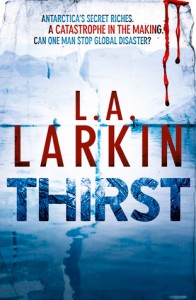
Thirst by L.A. Larkin

Posted September 16, 2012 by Michael @ Knowledge Lost in Thriller / 0 Comments

Thirst by L.A. LarkinTitle: Thirst (Goodreads)
Author: L.A. Larkin
Published: Pier 9, 2012
Pages: 332
Genres: Thriller
My Copy: ARC from Publisher

Buy: Book Depository (or visit your local Indie bookstore)

In the harsh environment of the Antarctic, the people of Hope Station are been hunted down. Glaciologist, Luke Searle has to fight for survival against a mercenary that will win at any cost, while trying to prevent an environmental disaster. He only has 5 days to fix this, can he stay alive long enough? Does he really know what he is going up against? L.A. Larkin’s Thirst is an Eco-Thriller set in one of the harshest environments known to man.

Thirst is a fast paced novel that will suck you right in with its constant suspense and the unpredictable elements within this book. The harsh setting of Antarctica and the sense of solitude and danger really helped drive this book and became my favourite element of this book. But there was something in the book that really didn’t sit well with me. This book has one of my Literary Bête Noires in it; the villains. I’ve blogged recently about how I never seem to enjoy cliché villains and unfortunately the fact that the protagonist was up against the Chinese in the book really detracted from my overall enjoyment of this book.

Apart from that one element, this book is a typical thriller, highly enjoyable read with some explosive situations. I’m happy that the book never seemed to go into the realm of formulaic but it did sit on the border and I did feel myself cringe at that thought it might head in that direction. Thankfully Larkin’s was able to recover with her writing style and her research of the environmental aspects of this book.  I must admit that towards the end of the book, when I pictured the protagonist Luke Searle, I kept comparing him to Steven Seagal and expected him to act that way.

Thirst was an enjoyable Eco-Thriller which was a lot of fun to read, while I did struggle with the villains being cliché, I did enjoy reading this novel. I would recommend this book to anyone that likes a good light read. I know many people are going to compare this book to Matthew Riley’s Ice Station but that shouldn’t be deterrent, it’s nice to see a female (why is there a lack of thrillers written by women within Australia?) can write a thriller just as exciting as something written by Riley.


Literary Bête Noires: Villains

Posted September 15, 2012 by Michael @ Knowledge Lost in Literary Bête Noires / 0 Comments

I’ve felt like my blog is starting to be overrun by book reviews and there is less to do with random book banter than I would like. So I plan to rectify this with introducing some more regular segments. In this one, I want to look at thinks that I find in books that either annoy or don’t sit right with me. Everyone has pet peeves with literature, it can be topics that have been overdone, cliches or just the way people seem to write. So I wanted to go though some of my literary bête noires as a therapeutical way to vent and maybe generate some interesting conversations in the comments.

The first literary gripe I want to look at has to do with villains. If you are writing a book and the villains are Russians, Chinese, or Middle Eastern then you have pretty much lost me already. There are other countries that annoy me to a lesser extent. But it’s not really the country that is the problem, all the writer is doing is generalising the people by making it sound like that the entire nation is full of villains; that is just plain lazy.

Alright it’s understandable if you are setting it in a war but when writing a thriller how about mixing it up a bit try something original, that’s all I’m asking. This formulaic approach to villains are one of my biggest problems with action or thriller novels. As soon as you enter into overdone territory with villains you’ve lost me.

There are more elements I find annoying with villains in literature but I mainly wanted to focus on nationality for this one. Please let me know your thoughts on villain nationality or villains in general and if you have any other insights on the topic that I’ve missed.


The Dinner by Herman Koch

Posted September 13, 2012 by Michael @ Knowledge Lost in Crime, Literary Fiction / 0 Comments

The Dinner by Herman KochTitle: The Dinner (Goodreads)
Author: Herman Koch
Translator: Sam Garrett
Published: Text, 2012
Pages: 309
Genres: Crime, Literary Fiction
My Copy: Paperback

Buy: AmazonBook DepositoryKindle (or visit your local Indie bookstore)

Paul and Claire are going out to dinner with Paul’s brother and his wife. The reason for this isn’t the usual family get together, this time they have something important to discuss; their children. The characters, the overpriced restaurant and the secret is what makes The Dinner by Herman Koch this novel live up to the hype. This satirical book was already a best seller but until only recently this book was never available in English. 

I have to admit I was really looking forward to reading this book for my local book club; but what I was getting into, I really didn’t know. The Dinner is dark elegant book that takes you on a journey with some very unexpected twists. At first glance this book felt like a very light and easy read and you will plow through this book so quickly that when something unexpected happens you won’t see it coming. The characters in the book seem very real and Paul’s brother and his wife remind me a lot of characters from a Bret Easton Ellis book; they are charismatic and ambitious but feel very shallow nihilists. 

The restaurant was a brilliant backdrop for this book; it was one of those places you need to book months in advance and Paul’s brother Serge thought it sport to try and book a table for the same day. Fine dining at a pretentious restaurant really felt like the perfect location for the explosive events in this book, you get the sense that everyone should act calm and composed in a place like this but what’s happened doesn’t really go hand in hand with calm or composed. 

I was really pleased with this book, I love the dark and satirical nature of the plot mixed with the fine dining experience, they come together to make a thrilling read. The Dinner is full of mayhem and you will be shocked with every course been served but there is so much more in this book, the characters are real and it will question your thoughts of the best way to raise your children. The thought provoking elements remind me of Christos Tsiolkas’ The Slap and this book finds the balance between mystery and family drama. A well developed novel that I highly recommend people read


Dystopian Fiction; A Brief History

Posted September 12, 2012 by Michael @ Knowledge Lost in Dystopia, Literature / 0 Comments

This post was originally a guest post that appeared on blahblahblahtoby; big thanks to Toby for allowing me to get involved in his Dystopian fortnight and for letting me share this post with my readers too.

Dystopian fiction has been around for a long time; interesting enough, it was an offshoot of utopian fiction which started growing in popularity in the 1900’s. I’m a little surprised that utopian fiction seemed to be the predominate genre but if you look at the history of dystopian literature you can see why. The spikes in popularity seems to have started from the lead up to the world war two and the cold war and then as a result of 9/11 and the war on terror. Escapist fiction; as a way to substitute the problems with the world with a more nightmarish world.

I thought it might be nice to have a quick look at the genre over time and highlight some essential reads (which stick out to me) for people that haven’t experienced all the joys of this genre. While there were dystopian novels before my first choice, I thought I would start with the one book that may be called the first purely dystopian novel.

We by Yevgeny Zamyatin (1921)

A highly influential novel based on the authors experience of the two Russian revolutions (1905 and 1917) and the First World War.  While this book is considered to be an influence for Aldous Huxley’s Brave New World (1932), George Orwell’s Nineteen Eighty-Four (1949) or even Kurt Vonnegut’s Player Piano (1952), it’s one book that is unfortunately often overlooked.


Brave New World by Aldous Huxley (1932)

Huxley refers to this book a “negative utopia” and looks at the idea of the government making a world so perfect and controlled that it really has the opposite effect; or does it? Are you really unhappy if you don’t know you are unhappy?


 Nineteen Eighty-Four by George Orwell (1949)

No dystopian list would be complete without this novel; actually these three novels could make up the definitive influences of every dystopian novel to follow. Big Brother is watching.  Orwell writes a satirical novel of what he sees as the dangers of totalitarianism.


Fahrenheit 451 by Ray Bradbury (1953)

It’s a pleasure to burn; this novel looks at book burning, mass media censorship and the importance of books. Fahrenheit 451 is set in an unspecified time in a hedonistic anti-intellectual America.


Atlas Shrugged by Ayn Rand (1957)

Set in the not too distant future this brick of a book has a look at the disappearance of innovators and industrialists and a collapsing economy. I’m not going to lie, I’ve not read this book but I couldn’t give a list of essential dystopian novels without this book.


A Clockwork Orange by Anthony Burgess (1962)

In a culture of extreme youth rebellion and violence, how can the government gain back control? Mind control and the removal of free will seems like a good idea, right?


The Handmaid’s Tale by Margaret Atwood (1985)

In this dystopian novel Atwood takes a look at a totalitarian society and the issue of woman’s rights within it. While I thought this was more like a social critique than a novel, it is still an essential read.


Never Let Me Go by Kazuo Ishiguro (2005)

Sheltered from the outside world these children were brought up to believe they are special and need to be protected, but they are only protected from the truth. This is more a book of love and friendship set in a dystopian environment.


Super Sad True Love Story by Gary Shteyngart (2010)

Super Sad True Love Story is a novel set in a very near future—oh; let’s say next Tuesday—where the world is dominated by Media and Retail. The story is centred on a thirty nine year old Russian immigrant, Lenny, and what could likely be the world’s last diary. The object of his affection, Eunice,  has her side of the story told by a collection of e-mail correspondences on her “GlobalTeens” account.

If you look at this list you can see the changing of the dystopian genre; what started as satirical looks at the fears of the world gradually changed to lighter stories of love and friendships. This brings me to the rising popularity of Young Adult Dystopian fiction. This seems to deal less with the social aspects made famous in dystopian fiction and more about friendships and endless love triangles. The lack of freedom, obsessive governments or biological issues have been replaced with post-apocalyptic romances. Not that there is a problem with this new wave of dystopian fiction (I’ve read a few good ones), I just find that the books with more social aspects offer so much more than a good read.  What are your thoughts and what would you call essential dystopian reading?