Category: Book Reviews

The Man in the High Castle by Philip K. Dick

Posted August 11, 2010 by Michael @ Knowledge Lost in Classic, Science Fiction / 0 Comments

The Man in the High Castle by Philip K. DickTitle: The Man in the High Castle (Goodreads)
Author: Philip K. Dick
Published: Vintage, 1962
Pages: 259
Genres: Classic, Science Fiction
My Copy: Personal Copy

Buy: Amazon (or visit your local Indie bookstore)

For those who haven’t read this month’s Book club book, the alternate reality classic The Man in the High Castle by Philip K Dick, I will try not to give away too much of the story. Most of you are aware of the basic plot outline, but I will just give you a quick overview before talking about the interesting concepts I found within the book. Set in 1962, 14 years after a longer World War II, life is under totalitarian Fascist imperialism as the war was won by Imperial Japan and Nazi Germany. Having divided the world the Axis Powers are now conducting intrigues against each other in North America.

Alternate Reality

With Japan and Germany being in power, the world is a much different place; more of a dystopian society, where everyone is considered racially superior to the Americans. The last remaining Jews are in hiding and continually being hunted down. The book actually deals with justice and injustice; gender and power; the shame of cultural inferiority and identity; and the effects of fascism and racism upon culture.

Metafiction

The Man in the High Castle focuses the story around a popular and banned novel written by Hawthorne Abendsen (The Man in the High Castle). The book entitled The Grasshopper Lies Heavy portrays an alternate reality where  Japan and Germany lost the war and America and England become the victors. Changing racialist-cultural tensions and creating a liberal, democratic, capitalist society.

I Ching

In this novel the I Ching (Book of Changes) is often consulted by the characters as an oracle. I Ching is an ancient Chinese book of divination and was used by Philip K Dick to determine the plot particulars. In two separate interviews Philip K Dick has said;

“I started with nothing but the name, Mister Tagomi, written on a scrap of paper, no other notes. I had been reading a lot of Oriental philosophy, reading a lot of Zen Buddhism, reading the I Ching. That was the Marin County zeitgeist, at that point; Zen Buddhism and the I Ching. I just started right out and kept on trucking.”

“In the event, he blamed the I Ching for plot incidents he disliked: “When it came to close down the novel, the I Ching had no more to say. So, there’s no real ending on it. I like to regard it as an open ending.”

Philip K Dick’s classic science fiction novel has a lot of interesting aspects to it. I think it could easily be one of those books you could spend hours discussing all the little characteristics to it. Another book that challenges your views on society by showing what life could be like if the war turned out differently. Reflected above were just the major aspects to this book.


To Kill A Mockingbird by Harper Lee

Posted July 28, 2010 by Michael @ Knowledge Lost in Classic / 0 Comments

To Kill A Mockingbird by Harper LeeTitle: To Kill A Mockingbird (Goodreads)
Author: Harper Lee
Published: Harper Collins, 1960
Pages: 323
Genres: Classic
My Copy: Personal Copy

Buy: Amazon (or visit your local Indie bookstore)

To celebrate 50 years of publication this month, The newly formed Literary Exploration Book Club decided to read Harper Lee’s classic To Kill A Mockingbird. The book has been described as a southern gothic novel which gave the book a certain appeal to me and was one of the main reasons I decided to read this book. What I found left me a little disappointed.  To begin with, I found the book didn’t start to get interesting till chapter 11. I know the back story was needed, it was a different time, but I didn’t much care for the childhood of Jean Louise, Jem or even Boo. To me it felt like it dragged on and could have used some cutting down, but some people like to hear about life in the 1930’s. When I did eventually get to chapter 11, I did start to enjoy the book a lot more and finally at chapter 17 we started to get into the real story of To Kill A Mockingbird; The Court Case.

Atticus was the only truly enjoyable character for me.  He was a wise and fair man, though he never wanted to take Tom Robinson case he did his upmost to make sure he was treated fairly and got the best representation possible. Atticus was the shining light throughout this book; he was a scholar and gentlemen through thick and thin. Once the court case was over and Atticus no longer had to deal with Tim Robinson the book again went back to its original slow pace and eventually fizzled out.

The book wasn’t all bad, it was well written and tackled some important topics, including racial injustice, class and even sexuality. I can see why this is a classic book and I think Harper Lee did a fantastic job at shedding light on some important social issues, the story just felt to slow for my liking, but I can understand why so many people enjoy this book.


The Great Gatsby by F. Scott Fitzgerald

Posted July 21, 2010 by Michael @ Knowledge Lost in Classic / 0 Comments

The Great Gatsby by F. Scott FitzgeraldTitle: The Great Gatsby (Goodreads)
Author: F. Scott Fitzgerald
Published: Scribner, 1925
Pages: 184
Genres: Classic
My Copy: Personal Copy

Buy: Amazon (or visit your local Indie bookstore)

One of the most interesting aspects of The Great Gatsby is the Point of View. I don’t think I’ve read a book in the point of view of an onlooker, which was written as well as this F. Scott Fitzgerald classic. The book does a decent job at shedding light on the egotistical, desire driven tendencies of human nature. Nick Carraway tells the story of a group of destructive personalities. Carraway starts out starry eyed towards high society but slowly becomes more and more uncomfortable with the unrestrained materialism and lack of morality that comes with it.

F. Scott Fitzgerald paints a unique literary picture of the time and life style, with interesting, snooty and slightly annoying characters. Everyone seems so self absorbed and never think of each other; which helped drive the story beautifully. The book is very familiar to the movie, though the book is far superior. I thoroughly enjoyed this book.


The Stranger by Albert Camus

Posted July 19, 2010 by Michael @ Knowledge Lost in Classic / 3 Comments

The Stranger by Albert CamusTitle: The Stranger (Goodreads)
Author: Albert Camus
Translator: Matthew Ward
Published: Knopf Doubleday, 1942
Pages: 123
Genres: Classic
My Copy: Library Book

Buy: Amazon (or visit your local Indie bookstore)

L’Étranger, known as The Outsider, or The Stranger by Albert Camus offers an interesting perspective of the philosophical movement; existentialism. Though, as a stand alone novel, it was very simple and uneventful. You need to read this book for its philosophical merit or not read it at all. Previously, I wrote a post about this book and The Cure song Killing An Arab, in which I talked about how the book covered topics like; absurdism, atheism, determinism, existentialism, nihilism, and stoicism.

I thought I needed to read the book and try to understand the connections. The book does an interesting job at covering this issues without being too noticeable. Sure, if you spend your time digesting or picking apart books, you are sure to notice it, but if you are reading the book just for the story, then you may miss the complexity of the story.

It is unusual to read a book that has a complexity to it, but still tells the story too simply. It might have lost some of its density when translated from French to English. I just look for more substance in my books, so I was a little disappointed.


Alice’s Adventures in Wonderland by Lewis Carroll

Posted June 27, 2010 by Michael @ Knowledge Lost in Childrens, Classic / 0 Comments

Alice’s Adventures in Wonderland by Lewis CarrollTitle: Alice's Adventures in Wonderland (Goodreads)
Author: Lewis Carroll
Published: Penguin, 1889
Pages: 239
Genres: Childrens, Classic
My Copy: Personal Copy

Buy: Amazon (or visit your local Indie bookstore)

One thing I think Lewis Carroll did right in Alice’s Adventures in Wonderland was the way he wrote a book suitable for kids and still enjoyable for adults. The characters in the book are so amazing that you can’t help but fall in love with them. Stand out characters for me included the philosophical Cheshire Cat and the melancholy Mock Turtle. The whole story was witty and full of amusing puns and is considered one of the best examples of literary nonsense. Alice’s Adventures in Wonderland overall is an enjoyable, well written and constructed tale and a surprisingly enjoyable book to read. I could possibly go on about the philosophy, the homages, or even the reflects to English society in the 19th century; but I will leave all that for the comments below. Read the book, enjoy the book and discuses the book. I really think this is one of those brilliant books that has so many elements worth discussing.


Mother Tongue by Bill Bryson

Posted June 23, 2010 by Michael @ Knowledge Lost in Non-Fiction / 0 Comments

Mother Tongue by Bill BrysonTitle: Mother Tongue (Goodreads)
Author: Bill Bryson
Published: Penguin, 1980
Pages: 270
Genres: Non-Fiction
My Copy: Paperback

Buy: Amazon (or visit your local Indie bookstore)

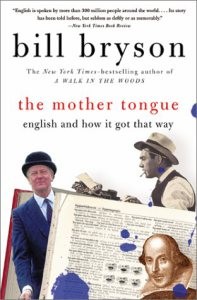
Recently I read Made In America by Bill Bryson, so I thought it would be appropriate to read Mother Tongue as well. Though there was a fair chunk of similar information in both books, Mother Tongue is just more relevant. While Made in America focused on the history of English in America; Mother Tongue focuses mainly on the history of English in general. Trying to cover questions like, “Why is there a ‘u’ in four and not in forty?” or “Why do we tell a lie and tell the truth?”

Bill Bryson does a great job of teaching and keeps the book interesting and sometimes humorous. Though the format and the style of the books are similar, I would recommend Mother Tongue over Made in America simply because the information is more relevant and covers all aspects of the English language.

Recommended for all English geeks, this book will give you a deeper understanding of the language as well as grammatical structures like amphibology. My wife might also be happy to hear that the book covers the topic of onomatopoeia.


Made In America by Bill Bryson

Posted June 7, 2010 by Michael @ Knowledge Lost in Non-Fiction / 0 Comments

Made In America by Bill BrysonTitle: Made in America (Goodreads)
Author: Bill Bryson
Published: Avon, 1994
Pages: 415
Genres: Non-Fiction
My Copy: eBook

Buy: Amazon (or visit your local Indie bookstore)

Although I don’t live in America, it is obvious that they have had a big influence on the English language. Bill Bryson’s Made In America explores the history of America and the effects it had on the language. I found the most interesting parts to do with censorship in America, from titbit becoming tidbit, cockroach becoming roach and to the extreme case of political correction which wanted to stop the use of terms like blackeye and blacksmith (but interestingly enough, not blackout). I feel I’ve gained some valuable insight into why American English is different to the commonly used Queens’ English, while getting a history into commonly used terms. Bill Bryson writes in such a way that it makes this book easy to read and at times humorous, which I feel is what you want in a Non Fiction book.


Animal Farm by George Orwell

Posted May 29, 2010 by Michael @ Knowledge Lost in Classic / 0 Comments

Animal Farm by George OrwellTitle: Animal Farm (Goodreads)
Author: George Orwell
Published: Penguin, 1945
Pages: 112
Genres: Classic
My Copy: Personal Copy

Buy: Amazon (or visit your local Indie bookstore)

‘Animal Farm’ is truly an interesting story; we all know what the story represents but George Orwell portrayed communists Russia in World War II really well. The book was short and I was able to read it in one day, almost in one sitting. I think we could spend a long time discussing which animal represents which Russian and working out which battle was The Battle of the Cowshed or The Battle of the Windmill. I did especially enjoy the flag (The Horn and Hoof Flag reminiscent of the hammer and sickle), Squealer (propaganda pig) and Moses the Raven (the Russian Orthodox Church). It is definitely one of those books you need to read at least once in your lifetime. I think I enjoyed it more than ‘Nineteen Eighty Four’.


Foucault’s Pendulum by Umberto Eco

Posted May 10, 2010 by Michael @ Knowledge Lost in Historical Fiction, Speculative Fiction / 0 Comments

Foucault’s Pendulum by Umberto EcoTitle: Foucault's Pendulum (Goodreads)
Author: Umberto Eco
Translator: William Weaver
Published: Vintage, 1989
Pages: 623
Genres: Historical Fiction, Speculative Fiction
My Copy: Personal Copy

Buy: Amazon (or visit your local Indie bookstore)

Foucault’s Pendulum may not be for everyone and I will try not to give away any of the story. Personally, I really enjoyed the way it was written.  I went into the book knowing it was about Secret Societies and conspiracy theories, but as I kept reading the book, I started to think it was real. I had to snap myself out of this thought process. The story follows a group of publishers who started deconstructing and analysing what they knew about the Templers, eventually they were drawing connections to other secret societies like the Rosicrucians, the Freemasons & the Jesuits. I don’t know how much of the information was real, but this book was written in such a way that you may get sucked in. It defiantly isn’t a book for everyone, it is very content heavy, but well worth the read if you have any interest in the topic.

If you want to know more about this book, check out my previous post about Foucault’s Pendulum.


The Catcher In The Rye by J.D. Salinger

Posted March 2, 2010 by Michael @ Knowledge Lost in Classic / 0 Comments

The Catcher In The Rye by J.D. SalingerTitle: The Catcher In The Rye (Goodreads)
Author: J.D. Salinger
Published: Penguin, 1951
Pages: 241
Genres: Classic
My Copy: Personal Copy

Buy: Amazon (or visit your local Indie bookstore)

On one hand The Catcher In The Rye was an impressive insight of teenage life. I identified with many of those feelings when I was in high school. I remember feeling alone, annoyed all the time and never feeling like doing anything. In this aspect J. D. Salinger was a master at capturing the feelings of my youth. But on the other hand, Holden Caulfield is the most annoying character I’ve ever read; I’ve wanted to punch him in the face so many times. He just infuriated me and I struggled to read this book because of that fact. On the upside there is a scene where Holden is having a conversation with an old school teacher, Mr. Antolini. The teacher told him that one day, he will discover what he is meant to do with his life, and on that day he will wish he paid attention in school. This is probably the most identifiable scene in the book; I know the feeling of wishing I paid attention and discovering a passion later in life.

Despite all the Controversy I really want to know why this book is always assigned to students in school. A book about teenage angst and dropping out of school; is that something you want students to learn about? High School Teacher who was involved in the controversy in America Shelley Keller-Gage stated; “[They] are being just like Holden . . . They are trying to be catchers in the rye.”