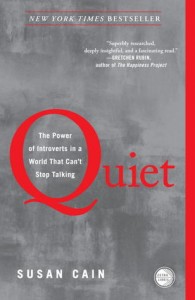
Quiet by Susan Cain

Posted December 4, 2015 by Michael @ Knowledge Lost in Non-Fiction / 0 Comments

Quiet by Susan CainTitle: Quiet: The Power of Introverts in a World That Can't Stop Talking (Goodreads)
Author: Susan Cain
Published: Broadway, 2012
Pages: 352
Genres: Non-Fiction
My Copy: Audiobook

Buy: AmazonBook DepositoryKindle (or visit your local Indie bookstore)

I tend to think there are many misconceptions around introverts; we live in a world that seems to praise extroverts. Susan Cain tries to help people understand the importance of introverts and why we need a balance between the two personality traits. Susan is an introvert herself and found her job as a lawyer expected an extroverted personality. However embracing her introversion, she was able to prove herself a valuable employer and lawyer; so much so that she went on to become a negotiations consultant.

Quiet is a book that seeks out to explain the need for introverts, while also looking at the history between these two personality types. I myself am extremely introverted and my Myers–Briggs Type Indicator is INTJ (this can change over time but I will not go into that at the moment). I found it useful to understand the history in how society deals with introverts; some of which still feels very relevant today. I remember reading sections focusing on the 1950s and 60s, thinking this happened to me and is still happening in today’s society. This leaves me to think that people do not have an understanding on the personalities and how to manage introverts.

Susan Cain goes into a lot of detail with suggestions on how to fit into such an extroverted world, from developing a pseudo-extroverted personality to finding a quiet place to work. Obviously it does depend on your different situations but I think there were some interesting ideas to implement. She also goes into the problems with open offices and productivity levels as well as the extroverted nature of church. I was surprised by just how much this book covered.

I really enjoyed Quiet and feel like I learnt a lot, however it just makes me want to learn more, especially about the history (it is a vicious cycle). I want to give this book to my parents because I think they might actually benefit in learning about the topic. In fact I want to give this book to everyone, I feel like it is an important topic and we need to know that people are different and need to be treated differently. This is another book to fulfil my passion for learning about psychology and I would happily take some recommendations based on this book.


The Three-Body Problem by Liu Cixin

Posted December 3, 2015 by Michael @ Knowledge Lost in Science Fiction / 0 Comments

The Three-Body Problem by Liu CixinTitle: The Three-Body Problem (Goodreads)
Author: Liu Cixin
Translator: Ken Liu
Series: Remembrance of Earth’s Past #1
Published: Tor, 2014
Pages: 400
Genres: Science Fiction
My Copy: Library Book

Buy: AmazonBook Depository (or visit your local Indie bookstore)

In the People’s Republic of China 1967, it was a time where the Cultural Revolution was purging the country of all capitalist ideals. A group of scientists, part of a secret military project, send signals into space to establish contact with aliens. An alien race on the brink of destruction known as the Trisolarans capture the signal and now plan to invade earth. A deeply philosophical game The Three-Body Problem occupies the mind of many scientist which features a world with three suns, causing chaos and unpredictability; trying to understand the order is what motives these people. The Three-Body Problem is a first contact novel often referred to as a cross between Dune and Independence Day.

The Cultural Revolution makes for an interesting backdrop for this novel and I feel an understanding is essential to the story. The Cultural Revolution was a social-political movement that was set in motion by Chairman Mao to transform The People’s Republic of China into the true Communist ideal. This was a cultural purging to remove all remnants of capitalism and to some extent even getting rid of some of China’s traditional elements. The movement ran from 1966 to 1976, although Chairman Mao did declare it over in 1969, but the Red Guard were still very active in their mission all the way till the death of their military leader Lin Biao.

This was also during the height of the space race, Sputnik was the first artificial satellite to be launched into space in 1957, giving the Soviet Union an early lead. The China National Space Administration (CNSA) is believed to have begun in the late 1950s, although their research into rockets were more focused on a ballistic missile program to help defend the country against the Americans and Soviets during the cold war. However China was still interested in space exploration and their first spacecraft to hold human occupancy, Shuguang-1, was designed in 1968.

Now, a three-body problem in physics, is a scientific process where you take initial data sets (position, masses, velocities, etc.) and determine the motion of the three bodies with the help of the laws of classical mechanics, such as Newton’s laws of motion. Historically the three specific bodies being studied were the Moon, the Earth and the Sun. This ties the title of the novel back to the space race and also predicting the world found in the game The Three-Body Problem. However this is only the beginning of trying to understand the workings of this novel and I have not even touched on the philosophical or social criticism aspects of The Three-Body Problem.

The Three-Body Problem by Liu Cixin1 won the Hugo award recently for ‘Best Novel’ and I found it to be an intriguing plot idea. I knew I had to read this, and I went in expecting something similar to Russian science fiction, where there was a lot of social commentary of what was happening within Communist China. This novel did not disappoint, I would compare this to the Russian first contact novel Roadside Picnic in the way it explored social and scientific ideals but then the philosophical elements remind me of the old sci-fi novels from the 1960s.

Special mention needs to be made to Ken Liu who did an excellent job of translating this book into English. I found myself looking forward to reading all his translation notes which explains historical and cultural references that Westerners like myself may not have known about. I also appreciate that he did not try to convert the narrative to a more accessible format but allowed outsiders a taste in the narrative structure found in Chinese books. I was really impressed with the first book in the Remembrance of Earth’s Past trilogy and I would like to think I would read the rest of the series, but I know what I am like when it comes to finishing a series.


Choke by Chuck Palahniuk

Posted December 2, 2015 by Michael @ Knowledge Lost in Contemporary / 0 Comments

Choke by Chuck PalahniukTitle: Choke (Goodreads)
Author: Chuck Palahniuk
Published: Anchor, 2001
Pages: 293
Genres: Contemporary
My Copy: Library Book

Buy: AmazonBook DepositoryKindle (or visit your local Indie bookstore)

Choke is the story of Victor Mancini and his friend Danny, over the course of a few months of their lives. However, there are frequent flashbacks to their childhood. As a med-student dropout, Victor devised an ingenious scam to help make money. He likes to pretend to choke, while dining in fancy restaurants. When he is not pulling off this scam, Victor likes to attend Sexaholics Anonymous meetings, looking for action.

I have read one Chuck Palahniuk novel before, Fight Club and I did not think much of it. I originally thought maybe it was the fact that I have already seen the movie and knew what to expect. I picked up Choke because it was on the 1001 Books You Must Read Before You Die list and thought it was a good excuse to try another of Palahniuk’s books. I know for certain that Chuck Palahniuk is not an author for me.

I found that Choke and Fight Club just had too many of the same elements in common. I expected psychological elements, I expected twists and I knew that Palahniuk would try to write something for shock value. Everything was expected and this made the novel feel boring and generic. There was nothing I really enjoyed about Choke at all, and I was looking forward to it ending.

I know there are a lot of Chuck Palahniuk fans out there, and I can see why he would appeal. For me it was the same book as Fight Club, and reading Choke offered nothing new to my reading experience. I am sure people might offer suggestions of other Chuck Palahniuk novels to try that are better, but in all honesty, I think I am done. I have so much to read, I do not have time to give this author another chance. Having said that, who knows what the future will bring, I might find myself reading my Palahniuk, but I will not be in any hurry to pick one up.


Monthly Review – November 2015

Posted November 30, 2015 by Michael @ Knowledge Lost in Monthly Reading / 2 Comments

Numero ZeroI had plans to devote the entire month of November reading non-fiction (for Non-Fiction November) and participating in NaNoWriMo, however things did not work out to plan. I started November in a hospital in Nouméa and sadly my mother-in-law passed away. This was completely unexpected and while I did spend a lot of time with my wife’s family, I still manage to complete some reading and some of my goals for NaNoWriMo. My writing goals included catching up on my blogging, which I have done and looking forward to writing non-review posts soon. As for my reading, I did end up with seven books completed for the month.

The first book I finished was The Art of Memoir by Mary Karr, which I was reading in preparation for NaNoWriMo. I had some plans to write my writing journey and while I never really got as much of that down on paper as I would like, I think this book gave me plenty of ideas. I have been enjoying writing lately and I hope to continue working on this little project and see where it takes me. I have never read Mary Karr’s memoirs (The Liars’ Club, Lit or Cherry) but this book has convinced me to check one (or all) of them out in the future.

While I was sitting in the hospital I was reading Howards End is on the Landing by Susan Hill on my phone. I am not a fan of ebooks but this was more about convenience. I really loved this book, which is pretty much Hill sharing anecdotes about the books on her shelves. I love the concept of exploring the memories associated with books, however it is a little sad my memory of this with be closely linked to the passing of my mother-in-law.

Following on I picked up Caitlin Doughty’s book Smoke Gets in Your Eyes, which I had planned to read before everything happened. I was worried I would not be able to handle the book. I did have to put aside Voices from Chernobyl by Svetlana Alexievich (translated by Antonina W. Bouis). However this book brought me comfort and I really learnt a lot about the death industry. Maybe not for everyone while mourning the loss of a family member but knowing what goes on was comforting.

I started reading The Possessed by Elif Batuman which has the subtitle ‘Adventures with Russian Books and the People Who Read Them’ which sounds right up my alley but it was so boring and her literary criticism felt off. This killed my non-fiction kick (I did eventually finish The Prossessed but not after a few works of fiction), so I picked up Knots and Crosses by Ian Rankin which is the first book in the Inspector Rebus series. I was inspired to read some crime fiction while writing my review of the last Dexter Morgan book. I feel I need to find a new crime series and I heard the Inspector Rebus series is good. Still too early to tell if this is the next series for me but I will try the next book to find out.

I planned to read Numero Zero at the beginning of December but I could not wait any longer. I really enjoy Umberto Eco’s books (this one translated by Richard Dixon) so I expected so much from this novel. While this was shorter and a little different, I really enjoyed this novel. Numero Zero felt more satirical that his other books, spending a lot of time criticising the media, especially newspapers and gossip magazines. This might be a good starting point for people who have never read Umberto Eco before; it is short and thrilling. It does have some real problem areas but for a novel less than 200 pages, they are easily overlooked.

My last book was Iron Curtain: The Crushing of Eastern Europe, 1944-56 by Anne Applebaum, which talks about the Soviet influences on Eastern Europe after World War II. This is jammed packed with information but I am fascinated about the history. I know a bit out Soviet history but not as much of what was happening in Eastern Germany, Poland or Hungry and this book covered this in great detail. Applebaum is an American, so I was a little worried that it might turn into a ‘pro-American, anti-Soviet’ book but I think she covered the topic rather well. Granted what the Soviet’s did was pretty horrible but I do not like when a book takes a propaganda approach to history.

I am not sure what to expect from December, although I am hosting a readalong of The Brothers Karamazov. I have some books on my selves I would love to read but I want to see what happens. Most people know I hate having a TBR. I did set some reading plans for November to meet the reading challenges for Non-Fiction November, but my TBR changed. I have a big book to read in The Brothers Karamazov and I think I want to pick up another but will see how things go. What do you plan to read for December, and how was your reading month in November?

Read More


The Handmaid’s Tale by Margaret Atwood

Posted November 29, 2015 by Michael @ Knowledge Lost in Classic, Dystopia / 0 Comments

The Handmaid’s Tale by Margaret AtwoodTitle: The Handmaid's Tale (Goodreads)
Author: Margaret Atwood
Published: Vintage, 1985
Pages: 324
Genres: Classic, Dystopia
My Copy: Audiobook

Buy: AmazonBook DepositoryKindle (or visit your local Indie bookstore)

Most people would be familiar with Margaret Atwood’s novel The Handmaid’s Tale; a Christian totalitarian theocracy has overthrown the US government and are controlling reproduction. Set in the not so distant future, this dystopian society serves as a platform for Margaret Atwood to explore some real issues. Written in 1985, it is surprising to think that these themes and issues are still relevant thirty years later.

When I read this novel about four years ago, I think I missed the point, saying “I felt like Margaret Atwood spent too much time trying to explain the dystopian world in which The Handmaid’s Tale is set rather than the story itself.” I obviously was reading this book for its plot rather than trying to understand what Atwood wanted to say. To be fair I recognised this, citing “I understand she was trying to create a world that was a metaphor of a totalitarian society and explore the issue of women’s right” but even that makes me sound naive or stupid. One reason I like rereading books is for the fact that it shows me how much I have improved as a reader. I gave The Handmaid’s Tale three stars when I read it in 2011, but it is now clear to me that this is a brilliant novel and needs a much higher rating.

Looking at this dystopian society; the government wants control over reproduction. To do this, women become a political tool, rather than humans. This government was created due to a dramatic decrease in birth rates. Women become the property of their husband or the state. Women are not allowed to vote, have jobs, read or anything else that might make them have individual thoughts.

“There is no such thing as a sterile man anymore, not officially. There are only women who are fruitful and women who are barren, that’s the law.”

This one quote really summed up this novel for me; the whole idea that women are only useful for one thing. Women are considered subhuman and their only use involves their ovaries and womb. Even the main character, Offred reflects in one scene that her body was an instrument of passion and desire but now she has only one purpose; reproduction. She does not consider it rape, because she signed up to be a Handmaid; but what other choice did she have? In fact rape is severely punished and the government believes the women are protected. Yet would it not be considered rape if we take away the women’s rights, including their right to give consent?

There are many layers that could be explored within The Handmaid’s Tale, I would like to explore the novel deeper. I think looking at this book from a religious angle would be interesting as well, and I think I will need to give it a reread before considering that. I am glad to give this book another go; rereading this was eye opening and really highlighted just how much I have grown. One thing I found humorous was that Margaret Atwood set this book in the United States of America and references escaping to safety in Canada. This is an iconic novel and Atwood is an author well worth exploring; having said that, I have only read The Handmaid’s Tale and the MaddAddam trilogy. Lucky for me, I have so many more Margaret Atwood novels to explore.


Bonjour Tristesse and A Certain Smile by Françoise Sagan

Posted November 28, 2015 by Michael @ Knowledge Lost in Classic / 2 Comments

Bonjour Tristesse and A Certain Smile by Françoise SaganTitle: Bonjour Tristesse (Goodreads)
Author: Françoise Sagan
Translator: Heather Lloyd
Published: Penguin, 2013
Pages: 217
Genres: Classic
My Copy: Paperback

Buy: AmazonBook Depository (or visit your local Indie bookstore)

Françoise Sagan become an overnight sensation in 1954 which the publication of her first novel Bonjour Tristesse. At the age of 18, she published the novel she will be remembered for; the story of Cécile, a seventeen year old living with her widowed father and his mistress on the French Riviera. During an uneventful summer, an old friend of her late mother comes and stirs the peaceful balance of their summer villa.

Not knowing much about Françoise Sagan, I could not determine just how autobiographical Bonjour Tristesse might have been. I do know that Sagan, much like Cécile was kicked out of school and both enjoyed the bourgeois lifestyle. Sagan is a pseudonym (real name Françoise Quoirez) that was taken from the character Princesse de Sagan from Marcel Proust’s À la recherche du temps perd (In Search of Lost Time). I expect that much of this novel is semi-autobiographical because she managed to perfectly capture the narcissism, emotions and angst of teenage life.

In 1955, a censored translation of Bonjour Tristesse hit the shelves for English speaking readers. It was only recently with Heather Lloyd’s translation that we able to enjoy an uncensored edition. Not that there was much of a reference to sex in the novel anyway. This new translation also packaged Françoise Sagan’s second novel, A Certain Smile into the one book. A novel about Dominique, who bored with her lover, starts an affair with a much older married man.

I found that Françoise Sagan likes to play with ideas of morality and pleasure, while also exploring just how problematic a wealthy and carefree life can be. She likes to look at the disillusionment of the bourgeois characters and explore the emotions that she must have been facing herself. In a lot of ways, I tend to associate the angsty style of Sagan with The Sorrows of Young Werther. Françoise Sagan and Johann Wolfgang von Goethe both managed to capture the intensity of emotions in their novels that I have not experienced in more recent books.

 Bonjour Tristesse is a stronger novel than A Certain Smile, but I think both books are worth experiencing. I feel like Bonjour Tristesse had a depth that was not found in A Certain Smile. Both come in at about 120 pages each and A Certain Smile might have benefited with more pages, to fill in the plot and characters a lot more. I enjoy the style of Françoise Sagan and I hope to get a chance to read a few more of her other novels. I wonder what age and life experience does to her writing style.


The Little Paris Bookshop by Nina George

Posted November 27, 2015 by Michael @ Knowledge Lost in Contemporary / 0 Comments

The Little Paris Bookshop by Nina GeorgeTitle: The Little Paris Bookshop (Goodreads)
Author: Nina George
Translator: Simon Pare
Published: Abacus, 2015
Pages: 320
Genres: Contemporary
My Copy: Paperback

Buy: AmazonBook DepositoryKindle (or visit your local Indie bookstore)

Jean Perdu is a bookseller, owning a bookstore on a barge floating along the Seine. Often referred to as a ‘literary apothecary’, for Jean Perdu had a unique ability to sense to perfect book to soothe his customers’ troubled souls. The only person he could never cure was himself and for the past twenty-one years he has been nursing a broken heart.

If it was not for the fact that The Little Paris Bookshop was picked for my in real life book club, I may have never picked it up. To be fair, this novel was picked based on the idea of bibliotherapy, without anyone reading it first. I was interested to see if this book was going to be as generic as it sounded as it is a book in translation; translated from German by Simon Pare. I did have hopes that this might end up as enjoyable as The Collected Works of A.J. Fikry, but sadly I was disappointed.

I normally love books about books but from the very start I was bored with The Little Paris Bookshop. It did pick up briefly when there was talked about The Elegance of the Hedgehog and Franz Kafka but this only lasted a few pages. My thoughts on this novel ranged from boring, cliché, overly sweet before cycling back to boring. I struggled to find anything to hold me through this book, the characters were dull, and nothing about the writing impressed me.

I tend to stay away from light reads; I like to be challenged a little, and I like to experience something exciting and explore interesting themes. There is nothing wrong with a light read, and at times it is needed. However The Little Paris Bookshop was not worth completing and if it was not for book club, I would have abandoned it (I should have). This is meant to be a romance/chick-lit type book but I have read so many better novels in these genres, and these are not genres I normally read. I hate to be so negative towards a book, but the only thing positive I can find with this novel is that it mentions other books, like The Elegance of the Hedgehog and the works of Franz Kafka.


Satin Island by Tom McCarthy

Posted November 26, 2015 by Michael @ Knowledge Lost in Literary Fiction / 0 Comments

Satin Island by Tom McCarthyTitle: Satin Island (Goodreads)
Author: Tom McCarthy
Published: Jonathan Cape, 2015
Pages: 173
Genres: Literary Fiction
My Copy: Library Book

Buy: AmazonBook Depository (or visit your local Indie bookstore)

Tom McCarthy has a unique approach to fiction; Satin Island is an avant-garde novel that explores the philosophical implications of corporate anthropology. A career path that I never thought existed but makes a lot of sense if corporations were using anthropologist for an extra edge. Rather than researching people for science, a corporate anthropologist would try to predict best possible scenarios to leak bad news, or which marketing strategies would have the biggest impact on the public.

Satin Island was longlisted for the Man Booker Prize, and it sounded very different to the other novels. I knew I had to check it out and see what it was all about; the back of the book gave nothing away. This is a post-modern novel and I am actually surprised to see it also making the shortlist for this year’s Man Booker. Normally the novels that are vastly different and experimental never make it past the longlist. Making the shortlist might mean that more people will pick up Satin Island and that can only be a good thing.

The protagonist for this novel is U. and it is pretty obvious that Tom McCarthy expects you to see yourself from this point of view. The book has no real plot or character development, leaving the reader to focus on the moral and social implications of corporate manipulation. The concept of a corporate anthropologist can be both fascinating and terrifying and McCarthy wants people to be aware of this fact.

For a book that is 173 pages long, this is in no way a short novel. The depth and complexity found in Satin Island would keep you thinking about the book for a while. I really appreciated what Tom McCarthy did in this book, it really opened my eyes to so many issues. Now that I am aware of the concept of corporate anthropology, I cannot help but see the way it could be used in marketing. Satin Island is experimental and if you are willing to try an avant-garde novel, it is well worth your time and effort.


Dexter is Dead by Jeff Lindsay

Posted November 25, 2015 by Michael @ Knowledge Lost in Crime / 0 Comments

Dexter is Dead by Jeff LindsayTitle: Dexter Is Dead (Goodreads)
Author: Jeff Lindsay
Series: Dexter #8
Published: Orion, 2015
Pages: 286
My Copy: Library Book

Buy: AmazonBook Depository (or visit your local Indie bookstore)

When I first started reading back in 2009, one of the series I became obsessed with was the Dexter Morgan series. I loved the concept of an anti-hero as the protagonist and Jeff Lindsay had come up with a good concept of a forensic analyst/sociopath. I liked exploring the mind of a killer but not just any sociopath; Dexter had a code, he could not control his urge to kill but he made it his mission to only hunt the people that deserved to die. We can talk about the moral complexities at great length but now I want to review Dexter is Dead.

This is the eighth and final book in the Dexter Morgan series; the books were a bit hit or miss but Dexter was a great character. Most people know of Dexter Morgan from the hit TV show Dexter, the character is the same but after the first book and season the two mediums took different directions. There are plenty of times where it felt like both the show and the books stole good ideas from each other but for the most part the storylines were different.

I cannot go into the plot of this one because it would contain too many spoilers; especially for book seven (Dexter’s Final Cut) as this takes place directly after those events. I liked that this novel took up after the last novel, bringing together a much larger plot; I want more crime novels to have an overarching plot line. I do not read many series, and I think the Dexter series is the only one I have spent so much time in, but I really enjoyed returning to such a great character.

Jeff Lindsay’s writing is not that strong and I felt there were many times where this book and series just got clunky or too clichéd. However because the protagonist was so well developed, this helped carry the bad writing. I am pleased to say Dexter is Dead is one of the stronger novels in the series and helped end everything on a high note. Also the ending of the book series is so much better than the ending of the TV show. I am going to miss the Dexter books and might have to find another crime series to replace the void it has left. Suggestions welcome.


You’re Never Weird on the Internet (Almost) by Felicia Day

Posted November 24, 2015 by Michael @ Knowledge Lost in Non-Fiction / 2 Comments

You’re Never Weird on the Internet (Almost) by Felicia DayTitle: You're Never Weird on the Internet (Almost) (Goodreads)
Author: Felicia Day
Narrator: Felicia Day
Published: Sphere, 2015
Pages: 262
Genres: Non-Fiction
My Copy: Audiobook

Buy: AmazonBook DepositoryKindle (or visit your local Indie bookstore)

I’ve been a fan of Felicia Day from when I first saw The Guild. I think she is a talented and quirky actress/writer/content creator. She knew how to use the Internet to her advantage and I have been watching her grow in popularity and in content creation. But let’s face it; her best work is from Dr. Horrible’s Sing-Along Blog, with Dr. Holly Marten from Eureka a close second. Obviously this is subjective and she has been involved with many great projects but those two really stand out for me.

You’re Never Weird on the Internet (Almost) is the first memoir from Felicia Day; it covers broad strokes of life so far. If you follow Felicia on the Internet, a lot of the information within the book is familiar. However it was nice to have everything in the one memoir. While I knew a fair chunk of what is covered in the book, I still enjoyed reading this.

The memoir goes into great depth with the concept of failure. Failure, should never mean the end, or taken so negatively. Felicia Day goes to great lengths to explain the amount of times she failed and the importance to keep going. This is a lesson Felicia had to learn time and time again and she hopes that she can pass on the advice to the readers. However I think this is one of those lessons we all have to learn for ourselves.

I listened to You’re Never Weird on the Internet (Almost) as an audiobook, read by Felicia Day. I think the audio experience enhanced my experience. I really enjoy listening to non-fiction as audiobook, and when the author reads their memoir, that just makes the experience better. Felicia Day is an interesting person but I do not think this book is for everyone. Fans of Felicia Day or people with an interest in content creation might enjoy You’re Never Weird on the Internet (Almost), but for everyone else, there is not much left here to offer.