Format: Paperback

My Issues With The Book Thief

Posted August 3, 2011 by Michael @ Knowledge Lost in Literature / 10 Comments

I felt the need to write a new blog post because it’s been a while and this book has been bugging me all night; time to create some controversy. I recently read The Book Thief, a book that has come highly recommended to me, but I’m struggling to see why. As many people know The Book Thief is a young adult book by Australian author Markus Zusak that has been an international bestseller and has won numerous awards. The book tells the story of a teenage girl living in Nazi Germany who likes to steal books. While most people adored this book, I never was able to get into it and I wasn’t really sure why; this seemed to keep me up all night, so I thought I would share what I liked and didn’t like about it.

The Writing

For the most part, this novel is well written; almost in a poetic way. But at the start of each part, I’m not sure why Zusak has to list every main character that will appear in the next section, it felt a bit like a screen play in that aspect and I really felt as if he was giving away the story before it actually happened. This was only a minor problem but it did bug me a little.  As for the rest of the writing, it was an unusual style that took awhile to adapt to but it really did work with the narrative.

The Characters

I never really got into any other characters in this book. I felt Liesel didn’t even need to steal books in the end but it didn’t really seem to stop her. Hans seemed to be a typical nice guy that didn’t know how to say no, Max didn’t really do much that was of interest, Rudy only cared about kissing Liesel and the only person that seemed to be colourful was her foster mother, Rosa. I thought all the characters were two dimensional and no one really had any depth. Quite frankly, I didn’t care what happened to any of them, the only person that seemed interesting was the Narrator; Death.

The Narrative

I like the fact that Death was the narrator; he did offer a unique perspective on some very dull characters. It took me a while to get used to the fact that Death wasn’t a dark character but a hopeful observer, but as my wife pointed out, Death wouldn’t be haunted by himself; it’s the humans that are haunted by him and we are the ones that think he represents an ending. It turned out that Death was haunted by humans, leading to some interesting themes throughout the book.

The Plot

I don’t know if it was my need for the macabre, the fact I wanted a dark YA book or the fact that it was set in Nazi Germany; but I really wanted this novel to be darker than it actually was. Being in war time Germany, you would expect something exciting to happen. They hide Max; the Jew in the basement and there was some bombings but apart from that, there was nothing of a climax in The Book Thief, it felt like it dragged on and never went anywhere. I really thought Zusak was holding back and was too afraid to go to a dark place and it ended up been too light and fluffy for a war time story.

The Major Themes

While this does appear to be a light read, there are still some very interesting themes throughout this novel. The main theme that stuck with me is the way Death is trying to understand the two sides of humanity; while the Nazi’s are cruel to the Jews, one member of the party, Hans, shows nothing but kindness and compassion towards them. While this is confusing to Death, it really is an interesting theme to have in a YA novel, where the majority of the readers are at a point in their life where they need to find their identity. Other themes that showed up in the book included guilt and the value of works (as a reader and a writer).

The Book Thief is for the most part a nicely written YA story, but the potential was there for something far better. I understand the fact that holding back for a YA novel, but I’m sure the readers know that war is a dark and scary place and the writer could have used that to make this book a more exciting read. I hope people enjoy this book, but for me I expected much more. What did others think of this book?


The Stranger by Albert Camus

Posted July 19, 2010 by Michael @ Knowledge Lost in Classic / 3 Comments

The Stranger by Albert CamusTitle: The Stranger (Goodreads)
Author: Albert Camus
Translator: Matthew Ward
Published: Knopf Doubleday, 1942
Pages: 123
Genres: Classic
My Copy: Library Book

Buy: Amazon (or visit your local Indie bookstore)

L’Étranger, known as The Outsider, or The Stranger by Albert Camus offers an interesting perspective of the philosophical movement; existentialism. Though, as a stand alone novel, it was very simple and uneventful. You need to read this book for its philosophical merit or not read it at all. Previously, I wrote a post about this book and The Cure song Killing An Arab, in which I talked about how the book covered topics like; absurdism, atheism, determinism, existentialism, nihilism, and stoicism.

I thought I needed to read the book and try to understand the connections. The book does an interesting job at covering this issues without being too noticeable. Sure, if you spend your time digesting or picking apart books, you are sure to notice it, but if you are reading the book just for the story, then you may miss the complexity of the story.

It is unusual to read a book that has a complexity to it, but still tells the story too simply. It might have lost some of its density when translated from French to English. I just look for more substance in my books, so I was a little disappointed.


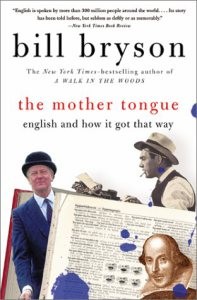
Mother Tongue by Bill Bryson

Posted June 23, 2010 by Michael @ Knowledge Lost in Non-Fiction / 0 Comments

Mother Tongue by Bill BrysonTitle: Mother Tongue (Goodreads)
Author: Bill Bryson
Published: Penguin, 1980
Pages: 270
Genres: Non-Fiction
My Copy: Paperback

Buy: Amazon (or visit your local Indie bookstore)

Recently I read Made In America by Bill Bryson, so I thought it would be appropriate to read Mother Tongue as well. Though there was a fair chunk of similar information in both books, Mother Tongue is just more relevant. While Made in America focused on the history of English in America; Mother Tongue focuses mainly on the history of English in general. Trying to cover questions like, “Why is there a ‘u’ in four and not in forty?” or “Why do we tell a lie and tell the truth?”

Bill Bryson does a great job of teaching and keeps the book interesting and sometimes humorous. Though the format and the style of the books are similar, I would recommend Mother Tongue over Made in America simply because the information is more relevant and covers all aspects of the English language.

Recommended for all English geeks, this book will give you a deeper understanding of the language as well as grammatical structures like amphibology. My wife might also be happy to hear that the book covers the topic of onomatopoeia.


Animal Farm by George Orwell

Posted May 29, 2010 by Michael @ Knowledge Lost in Classic / 0 Comments

Animal Farm by George OrwellTitle: Animal Farm (Goodreads)
Author: George Orwell
Published: Penguin, 1945
Pages: 112
Genres: Classic
My Copy: Personal Copy

Buy: Amazon (or visit your local Indie bookstore)

‘Animal Farm’ is truly an interesting story; we all know what the story represents but George Orwell portrayed communists Russia in World War II really well. The book was short and I was able to read it in one day, almost in one sitting. I think we could spend a long time discussing which animal represents which Russian and working out which battle was The Battle of the Cowshed or The Battle of the Windmill. I did especially enjoy the flag (The Horn and Hoof Flag reminiscent of the hammer and sickle), Squealer (propaganda pig) and Moses the Raven (the Russian Orthodox Church). It is definitely one of those books you need to read at least once in your lifetime. I think I enjoyed it more than ‘Nineteen Eighty Four’.


Foucault’s Pendulum by Umberto Eco

Posted May 10, 2010 by Michael @ Knowledge Lost in Historical Fiction, Speculative Fiction / 0 Comments

Foucault’s Pendulum by Umberto EcoTitle: Foucault's Pendulum (Goodreads)
Author: Umberto Eco
Translator: William Weaver
Published: Vintage, 1989
Pages: 623
Genres: Historical Fiction, Speculative Fiction
My Copy: Personal Copy

Buy: Amazon (or visit your local Indie bookstore)

Foucault’s Pendulum may not be for everyone and I will try not to give away any of the story. Personally, I really enjoyed the way it was written.  I went into the book knowing it was about Secret Societies and conspiracy theories, but as I kept reading the book, I started to think it was real. I had to snap myself out of this thought process. The story follows a group of publishers who started deconstructing and analysing what they knew about the Templers, eventually they were drawing connections to other secret societies like the Rosicrucians, the Freemasons & the Jesuits. I don’t know how much of the information was real, but this book was written in such a way that you may get sucked in. It defiantly isn’t a book for everyone, it is very content heavy, but well worth the read if you have any interest in the topic.

If you want to know more about this book, check out my previous post about Foucault’s Pendulum.


The Catcher In The Rye by J.D. Salinger

Posted March 2, 2010 by Michael @ Knowledge Lost in Classic / 0 Comments

The Catcher In The Rye by J.D. SalingerTitle: The Catcher In The Rye (Goodreads)
Author: J.D. Salinger
Published: Penguin, 1951
Pages: 241
Genres: Classic
My Copy: Personal Copy

Buy: Amazon (or visit your local Indie bookstore)

On one hand The Catcher In The Rye was an impressive insight of teenage life. I identified with many of those feelings when I was in high school. I remember feeling alone, annoyed all the time and never feeling like doing anything. In this aspect J. D. Salinger was a master at capturing the feelings of my youth. But on the other hand, Holden Caulfield is the most annoying character I’ve ever read; I’ve wanted to punch him in the face so many times. He just infuriated me and I struggled to read this book because of that fact. On the upside there is a scene where Holden is having a conversation with an old school teacher, Mr. Antolini. The teacher told him that one day, he will discover what he is meant to do with his life, and on that day he will wish he paid attention in school. This is probably the most identifiable scene in the book; I know the feeling of wishing I paid attention and discovering a passion later in life.

Despite all the Controversy I really want to know why this book is always assigned to students in school. A book about teenage angst and dropping out of school; is that something you want students to learn about? High School Teacher who was involved in the controversy in America Shelley Keller-Gage stated; “[They] are being just like Holden . . . They are trying to be catchers in the rye.”


Brave New World by Aldous Huxley

Posted January 7, 2010 by Michael @ Knowledge Lost in Science Fiction / 0 Comments

Brave New World by Aldous HuxleyTitle: Brave New World (Goodreads)
Author: Aldous Huxley
Published: Vintage, 1932
Pages: 288
Genres: Classic, Science Fiction
My Copy: Personal Copy

Buy: Amazon (or visit your local Indie bookstore)

Aldous Huxley got it right when he wrote Brave New World, he wrote about a society were everyone lived for themselves, only considered about the pleasure they would receive out of life. This was written as a Utopian society but it does seem to reflect our society as well. The novel anticipates developments in reproductive technology and sleep-learning that combine to change society. In 1999, the Modern Library ranked Brave New World fifth on its list of the 100 best English-language novels of the 20th century.


The Strange Case of Dr Jekyll and Mr Hyde by Robert Louis Stevenson

Posted October 2, 2009 by Michael @ Knowledge Lost in Classic, Gothic, Science Fiction / 0 Comments

The Strange Case of Dr Jekyll and Mr Hyde by Robert Louis StevensonTitle: The Strange Case of Dr. Jekyll and Mr. Hyde (Goodreads)
, 1986
Pages: 144
Buy: Amazon (or visit your local Indie bookstore)

The Strange Case of Dr Jekyll & Mr Hyde is a classic novella by Robert Louis Stevenson. The work is known for its vivid portrayal of a split personality, split in the sense that within the same person there is both an apparently good and an evil personality each being quite distinct from the other. The novella’s impact is such that it has become a part of the language, with the phrase “Jekyll and Hyde” coming to mean a person who is vastly different in moral character from one situation to the next. Robert Louis Stevenson is an amazing writer and this book is well worth the read, I’ve always enjoyed a story that tries to explore two sides of a situation.


Hey! Nietzsche! Leave them kids alone!: The Romantic Movement, Rock & Roll, And The End Of Civilisation As We Know It

Posted July 1, 2009 by Michael @ Knowledge Lost in Non-Fiction / 0 Comments

Hey! Nietzsche! Leave Them Kids Alone!Hey! Nietzsche! Leave them kids alone!: The Romantic Movement, Rock & Roll, And The End Of Civilisation As We Know It by Craig Schuftan is a non fiction book on the links between The Romantic Movement and Modern Rock music. I absolutely loved this book, it took me 6 months to read because of all the research I did along with it. But I now have a new found obsession with the Romantic Movement and have been reading a lot of great poems from the period.

This book is on the top of my Non Fiction List.


Slaughterhouse-Five by Kurt Vonnegut

Posted May 30, 2009 by Michael @ Knowledge Lost in Classic, Science Fiction / 0 Comments

Slaughterhouse-Five by Kurt VonnegutTitle: Slaughterhouse-Five (Goodreads)
Author: Kurt Vonnegut
Published: Vintage, 1969
Pages: 186
Genres: Classic, Science Fiction
My Copy: Personal Copy

Buy: Amazon (or visit your local Indie bookstore)

Slaughterhouse-Five, or The Children’s Crusade: A Duty-Dance With Death is an unusual story with many layers to it. The book itself is a post-modern, anti-war, science fiction metafiction novel. The Narrator starts off telling people about the book he is writing on the subject of Dresden and being in a POW camp (The Slaughterhouse) during the War. Trying to remember what happened in Dresden, the narrator goes on to tell the story of some of the other people in the Slaughterhouse with him. Billy Pilgram is the main character in the book, an optometrist who has become unstuck in time and randomly travels through time and is abducted by the “four-dimensional” aliens from planet Tralfamadore. Being POW in Dresden has had a lasting effect on Billy’s post-war life, and combined with the abductions and time travel, he has become fatalistic.

The whole story just has so many layers to try to explain, but it makes for an interesting read. Since Billy keeps randomly traveling to the Past, Future and Tralfamadore there just seems to be a lot going on and can get a little confusing. The book really highlights the effects of war on the survivors and what could be considered schizophrenia.

…And So It Goes