Publisher: Knopf Doubleday

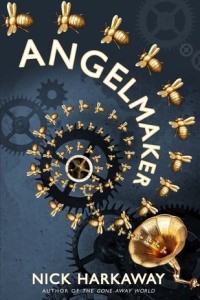
Angelmaker by Nick Harkaway

Posted July 14, 2012 by Michael @ Knowledge Lost in Literary Fiction, Thriller / 0 Comments

Angelmaker by Nick HarkawayTitle: Angelmaker (Goodreads)
Author: Nick Harkaway
Published: Knopf Doubleday, 2012
Pages: 482
Genres: Literary Fiction, Science Fiction, Thriller
My Copy: Paperback

Buy: AmazonBook DepositoryKindle (or visit your local Indie bookstore)

Joe Spork is the son of an infamous gangster “Tommy Gun” Spork, trying to live a quiet life fixing antique clocks. His plans were uprooted when he finds an unusual clockwork mechanism. Turns out that device is a doomsday machine and Joe has triggered it. Now Joe Spork has to face the wrath of both the British government and the diabolical villain Shem Shem Tsien. Angelmaker is an adventure unlike anything I’ve read before, featuring a mystery involving Joe Spork and his quest to stop the evil villain and his doomsday device.

Angelmaker blends elements of Steampunk with some literary writing into the story; while reading this book I kept thinking how much this book reminds me of an old Victorian novel, with the prose and style. The back drop to this story is the criminal underbelly of London which is packed with atmospheric charm. All this is mixed with an action adventure that would remind you of a James Bond plot. Never have I read a book that blends so many genre elements so masterfully to make my pick for Best Novel of 2012 (so far).

I’ve heard this book being called a Charles Dickensian romp and while I’ve not read enough Dickens to accurately agree with this statement, I do feel that the writing does resemble the Victorian era nicely. I think this is what makes the Steampunk elements of this book feel more authentic. I know a lot of people can argue this book isn’t really true Steampunk but when I think of this genre, I think of Victorian alternative history and this book does fall under that style.

Angelmaker is either a literary Steampunk novel or a Cold War-style espionage adventure, either way this is definitely a book worth trying. I had so much fun reading this story; it pleased the genre and literary reader inside of me. I hope to find more books like this that would please both types of readers, so if you have any recommendations I would love to hear about them in the comments below.


The Grifters by Jim Thompson

Posted June 27, 2012 by Michael @ Knowledge Lost in Pulp / 0 Comments

The Grifters by Jim ThompsonTitle: The Grifters (Goodreads)
Author: Jim Thompson
Published: Knopf Doubleday, 1963
Pages: 189
Genres: Pulp
My Copy: Personal Copy

Buy: AmazonBook Depository (or visit your local Indie bookstore)

There is a reason they call Jim Thompson the Dimestore Dostoevsky; his works really spotlight the moral dilemma his protagonists and main characters face, so I was really looking forward to reading The Grifters.  I’ve seen the movie so I was interested in seeing the inner thoughts of the characters. 25-year-old short con operator Roy Dillion suffers an injury when a simple con goes horribly wrong; he finds himself in hospital recovering from an internal haemorrhage. This brush with death has led him to rethink his life, though his mother Lilly feels like Roy still owes her. She’s inattentive and manipulative while trying to care for Roy, but she is also trying to pull off a long con at the race tracks at the same time. Throw in another femme fatale, Moira, Roy’s girlfriend, who we also find out is also a grifter who favours the long con. The three explosive characters make for an interesting and twisted noir story, much to what we have come to expect from Jim Thompson.

I have to admit I do love Jim Thompson’s twisted plotting, he captures the pulp feel well while giving it is own flavour of surrealism. While The Grifters is not is most solid piece it does a good job at spotlighting what this author can do with crime and with is unreliable narrating. The characters are great and they each work well together while making life difficult for each other. His is one of the few pulp authors that break into the world of serious literary while never losing sight of what he does best.

If you haven’t read a Jim Thompson book maybe this is a good place to start, it’s not as dark or gritty, the characters are great, the plot isn’t as twisted as some of his other works and the suspense is a bit watered down. Let’s just call this book ‘Jim Thompson for beginners’; it gives you everything you expect in a Thompson book, just not to the same intensity, making the book approachable and easy to read.


The Hanging Garden and Unfinished Novels

Posted May 28, 2012 by Michael @ Knowledge Lost in Historical Fiction / 0 Comments

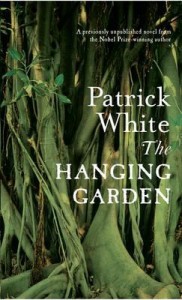
The Hanging Garden and Unfinished NovelsTitle: The Hanging Garden (Goodreads)
Author: Patrick White
Published: Knopf Doubleday, Random House, 2012
Pages: 224
Genres: Historical Fiction
My Copy: Personal Copy

During my last book club gathering, we were talking about Patrick White’s unfinished novel; The Hanging Garden and this lead into a discussion of books being published after the author dies which the author never wanted to see the light of day. Patrick White never wanted this novel released; I believe he did tell someone to burn it because it wasn’t finished or anywhere near ready for readers. There are heaps of authors that have had books released that were never meant to be released including; Kurt Vonnegut, Virginia Woolf, Mark Twain, Ernest Hemingway, Leo Tolstoy and the most famous of them all was Franz Kafka’s The Trial. This does lead to some interesting topics; do you think books that the author never intended to be released should be published? Are publishers just using them as a money making gimmick? And lastly, if those manuscripts were submitted to a publisher by an unknown author, would they still be published?

Patrick White is a two time Miles Franklin award winner and has also won the Nobel Prize for Literature. His unfinished novel The Hanging Garden was only just recently published; it feels like an old novel in the sense that, while it’s nicely written; nothing ever happens in the book. This is very much a character driven book, focusing on the two characters and a wild garden. I think I’d be alright with reading a book like this if I didn’t have the feeling that the author hated every single one of his characters; he was mean and cruel to them all, not just the key characters. As a general rule I love dark and flawed characters but this just felt mean and even the attempts of being erotic felt awkward. I spent the whole book waiting for something to happen and I was left disappointed. Also, as this is an unfinished novel, I don’t know what the overall goal was with this book and I get the feeling that maybe Patrick White doesn’t either. There are parts of this book that are beautifully written and then there are parts that felt like the author’s ramblings. This is supposed to be an unedited book but while I think there was some editing done there are also parts of the book that clearly feel unedited. Including a few paragraphs that didn’t make sense and had no punctuation and then some notes to himself reminding him to explore or research some parts later. While I’m not a fan of this book, I think a lot of people might get a kick out of it. Either for the memories of the time and the place; the memorable characters, or just to see the thought process of once of Australian top authors of all time.

On this day 100 years ago, Patrick White was born


Fifty Shades of Grey by E.L. James

Posted May 23, 2012 by Guest Post in Erotica, Guest Posts / 20 Comments

Fifty Shades of Grey by E.L. JamesTitle: Fifty Shades of Grey (Goodreads)
Author: E.L. James
Series: Fifty Shades #1
Published: Vintage, 2011
Pages: 528
Genres: Erotica
Buy: Amazon (or visit your local Indie bookstore)

I first came to hear about Fifty Shades of Grey through blog posts and friends, and couldn’t believe all the hype and excitement this book was creating amongst the reading world. It was phenomenon. I read several romances and erotica in the past so I became curious. I think the only thing that I was holding me back was the BDSM relationship. I’ve hardly read any books that involve BDSM, so I was slightly a bit nervous. But curiosity got the better of me and I decided to give it a go.

Now that I’ve read it, I’d have to say it was the worst book I have ever read and I want my 2 weeks back. When a few people mentioned that it was mommy porn, I should’ve taken their comment seriously, and not just waved it off as a silly and biased comment toward this genre. By the end of it, that is exactly how it felt.

The sex scenes were continuous, repetitive and boring; one scene, after the other, going through the motion of sex with a little variation of positions or setting but it was all the same – Porn. There was nothing sexy about it. It lacked any passion, class or emotion and I was numb the whole way through. As far as the BDSM was concerned, there was nothing new that I haven’t read previously. It was more talk and negotiation on how far Ana will go than the act itself. There were a few bondage sessions here and there but it was very light.

The writing was pathetic and utterly ridiculous, which made the characters unlikable. Ana is meant to be this intelligent, 22 year old literary student but her personality didn’t match to her persona. The constant use of these juvenile words and phrases such as ‘Inner Goddess’ or ‘talking to the Subconscious’ or ‘Holy Fuck’ almost made me want throw the book against the wall. She would gush or blush over the most so trivial things and came across as being an immature and stupid lady. It’s how I would expect a young teenager to act.

Christian on the other hand, I had an instant dislike him immediately. He’s a deranged and twisted character who likes to dominate every aspect of Ana’s life, not only in the bed; he would question her on how often she would eat, stalk her and set out rules on he would like her to act/behave around him – otherwise she would be punished (BDSM style). I felt the author tried very hard to make him seem appealing or sexy by Ana gushing and being aroused over his looks, charm, sexual comments but his behaviour was a complete turn off and he sounded creepier to me. I honestly can’t understand what women can see that is so appealing in Christian’s character!?!

All in all I think this series could be a great introduction to the genre, if you are new and interested in reading erotica as they ‘flying of the self’ and most people are raving about it. But unfortunately, it didn’t work for me and I have no intention of continuing the series in the future.

This is a guest post by Mish; when she is not reading she is busy moderating that Aussie Readers group on Goodreads. Big thanks to her for this post and being the first guest blogger on Literary Exploration.


Talulla Rising by Glen Duncan

Posted May 9, 2012 by Michael @ Knowledge Lost in Horror / 0 Comments

Talulla Rising by Glen DuncanTitle: Talulla Rising (Goodreads)
Author: Glen Duncan
Series: Bloodlines #2
Published: Knopf Doubleday, 2012
Pages: 368
Genres: Horror
My Copy: ARC from Edelweiss

Buy: Amazon (or visit your local Indie bookstore)

Glen Duncan’s back with the follow up to the brilliant 2011 novel The Last Werewolf. I’ve been looking forward to see how the story continues as I personally felt the last novel left off with a bit of a cliff-hanger. Talulla Rising continues the story, now from the point of view of Talulla Demetriou; an exciting strong female protagonist, whom I loved simply because she is both kick-ass and full of inner torment. The novel kicks off with a brief look back at Talulla’s life before being turned, a slightly too small of a glimpse but enough to give you an idea of the type of woman she was before becoming a werewolf.

Like the last novel, Talulla Rising continues the memoir style; not only is there a focus on the inner struggle between the human and wolf side but now Talulla has her mother’s side thrown into the mix. WOCOP (World Organisation for the Control of Occult Phenomena) have taken Talulla’s newly born son and she is racing to save him before he is used in a horrible blood-drinking ritual. While she is trying to get her son back she is still getting hunted by WOCOP (as Glen Duncan puts it in the book, think CIA meets Keystone Kops meets Spanish Inquisition) as well. As the story progresses you get a sense of just how twisted this organisation.

Talulla Rising is a fast paced, exciting novel; dark, gritty and over sexed. I really love how Glen Dunan takes a popular genre that has been selling well and makes it literary and enjoyable to read again. If the constant excitement of this novel doesn’t keep you going then the dark humour throughout this book will. From the slight pokes of other authors in literature to Talualla remembering that her first human tasted like onions and whiskey; the humour in this book was pleasing. But when it comes done to it, in the end, the thing I loved the most about this book and the one that come before this, is the internal struggle; there is something about that that always pleases me. I’m looking forward to seeing how Glen Duncan wraps up this trilogy when he releases By Blood We Live; hopefully next year.


The Man in the High Castle by Philip K. Dick

Posted August 11, 2010 by Michael @ Knowledge Lost in Classic, Science Fiction / 0 Comments

The Man in the High Castle by Philip K. DickTitle: The Man in the High Castle (Goodreads)
Author: Philip K. Dick
Published: Vintage, 1962
Pages: 259
Genres: Classic, Science Fiction
My Copy: Personal Copy

Buy: Amazon (or visit your local Indie bookstore)

For those who haven’t read this month’s Book club book, the alternate reality classic The Man in the High Castle by Philip K Dick, I will try not to give away too much of the story. Most of you are aware of the basic plot outline, but I will just give you a quick overview before talking about the interesting concepts I found within the book. Set in 1962, 14 years after a longer World War II, life is under totalitarian Fascist imperialism as the war was won by Imperial Japan and Nazi Germany. Having divided the world the Axis Powers are now conducting intrigues against each other in North America.

Alternate Reality

With Japan and Germany being in power, the world is a much different place; more of a dystopian society, where everyone is considered racially superior to the Americans. The last remaining Jews are in hiding and continually being hunted down. The book actually deals with justice and injustice; gender and power; the shame of cultural inferiority and identity; and the effects of fascism and racism upon culture.

Metafiction

The Man in the High Castle focuses the story around a popular and banned novel written by Hawthorne Abendsen (The Man in the High Castle). The book entitled The Grasshopper Lies Heavy portrays an alternate reality where  Japan and Germany lost the war and America and England become the victors. Changing racialist-cultural tensions and creating a liberal, democratic, capitalist society.

I Ching

In this novel the I Ching (Book of Changes) is often consulted by the characters as an oracle. I Ching is an ancient Chinese book of divination and was used by Philip K Dick to determine the plot particulars. In two separate interviews Philip K Dick has said;

“I started with nothing but the name, Mister Tagomi, written on a scrap of paper, no other notes. I had been reading a lot of Oriental philosophy, reading a lot of Zen Buddhism, reading the I Ching. That was the Marin County zeitgeist, at that point; Zen Buddhism and the I Ching. I just started right out and kept on trucking.”

“In the event, he blamed the I Ching for plot incidents he disliked: “When it came to close down the novel, the I Ching had no more to say. So, there’s no real ending on it. I like to regard it as an open ending.”

Philip K Dick’s classic science fiction novel has a lot of interesting aspects to it. I think it could easily be one of those books you could spend hours discussing all the little characteristics to it. Another book that challenges your views on society by showing what life could be like if the war turned out differently. Reflected above were just the major aspects to this book.


The Stranger by Albert Camus

Posted July 19, 2010 by Michael @ Knowledge Lost in Classic / 3 Comments

The Stranger by Albert CamusTitle: The Stranger (Goodreads)
Author: Albert Camus
Translator: Matthew Ward
Published: Knopf Doubleday, 1942
Pages: 123
Genres: Classic
My Copy: Library Book

Buy: Amazon (or visit your local Indie bookstore)

L’Étranger, known as The Outsider, or The Stranger by Albert Camus offers an interesting perspective of the philosophical movement; existentialism. Though, as a stand alone novel, it was very simple and uneventful. You need to read this book for its philosophical merit or not read it at all. Previously, I wrote a post about this book and The Cure song Killing An Arab, in which I talked about how the book covered topics like; absurdism, atheism, determinism, existentialism, nihilism, and stoicism.

I thought I needed to read the book and try to understand the connections. The book does an interesting job at covering this issues without being too noticeable. Sure, if you spend your time digesting or picking apart books, you are sure to notice it, but if you are reading the book just for the story, then you may miss the complexity of the story.

It is unusual to read a book that has a complexity to it, but still tells the story too simply. It might have lost some of its density when translated from French to English. I just look for more substance in my books, so I was a little disappointed.


Foucault’s Pendulum by Umberto Eco

Posted May 10, 2010 by Michael @ Knowledge Lost in Historical Fiction, Speculative Fiction / 0 Comments

Foucault’s Pendulum by Umberto EcoTitle: Foucault's Pendulum (Goodreads)
Author: Umberto Eco
Translator: William Weaver
Published: Vintage, 1989
Pages: 623
Genres: Historical Fiction, Speculative Fiction
My Copy: Personal Copy

Buy: Amazon (or visit your local Indie bookstore)

Foucault’s Pendulum may not be for everyone and I will try not to give away any of the story. Personally, I really enjoyed the way it was written.  I went into the book knowing it was about Secret Societies and conspiracy theories, but as I kept reading the book, I started to think it was real. I had to snap myself out of this thought process. The story follows a group of publishers who started deconstructing and analysing what they knew about the Templers, eventually they were drawing connections to other secret societies like the Rosicrucians, the Freemasons & the Jesuits. I don’t know how much of the information was real, but this book was written in such a way that you may get sucked in. It defiantly isn’t a book for everyone, it is very content heavy, but well worth the read if you have any interest in the topic.

If you want to know more about this book, check out my previous post about Foucault’s Pendulum.


Brave New World by Aldous Huxley

Posted January 7, 2010 by Michael @ Knowledge Lost in Science Fiction / 0 Comments

Brave New World by Aldous HuxleyTitle: Brave New World (Goodreads)
Author: Aldous Huxley
Published: Vintage, 1932
Pages: 288
Genres: Classic, Science Fiction
My Copy: Personal Copy

Buy: Amazon (or visit your local Indie bookstore)

Aldous Huxley got it right when he wrote Brave New World, he wrote about a society were everyone lived for themselves, only considered about the pleasure they would receive out of life. This was written as a Utopian society but it does seem to reflect our society as well. The novel anticipates developments in reproductive technology and sleep-learning that combine to change society. In 1999, the Modern Library ranked Brave New World fifth on its list of the 100 best English-language novels of the 20th century.


Slaughterhouse-Five by Kurt Vonnegut

Posted May 30, 2009 by Michael @ Knowledge Lost in Classic, Science Fiction / 0 Comments

Slaughterhouse-Five by Kurt VonnegutTitle: Slaughterhouse-Five (Goodreads)
Author: Kurt Vonnegut
Published: Vintage, 1969
Pages: 186
Genres: Classic, Science Fiction
My Copy: Personal Copy

Buy: Amazon (or visit your local Indie bookstore)

Slaughterhouse-Five, or The Children’s Crusade: A Duty-Dance With Death is an unusual story with many layers to it. The book itself is a post-modern, anti-war, science fiction metafiction novel. The Narrator starts off telling people about the book he is writing on the subject of Dresden and being in a POW camp (The Slaughterhouse) during the War. Trying to remember what happened in Dresden, the narrator goes on to tell the story of some of the other people in the Slaughterhouse with him. Billy Pilgram is the main character in the book, an optometrist who has become unstuck in time and randomly travels through time and is abducted by the “four-dimensional” aliens from planet Tralfamadore. Being POW in Dresden has had a lasting effect on Billy’s post-war life, and combined with the abductions and time travel, he has become fatalistic.

The whole story just has so many layers to try to explain, but it makes for an interesting read. Since Billy keeps randomly traveling to the Past, Future and Tralfamadore there just seems to be a lot going on and can get a little confusing. The book really highlights the effects of war on the survivors and what could be considered schizophrenia.

…And So It Goes