Source: Personal Copy

Vernon Subutex Trilogy by Virginie Despentes

Posted September 24, 2020 by Michael @ Knowledge Lost in Contemporary / 2 Comments

Vernon Subutex Trilogy by Virginie DespentesTitle: Vernon Subutex Trilogy (Goodreads)
Author: Virginie Despentes
Translator: Frank Wynne
Published: MacLehose Press, 2017-2020
Pages: 1088
Genres: Contemporary
My Copy: Paperback

Buy: AmazonBook DepositoryKindleWordery (or visit your local Indie bookstore)

How many translated series can you think of? Apart from Proust, or Elena Ferrante or Karl Ove Knausgård. Maybe, there are more than I expected; Virginie Despentes’ trilogy Vernon Subutex is currently the most talked about, with book three just being released in English. This trilogy started off as a cutting-edge look into the punk sub-culture of France but slowly, with each book the focus shifted, stepping away from the music industry, towards a mystery in book two and finally the third novel focusing more on a cult-like community. While Vernon Subutex is the focus of this trilogy, I found that the different styles of each novel become a little disconcerting for myself.

Virginie Despentes draws from her own career in these books, I suspect using some of her own experiences to drive the plot. Before becoming a novelist, she worked in a few fields including as a sex worker and a pornographic film critic. While these careers play a part in the Vernon Subutex trilogy along the way, it started with her experiences as a salesclerk in a record store and a freelance rock journalist. It is these aspects that I found the most fascinating, my love of music (particularly punk rock) really drew me to this series in the first place.

I loved how the first novel focused on the music, Vernon Subutex started working in this record store in his twenties. The store was legendary back in the days, but now thanks to the internet and digital music it is struggling. Even Vernon Subutex himself has a cult-like status (which plays out more later in the series) with people on the internet speculating that he owned the last recordings of musician Alex Bleach. What I loved the most about Vernon Subutex 1 was reading about the industry and exploring the dark side of the punk culture, from the violence and drug abuse often associated with this culture to the less talked about racism and sexism.

Unfortunately, the books slowly digressed away from exploring the punk scene, and maybe my interest did as well. That is not to disregard books Two or Three, my interest was the scene and I was less interested in following the character Vernon Subutex. The first novel focused on the punk scene, whereas book two focused on this one character and a small group of people around him, a group that have banded together at a bar in the Parc des Buttes-Chaumont. While the plot of Vernon Subutex 2 focuses more on what happened to the lost tapes of Alex Bleach, I was more interested in themes than plot, so this became a book about class struggle.

This group of people hanging in the Parc des Buttes-Chaumont turned into a cult, which leads to the third novel of this trilogy, where Vernon Subutex has become a spiritual leader to the group. The final book in the series, for me is the weakest, but it was clear Virginie Despentes knew what she was doing and where she wanted to take this journey. There was a strong focus on social struggles that plays out here, focusing more on homelessness and the way these people banded together. The cast of characters slowly shrinks with each book, but I really like how Despentes brings in new characters and then they disappear after a short period of time. This might frustrate many, but I found it natural; sometimes you meet someone, and they are only in your life for a small period of time, they might make an impact but then they are gone.

Vernon Subutex 3 was more political, with the 2015 Charles Hebdo shootings playing a part of the plot. The satirical papers controversial depictions of Muhammad are believed to be the cause of that attack. However, it was Michel Houellebecq that was on the cover of the magazine when this attack happened. I bring this up because I find Virginie Despentes and Houellebecq have similar styles. Both are satirical French authors that make me question myself and their writing style. They leave me with an unease while reading them and I spend time contemplating their satirical nature. I even find myself wondering if they are actually satirical or just overdoing the transgressive. This is not easy reading and knowledge of the punk scene and modern French history became vital aspects of my appreciation of Vernon Subutex.

When I think about the writing of Virginie Despentes, I have a similar feeling as when I think about Michel Houellebecq, I am unsure how I feel about them as authors. I have read five Despentes novels and while I enjoyed the Vernon Subutex trilogy, I find it hard to fully appreciate her works. Her writing is a combination of the thriller genre, but it tends to be overly transgressive. I am not trying to be negative, just not the style of literature I tend to enjoy. I am curious to know more about Despentes’ life and might read her feminist manifesto King Kong Theory, which like the Vernon Subutex trilogy has been translated by the legendary Frank Wynne.


Ducks, Newburyport by Lucy Ellmann

Posted November 1, 2019 by Michael @ Knowledge Lost in Literary Fiction / 8 Comments

Ducks, Newburyport by Lucy EllmannTitle: Ducks, Newburyport (Goodreads)
Author: Lucy Ellmann
Published: Text, July 4, 2019
Pages: 1040
Genres: Literary Fiction
My Copy: Paperback

Buy: AmazonBook DepositoryKindleWordery (or visit your local Indie bookstore)

Having spent the good part of a month reading Ducks, Newburyport might shock many of the readers here, the fact that I spend most of my time reading books in translation, the fact that I often have reservations about reading a 1000+ page book, not willingly but mainly because I can’t stop myself from fixating on numbers, and the fact that it is rare for me to pick up a hyped book like this one, but in my defence I wanted to read this before the Booker Prize, I had actually heard about it from the Three Percent Podcast and knew that I had to get my hands on this novel. I think many people are put off by the style, Ducks, Newburyport has been promoted as a single sentence stream of consciousness novel which might make people feel hesitant. However, I think this is a surprisingly easy novel to read, and once you are in the groove of things, you will really enjoy the journey. The book focuses on the inner thoughts of an Ohioan wife as she is backing pies.

I have always been fascinated with the stream of consciousness but sometimes it feels like a gimmick, with Ducks, Newburyport it feels natural. This woman has a lot on her mind, from her own health worries, her family and the state of America. The books length is designed to be intimidating, to simulate that crushing feeling of thoughts and emotions. What impressed me most was the way Ducks, Newburyport blended pop-culture, personal experiences, memories and even synonyms to progress her inner thoughts, then sometimes they are just random tangents.

I can’t stop thinking about the way this woman censors her own thoughts, there are many times where she censors phrases like Trump’s ‘grab ‘em by the p____’ or using words like derriere. I think it speaks volumes about her character, this need to act a certain way, even in her own thoughts. She really freaks out when the thought of anal sex pops into her head. I feel like Lucy Ellmann wants to explore these feelings surrounded acting the way the patriarchy wants her to act, those feeling of shame or surprise, and the need to censor her own mind. The glossary of anagrams at the back of the book have also been sanitised, so FFS means For Pete’s Sake.

Having the book set in Ohio was an interesting choice, admittedly I did have to look up the state’s politics. Ohio seems like a real melting pot of political viewpoints, there is a very close divide between Republicans and Democrats. This really allows Lucy Ellmann to explore the volatile political landscape of America at the moment. Looking at major issues like climate change, gun control, mass shootings, and so much more.

The structure of Ducks, Newburyport is something that needs to be addressed. I have seen many people freak out about the idea of a single sentence, stream of conscious narrative but I found it really easy to read. The repetitive phrase ‘the fact that’ quickly gets drowned out and I tend to use the phrase as the start of the next sentence. Having said that, I like that Ellman gave a middle finger to writing rules like ‘avoiding repetition’ or punctuation and really did her own thing, and it worked.

Lucy Ellmann has published seven books in the past, but her regular publishing house, Bloomsbury rejected Ducks, Newburyport. Leaving the book to be published by small indie presses, Galley Beggar Press in the UK, Canadian publisher Biblioasis for North America and Text Publishing here in Australia. Ellmann is the daughter of two literary critics, her father Richard has written a biography on James Joyce author of Ulysses which Ducks, Newburyport continuously gets compared to. However, her mother, Mary Ellmann often wrote about the representation of femininity in British and American literature, and I think that maybe she had just as much of an influence on Lucy’s writing and worth mentioning. The book focuses heavily on feminism, motherhood and female representation in pop culture.

As most people know, I love pop culture and really appreciated the content references throughout the novel. Not only recent references but also exploring classics like The Odd Couple and a favourite of mine, The Apartment. All through the novel the narrator burst into random songs, and thinks about film and television, as well as literature. Without these references, I probably wouldn’t have enjoyed Ducks, Newburyport as much as I did.

Having said all that, while there are so many serious issues being explored within the novel, Ducks, Newburyport is extremely funny. I enjoyed every moment I spent with the novel. I loved the way the book advanced the narrative through memories. I found it to be a great way to develop the characters within the novel. Could a non-translated book be my favourite read for 2019? At this point, it is too close to tell.  I highly recommend Ducks, Newburyport and think this book will require multiple reads in the future. It is the type of novel with mainly layers to unpack, and I look forward to reading it again. Also, I think this would make an amazing audiobook.


Sphinx by Anne Garréta

Posted May 4, 2019 by Michael @ Knowledge Lost in Literary Fiction / 0 Comments

Sphinx by Anne GarrétaTitle: Sphinx (Goodreads)
Author: Anne Garréta
Translator: Emma Ramadan
Published: Deep Vellum Publishing, April 21, 2015
Pages: 152
Genres: Literary Fiction
My Copy: Paperback

Buy: AmazonBook DepositoryKindleWordery (or visit your local Indie bookstore)

I may have read Sphinx by Anne Garréta back in November last year but there has not been a day go by where I have not thought about this amazing book. I had always planned on writing a review for this novel but kept putting it off in favour of reading other books; this feels like the story of my writing habits. Since the details are still burned into my brain, I have no problem talking about this masterpiece.

Anne Garréta joined the Oulipo in 2000, which is an experimental literary group of French speaking writers who like to put constraints to their writing. The idea is to force the writer to create new structures and patterns in their own writing. The Oulipo was founded in 1960 by Raymond Queneau and François Le Lionnais. Notable members include Italo Calvino and Georges Perec who wrote the most notable Oulipian novel La Disparition (English title: A Void), which was written without using the letter e. When translating these books, many translators chose to keep the same constraints, in the case of A Void, translator Gilbert Adair kept the same constraint of not using the letter e. The Spanish translation did not use the letter a (since e is used too frequently), Russian contains no о and Japanese does not use  (i).

In the introduction of Sphinx, Daniel Levin Becker talks about the Oulipian constraint found in this book and he is of the opinion that is best not to spoil it for others, allowing them to discover it organically. If you feel it is better not to know, then stop reading here.

Read More


Love in the New Millennium by Can Xue

Posted April 26, 2019 by Michael @ Knowledge Lost in Contemporary / 0 Comments

Love in the New Millennium by Can XueTitle: Love in the New Millennium (Goodreads)
Author: Can Xue
Translator: Annelise Finegan Wasmoen
Published: Yale University Press, November 20, 2018
Pages: 288
Genres: Contemporary
My Copy: eBook

Buy: AmazonBook DepositoryKindleWordery (or visit your local Indie bookstore)

Longlisted for the Man Booker International Prize 2019
Longlisted for the BTBA 2019

There is something about Love in the New Millennium that I was not able to connect with.  Out of the entire Man Booker International longlisted books for 2019, this is the one that I struggled the most with. It was not because of the unlikeable characters or toxic relationships, there was just something that did not work. I spent a lot of time wondering if I felt disconnected from the cultural aspects of this novel, but I have come to the conclusion that me and Can Xue do not agree, or at least with this book.

The premise of this book is basically love stories of the new millennium. It is a collection of interconnected stories that center around a few different characters. Love in the New Millennium is meant to be an exploration into modern day romance, dating and relationships, however there is nothing inherently modern about this novel. Has the author adopted same for a magical realism where modern people are living in a world void of technology? I do not remember a single mention of the internet or cell phones in the entire book. I know this a Chinese novel, so culturally things are different, but I find it hard to believe that technology does not play a part in their lives. Can Xue is 66 years old, so it felt like she did not truly understand how young people live.

“People like us, more dead than alive, always indecisive.”

Having said that, this book was packaged as a dark comical look at a group of women living in a world of constant surveillance. I went into this thinking maybe this will be an exploration into women living in a world of social media. An Orwellian look at dating in the computer age. However, this book feels more like Middlemarch in a sense that it is not the surveillance cameras that people have to worry about, it is the gossip from other people.

The main problem with Love in the New Millennium for me what probably the fact that I built this book up differently in my head. Generally I prefer not to know too much about the books I plan to read, but since this was longlisted for the Man Booker International Prize, as well as the BTBA, I felt like I needed to know more about this book in order to join in on the conversations before actually reading it. I was hoping for a satirical look into dating in the new millennium, as well as some insights into modern day China, but this novel delivered none of that.

“Before entering a dream, she thought, a little enviously, they must be so happy. In her dream, she heard the couple outside referring to her as “the orphan.” When she heard these two syllables, or—phan, her tears rolled down in waves, soaking the pillow. Her dreamscape was passionate, with two silvery forms always floating around her. She saw milkvetch all around, honeybees everywhere, to her right the houses of the disappearing village, and the maple leaves burning like fire.”

Having said all that, there is this weird dream-like, almost surreal quality to the novel that played a small factor in not abandoning this book completely. My main reason for sticking to the book was because it was nominated for the Man Booker International Prize. The writing was never really bad, Annelise Finegan Wasmoen did a great job of translating this into English. For me, my main verdict came down to the subject matter and my disappointment in not exploring these very important issues. There are so many different socio-political, philosophical and psychological avenues that were left unexplored.

When Can Xue is blurbed as the “most important novelist working in China today” and is also known as an avant-garde writer, I expected something more from Love in the New Millennium. She is also a literary critic who has written about Dante, Jorge Luis Borges, and Franz Kafka, so you cannot judge me for expecting so much more. Love in the New Millennium left me wanting a very different book, and I think that might have been what disappointed me the most about this novel. I have no idea why it made the longlist for both the Man Booker International Prize and the Best Translated Book Award, but clearly others see something in this book that I could not see.


Disoriental by Négar Djavadi

Posted October 19, 2018 by Michael @ Knowledge Lost in Literary Fiction / 8 Comments

Disoriental by Négar DjavadiTitle: Disoriental (Goodreads)
Author: Négar Djavadi
Translator: Tina Kover
Published: Europa Edition, 2018
Pages: 338
Genres: Literary Fiction
My Copy: Paperback

Buy: AmazonBook DepositoryKindleWordery (or visit your local Indie bookstore)

Shortlisted for the National Book Award for Translated Literature 2018
Longlisted for the BTBA 2019

Normally I am not a fan of multi-generational stories but there is always an exception to the rule and Disoriental is just that. My major problem is that there is never enough time spent with the characters. In this novel we follow Kimiâ Sadr who fled Iran with her mother and sisters at the age of ten. They join their father in France in the hopes for a better life. Now fifteen years later Kimiâ is overwhelmed with the memories of her ancestors.

What I loved about this novel is the way Négar Djavadi focuses specifically on one person but uses her as the foundation to look at the ancestry of her family. The constant waves of memories and stories are the driving force of Disoriental which allows the reader to explore the cultural history of Iran. From her great-grandfather Montazemolmolk, who had a harem of fifty-two wives, to Kimiâ, a queer woman sitting in a Parisian fertility clinic.

The inner flap refers to this novel as a kaleidoscopic story and I cannot think of a better way to describe Disoriental. We experience many key moments in Iranian history from the perspective of the Sadr family. We look at the cultural changes, the politics and the family throughout. The difference between Kimiâ and her great-grandfather are vastly different. A key element I found fascinating was the treatment of the LGBTQI community. A place where losing your virginity before marriage, having an affair, or abortion, or even a drug addiction is better than being a homosexual. I was surprised to learn that sex changes are legal in Iran, it is better to change your entire gender identity than be same sex attracted.

This whole history makes up the struggle for Kimiâ in the fertility clinic. She is torn between family traditions and her own ‘disorientalisation’ as a modern woman. While this might sound like a bleak novel and in many ways it really is, Négar Djavadi offers so much tenderness to the whole experience as well. We look at the history, we see the family dramas but we also see the triumphs as well. Living in Paris where Kimiâ has more freedom than she may have had in an alternate life. There is so much more to explore within Disoriental but for me this was a novel of identity. Her family’s past defines Kimiâ Sadr as much as her own identity.

I found so much tenderness within such an important book. It was the little moments in their lives that really helped along the way. For example at the beginning of the novel Kimiâ’s father Dirius never took the elevator. He say they were for ‘them’ and by ‘them’ he meant the citizens of France. In this little anecdote we see so much about the attitude he had as an immigrant. Without going into the bleak backstory we know Dirius Sadr sees himself as a second-class citizen not wanting to do anything that might offend the people around him. This small tale says so much without going into specifics. It is this kind of storytelling that allows Négar Djavadi to write about so much about the world without adding to the bleakness.

I am very impressed with Disoriental. I love a novel that can explore important subjects and deal with the current start of the world without making the whole reading experience feel like a chore. I assume that this novel is semi-biographical but I am only speculating. Négar Djavadi has done an amazing job and it is important to have novels like Disoriental in the world. Tina Kover did a wonderful job translating this book which allows me to understand a little more about the world I live in. I highly recommend Disoriental, and it is my pick to win the National Book Award for Translated Literature in 2018.


Wait, Blink by Gunnhild Øyehaug

Posted October 15, 2018 by Michael @ Knowledge Lost in Contemporary / 2 Comments

Wait, Blink by Gunnhild ØyehaugTitle: Wait, Blink (Goodreads)
Author: Gunnhild Øyehaug
Translator: Kari Dickson
Published: Farrar, Straus and Giroux, 2018
Pages: 256
Genres: Contemporary
My Copy: Hardcover

Buy: AmazonBook DepositoryKindleWordery (or visit your local Indie bookstore)

Longlisted for the National Book Award for Translated Literature 2018

After reading Love by Hanne Ørstavik, it felt rather strange to go to Wait, Blink by Gunnhild Øyehaug. Not because they are both by Norwegian authors but because they both take a small slice of the everyday and explore it. Although that is pretty much the end of the similarities. Wait, Blink reads very differently, it is contemporary look into the life, mainly three woman at different stages of their lives.

Wait, Blink is riddled with pop-culture references, mainly looking at the connection between art and love. While it also feels like Gunnhild Øyehaug is trying to understand this obsession western films have with women in oversized men’s shirts. The novel makes references to film scenes where a women is in an oversized men’s shirt and how it is often a symbol used to represent sex. One of the key example talked about was Sofia Coppola’s 2003 film Lost in Translation starring Scarlett Johansson. Interestingly enough Yngvild Sve Flikke adapted this novel in 2015 and called it Women in Oversized Men’s Shirts (Kvinner i for store herreskjorter).

This novel had a very contemporary feel to it which made it a very quick read. The film as well as other pop-culture references worked for a geek like myself. At the heart of the novel it felt like a poetic look into the lives of three different women. The way they navigated through their own lives and romantic situations were very different. Although I have to disagree with the subtitle of this book; “A Perfect Picture of Inner Life”.

While this is a novel that explores the inner lives of these women, it felt more like a snapshot into their worlds. We have three different women at different stages of their lives but because they are different people, it is hard to get a perfect picture of inner life. This is small glimpses into the lives of three women and while I would love to follow them further (especially Sigrid the young literary student) we only see a fragment and nothing more. From the National Book Award longlist for Translated Literature, Wait, Blink is one of my favourites and I am pleased it is getting some attention.


Love by Hanne Ørstavik

Posted October 11, 2018 by Michael @ Knowledge Lost in Literary Fiction / 0 Comments

Love by Hanne ØrstavikTitle: Love (Goodreads)
Author: Hanne Ørstavik
Translator: Martin Aitken
Published: Archipelago Books, 2018
Pages: 180
Genres: Literary Fiction
My Copy: Audiobook

Buy: AmazonBook DepositoryKindleWordery (or visit your local Indie bookstore)

Shortlisted for the National Book Award for Translated Literature 2018

There is something hypnotic about Love by Hanne Ørstavik that has really stayed with me. Set over a cold night in Norway the novel follows Vibeke and Jon, a mother and son living in a small town. It is the night before Jon’s birthday and we follow them throughout the night. They may be a family but they are on separate journeys.

What really drew me to this book is the uneasy feeling I constantly had around these two different characters. They lived together but they felt separated. There was a tension in the air the entire time and I was never sure if I should trust any characters in the novel. This tension is what made Hanne Ørstavik’s Love a compelling read. The mother/son relationship is not what you expect and feels odd but that is what is driving the novel.

“The sound of the car. When he’s waiting he can never quite recall it. I’ve forgotten, he tells himself. But then it comes back to him, often in pauses between the waiting, after he’s stopped thinking about it. And then she comes, and he recognizes the sound in an instant; he hears it with his tummy, it’s my tummy that remembers the sound, not me, he thinks to himself. And no sooner has he heard the car than he sees it too, from the corner of the window, her blue car coming round the bend behind the banks of snow, and she turns in at the house and drives up the little slope to the front door.”

It is rare to read a novel where the mundane feels so thrilling. Love is a novel of the everyday life but written almost in a way a thriller would be written. The shifting narrative helps keep the two connected while the plot is showing the disconnection between the two. It really was a brilliant way to have two characters remain connected and disconnected at the same time.

The emotional tension Hanne Ørstavik created in Love is what makes this a standout read. Martin Aitken was able to provide a brilliant translation from the Norwegian and I can see myself dipping into this one again and again. I have not been able to stop thinking about this one and I feel like the way Ørstavik was able to manipulate the reader, but in a good way. It her ability to make the everyday feel eerie, mixed with her masterful storytelling. It is hard to keep that tension at the best of times but Love makes it look easy.


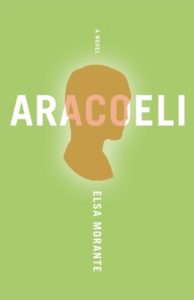
Aracoeli by Elsa Morante

Posted September 29, 2018 by Michael @ Knowledge Lost in Literary Fiction / 1 Comment

Aracoeli by Elsa MoranteTitle: Aracoeli (Goodreads)
Author: Elsa Morante
Translator: William Weaver
Published: Open Letter, 2009
Pages: 311
My Copy: Paperback

Buy: AmazonBook DepositoryWordery (or visit your local Indie bookstore)

When an Italian booktuber (Bruno) offers some recommendations for great Italian authors to check out, I am going to pay attention. In his video, he recommended Alberto Moravia and Elsa Morante, who were married for twenty years. Comparing Elsa Morante to Elena Ferrante peaked my interest and the recommendation given was her last novel Aracoeli. A melancholic novel about an aging man attempting to recover his past and get his life on track. Stuck in a dead-end job for a small publishing house, 43 year old Manuel travels to the home town of his mother Aracoeli, to try and understand her.

People that have a deep understanding of psychology would get more from Aracoeli than I did but what struck me is his obsession with his mother. I do believe that Manuel is a very unreliable narrator so all his thoughts and feelings have to be considered before discovering the truth. His self-loathing I could handle but I was often frustrated with his short-sightedness. It was difficult to like this character because I found myself constantly trying to analyse him, never sure if I was understanding who he truly was.

Aracoeli was an enigma as well, mainly because we are constantly inside Manuel’s had. I never felt like I was fully understanding this character, and when the novel talks about how she contracts an incurable disease (syphilis is implied) or how she was a nymphomaniac I spent more time wondering about her situation. She was a victim of her circumstances and the way women were treated. Reading Aracoeli felt more like sifting through all that is going on to find the truth, but that is part of its appeal.

If I am to compare Elena Ferrante to Elsa Morante, it would be in relation to the way both wrote about the treatment of women. Both wrote incredibly complex Neapolitan women trying to navigate their way through life. I think Ferrante is a much easier read but I might consider Morante a much more rewarding experience.

I do not begin to understand the complexity of Aracoeli and I know it will be many read throughs before I even scratch the surface. I love novels like this because they make you work for a much more rewarding experience. I may not understand Aracoeli now but I hope to in the future. There is so much despair and destruction in the book, but I find myself pondering it weeks after I finished it. I have to return to Aracoeli, it is the type of book that leaves you no other choice.


Purge by Sofi Oksanen

Posted September 26, 2018 by Michael @ Knowledge Lost in Literary Fiction, Thriller / 2 Comments

Purge by Sofi OksanenTitle: Purge (Goodreads)
Author: Sofi Oksanen
Translator: Lola Rogers
Published: Grove Press, 2008
Pages: 390
Genres: Literary Fiction, Thriller
My Copy: Audiobook

Buy: AmazonBook DepositoryKindleWordery (or visit your local Indie bookstore)

I love a good literary thriller but I rarely find one that really impresses me. There is something about taking genre fiction and using it to explore social issues. If done right it provides us with a fast paced narrative full of thrills but will also leave the reader with plenty to think about. A recent example that comes to my mind is The 7th Function of Language by Laurent Binet. Then there is Purge. The 7th Function of Language was able to blend literary theory in a fast paced plot, while Purge takes more an approach to explore the complex social and political issues facing Estonia after the Soviet collapse.

Aliide Truu is an elderly woman living in the Estonian countryside which keeps her isolated from the outside world and all the tragic events happening around her. One day she discovers another woman looking into her kitchen window, who turns out to be Zara, the granddaughter of her sister Ingel. Zara is on the run from the Russian mafia, after they forced her into the sex trade. Purge is an unflinching novel that explores the obstacles women face in this rapidly changing society.

“Those who poke around in the past will get a stick in the eye.”

Both women have their past and secrets which they rather not discuss. For Aliide, an escape from the current political issues felt like only answer. A feeling that feels all too familiar with the current state of the world. However what we truly know about Aliide is still surrounded in mystery. It is rather Zara’s life that is the major focus, exploring the corruption and the sickening world of human trafficking. All of which feels like a direct result of that power vacuum in the country.

“She found it hard to believe that there would be any bold moves, because too many people had dirty flour in their bags, and people with filthy fingers are hardly enthusiastic about digging up the past.”

Setting the novel in 1992 allows the reader to explore an Estonia that was going through many recent political changes. In the late 1980s Estonia saw many political arrests for crimes against humanity. This brought great resistance against the Russification of Estonia, especially with the collapsing Soviet Union, which lead to their eventual independence in 1991. The country’s social and political values were changing, for better or for worse, this lead to the emerging Russian mafia.

The bleak exploration into Estonian life from the perspective of two women with different pasts tends to remind me of the Soviet novels I have read in the past. Novels that look at both political and social issues that a country faces. For Sofi Oksanen, it allowed her to focus on the hardships facing women of the country as well.  The style and fast paced narrative of Purge reminds me specifically of the ‎Aleksandr Solzhenitsyn novel In the First Circle. Both exploring the effects of the Soviet era on the people within the narratives. In the First Circle focuses on life during the Soviet era while Purge is looking more at the after effects.

I have read Sofi Oksanen before and found her to be very bleak. The novel When the Doves Disappeared just felt dense and I found myself struggling to get through it. It is a novel I would love to dip into again at some point, but I think Purge offered me much more. With Purge, I have a new found appreciation for Sofi Oksanen and the novel motivates me to read more from her. Purge is a novel I highly recommend, but be warned, Baltic literature tends to be very bleak.


The Door by Magda Szabó

Posted August 28, 2018 by Michael @ Knowledge Lost in Classic / 2 Comments

The Door by Magda SzabóTitle: The Door (Goodreads)
Author: Magda Szabó
Translator: Len Rix
Published: NYRB Classics, 1987
Pages: 262
Genres: Classic
My Copy: Audiobook

Buy: AmazonBook DepositoryWordery (or visit your local Indie bookstore)

Magda Szabó is one of those authors I have wanted to read for a very long time; her novel The Door seemed like the perfect place to start. This Hungarian modern classic explores the relationship between two very different women. Our narrator Magda is a writer and intellectual who is constantly in and out of favour with the government, while Emerence is her strong and opinionated house keeper. The novel starts with Magda waking up from a dream to face a haunting fact, that she killed Emerence.

The first thing that sticks out to me in this novel is the relationship between Magda and Emerence. I am drawn to the raw approach Magda Szabó took to explore this relationship. There are times where there was heat and toxicity between the two but then there were other times of affection and love. It is rare to read a relationship written so well. I often feel like the nuances of a relationship are never explored to any satisfactory level. In The Door we get to experience the ups and downs of this relationship. There are many times I felt frustrated by their actions but that ends up just being their different personalities butting heads.

Throughout the novel, a door is used as a metaphor to give the reader a more in depth look at these two characters. At times the door is a symbol of secretiveness, especially when it comes to Emerence. However there are times that it is used to symbolise the current state of their friendship. Whether they were actively distancing themselves from each other or they were close enough to share in a secret. The effect of the door becomes an important symbol of understanding Emerence. The fact that she would greet her guests outside and never let them inside shows just how close the two have become when she lets Magda inside.

Set between 1960 and 1980 in Hungary, it is important to know that this was when the Hungarian Socialist Workers’ Party was in control. If you explore this relationship of Magda and Emerence under a Marxist lens you will see where I am going here. We have Magda representing the intelligentsia and Emerence is a symbol of the working class. The idea behind the Bolshevik Revolution was to make sure people were treated the same. Without the working class, the October Revolution would have never happened. However it was the intelligentsia that took leadership, essentially creating a new social class system, thus negating their whole revolution.

In the end of The Door we are left we are left with the emptiness of losing Emerence. This woman seemed to possess inhuman strength and drive and her death left such a big hole not only Magda’s life but the whole community. If I was to compare Emerence death with the state of Hungary at the time of writing this novel. I would say that this is a reflection of the Hungarian economic and political reforms which let the country into mounting foreign debts. The cause of this points to Hungary’s outdated manufacturing facilities the inability to produce goods that were saleable on world markets.

It might be my love for Soviet literature, but my approach to this was very much a Marxist approach. Like many books in the Soviet era, I think The Door explored so many interesting elements of the country’s political and social issues. From religion to the class struggle and then the death of the working class. Analysing a novel and looking at the historical context really opens up the book for me. I know some people do not appreciate literary theories but for me it is a way to bring the text to life. Marxism and psychoanalysis are the two methods I seem to use the most, but I do not think I am equipped to fulling analyse Emerence. Although Magda might be easier, same name as the author, a writer, an enemy to the Communist Party, sounds autobiographical to me. Which makes me wonder, what was she trying to say with the death of Emerence?