Tag: Culture

Cultural Profile – The Pre-Raphaelites Brotherhood

Posted January 24, 2010 by Michael @ Knowledge Lost in Art, Culture / 0 Comments

I mentioned avant-garde in the previous entry so I thought it was only fitting to look at the originals. The Pre-Raphaelites Brotherhood has been considered the first avant-garde movement in art. They throw away the rule book of art to create something different and exciting. They believed that the Classical poses and elegant compositions of Raphael in particular had been a corrupting influence on the academic teaching of art, hence the name Pre-Raphaelites.

The brotherhood rejected the rule and formula of art that were been taught by Sir Joshua Reynolds and the Royal Academy of Art. They considered the work ‘sloppy’ and formulaic, they believed that Sir Sloshua (Sir Joshua) was stopping them explore other styles, they wanted to return to the abundant detail, intense colours, and complex compositions of Quattrocento Italian and Flemish art.

The brotherhood stop up against the norm and followed their own doctrine:

  • To have genuine ideas to express;
  • To study Nature attentively, so as to know how to express them;
  • To sympathise with what is direct and serious and heartfelt in previous art, to the exclusion of what is conventional and self-parodying and learned by rote;
  • And, most indispensable of all, to produce thoroughly good pictures and statues.

Influenced by Romanticism, they thought that freedom and responsibility were inseparable so they followed the principles of realism. The Brotherhood was met with lots of controversy in there struggle against the Royal Academy of art, but ultimately they influenced and changed art history as well. When the brotherhood disbanded the artists who had worked in the style still followed these techniques (initially anyway) but they no longer signed their works with “PRB”

Finnegans Wake

Posted January 24, 2010 by Michael @ Knowledge Lost in Literature / 2 Comments

Because this book is known as one of the most difficult works of fiction in the English language, I thought I would explore the book a little more. No, I have not and probably never will read Finnegans Wake by James Joyce (Ok, I lie, I would probably try to read it, if my passion for modern culture continues) but I like to learn more of these types of books.

The thing I found interesting about what I’ve learnt is this book is that the entire thing is written in an idiosyncratic language, consisting of multilingual puns and portmanteau words. This to me would mean that there would never be a correct interpretation of this book; it’s just a twisted world full of no answers.

The book is a non linear story which attempts to recreate the experience of sleep and dreams. Which is interesting because back in the early 1900 Freud wrote a book called “The Occurrence in Dreams of Material from Fairy Tales”. In this he made mention of dreams been a coded message waiting to be cracked. So it seems Finnegans Wake was just James Joyce deciding to follow this idea and blend it with his obvious love of puns to create a completely unorthodox book.

For a book that took seventeen years to write, it’s hard to think what the point of it is. Is this just a social experiment that Joyce was doing? Maybe he was just setting out to defy all conventions of plot and character construction. What ever the reason was it remains on of the most interesting ideas I’ve seen so far.

Just a great example of avant-garde in modern literature that doesn’t get read. I think the only people that do read it are the people fascinated with this kind of topic and the people that read it to sound intellectual.

I would love to talk to someone who’s actually read this book.

EDIT: I read somewhere that the idea of all the puns is so essentially the book never ends.

Support Knowledge Lost and my reading habits, If you wish to get a copy of Finnegans Wake do so here.


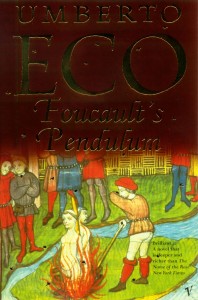
Foucault’s Pendulum by Umberto Eco

Posted January 23, 2010 by Michael @ Knowledge Lost in Literature / 0 Comments


Foucault's PendulumI found this book recently called “Foucault’s Pendulum” (still haven’t read it) but I’m in love with the concept. Reminds me of the John Cage Quote “Finnegans Wake is one of the books I’ve which always loved, but never read” (sorry for the tangent, just adding that quote to remind me to write about both John Cage and Finnegans Wake).

Written by Italian novelist and philosopher Umberto Eco the novel is basically about three friends that decide they can make a better conspiracy theory then what’s out there and they set out to create the conspiracy known as ‘The Plan’. As the story progresses these three begin to forget it’s a game and become more and more obsessed with the ideas and theories and start making connections to other theories out there; like lost artefacts and the Templers. Even a very real secret society begins to believe one of the three possesses the key to the lost treasure of the Knights Templar. Eventually ‘The Plan’ involves connections between a whole range of different societies like;

  • The Knights Templar
  • The Rosicrucians
  • The Gnostics
  • The Freemasons
  • The Bavarian Illuminati
  • The Elders of Zion
  • The Assassins of Alamut
  • The Cabalists
  • The Bogomils
  • The Cathars
  • The Jesuits

The concept is brilliant and makes me ponder a few ideas, like ‘Will people believe anything that is printed?’ and ‘Do you start believing your own lies if you say them enough?’

I have a huge pile of books to read but I’m excited about reading this book. It has been described as “the thinking person’s Da Vinci Code” with makes me even more excited, I know the Da Vinci Code was a good read but it wasn’t thought provoking.


Disarm – a Modern Frankenstein story

Posted January 22, 2010 by Michael @ Knowledge Lost in Culture / 0 Comments

Billy Corgan from The Smashing Pumpkins wrote the song Disarm about a fantasy of cutting his parents limbs off. Because he hated them, he hated the fact they brought him into this world which is full of hate and all he wants, is to be loved.

“It’s about chopping off somebody’s arms.. The reason I wrote Disarm was because, I didn’t have the guts to kill my parents, so I thought I’d get back at them through song. And rather then have an angry, angry, angry violent song I’d thought I’d write something beautiful and make them realize what tender feelings I have in my heart, and make them feel really bad for treating me like shit. Disarm’s hard to talk about because people will say to me ‘I listen to that song and I can’t figure out what it’s about.’ It’s like about things that are beyond words. I think you can conjure up images and put together phrases, but it’s a feeling beyond words and for me it has a lot to do with like a sense of loss. Being an adult and looking back and romanticizing a childhood that never happened or went by so quickly in a naive state that you miss it.”  — Billy Corgan on Disarm

Does this sound familiar?

Well it defiantly does to me, my all time favourite book is “Frankenstein; or, The Modern Prometheus” by Mary Shelley which is an amazing story written in two view points. Dr. Victor Frankenstein created a monster and being scared of his creation abandoned it. Monster Frankenstein was a lost soul, with nothing the desire to be loved, yet his creator abandoned him and society feared and wanted to destroy him.

At the very end of the book when asked to justify his actions Monster Frankenstein said something like; “I do this because I feel too much, I was brought into this world with the desire to love and denied it at every turn”

Both Billy Corgan and Monster Frankenstein both wanted to be love but life and society seemed to give them violent thoughts. Billy Corgan expressed his dark thoughts via writing a song but Monster Frankenstein didn’t know how to handle these thoughts.

Support Knowledge Lost and my reading habits, If you wish to get a copy of Frankensteinor the Smashing Pumpkins album which featured Disarm; Siamese Dream do so here.