Tag: existentialism

Existence Precedes Essence: Understanding Existentialism

Posted December 5, 2016 by Michael @ Knowledge Lost in Philosophy / 4 Comments

When thinking about the term existentialism, a quote by Jean-Paul Sartre may come to mind; “existence precedes essence”. 1 This was a relatively new way of thinking within philosophy. The idea criticises the concept that everyone has an essence and our lives tend towards the actualisation of our essence, which dates back to Aristotle. Over the years, this idea of essence evolved into predestines, as philosophers leaned more towards religious ideas. For Sartre, this was an absurd way of thinking and this might have been connected to his atheist beliefs. However, this is not a universal idea in existentialism, many disagreed with Sartre, but it did start a new philosophical movement.

existentialists
Søren Kierkegaard, Friedrich Nietzsche and Jean-Paul Sartre

While Søren Kierkegaard, Friedrich Nietzsche and Fyodor Dostoevsky are all considered existentialists, the term was actually coined by Jean-Paul Sartre. It is widely believed that Kierkegaard may have been the first existentialist philosopher but he used the word ‘individualism’ to refer to his philosophical ideas. When looking as his writing, it is easy to see why it is closely associated to existentialism. In his book The Sickness unto Death, Kierkegaard wrote “The greatest hazard of all, losing one’s self, can occur very quietly in the world, as if it were nothing at all. No other loss can occur so quietly; any other loss – an arm, a leg, five dollars, a wife, etc. – is sure to be noticed.” 2

This leads us to ask, ‘What exactly is existentialism?’ which is not an easy question to answer. If you consider historical events that were happening at the start of existentialism (early twentieth century), you notice the world was a confused and complex place. When Sartre started his works, the world had already experienced one World War and was about to head into a second one. The political landscape was very unstable; Marxism, Communism and Fascism were all growing movements. Western ways of thinking were not providing the answers people craved about the meaning of life or at least a way to address the human condition.

Existentialism became a new philosophical way of thinking; a new way of facing a confused world that they could not accept. It was not a doctrine or a philosophical system rather existentialism was a movement. It was an inwards approach to thinking, when Jean-Paul Sartre said “existence precedes essence”, he was stating we exist first, and it is up to us to find what defines us then live our lives accordingly.  Which linked back to Søren Kierkegaard who said, “The most common form of despair is not being who you are.” 3 This was the foundation of existentialism; it did not matter if other philosophers believed existence came before essence, what mattered was living life authentically. To do so, there were three main sides to this form of thinking to consider: individualism, freedom and passion.

Individualism is the ethical idea that we are all responsible for our own actions. Rather than living by the morals set out by our society, religion and our elders, we must seek our own individual self-relevance and liberties. It was Friedrich Nietzsche who once said “The individual has always had to struggle to keep from being overwhelmed by the tribe. If you try it, you will be lonely often, and sometimes frightened. But no price is too high to pay for the privilege of owning yourself.” 4 Moral individualism should not be confused with selfishness or a desire for anarchy; rather it simply suggests that humanity must be defined by the individual. No two people are alike; thus, having set rules and ideas for everyone imposes restrictions on living authentically.

Freedom was a response to the current social/political situations; without freedom there was no possible way to allow people to be individuals and is considered the primary virtue to authenticity. This is more than the freedom to do whatever one desires. Existentialist often use the term facticity as a term to mean the limitation and a condition to freedom. For example, our birthplace, past choices and so on, may either limit or aid our quest to live our life authentically. If we are born blind, that may take away our freedom to read this text but does not mean we can never read.

Passion is self-evident, the need to find a purpose to life. A primary concern to “existence precedes essence” was simple to find a reason to live – your passion. For me, my passion would include literature, philosophy and writing articles like this. I am motivated in working towards a way to make my passions my career. That is not to say that there are no other reasons to live; such as loved ones or the simple pleasures in life.

meaning-of-lifeOnce you establish these four philosophies as the backbone of existentialism, you may have started on the journey down the rabbit hole into the existentialist way of thinking. Having definitive answers to life maybe be attractive but we realise life is not that simple. When adopting existentialism as your personal philosophy, be warned that many of the great existentialists did abandon their own philosophies. To quote Søren Kierkegaard once more; “Life can only be understood backwards; but it must be lived forwards.” 5 Existentialism has its appeals; it is often adopted by young adults as permission to be an individual and focus on themselves. However as the quote above stated, it is only in reflection that we understand our lives and where we went wrong and life is not that easy, you cannot simply rely on other people’s ways of thinking.

Essentially, existentialism suggests that we should all live our lives authentically and free. Our goal in life is to find our essence – our reason to live. Albert Camus has been quoted as saying “should I kill myself, or have a cup of coffee?” 6 which suggests that something as simple as a cup of coffee is enough to continue living. There are two major branches of existentialism that I have not mentioned, nihilism (the belief that life is meaningless) and absurdism (life has no purpose and the universe is chaotic) but I will not be going into details about the differences at the moment.

My goal of this was to give you a better understanding into existentialism but as you might have discovered, it can be complex. I hope you now have a basic understanding, allowing you to go down the rabbit hole of thinking about philosophy and what you believe. For more information about existentialism and the people behind this philosophical movement, I would recommend the book At the Existentialist Café by Sarah Bakewell. 7 This covers the history of existentialism as well as a little about people involved, like Jean-Paul Sartre, Simone de Beauvoir, Albert Camus, Martin Heidegger, Edmund Husserl, Karl Jaspers, Maurice Merleau-Ponty and so many others. I felt very inspired after reading At the Existentialist Café, that I have gone down a rabbit hole exploring philosophy and hope to write more about it in the near future.


The Meursault Investigation by Kamel Daoud

Posted September 12, 2016 by Michael @ Knowledge Lost in Literary Fiction / 2 Comments

The Meursault Investigation by Kamel DaoudTitle: The Meursault Investigation (Goodreads)
Author: Kamel Daoud
Translator: John Cullen
Published: Oneworld Publications, 2013
Pages: 143
Genres: Literary Fiction
My Copy: Paperback

Buy: AmazonBook DepositoryKindle (or visit your local Indie bookstore)

One of the key components to philosophy is the ability to argue your point, this is done in many different ways and Albert Camus’ novel The Stranger does exactly that. Kamel Daoud took the same approach for his counterargument, with his novel The Meursault Investigation. This novel seemed to have taken the world by storm, winning the Goncourt du Premier Roman, the Prix des Cinq Continents, the Prix François Mauriac and shortlisted for the Prix Goncourt. It follows Harum seventy years after his brother Musa (the Arab) was killed by Meursault. Harum is reflecting back on his life and the impact Meursault’s story has had on himself, his family and Algeria.

Kamel Daoud’s response to The Stranger is basically saying that life is not absurd, it has meaning. Taking a life has consequences and execution is not simply a life for a life. Meursault killing the Arab had a big impact, and never referring to him by name allowed Camus to focus his story but at the risk of missing the bigger picture. So seventy years later, well after Algeria has declared their independence from France, the story of Meursault is still a topic of discussion.

First of all, the death of Musa has an impact on the life of Harum and his family. The Meursault Investigation starts off exploring the life of Harum and his mother and how the death of Musa effected them. The novel spirals out, first looking at the effect it had on Harum, then his mother and family and then finally Algeria. This may come across as repetitive but I think it was important to understand the impact.

I watched a lecture by Daoud that talks about The Stranger and comparing it to Robinson Crusoe. This is an exploration into post-colonialism; Meursault meets someone who was different to him and kills him. Robinson Crusoe did the same thing to Friday, just not physically; he forced him to convert to his idea of civilisation. That meant changing the way his acted, dressed and most of all his religious beliefs. The fact that Meursault killed an Arab on the beach could be symbolic of the island. If you follow this train of thought, The Meursault Investigation turns into a very complex philosophical argument, not only against The Stranger but the opinions of Western society (especially France) towards the raise of Islam.

The Meursault Investigation is an angry novel with some very deep philosophical ideas embedded into the pages. Published originally in French (translated by John Cullen) this novel evoked similar reactions for me as Submission by Michel Houellebecq in the way it explores France’s reaction to Islam. I understand people’s criticism about repetitive in The Meursault Investigation but I feel like it was necessary as Daoud needs to keep circling back to the death of the Arab and exploring how it affected everyone. This is the butterfly effect and I enjoyed every moment of this novel.


The Stranger by Albert Camus

Posted May 2, 2015 by Michael @ Knowledge Lost in Classic / 6 Comments

The Stranger by Albert CamusTitle: The Stranger (Goodreads)
Author: Albert Camus
Translator: Matthew Ward
Published: Vintage, 1941
Pages: 123
Genres: Classic
My Copy: Paperback

Buy: AmazonBook DepositoryKindle (or visit your local Indie bookstore)

The Stranger (also known as The Outsider or L’Étranger) tells the story of Meursault, an unsympathetic French Algerian, who after attending his mother’s funeral, finds himself killing an Arab man. The novel follows a first-person narrative that explores the events before and after this murder. Albert Camus said is best when he said “I summarised The Stranger a long time ago, with a remark I admit was highly paradoxical: ‘In our society any man who does not weep at his mother’s funeral runs the risk of being sentenced to death.’ I only meant that the hero of my book is condemned because he does not play the game.”

On the surface The Stranger is the story of an emotionless protagonist; Meursault does not care about anything and could be considered a sociopath. However, this novel is often cited as an example of Camus’ philosophy on the absurd and existentialism. So in order to fully grasp the intent behind this classic novel, we must look into just what existentialism is and more practically absurdism.

The absurd is often referring to the conflicting philosophy that humans have a tendency to seek out value and meaning in life. However absurdism believes it is logically and humanly impossible to find any meaning of life. Philosophers may have very different doctrines but they generally believe that philosophical thinking begins with the human subject. Though existentialism comes from the disorientation or confusion that we are living in a meaningless (or absurd) world.

For Albert Camus, The Stranger is an exploration into the meaning of life and if life has no meaning what is the purpose of morality. Meursault’s detachment from the world is a result of his conclusion that life is meaningless; “The chaplain knew the game well too, I could tell right away: his gaze never faltered. And his voice didn’t falter, either, when he said, ‘Have you no hope at all? And do you really live with the thought that when you die, you die, and nothing remains?’ ‘Yes,’ I said.” Paradoxically, it was only after being sentenced to death, that Meursault was able to obtain some sense of happiness.

Without an understanding of Albert Camus’ philosophical ideas, I do not think that the reader will have any hope in truly understand or appreciating this novel. However I have heard that The Stranger has been an option for high school students (especially in America) to study. I wonder how many students fall into the trap of picking this novel thinking it was short only to discover how difficult it is to analyse. I do not have enough of an understanding of absurdism or existential philosophy to full appreciate The Stranger. However re-reading this novel has helped me understand this enough to enjoy the Camus’ philosophical ideas.


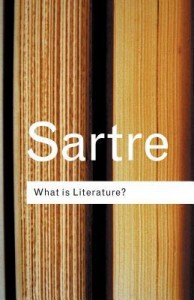
What Is Literature? by Jean-Paul Sartre

Posted December 16, 2014 by Michael @ Knowledge Lost in Non-Fiction / 2 Comments

What Is Literature? by Jean-Paul SartreTitle: What Is Literature? (Goodreads)
Author: Jean-Paul Sartre
Translator: Bernard Frechtman
Published: Routledge, 1947
Pages: 280
Genres: Non-Fiction
My Copy: Library Book

Buy: AmazonBook Depository (or visit your local Indie bookstore)

What Is Literature? (Qu’est ce que la littérature?) by Jean-Paul Sartre has also been published as Literature and Existentialism. It is a collection of freestanding essays originally published in the French literary journals Les Temps Modernes, Situations I and Situations II. Jean-Paul Sartre is best known as the French philosopher who played a key part in the schools of existentialism and phenomenology. It is sometimes forgotten that he was also a literary critic and a Marxist who was often vocal about the abuses of human rights by the Soviet Union.

The reason I mention that Jean-Paul Sartre was a Marxist is because this plays a big part of What Is Literature? To understand his political standing is useful because it plays an important role in his literary criticism; Sartre was very vocal political, and though he embraced Marxism he never joined the communist party. While his literary criticism is always focused on Marxism, his schools of thought in philosophy are relevant, as well as his views on sociology and post-colonialism.

There are four essays found within What Is Literature? “What is Writing?”, “Why Write?”, “For Whom Does One Write?” and “Situation of the Writer in 1947”. “What is Writing?” is probably the most fascinating (for me, anyway) of the four essays, exploring the ideas of writing that distinguish it as an art form apart from poetry, painting and music. I found it interesting how Sartre has separated poetry and journalism out of his thoughts of writing to focus on literature as an art form. Whether you believe his idea of not, Jean-Paul Sartre will give you plenty of food for thought and I have to admit that a sufficient amount of it went over my head.

Jean-Paul Sartre has spent a great deal of time thinking about literature and writing as an art and philosophical idea, more than I could ever imagine. Because of this, it can be difficult and as a reader I had to admit that I wouldn’t understand everything. What Is Literature? did however leave me with plenty to think about and offer me a fresh perspective and that is all I wanted from this book. Let’s face it, this is a pretty pretentious book to read but I still think it is worth exploring the ideas within What Is Literature?


The Stranger by Albert Camus

Posted July 19, 2010 by Michael @ Knowledge Lost in Classic / 3 Comments

The Stranger by Albert CamusTitle: The Stranger (Goodreads)
Author: Albert Camus
Translator: Matthew Ward
Published: Knopf Doubleday, 1942
Pages: 123
Genres: Classic
My Copy: Library Book

Buy: Amazon (or visit your local Indie bookstore)

L’Étranger, known as The Outsider, or The Stranger by Albert Camus offers an interesting perspective of the philosophical movement; existentialism. Though, as a stand alone novel, it was very simple and uneventful. You need to read this book for its philosophical merit or not read it at all. Previously, I wrote a post about this book and The Cure song Killing An Arab, in which I talked about how the book covered topics like; absurdism, atheism, determinism, existentialism, nihilism, and stoicism.

I thought I needed to read the book and try to understand the connections. The book does an interesting job at covering this issues without being too noticeable. Sure, if you spend your time digesting or picking apart books, you are sure to notice it, but if you are reading the book just for the story, then you may miss the complexity of the story.

It is unusual to read a book that has a complexity to it, but still tells the story too simply. It might have lost some of its density when translated from French to English. I just look for more substance in my books, so I was a little disappointed.


Trying to Understand Existentialism

Posted March 14, 2010 by Michael @ Knowledge Lost in Culture, Philosophy / 0 Comments

The Myth of Sisyphus

“The struggle itself…is enough to fill a man’s heart. One must imagine Sisyphus happy.”

Albert Camus

Existentialism is an interesting philosophical concept; if God doesn’t exist then life has no point. So if life has no point, we can basically do what ever we want, make our own life worth living.

Existentialist thinkers focus on the question of concrete human existence and the conditions of this existence rather than hypothesizing a human essence, stressing that the human essence is determined through life choices. However, even though the concrete individual existence must have priority in existentialism, certain conditions are commonly held to be “endemic” to human existence.

It is in relation to the concept of the devastating awareness of meaninglessness that Albert Camus claimed that “there is only one truly serious philosophical problem, and that is suicide” in his The Myth of Sisyphus. Although “prescriptions” against the possibly deleterious consequences of these kinds of encounters vary, from Kierkegaard’s religious “stage” to Camus’ insistence on persevering in spite of absurdity, the concern with helping people avoid living their lives in ways that put them in the perpetual danger of having everything meaningful break down is common to most existentialist philosophers. The possibility of having everything meaningful break down poses a threat of quietism, which is inherently against the existentialist philosophy.

Existentialist thinking makes me wonder about things like;

  • Angst
  • Authenticity or even inauthenticity
  • Despair
  • Facticity
  • Freedom
  • Reason

Where do these fit into the world of Existentialism?


Killing An Arab

Posted March 7, 2010 by Michael @ Knowledge Lost in Philosophy / 0 Comments

The debut single from UK Goth greats; The Cure was Killing An Arab. Robert Smith calls the song a “short poetic attempt at condensing my impression of the key moments in L’Étranger (The Stranger) by Albert Camus”. The song tells the story of the scene on the beach where the protagonist Meursault shots the Arab attacker. The Stranger (also known as The Outsider) covers philosophical concepts like) absurdism, atheism, determinism, existentialism, nihilism, and stoicism.

One interesting concept in this book and the main reason I want to read it, is the fact that Meursault chooses not to lie. In the afterword Camus stats;

[Meursault] refuses to lie. Lying is not only saying what isn’t true. It is also, in fact especially, saying more than is true and in the case of the human heart, saying more than one feels. We all do it, every day, to make life simpler.

The best example of people lying would be the typical conversations

“How have you been?”

“Fine”

The response “Fine” is hardly ever true and is just avoiding the real issues you are going through. But in the same conversation; how many people ask “How have you been?” and not really cared one way or another, just using it as a conversation starter.