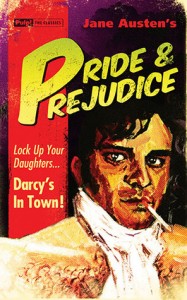
 Title: Pride and Prejudice (Goodreads)
Author: Jane Austen
Published: Pulp! The Classics, 1813
Pages: 320
Genres: Classic
My Copy: Personal Copy
Buy: Amazon, Book Depository (or visit your local Indie bookstore)
Jane Austen’s Pride and Prejudice is often considered one of the greatest novels of all time; the story of proud William Darcy and the prejudices of Elizabeth Bennet. From Lizzie’s perspective their spirited courtship plays out on the page; in this witty comedy of manners, upbringing, morality, education, and marriage in early 19th century society.
Most of you would already know this story; you’ve probably seen an adaptation or two in your time. For me, I was never interested in reading this book, I knew what it was about but I never knew what to expect. Eventually I had to read this book, in part for university and because it’s a classic that will always remain on the 1001 Books You Must Read Before You Die List. This is the novel that just will not die; 200 years later since this was published the book still sits very often in the top ten in a lot of bookstores and other literary lists. It’s been adapted multiple times as well as been retold many times (highlights include Lost in Austen & The Lizzie Bennet Diaries). The novel has also inspired a range of other books including books by Georgette Heyer, Agatha Christie and Helen Fielding.
First of all I want to look at Jane Austen’s attempt to play with the traditional quest format to offer us this rather clever novel. Let’s look at the novel from a traditional storytelling point of view. The potential princes in this novel; Darcy was considered clever and cold, Mr Wickham was too hot, then there was Mr Collins, the one that could save the ‘castle’ who should be just right, but he was not warm but tepid and boring. The pattern is reshaped and slowly the princess’ heart has been won, even if she doesn’t know it straight away. Then Austen needs to make the suitor eligible to win over the heroine; so she sends him on a quest to win Lizzie’s heart. Then like all quest stories, the story ends abruptly, with a marriage and a happy ending. This ancient pattern only provided the basic story structure for Jane Austen to weave her story into.
The interesting thing about this novel is the fact that this book has no physical action in the entire book; the novel rather concerns itself with the complexity of courtship and marriage in the landowning classes in provincial England. Austen writes about the people she knows, doing the activities we would expect them to do. Yet she manages to write it with such wit and skill that the novel refreshing and remained so popular.
Elizabeth Bennet is clearly Austen’s favourite in the book; the character is stronger and smarter than even the men in the book. Yet she goes to great lengths to make sure that this is believable. While she is clever, Lizzie still has romance/the sublime on her mind; her references to the Lake Distracts could be considered evidence of this. I feel like Jane Austen is trying to show that a woman like Lizzie should be deserving of the family home more than someone like Mr Collins. The Bennet’s are not middle class in this novel; Mr Bennet doesn’t work, he is a man of leisure, landowners but without a son their property will be inherited by Mr Collins. So we have this impending doom (according to Mrs Bennet) with only one hope of saving the family, marriage. When Lizzie Bennet rejects Mr Collins and eventually marries Darcy, Austen tries to tell us that character matters more than rank when it comes to romance, but then there is still a whole lot to do with rank and class that remains within the novel.
At the start of the novel Lizzie and Darcy hate each other but by the end they are the perfect couple. So what is Austen trying to tell us with this change in momentum? To do this let’s look at the other relationships; First off there is some evidence that Mr and Mrs Bennet got married at a very young age, lust had brought the two together and there might have been a pregnancy. Now that the lust has cooled they find they have nothing in common. Mr Collins and Charlotte are almost the opposite; there is no passion in their marriage, it was more of a business arrangement, no kids and unhappy in their marriage. Mr Bingley and Jane are just smitten with each other; there is no real evidence that there is anything more than just an infatuation. So when it comes to Lizzie and Darcy, they are written as the opposite, they are not smitten, they have to make their way there. They develop a healthy respect and admiration as well as love. All the details are focused on Lizzie and Darcy; all the other characters are rather underdeveloped, they feel more like caricatures, yet we still need to look at the other couples to see what Austen was trying to achieve.
Now I want to look more at the writing and style rather than character and plot. Pride and Prejudice started off as an epistolary novel, it has been said that this was originally written as a series of letters; this is why there is a huge lack of character description. This is also a novel of wit so let’s focus more on how Jane Austen achieves that.
“It is a truth universally acknowledged, that a single man in possession of a good fortune must be in want of a wife.”
Looking at the very first line we get a sense of Austen’s ironical attacks; Bingley and Darcy both have women lined up but both don’t seem too keen to marry. Single men with large fortunes have the luxury of doing what they want. It is only Mrs Bennet that is trying to convince the reader that the opening line is indeed true. Just in the first few lines we can see the subtlety of Austen’s language. This book is full of other slight digs at society and it took me a second read through to really see them, but they are there and I suspect that is why this book continues to remain popular; no matter how many times you read this book there is still something to discover.
Jane Austen likes to dig at the concepts at Class and Courtship, but more so towards love and marriage. It is interesting to see that many people read this book at face value and just gloss over any attempt at irony in this book. This book is riddled with discursive and dramatic irony but to Jane Austen’s credit she was able to do it in such a subtle way that it can be easily overlooked or missed. For a cynical person like me, it was this irony that I respect the most. I love that you can read this book as a great romance or as an ironic look at love and marriage. While the irony plays out in the book, Jane Austen’s fundamental optimism makes sure no damage was done and the outcome is a happy one.
I expected Pride and Prejudice to be a romance, exploring the courtship of Lizzie and Darcy, which it is, but I was so pleased that there was so much more in this novel to explore. I read this novel and then went back and reread this novel right away; this was mainly because I needed to for Uni but I found this deliciously cynical voice come through the second time that changed my opinion of this book. I’m not sure if Jane Austen’s novels are always so ironic but if they are, she has found herself a new fan.


 I’ve often contemplated this question and since studying at university I’ve noticed that they often recommend two publishers more than any other; Norton Classics and Oxford World Classics. While they don’t have the best covers, I’ve had the greatest success with Oxford World Classics, to the point that I don’t want to buy any other editions. If asking the internet which translation of a novel I should read, for War and Peace it is Louise and Aylmer Maude and for Crime and Punishment, Jessie Coulson is often the answer. They are the translators used in the Oxford World Classics.