Tag: The Zhivago Affair

Down the Non-Fiction Rabbit Hole

Posted November 2, 2016 by Michael @ Knowledge Lost in Literature, My Essays / 6 Comments

The quote by Socrates “The more I learn, the more I learn how little I know” has been on my mind for quite some time. There seems to be no truer statement to describe how I feel at the moment. One of the reasons I spend so much time reading is because I want to learn. Fiction can tell us so much about the world around us, and the experiences faced by different cultures. I am drawn to translated fiction because of what it can teach me about the world. It has taken me some time but I am slowly been drawn to non-fiction as well. Reading recently Secondhand Time by Svetlana Alexievich (translated by Bela Shayevich) and Wild Swans by Jung Chang I discovered just how much about the world I still need to learn.

While Russia is a particular interest of mine, Secondhand Time gave me some insights I did not realise I needed. This is a stunning collection interviews collected by Svetlana Alexievich of people just talking about their personal experience with the collapse of the USSR. I thought I had a decent grasp of the history of the Soviet Union but this book shattered it completely. It is not enough to understand the basic history, life is much more complex and there is so much more to learn. I need to know more about post-Soviet Russia and I plan to learn, starting with The Invention of Russia by Arkady Ostrovsky.

Wild Swans is a biography of three generations of women living in China. Jung Chang tells the story of her grandmother, her mother and then herself, the experiences they all faced in a rapidly changing country. Her grandmother, grew up in a world of foot binding and warlords, while her mother saw the rise of Chairman Mao and communism. This is a story that spans from the Manchu Empire to the Cultural Revolution. It was here I discovered a deeper understanding of communist China; I would never have known about the Great Leap Forward or the Cultural Revolution in such detail without the personal accounts found in this book. If I combine my love for Soviet history, I find myself wondering if I should learn more about communism in other countries. Do I dare to try and compare the differences?

nonfiction2016

There is so much to learn and I feel myself being drawn down the rabbit hole. I have identified three major interests that seem to be the current focus of mine when it comes to non-fiction. This is Russian history, philosophy and books about books. I know this is only the tip of the iceberg and I will be venturing down so many more paths in the future but for now I will start here.

With my love of Russian literature, I feel the need to have a deeper understanding of their history, especially surrounding the politics. Not only will this aid my understanding into the literature I am reading but it will also help me better appreciate the satirical nature that is often found in Russian literature. I am slowly working my way down this rabbit hole with books like Iron Curtain by Anne Applebaum, a look into the way the USSR treated Eastern Europe and Voices from Chernobyl by Svetlana Alexievich (translator: Antonina W. Bouis), an oral history into the nuclear disaster in 1986. Even a book like The Zhivago Affair by Peter Finn and Petra Couvée has been useful; not only does it explore the story of Doctor Zhivago but the impact it had on the world around it.

A new love for philosophy started with At the Existentialist Café by Sarah Bakewell and now I want to know so much more about Jean-Paul Sartre, Simone de Beauvoir, Albert Camus, and Søren Kierkegaard. But I do not plan to just stop at the existentialists, I have so much to learn. My knowledge of philosophy may have come from a novel called Sophie’s World by Jostein Gaarder (translator: Paulette Møller). There is a lot more I could learn from the philosophers, and I have started my journey, with Beyond Good and Evil by Friedrich Nietzsche (translated by R.J. Hollingdale) and The Story of Philosophy by Will Durant.

Finally, my love for literature has drawn me to reading about literature. Not just memoirs and biographies, although you may notice in my reviewing that I find context important. So a memoir or a biography gives me a deeper appreciation of the literature. A memoir like Little Failure gave me a greater understanding about its author Gary Shteyngart and a collection of letters and diary entries called Manuscripts Don’t Burn (translated and edited by J.A.E. Curtis) was a valuable insight into Mikhail Bulgakov. But then there are books about the reading journey that are entertaining to read, while still being a valuable part of my own reading life. I am talking about books like The Year of Reading Dangerously by Andy Miller, 84 Charing Cross Road by Helene Hanff and Howards End is on the Landing by Susan Hill. I can be very particular about books about books, the tone has to be right, their taste in literature and the way they talk about literature is equally important, and so for my money I would recommend Ex Libris by Anne Fadiman as the pinnacle in this genre of non-fiction. My reading journey is far from over, in fact it is only just beginning. Having only spent six years as a reader, I have so far to go. It is all part of my never ending quest to become well read. I will be focusing on reading more non-fiction, starting with these three interests and branching out.

Following the path of knowledge wherever it might take me. I look forward to talk about my journey as I continue and would also appreciate any recommendations.
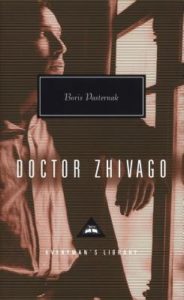

Doctor Zhivago by Boris Pasternak

Posted October 1, 2016 by Michael @ Knowledge Lost in Classic / 2 Comments

Doctor Zhivago by Boris PasternakTitle: Dr Zhivago (Goodreads)
Author: Boris Pasternak
Translator: Max Hayward, Manya Harari
Published: Everyman's Library, 1957
Pages: 512
Genres: Classic
My Copy: Hardcover

Buy: AmazonBook DepositoryKindle (or visit your local Indie bookstore)

When thinking about staples in Soviet literature, one book immediately comes to mind, and that is Doctor Zhivago by Boris Pasternak. A novel in the vein of the Russian epics like War and Peace, Pasternak’s novel tells of a tragic hero, Yury Zhivago. The novel follows the life of a flawed character as he tries to control his life and his hormones. While trying to live a moral life, he is often a victim of his own desires and misfortune, while Russia changes around him.

I have mixed feelings about this modern classic and this is mainly due to the fact that some people refer to this as an epic romance. Doctor Zhivago is as romantic as Wuthering Heights as it explore romanticism rather than love. Russian Romanticism often has an emphasis on the metaphysical discontent of society and one’s self. In this way, yes, Doctor Zhivago is a wonderfully Romantic novel but if you are looking for love, you’ve come to the wrong book. I know translator Richard Pevear has called this a moving love story (which cements many issues I have with Richard Pevear and Larissa Volokhonsky) however, can you call the struggle with morality a tale of romance?

Let’s talk about the relationships found within Doctor Zhivago. The relationship between Yury and Lana is the main focus of this classic; a woman he has lusted after for his entire life. However he marries Tonya, a woman that Yury shows no real affection towards. This is not to say that Yury does not care for Tonya, just the whole idea of marrying someone while in love with someone else is just stupid. Now I know this is an autobiographical novel and it is a reflection of Boris Pasternak’s own relationship mistakes but the relationship between Yury and Lana was always doomed, especially since she shows no interest in him.

There is something to be said about the marriage of Yury and Tonya. Following the loss of his mother and the abandonment of his father, Yury is consistently seeking out a maternal figure. One may even call it an Oedipus complex and Tonya is more of a mother figure to him. This brings up a major theme in Russian literature not just Doctor Zhivago. In the case of this novel, the human desire for companionship plays out in context of the longing for stability. Russia has suffered a lot of tumultuous times and the desire for stability tends to be reflected in their literature.

What interested me the most about Doctor Zhivago was what it had to say about the political landscape. This is why the novel was refused publication in the Soviet Union and the story behind the book is just as interesting. I picked up The Zhivago Affair: The Kremlin, the CIA, and the Battle over a Forbidden Book by Peter Finn and Petra Couvée as soon as finishing Doctor Zhivago. This book is part biography on Boris Pasternak and part history of the novel.

Boris Pasternak was so passionate about writing Doctor Zhivago, he would continually return to it in-between paid translation work. He knew that it would never be published in the Soviet Union but wanted his story out there. Because the novel covered a time between the first Russian Revolution of 1905 and the Civil War. The reader is able to follow the ideological struggle that Pasternak would have had towards his much loved motherland, from the dreams of a socialist utopia to its grim reality. These themes, its criticism towards Stalin and mentioning the realities of the Gulag (covering this topic before Aleksandr Solzhenitsyn) were some of the main reasons this book was denied publication. It was the CIA who published the book and distributed it in the Soviet Union as propaganda, the story behind this an interesting one, which I learnt from The Zhivago Affair.

Doctor Zhivago was smuggled out of the country by Giangiacomo Feltrinelli with Pasternak asking him to help get his novel out to the world, who first published the book in Italian. Pasternak also gave the manuscript to George Kutkov in the hopes of a decent and faithful English translation. Katkov promised the best translation possible and settled on Max Hayward and Manya Harari for this task. According to The Zhivago Affair, “The pair alternated chapters and then checked each other’s work. Katkov supervised them both, ‘going over everything for accuracy and nuance.’”

Originally Katkov suggested to Pasternak to use Vladimir Nabokov for the translation but this idea was rejected. “This won’t work; he’s too jealous of my position in this country to do it properly.” I am not sure what the relationship between Pasternak and Nabokov is but he has been quoted in 1927 as saying “His verse is convex, goitrous and google eyed, as though his muse suffered from Basebow’s disease. He is crazy about clumsy imagery, sonorous but literal rhymes, and clattering metre.” When Doctor Zhivago was published in America it knocked Lolita off the number one spot on the best seller list. This lead Nabokov to call it “a sorry thing, clumsy, trite and melodramatic, with stock situations, voluptuous lawyers, unbelievable girls, romantic robbers and trite coincidences.”

Despite the criticism and while I do agree it is a little clumsy in its coincidences, I cannot deny Doctor Zhivago as anything but a masterpiece. I know Boris Pasternak wanted the novel to be accessible and simple, and I was surprised how easy it was to read. There is plenty to say about this novel and I would love to talk more about it. I know this will be a novel that will be read over and over again and I encourage others to read it not for the story but for what is says about the Soviet era. Doctor Zhivago is such a cultural phenomenon and at great risk to its author, in fact apparently when Boris Pasternak gave the manuscript to Giangiacomo Feltrinelli he said “you are hereby invited to my execution.”