Tag: Travel

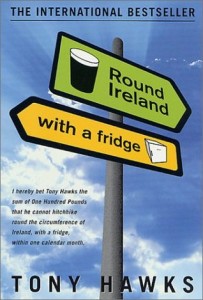
Round Ireland with a Fridge by Tony Hawks

Posted December 11, 2014 by Michael @ Knowledge Lost in Humour, Non-Fiction / 0 Comments

Round Ireland with a Fridge by Tony HawksTitle: Round Ireland with a Fridge (Goodreads)
, 1997
Pages: 248
Buy: AmazonBook Depository (or visit your local Indie bookstore)

What happens when you make a stupid bet while drunk at a bar? If you are anything like Tony Hawks, you actually try to win the bet. With £100 at stake, Tony Hawks decides to hitchhike around Ireland with a fridge (even though buying the fridge cost him £130). Round Ireland with a Fridge is a travel memoir about the adventures Tony Hawks had with his fridge.

First of all, it is important to point out that Tony Hawks is a British comedian and is not to be confused with the skateboarder. While he is best known for his travel memoirs, Hawks first claim to fame was as the lead of the comedy band Morris Minor and the Majors, which had a hit with a Beastie Boys parody in 1988.  He is also a voice actor, most notable for voicing a vending machine and a suitcase in Red Dwarf.

This book starts off with Tony Hawks talking about how he doesn’t spend much time drinking or going to bars. Then for the entire novel he drinks in bars as he hitchhikes around Ireland. Putting aside this huge contradiction this book is actually very entertaining and manages to captivate the audience for its 246 pages. Travelling from Dublin to Donegal, from Sligo through Mayo, Galway, Clare, Kerry, Cork, Wexford, Wicklow–and back again to Dublin this a story of the people he meets along the way.

The fridge actually become more of an asset that Tony Hawks originally expected, helping him get rides, free accommodation and even pick up woman. Even the fridge had its own adventures; it was christened by a nun and even went surfing. While this may seem like a gimmick you will find some interesting philosophical thoughts on people and life as Tony Hawks reflects on all the experiences he had with his fridge.

I had a lot of fun with this book and I am so glad to have read it. There were so many laugh out loud moments (I especially enjoyed Hawks views on marathons) and still offered plenty to think about. As a travel memoir I expected something like Bill Bryson and while the comedy is there I think there was more opportunity to teach people about Ireland and its culture. Highly recommend this book and I plan to seek out Playing the Moldovans at Tennis so I can dip back into Tony Hawks writing again.


Gulliver’s Travels by Jonathan Swift

Posted November 18, 2014 by Michael @ Knowledge Lost in Classic / 0 Comments

Gulliver’s Travels by Jonathan SwiftTitle: Gulliver's Travels (Goodreads)
Author: Jonathan Swift
Published: Oxford World's Classics, 1726
Pages: 362
Genres: Classic
My Copy: Paperback

Buy: AmazonBook DepositoryKindle (or visit your local Indie bookstore)

Jonathan Swift’s classic satire novel Travels into Several Remote Nations of the World. In Four Parts. By Lemuel Gulliver, First a Surgeon, and then a Captain of Several Ships was released in 1726 but in 1735 the title was amended simply to Gulliver’s Travels. The novel was popular not only because it was a parody on the popular “travellers’ tales” genre but as a satire on human nature. It later gained increase popularity in its abridged form as a classic in children’s literature.

It seems a little odd to me that many people have experienced Gulliver’s Travels as a children’s book. Comparing what I know from the abridged children’s book to the version I just read, it feels like a completely different book. The abridged version I believe only focuses on books 1 and 2 and all satire, allegory or symbolism has been stripped from it, which means the bulk of makes Jonathan Swift a great writer has been completely removed and only the fantastical elements remain. Other classics received a similar treatment to turn into a kids book including, Robinson Crusoe, The Thousand and One Nights (known as The Arabian Nights) and to a less extent Alice’s Adventures in Wonderland and Peter Pan.

When reading a book like Gulliver’s Travels it is important to remember that Jonathan Swift deals heavily in irony. Take for example his essay ‘A Modest Proposal’ in which he suggests a solution to the population issue in Ireland. He suggested that we need to “regard people as commodities” and went on to say that “A young healthy child well nursed, is, at a year old, a most delicious nourishing and wholesome food, whether stewed, roasted, baked, or boiled; and I make no doubt that it will equally serve in a fricassee, or a ragout.” This straight-faced proposal is a form of Juvenalian satire where Swift mocks the heartless attitudes the government has towards the poor, as well as Irish policy in general.

Gulliver’s Travels’ satirical themes are very subtle but are typically directed towards moral, political, social and religious ideals. The main satirical themes I found within the novel focused on war, corruption in the laws and politics and the ignorance or arrogance of doctors. There is a lot of irony within the book, for example the term medical malpractice refers to ordinary medical practices and horrific carnage is meant to be extremely fun.

This is a book that comes with more layers than an onion; we could look at the travel novel as a genre, colonialism, and even the changes in Gulliver’s opinions and language over the course of the book. You could even read this as a rebuttal to Defoe’s optimistic account of human capability in Robinson Crusoe which was published seven years earlier. On the surface, you can look at Gulliver’s Travels as four different short stories but if you decide to explore it deeper you are heading down a rabbit hole you may never escape.

I have to admit I didn’t spend as much time as I should have and explored some of the ideas within this classic a little deeper. I was very aware that if I dug deeper I would be stuck reading this book for the rest of the year, maybe the next. I am fascinated by this book, I would love to dig deeper in the future but with the aid of a study guide or something similar. I will be reading this book again and I would like to encourage others to pick it up if they haven’t done it in the past. Swift really has a decent grasp on satire; so much so that we have the term Swiftian to refer to his satirical tone and pessimistic outlook in literature.


The Literary Exploration Reading Challenge Returns for 2014

Posted December 12, 2013 by Michael @ Knowledge Lost in Literature / 9 Comments

The Literary Exploration reading challenge is back, by popular demand. As most people know, Literary Exploration tries to explore all different genres in the hope to become a well-rounded reader and even discover something new. So we are challenging everyone to dedicate either 12, 24 or 36 books that you would normally read during the year to different genres. We have compiled a list which hopefully will give you a chance to explore literature a little deeper.

It’s real simple; below you will see an easy (12 books), hard (24 books) or insane (36 books) challenge. Each genre links to the Goodreads genre page if you need some suggestions on what to read. We want you to have some fun and explore; hopefully you might find a new genre that peaks your interest. To sign up either join the Literary Exploration book club on Goodreads and talk about your progress with others involved or for the bloggers out there, if you want to add it as part of your blogging experience simply let us know with a link (to your Literary Exploration Challenge page) in the comments below so our readers can see how you are going.

This year we have adjusted the insane challenge slightly to make it a little more rounded. The popularity of the reading challenge with overwhelming and we are pleased to see how many people wanted to do it again next year. We have even offered some bonus for those who want to take it to the next level. The idea of this challenge is to have a well-balanced list of genres and not focusing on one genre more than any others.

Good luck all who decide to join in. I personally am going to go for the 36 book, insane challenge and I’m really looking forward to it. While there are some genres I’m not looking forward to reading, it’s all part of being a literary explorer. What could be wrong with that?

Read More


Death in the Afternoon by Ernest Hemingway

Posted August 30, 2013 by Michael @ Knowledge Lost in Non-Fiction / 0 Comments

Death in the Afternoon by Ernest HemingwayTitle: Death in the Afternoon (Goodreads)
Author: Ernest Hemingway
Published: Scribner, 1932
Pages: 416
Genres: Non-Fiction
My Copy: eBook

Buy: AmazonBook Depository (or visit your local Indie bookstore)

Death in the Afternoon is a non-fiction book by Ernest Hemingway that explores the ceremony and traditions of Spanish bullfighting. Looking at the history and the culture behind bullfighting, the book also explores the dangers and fears being faced. Still considered one of the best books ever written about bullfighting, Death in the Afternoon explores the sport by one of its aficionados.

This is an interesting book, not something I would read normally but I did enjoy it. While I am morally opposed to bullfighting I didn’t have any really knowledge of the sport and culture behind it. So I went into this book with an open mind and a little hesitant. I had never had a good experience with Hemingway in the past; granted I’ve only read one of his novels (The Old Man and the Sea) but it was enough to never go back. I know this is not a good reason not to return but I have to admit I did enjoy the writing styles.

Ernest Hemingway has a very descriptive writing style which makes for some interesting insights; but sometimes too much. I get the impression that he is using humour in some of his writing but it’s so obscure that it either goes over my head or is just downright weird. I know Hemingway was a rather unusual man and had an interesting life but he isn’t someone that I think I will ever understand or connect with in any way. While I’m against bullfighting, Hemingway seems to be an advocate towards it and often wants it to be more violent and deadly.

You have to understand that Ernest Hemingway is an arrogant, sexist, pompous ass and it often comes through in his writing, so you have to take everything he says with a huge grain of salt. I found myself disagreeing with him all too often but still interested in what he was saying. I went into this book knowing that Hemingway and I weren’t going to get along at times, which was lucky because I was ready to throw out any of his opinions that didn’t align with mine. I did find it interesting how he kept using bullfighting as a metaphor for art and Spain; I don’t know if I agree with this but he seemed was be determined to make this point.

While I’m still opposed to bullfighting, I now have a whole lot more information about the topic; possibly too much. Hemingway’s writing style was enough to make me willing to try something else of his (if I find something good) and this was an interesting and different reading experience. I don’t read enough non-fiction, let alone travel or sports writing so this was a book way out of left field. I’m determined to read more non-fiction now and I hope that I manage to get through at least one a month. Also interesting to see how this review turned out; I’m never know how to approach a non-fiction review and I think I did alright here.


Questions of Travel by Michelle de Kretser

Posted August 22, 2013 by Michael @ Knowledge Lost in Literary Fiction / 0 Comments

Questions of Travel by Michelle de KretserTitle: Questions of Travel (Goodreads)
Author: Michelle de Kretser
Published: Allen & Unwin, 2012
Pages: 528
Genres: Literary Fiction
My Copy: Personal Copy

Buy: AmazonBook Depository (or visit your local Indie bookstore)

Laura Fraser is an artistic Australian, who lost her mother at a very early age and her father was cold and distinct towards her, as was her brother. On the other side of the world Ravi Mendes’ life was almost the complete opposite to Laura, but still struggles in life at times; currently he is determined to break into the computer science industry. Alternating from one character to the other, Michelle de Kretser’s Questions of Travel explores why we are all influenced by travel.

Questions of Travel won the Miles Franklin award this year but if it wasn’t for my book club I would never have read it and I think that might have been a mistake. This novel is almost a post-modernist novel in the experimental way the author approached it. I read this book as if the two characters are sitting me down and going through their photo album and telling the story related to each picture. Slowly we get the full story but there are a lot of pieces we have to fill in for ourselves. The reason I thought this was just the way it was written and you have these really short chapters but every now and then you get a long one. Also the dates on each chapter become more specific as we got closer to the present day, almost like the character remembers the year rather than the decade now.

While reading this novel I got the impression that Michelle de Kretser was trying to explore the whole philosophy behind travel; why we do it? What we love about it? That feeling you get being in a strange country. This was a really interesting approach she took and really worked well with the experimental writing style. The author used to write for the Lonely Planet and throughout this novel you can see her small digs at these books and the bureaucracy behind them. Little things like this really helped lighten the mood for the novel.

Questions of Travel has some beautiful language throughout the book and you find yourself really taking the time to enjoy the book (even though I didn’t have much of that before my next book club meeting). This novel demanded more time than I gave it and I might have missed so much but due to time restrictions I had to power through it. There were times I found some great quotes and I wanted to write them down but I was in too much of a hurry (also I never seem to do that but am trying to make more of an effort).

The novel is both thought provoking and emotional; you’ll experience the highs and lows of the two main characters and even if you have found a favourite, both characters offer interesting insights to life and travel. Also on a positive note, this novel also offers one of the best opening chapters I’ve read in recent times, it comes out of nowhere and smacks you in the face. I spent days trying to decide if I liked this book and what I liked about it and that right there is why I enjoyed it; like Slaughterhouse-Five the time spent afterwards thinking about it is what I will remember more than the book itself. I’m not sure if I would recommend this novel to many people, you’d have to be willing to read experimental or post-modernist novels to really enjoy what Michelle de Kretser is doing.


On The Road by Jack Kerouac

Posted December 30, 2012 by Michael @ Knowledge Lost in Book of the Month, Classic / 0 Comments

On The Road by Jack KerouacTitle: On The Road (Goodreads)
Author: Jack Kerouac
Published: Penguin, 1957
Pages: 307
Genres: Classic
My Copy: Personal Copy

Buy: AmazonBook Depository (or visit your local Indie bookstore)

On the Road is a semi autobiographical novel about Jack Kerouac’s travels through America. Set in 1947 the novel documents the travels of Sal Paradise with his friend Dean on a quest of self-knowledge and life experiences. This novel is often considered as the definitive ideal of the Beat generation and living life postwar. The Beat movement is a cultural movement which rejected a normal life for a bohemian lifestyle; this movement inspired jazz, poetry and literature.  The non-conformity and spontaneous creativity as well as experimentation with drugs, alternative sexualities and interest in Eastern religions lead to the hippy movement in the 1960’s even though there are many differences.

On the Road is a novel of friendship, not just between Sal and Dean but the people that come and go from your life. Hitchhiking through America gives an opportunity to see this quickly; Sal meets new people all the time and just like that they are gone from his life; their impact on Sal may very but it really is a good way to show the effects people have without having to scratch a story over a few years. Then there is the friendship between Sal and Dean, it’s clear to me that Sal is idolising his friend and his need to be just like him is really not helping him to grow. Sal does grow through the book but it never feels like Dean has, this really changes the dynamic of their friendship as the book goes on.

This is also a book on the ideals of the beatniks; they are young and wanting to experience life, learn from their experiences. But underneath it all Sal feels unhappy. Either alone, in a relationship or just having casual hook-ups, Sal is never content. The only time I ever feel like Sal is enjoying himself is when he is having intellectual conversations, but he never really works out how to channel that passion to make his life mean something, I did think he would find contentment in writing but he never really does. The characters feel they should learn from life instead of books and this leads more to sex, substance abuse and even madness seem to be the end results of their experiences rather than knowledge.

While some might think this is a rather boring novel, I tend to think there is so much in the book worth exploring. I like the style and feel of this book, it reminds me of dirty realism and the quest for knowledge and satisfaction in life really hit home for me. My past experiences are nothing like those of Sal or Kerouac’s but there is something so real and raw about this book that I enjoyed. Overall it was interesting to read the book as a manifesto to the beat generation.


Monthly Review – September 2012

Posted September 30, 2012 by Michael @ Knowledge Lost in Monthly Reading / 0 Comments

Now that September comes to a close, I would like to hear what people thought of As I Lay Dying. Did you read it? Did you find it difficult? Or any other comments you want to make of this book. Personally I found it difficult to read, and while I wouldn’t say I really enjoyed this book, I did find the writing style very interesting.

Next month’s book is to help celebrate banned booked week (which is currently on now) and we will be reading Salman Rushdie’s The Satanic Verses which has been often described as one of the most controversial and acclaimed novels ever written. I’m sure this book will spark some interesting conversations but I do worry that it may cause fights. I hope everyone reading and  discussing the book, does so in a respectful manner. Also as a reminder that next month we will be reading House of Leaves by Mark Z. Danielewski as part of the Horror theme and we will be looking for a book to fit the Road Trip/Travel theme. If you’re not aware, the book discussion and everything else will be happening over on the Goodreads forums, so feel free to join in there.

During the month I’ve read some great books, but I wasn’t as productive as last month. Some of the highlights from the months reading include, Justin Cronin’s The Twelve which I was lucky enough to get an advanced review copy of, Dare Me by Megan Abbott and He Died with his Eyes Open by Derek Raymond. But my favourite of the month was The Yellow Birds by Kevin Powers; which is a heartbreaking work of beauty. A book of friendship and loss, The Yellow Birds follows the story of Private Bartle and his time served in Al Tafar, Iraq and the aftermath. What have you been reading this month and what did you enjoy? I would love to hear about your reading life in the comments below.

  • Soulless by Gail Carriger 
  • The Geneva Trap by Stella Rimington 
  • Live by Night by Dennis Lehane 
  • 11.22.63 by Stephen King 
  • As I Lay Dying by William Faulkner 
  • The Transport Accident by Ned Beauman 
  • One Night Stands and Lost Weekends by Lawrence Block 
  • Tigers in Red Weather by Liza Klaussmann 
  • The Prague Cemetery by Umberto Eco 
  • The Twelve by Justin Cronin 
  • He Died with His Eyes Open by Derek Raymond 
  • Dare Me by Megan Abbott 
  • The Yellow Birds by Kevin Powers