Tag: Umberto Eco

Distracted by Other Books

Posted May 1, 2018 by Michael @ Knowledge Lost in Monthly Reading / 2 Comments

My Thoughts and Reading in April 2018
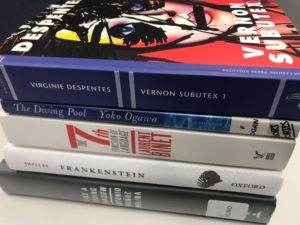
Earlier in the month my wife was suffering from a major headache, so lying in the dark I decided to pick up my kindle to avoid disturbing her. I had The White Book on my Paperwhite and I knew it would not take me that long to read. Reading in the dark I was transfixed by the light of my Kindle. There is a line in the book that really stayed with me, “Certain objects appear white in the darkness. When darkness is imbued with even the faintest light…” There is something to be said about reading a book at the right time, because the experience alone made this book enjoyable. I love sitting in the dark but normally hate reading on my Kindle, the combination of darkness and talking about white just meshed well.

However that experience pales in comparison to reading The 7th Function of Language. Have you ever read a novel that you think has been tailor made for you? This was my experience with The 7th Function of Language. Everything about this book ticked my boxes, from the mystery element, to the literary criticism. I loved every minute reading this one and I cannot wait to re-reading it in the future. This reminds me of my favourite Umberto Eco book, Foucault’s Pendulum. I had to laugh at the fact so many people were calling this novel ‘too pretentious’ but others were comparing it to Dan Brown.

I often wonder if my literary tastes are the direct opposite to the norm, because I tend to love so many books others are regularly dismissed. Not that I mind at all. It helps with my pretentious literary credibility. Although I think The 7th Function of Language is not pretentious and would make for an exciting audiobook. I have not read hhHh but after reading this one, I am keen to find a copy. Although that novel is more war based, I am still very curious. It did get a lot of hype and attention, which might mean I will be disappointed by the novel.

This month marked the start of my very own podcast, Lost in Translations. My wife and I have been planning this for a very long time and by planning I mean procrastinating. But this we finally released the first episode which is an introduction episode. I was very nervous but beyond thrilled with just how well it turned out. I am surprised how much support I got on a project that has just launched. I am looking forward to releasing the first official episode where we discuss a book I loved last year (no spoilers into what it will be). My wife will be my first guest and while we have not recorded the episode yet, I hope to have it release in the middle of May.

I have loved reading the Man Booker International prize longlist and I am starting to see the light at the end of the tunnel, especially after finishing Like a Fading Shadow and Vernon Subutex 1. It has been a bit of a letdown for me. There are so many books on the list that I thought were so-so but not much I loved, besides The 7th Function of Language, Frankenstein in Baghdad and Die, My Love. I will read the next Vernon Subutex book, and I did have a lot of fun reading it but it was not a standout. I am starting to be distracted by other books and itching to read other things. I am not married to the idea of completing the entire longlist but I thought it was a great opportunity to be part of the community. I am yet to read Go, Went, Gone and Flights, which are on my TBR, so they will get read. I am in the middle of The Imposters and have not brought a copy of The Flying Mountain. So that is four books from the longlist that I would love to complete but the only one I am positive I will read soon is Flights.

The BTBA longlist is looking very tempting.

I re-read Frankenstein again, I received a beautiful edition of the 1818 text and thought it was time to read again. I did use this as an excuse to write a piece on how Frankenstein has impacted my life. Surprisingly I think I learnt a little about myself writing that piece and I am always astounded by what I discover about myself while writing. I think there is something therapeutic about writing and it often unlocks connections I have not thought were there. Writing about Frankenstein helped me understand a little more about my past. That piece will be in the next issue of The Literati which is released very soon.

Finally I picked up The Diving Pool to read, which is the pick for a bookclub I am apart of on Goodreads. I love being a part of a Goodreads group reading books in translation, but not many people are interested in communicating. I love a good forum but I think maybe they have run their course. People join but quickly lose interest. I love the idea of talking about books, especially translations but maybe Goodreads groups are not the right spot. What is the future for the forum format? Is it Discord? Or maybe it is a Facebook group.

I feel like this month has been less productive than other months. Only six books read and hardly any writing getting done. I am happy to see my podcast become a reality so I should not complain. I have The Lost Flowers of Alice Hart on the go, which I need to read for my IRL bookclub but I have not planned what else I will be reading. I like to read on a whim and maybe the Man Booker International prize longlist messed with that and has put me into a little of a slump. Although I hope to break out in May and get back to all the books that keep distracting me throughout the month. We are housesitting so I do not have access to all my books, which might mean a little control but I hope it does not keep my slump going any further.
Read More


Distracted by Other Books

Posted April 3, 2018 by Michael @ Knowledge Lost in Monthly Reading / 0 Comments

My Thoughts and Reading in March 2018

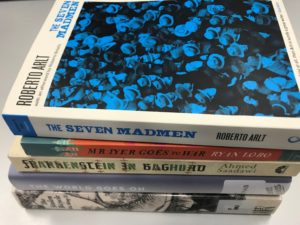
I live in a city that often does not get much rain. So when we get two weeks of constant rain it is a rare treat. There is nothing better than curling up in bed with a cup of tea and a good book, while thunder and lightning is raging outside. I was able to spend those two glorious weeks reading Frankenstein in Baghdad. Most people know about my obsession with Frankenstein, the book that literally changed my life. Normally I am apprehensive about any take on this classic novel but Ahmed Saadawi was able to deliver something sensational. His take on the classic was able to compare the tale with post-invasion Iraq in a unique way. Since it has been two hundred years since Mary Shelley’s novel, I cannot help but think about revisiting the book once again. Oxford World Classics did send me a beautiful hardback edition, so a reread is in my very near future.

Thinking about Frankenstein got me thinking about other books that have helped shape my life, which obviously leads me to my obsession with Russian literature. The Anna Karenina Fix seemed like the perfect bibliomemoir for me. As someone with a love for Russian lit, I found myself easily drawn to Viv Groskop’s memoir. One day I will write about all those books about books that I love and I have no doubt The Anna Karenina Fix will make that list. It made me want to reread so many of my favourites and then the ones I have missed, then go back to this book and read it again.

I am the type of reader that reads to learn about the world, to experience different cultures and explore new ideas. However there are times when I need to just switch off and read some palette cleansers. For me, this is crime fiction, but I am very particular about what I like. For the most, I will read an entire crime novel even if I was not enjoying it. Luckily there was something about Babylon Berlin that I loved. This is the first book in the Gereon Rath series and what drew me to this book was that it was set in 1929 Berlin. So in the background of this crime investigation we see Berlin as it changes, with the fears of communism and the newly emerging Nazi Party. I cannot help but compare it the Bernie Gunther series. While I have only read March Violets, since Philip Kerr passed way this month, I think I need to return to this detective and read The Pale Criminal. I did also read The Spellman Files at the suggestion of everyone who compared it to Veronica Mars.

The crime fiction I am attracted to the most is the old pulp era, the stuff from the 1920s to the 1940s. There is something about that writing, it is sharp and to the point, but still remains beautiful. Even forgotten classics like The Seven Madmen from Argentina seem to adopt that same style. The Seven Madmen is the kind of book that will remain with me for a long type and I am tempted to reread it, but I will get distracted by other books. After reading this book, I felt like staying with Argentinian literature and I was able to do that with the next book I read, Die, My Love.

The Man Booker International Prize longlist was announced and like many of my fellow book nerds, I was excited to see what would make the list. I had read Frankenstein in Baghdad but it was the only one on the longlist I have actually read. I would love to read the entire longlist but time and availability is always a factor. My library only had four of the thirteen from the longlist but I owned one already. So I thought I would make use of a Kindle Paperwhite to help. I have often struggled to get into ebook reading but the accessibility was my only hope to read the longlist. I will always prefer physical books, but maybe I will be convinced to read more ebooks. My constant distractions with other books and an ereader might be a deadly combination.

Obviously the first book I read was Die, My Love. The fact that it was Argentinian literature, made this an easy choice. This was such an affecting read, I will have to get a physical copy. After completing this novel, all I wanted to do was stay in Argentina forever. I think I could live a happy life only reading Argentinian lit, it has similarities to Russian literature but still feels very unique. I am also pleased to see a strong literary scene of Argentinian women; from Die, My Love, to books like Things We Lost in the Fire, Fever Dream and Savage Theories.

Unfortunately there were a few books that followed that I was not able to connect with, and left me unmotivated to read. Two were Man Booker International Prize longlist picks, The Dinner Guest and The Stolen Bicycle, but the third was this month’s bookclub pick. It was a modern take on Don Quixote set in India called Mr Iyer Goes to War and all I could think was about rereading Don Quixote. My problems with The Dinner Guest and The Stolen Bicycle were as followed; the first felt too similar to another book, while the later just went overboard with the one topic and that frustrated me.

The Man Booker International Prize longlist left me pondering translations. I love reading from around the world, to the point where I am considering turning it into a podcast. I discovered I do not know as much about translation theory as I would like. Maybe I need to explore some Walter Benjamin or as I discovered, Edith Grossman (who translated Don Quixote) wrote a book called Why Translation Matters. Do I need to know another language to explore translation theory in great detail? I know Umberto Eco also has a book on translations too, it is called Experiences in Translation. This might be another rabbit hole to go down in the new future.

I managed to have a very productive reading month, I finished it off with my second László Krasznahorkai book, which was his short story collection The World Goes On. This made ten books for March, and I am presently surprised, especially since I had three books that were a struggle. The only thing I currently have on the go is The 7th Function of Language, which is another book from the longlist. At this rate, I may be able to read the entire longlist before the prize is announced in May. However the availability of the last seven books is the major factor. I own two and waiting on one from the library, so it is becoming more of a possibility. I am having a hard time guessing what will make the shortlist, so I have delayed a few that I think might be on the list. That way I can still remain in the conversation.

Read More


Numero Zero by Umberto Eco

Posted December 24, 2015 by Michael @ Knowledge Lost in Literary Fiction / 0 Comments

Numero Zero by Umberto EcoTitle: Numero Zero (Goodreads)
Author: Umberto Eco
Translator: Richard Dixon
Published: Harvill Secker, 2015
Pages: 208
Genres: Literary Fiction
My Copy: Library Book

Buy: AmazonBook DepositoryKindle (or visit your local Indie bookstore)

Colonna is a down and out hack-journalist that has just stumbled on an opportunity of a lifetime. Assistant editor for an emerging newspaper, as well as ghost writing a memoir for Simei, the editor and creator of the paper Domani. As he interacts with the team of journalists he learns about a conspiracy theory about Mussolini’s corpse. Umberto Eco returns for another fast paced thriller involving an elaborate conspiracy theory in this short novel, Numero Zero.

Every time I read an Umberto Eco novel, I have been really impressed. He is often referred to as the intellectual Dan Brown, meaning they both share a similar style but Eco packs in a lot more information. The first Eco novel I read (and still my favourite) was Foucault’s Pendulum and it explored ideas of religious and secret organisations and making a conspiracy theory out of it. Conspiracy theories play a big role in his other novels which I have read (The Name of the Rose and The Prague Cemetery). However I feel that Numero Zero seems to be more similar to Foucault’s Pendulum.

While Umberto has the ability to create a fast paced thriller that is both witty and wry, I am always impressed with the amount of information he can pack into his novels. While Numero Zero is a very short novel, sitting under two hundred pages, there are times that it feels like an information dump. Most information or theories are told in dialogue and my biggest problem with this book was the amount of information being provided seem to detract from the historical thriller style.

The narrator of Numero Zero is fifty something year-old Colonna who provides a unique view through the events of the novel. A college drop-out, Colonna is a bitter and cynical protagonist who flitted from job to job. From tutoring, proofreading, being a copy editor and slush-pile reader, he has had his fair share of experience in journalism. The newspaper Domani (Yesterday) intends to deliver the news earlier than all the other papers, creating some backdated issues to experiment with format and methods of reaching the papers ultimate goal. Although Simei is planning to use these back issues as blackmail material to push himself into a high social position.

This allows Umberto Eco to do something different in Numero Zero. I do not remember any of Eco’s previous novels being as satirical as this book. Eco is satirising the media throughout the entire novel. Exploring the ways journalists manipulate the news being distributed to the general public. I did not expect the novel to be satirical but I really enjoyed the way Umberto Eco managed to blend his style and still explore a current social issue.

If you have never read an Umberto Eco novel, I do think Numero Zero makes for a good starting point. Most of Eco’s novels are a lot bigger and this novel allows you to dip into his style without a huge time investment. While this book did have a problem with information dumping, it still makes for a decent starter novel. Not his best book, but if you enjoy Numero Zero then all Umberto Eco’s other novels are for you.


Monthly Review – September 2012

Posted September 30, 2012 by Michael @ Knowledge Lost in Monthly Reading / 0 Comments

Now that September comes to a close, I would like to hear what people thought of As I Lay Dying. Did you read it? Did you find it difficult? Or any other comments you want to make of this book. Personally I found it difficult to read, and while I wouldn’t say I really enjoyed this book, I did find the writing style very interesting.

Next month’s book is to help celebrate banned booked week (which is currently on now) and we will be reading Salman Rushdie’s The Satanic Verses which has been often described as one of the most controversial and acclaimed novels ever written. I’m sure this book will spark some interesting conversations but I do worry that it may cause fights. I hope everyone reading and  discussing the book, does so in a respectful manner. Also as a reminder that next month we will be reading House of Leaves by Mark Z. Danielewski as part of the Horror theme and we will be looking for a book to fit the Road Trip/Travel theme. If you’re not aware, the book discussion and everything else will be happening over on the Goodreads forums, so feel free to join in there.

During the month I’ve read some great books, but I wasn’t as productive as last month. Some of the highlights from the months reading include, Justin Cronin’s The Twelve which I was lucky enough to get an advanced review copy of, Dare Me by Megan Abbott and He Died with his Eyes Open by Derek Raymond. But my favourite of the month was The Yellow Birds by Kevin Powers; which is a heartbreaking work of beauty. A book of friendship and loss, The Yellow Birds follows the story of Private Bartle and his time served in Al Tafar, Iraq and the aftermath. What have you been reading this month and what did you enjoy? I would love to hear about your reading life in the comments below.

  • Soulless by Gail Carriger 
  • The Geneva Trap by Stella Rimington 
  • Live by Night by Dennis Lehane 
  • 11.22.63 by Stephen King 
  • As I Lay Dying by William Faulkner 
  • The Transport Accident by Ned Beauman 
  • One Night Stands and Lost Weekends by Lawrence Block 
  • Tigers in Red Weather by Liza Klaussmann 
  • The Prague Cemetery by Umberto Eco 
  • The Twelve by Justin Cronin 
  • He Died with His Eyes Open by Derek Raymond 
  • Dare Me by Megan Abbott 
  • The Yellow Birds by Kevin Powers