Tag: War and Peace

Understanding my Fascination on Russian Literature

Posted January 31, 2017 by Michael @ Knowledge Lost in Literature / 0 Comments

I am not entirely sure where my interest in Russian literature came from. I think it started with a fascination with the Cold War, which lead to a desire to understand the complex nature of the Soviet Union, both its politics and the people. The first Russian novel I read was Anna Karenina by Leo Tolstoy, however my obsession with Russian literature came soon after. When I first became a reader I was using the 1001 Books You Must Read before You Die list as a guide to work out what to read. While I would love to complete the full list, it has served its purpose, which was to expose me to good literature in all genres, allowing me to find where my literary tastes lie.

My Russian literature obsession grew from my interest in satire, beginning with Super Sad True Love Story by Gary Shteyngart, which is a dystopian tale of globalisation. However under all that, it is an autobiographical novel of a Russian immigrant. I loved discovering the story underneath the plot, and I quickly discovered that Russian literature was a treasure trove for that. Russia has a very complex history; this is often reflected in its literature and makes it a big part of Russian culture.

Just a brief history on Russian literature, which has its roots in Chivalric romance, epics and chronicles on the Russian life. It is here at its roots where we establish the importance of irony and satire in the literature. It was Peter the Great’s efforts to modernise Russia that gave way to Russian literature in the 18th century. While I have not read any of these authors from this time, authors like Antiokh Kantemir and Vasily Trediakovsky were notable contributors to its literature. The 19th century is the golden age for Russian literature with Nikolai Gogol, Fyodor Dostoevsky, Anton Chekov, Ivan Turgenev and Leo Tolstoy creating some of Russia’s greatest pieces of literature. It was also where the literary movement Russian Romanticism was established, which explores metaphysical discontent with society and self, from notable authors like Alexander Pushkin and Mikhail Lermontov. The silver age in the beginning of the 20th century was focused around poetry and the avant-garde. Poets often associated with the silver age include Marina Tsvetaeva and Boris Pasternak.

This was then followed by the Soviet era, which was the rise of Socialist realism, Russian formalism and futurism. While the Soviet era was an extremely complex period for literature, and covers so many different literary styles, it is easier to put all of the work from the Soviet Era together. If you want to break out the soviet era, you could do that by Samizdat, Tamizdat and Gosizdat. Samizdat ‘self-published’ is the distribution of literature illegally published (often by carbon copies of typescripts) and distributed among other Russians. This is similar to a method used in the Tsarist era, and allowed uncensored literature by authors like Mikhail Bulgakov and Aleksandr Solzhenitsyn to reach an audience. Tamizdat ‘over there’ is when a soviet writer has their works published in the West because they could not publish in Russia. Most Soviet authors had to rely on this method to have their works published, most notable example of Tamizdat is Boris Pasternak’s Doctor Zhivago. Gosizdat ‘State publisher’ was the term used for officially sanctioned publications. In all honesty, I cannot think of a single modern classic from the Soviet Era that was published originally by the state. Although the Russian literature magazines where many works were first published would have been state run.

The post-Soviet era covers all literature published after the collapse of the USSR. Although the censorship of the soviet era was officially lifted, writers still approached sensitive subjects in a similar fashion. In part by the political/economic chaos of the post-Soviet era and partly to follow the traditions of great Russian literature. Although authors like Boris Akunin enjoy huge success in popular fiction, writing a historical detective series. This does not include the authors that fled Russia or the Soviet Union and became authors after gaining citizenship elsewhere, such as Ayn Rand, Isaac Asimov, and Vladimir Nabokov.

While there is a rich history of Russian literature, often there are common themes that appear throughout the ages. Most notably is the struggle for stability; Russian history has been a whirlwind of war and tyranny. This struggle often translates as redemption through suffering. This could be a struggle with religion, philosophy, society or even one’s self. That struggle can be seen in novels ranging from the likes of The Brothers Karamazov to Vladimir Sorokin’s 2006 science fiction novel Day of the Oprichnik. Although my wife might agree with Russian literary critic Viktor Shklovsky, who said “Russian literature is devoted to the description of unsuccessful love affairs.”

Authors within Russia often fall into the social class (I don’t think I need to explain the role class plays in Russia) known as the intelligentsia. This class of intellects are tasked to guide or critique society’s culture and politics. This is why Russian literature plays such a huge role in Russian culture, and also explains why literature was so controlled in the Soviet era. Union of Soviet Writers was formed by Stalin to control the field of literature in the USSR. Membership was not mandatory but if an author was not a member, they would have very limited opportunities for publication. Despite their best efforts, thankfully we still have a rich selection of Soviet literature critiquing the culture and politics of the time.

In both Tsarist Russia and the Soviet Union, authors had to be careful of what they said, many were exiled to a labour camp for what they wrote. So literary devices were often deployed to say what needed to be said in a more creative way. Literary devices often found in Russian literature include metaphors, allegories, irony, satire and even propaganda to express the author’s views. Which is why many Russian classics are very philosophical or political in nature. It is the dangerous writing that seems to have stood the test of time.

There is so much to offer in Russian literature, I know I have so much I need to learn and read but I am excited about the prospects. I find it sad when I see “Russian novel” used as shorthand for lengthy or turgid; I never understood that. While War and Peace is often considered a challenging book due to its length, there is a reason why it is considered a masterpiece. I would love to gain some recommendations on Russian literature I should check out. My personal favourites include Crime and Punishment by Fyodor Dostoevsky, The Master and Margarita by Mikhail Bulgakov and for something really weird, Day of the Oprichnik by Vladimir Sorokin.

Doctor Zhivago by Boris Pasternak

Posted October 1, 2016 by Michael @ Knowledge Lost in Classic / 2 Comments

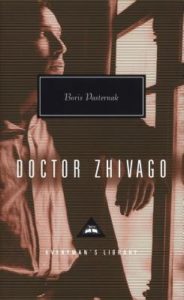
Doctor Zhivago by Boris PasternakTitle: Dr Zhivago (Goodreads)
Author: Boris Pasternak
Translator: Max Hayward, Manya Harari
Published: Everyman's Library, 1957
Pages: 512
Genres: Classic
My Copy: Hardcover

Buy: AmazonBook DepositoryKindle (or visit your local Indie bookstore)

When thinking about staples in Soviet literature, one book immediately comes to mind, and that is Doctor Zhivago by Boris Pasternak. A novel in the vein of the Russian epics like War and Peace, Pasternak’s novel tells of a tragic hero, Yury Zhivago. The novel follows the life of a flawed character as he tries to control his life and his hormones. While trying to live a moral life, he is often a victim of his own desires and misfortune, while Russia changes around him.

I have mixed feelings about this modern classic and this is mainly due to the fact that some people refer to this as an epic romance. Doctor Zhivago is as romantic as Wuthering Heights as it explore romanticism rather than love. Russian Romanticism often has an emphasis on the metaphysical discontent of society and one’s self. In this way, yes, Doctor Zhivago is a wonderfully Romantic novel but if you are looking for love, you’ve come to the wrong book. I know translator Richard Pevear has called this a moving love story (which cements many issues I have with Richard Pevear and Larissa Volokhonsky) however, can you call the struggle with morality a tale of romance?

Let’s talk about the relationships found within Doctor Zhivago. The relationship between Yury and Lana is the main focus of this classic; a woman he has lusted after for his entire life. However he marries Tonya, a woman that Yury shows no real affection towards. This is not to say that Yury does not care for Tonya, just the whole idea of marrying someone while in love with someone else is just stupid. Now I know this is an autobiographical novel and it is a reflection of Boris Pasternak’s own relationship mistakes but the relationship between Yury and Lana was always doomed, especially since she shows no interest in him.

There is something to be said about the marriage of Yury and Tonya. Following the loss of his mother and the abandonment of his father, Yury is consistently seeking out a maternal figure. One may even call it an Oedipus complex and Tonya is more of a mother figure to him. This brings up a major theme in Russian literature not just Doctor Zhivago. In the case of this novel, the human desire for companionship plays out in context of the longing for stability. Russia has suffered a lot of tumultuous times and the desire for stability tends to be reflected in their literature.

What interested me the most about Doctor Zhivago was what it had to say about the political landscape. This is why the novel was refused publication in the Soviet Union and the story behind the book is just as interesting. I picked up The Zhivago Affair: The Kremlin, the CIA, and the Battle over a Forbidden Book by Peter Finn and Petra Couvée as soon as finishing Doctor Zhivago. This book is part biography on Boris Pasternak and part history of the novel.

Boris Pasternak was so passionate about writing Doctor Zhivago, he would continually return to it in-between paid translation work. He knew that it would never be published in the Soviet Union but wanted his story out there. Because the novel covered a time between the first Russian Revolution of 1905 and the Civil War. The reader is able to follow the ideological struggle that Pasternak would have had towards his much loved motherland, from the dreams of a socialist utopia to its grim reality. These themes, its criticism towards Stalin and mentioning the realities of the Gulag (covering this topic before Aleksandr Solzhenitsyn) were some of the main reasons this book was denied publication. It was the CIA who published the book and distributed it in the Soviet Union as propaganda, the story behind this an interesting one, which I learnt from The Zhivago Affair.

Doctor Zhivago was smuggled out of the country by Giangiacomo Feltrinelli with Pasternak asking him to help get his novel out to the world, who first published the book in Italian. Pasternak also gave the manuscript to George Kutkov in the hopes of a decent and faithful English translation. Katkov promised the best translation possible and settled on Max Hayward and Manya Harari for this task. According to The Zhivago Affair, “The pair alternated chapters and then checked each other’s work. Katkov supervised them both, ‘going over everything for accuracy and nuance.’”

Originally Katkov suggested to Pasternak to use Vladimir Nabokov for the translation but this idea was rejected. “This won’t work; he’s too jealous of my position in this country to do it properly.” I am not sure what the relationship between Pasternak and Nabokov is but he has been quoted in 1927 as saying “His verse is convex, goitrous and google eyed, as though his muse suffered from Basebow’s disease. He is crazy about clumsy imagery, sonorous but literal rhymes, and clattering metre.” When Doctor Zhivago was published in America it knocked Lolita off the number one spot on the best seller list. This lead Nabokov to call it “a sorry thing, clumsy, trite and melodramatic, with stock situations, voluptuous lawyers, unbelievable girls, romantic robbers and trite coincidences.”

Despite the criticism and while I do agree it is a little clumsy in its coincidences, I cannot deny Doctor Zhivago as anything but a masterpiece. I know Boris Pasternak wanted the novel to be accessible and simple, and I was surprised how easy it was to read. There is plenty to say about this novel and I would love to talk more about it. I know this will be a novel that will be read over and over again and I encourage others to read it not for the story but for what is says about the Soviet era. Doctor Zhivago is such a cultural phenomenon and at great risk to its author, in fact apparently when Boris Pasternak gave the manuscript to Giangiacomo Feltrinelli he said “you are hereby invited to my execution.”


The Death of Ivan Ilyich by Leo Tolstoy

Posted January 15, 2015 by Michael @ Knowledge Lost in Classic / 0 Comments

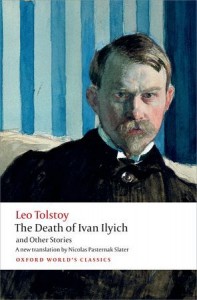
The Death of Ivan Ilyich by Leo TolstoyTitle: The Death of Ivan Ilyich (Goodreads)
Author: Leo Tolstoy
Translator: Nicolas Pasternak Slater
Published: Oxford World's Classics, 1884
Pages: 256
Genres: Classic
My Copy: Paperback

Buy: AmazonBook DepositoryKindle (or visit your local Indie bookstore)

Ivan Ilych’s life revolved around his career; as a high court judge he takes his job very seriously. However after he falls off a ladder, he soon discovers that he is going to die. The Death of Ivan Ilyich is a novella that deals with the meaning of life in the face of death. A masterpiece for Leo Tolstoy written after his religious conversion in the late 1870s.

Something that was fascinating about The Death of Ivan Ilyich is the drastic change in writing style when comparing it to Anna Karenina and War and Peace. I am not just referring to the length, but that does play a big part. I have read somewhere that Tolstoy intentionally made Anna Karenina and War and Peace so long because he wanted to replicate life and the journey the characters face. Allowing the reader to experience every decision and moral dilemma that the character is facing, exploring the growth or evolution of each and every person within the novels.

The Death of Ivan Ilyich takes a more focused approach, dealing with major questions revolving around the meaning of life, death and spirituality. Leo Tolstoy had a major conversion in the late 1870s and the questions in this novel were the questions he was asking himself. Whether or not Ivan Ilyich found the answers he was looking for is up to the reader but it is believed that Leo Tolstoy was still looking for the same answers well after finishing this novella.

There is a lot of pain and torment that appears in this book, which reflects the authors search for answers and that is what really stood out for me. Not only was I reading a spiritual/existential struggle of the protagonist but Tolstoy’s own feeling really came out within the pages. This is what makes this a masterpiece that explores the tortured artist in great detail. I don’t want to say much more, this is the type of book people have to read and make their own mind up about the themes presented, but it is worth reading.


ArmchairBEA 2014: Introduction and Literature

Posted May 26, 2014 by Michael @ Knowledge Lost in ArmchairBEA / 30 Comments

abea

This is my third year participating in the Armchair BEA event. While I am not an American I do like the opportunity to join with book bloggers around the world and talk about our favourite subject, books. I am sure most people know already but just in case; BEA is the Book Expo of America, held in New York, where people in the book industry of America get to be enticed with new books from publishers. There is an event now known as BookCon where book lovers can experience the same enticement, however they won’t get any diversity. Putting aside the problems with BookCon, I’m pleased to join all the fun with Armchair BEA. This is a virtual conference for the book bloggers that can’t make it to BEA. Over the next few days I will be joining in with this event and their daily blog post topic suggestions.

For the past two years I’ve been enjoying this event, it is a great way to meet new bloggers and show off your own book blog. As this is the first day of Armchair BEA I probably should move on to the topics for the day. Today we are introducing ourselves and talking about my favourite topic…literature. As a way of introduction Armchair BEA has provided ten questions and asks everyone to pick their favourite five and answer them.

Please tell us a little bit about yourself: Who are you? How long have you been blogging? Why did you get into blogging? Where in the world are you blogging from?

My name is Michael, I hail from North Queensland in Australia and I only became a reader in 2009. I started blogging not long after that over at Knowledge Lost as a way to sort my thoughts and explain what I had learnt along the way. I know I need to spend more time on that blog and I’m hoping to get back into it now that I’m forcing myself to write every day. I started Literary Exploration as a way to document my book journey and soon discovered I’m very passionate about books and book blogging. There is one thing I hate about book blogging but for the most part I really enjoy the whole experience.

Describe your blog in just one sentence. Then, list your social details — Twitter, Facebook, Instagram, etc. — so we can connect more online.

Literary Exploration is documentation of my bookish journey as I explore literature in all its forms.

You can normally find me on twitter: @knowledgelost or my blog @litexploration as well as Facebook, Instagram, sometimes Tumblr and Pinterest. I’m also very active on Goodreads (also check out the Literary Exploration Book Club), Literally and Booklikes.

What was your favourite book read last year? What’s your favourite book so far this year?

Highlights of 2013 include;

For more books check out my best of 2013 post

Highlights of 2014 (so far) include;

What is your favourite blogging resource?

One of the best investments I’ve made for my blog is the Ultimate Book Blogging Plugin. This one plugin has saved me a lot of time and makes my life so much easier. I can collect a lot of relevant information thanks to this plugin and it automatically updates my review index. It has a lot of cool features and I highly recommend it to all book bloggers. Of course you’ll all have to move to a self-hosted WordPress platform but that is a good idea anyway.

Spread the love by naming your favourite book blogs:

I’m always happy to recommend some great book blogs; here are some that I’m always happy to see updates from;

Time now to look at that all important topic of Literature: I’m a bit of a pretentious reader, so I’m always interested in reading books that are considered high literature. I’ve even set myself a life goal of reading the entire 1001 Books You Must Read Before You Die List, I might even try to review them all too. I find myself drawn to literary more as I become a better reader; there is something about the prose and structure that stands out. As a literary explorer I try not to entrench myself in just one genre, but luckily there is plenty of great literary genre novels out there. I don’t have to sacrifice quality in order to read genre fiction.

However there are so many classics out there that I still have to read and I feel bad for not having read books like Middlemarch, The Brothers Karamazov, The Woman in White, The House of Mirth and so on. I want to catch up on all these great novels and I think classics are an essential part of the reading journey. I recommend every reader try to read more classics and to help you along, I suggest joining something like The Classics Club is a great way to challenge yourself to more classics. I want to take to the conversation to the comments but I’d like to ask some questions of the readers to help the conversation along;

  • What is your favourite literary novel (in any genre)?
  • Which classic would you like to read but are dreading?
  • What genre do you spend most of you time reading?
  • What genres tend to scare you?
  • Finally, are there classics that just seem too hard and why?

ArmchairBEA is a virtual convention for book blogger who can’t attend Book Expo America and the Book Blogger Convention. Button by Sarah of Puss Reboots


My Next Reading Project – Middlemarch

Posted May 25, 2014 by Michael @ Knowledge Lost in Literature / 8 Comments

I’ve often said that big books scare me and I still think that is true but there are exceptions. I’ve found that if I have a reading project and slowly work through a big novel, I not only finish the novel but also tend to enjoy the experience. I’ve done a few reading projects in the past, including making my way through Infinite Jest, which took a few months and increased my pretentious level. More recently I completed War and Peace; I think that took about five months to complete but well worth it.

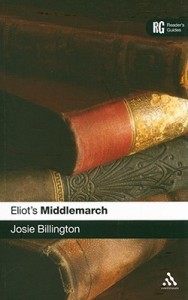
When I finish university for the semester I’m planning another reading project, this time for novel that isn’t as big as Infinite Jest and War and Peace. This time I’m going to tackle Middlemarch by George Eliot beginning in June. Middlemarch is a social critique so I’m going to have to get understand the historical and cultural context. To do this I’m going to try using a reading guide; I’ve never used one before but I think it is time I put them to the test. After asking around, I’ve settled on the reading guide Eliot’s Middlemarch by Josie Billington, which is part of the Continuum Reader’s Guides series.

I’m not sure what to expect but I’m looking forward to reading Middlemarch; I’ve heard some great things about this novel and I’m sure I’ll be a very proud man when I complete it. I am not entirely sure what to expect but I’m excited for the ride. Have people had as much success with reading projects as I have? I think they can be very useful for those big bricks. I like to slowly take my time and spend months chipping away at a novel like this; it allows me time to process in between. Like War and Peace, Middlemarch was originally published as a serial, so I suspect that I’ll get some repeated information, which is useful when reading a novel so slowly. I’m looking forward to this project and I hope the reading guide helps.


How do you pick an imprint for classics?

Posted May 3, 2014 by Michael @ Knowledge Lost in Literature / 8 Comments

Every publisher seems to have their own classics section. Penguin Random House now control most of the market (Penguin Classics, Modern Classics, Signet Classics, Vintage Classics, etc). So how do you choose which collection to buy from? Do you even pay attention to the publisher? When I first started hording collecting books, I didn’t pay too much attention and went for the prettier cover but I’m beginning to wonder if this is a decent solution.

1-05-2014 11-38-14 AM

Sure, I would love to own every book released in the Pulp! the Classics; they are fun and I do own a few of them already but buying a classic because of their covers isn’t really effective. Not all editions are the same, in particular translated classics. When picking up a Russian classic do you know which translator to pick? Do you spend time researching the best translator or do you have a publisher you can trust?

I’ve often contemplated this question and since studying at university I’ve noticed that they often recommend two publishers more than any other; Norton Classics and Oxford World Classics. While they don’t have the best covers, I’ve had the greatest success with Oxford World Classics, to the point that I don’t want to buy any other editions. If asking the internet which translation of a novel I should read, for War and Peace it is Louise and Aylmer Maude and for Crime and Punishment, Jessie Coulson is often the answer. They are the translators used in the Oxford World Classics.

I’m not sure what it is, I just trust Oxford World Classics more than any other and they often offer some great questions to ask yourself in the back of the novel. My new found love for Oxford World Classics and the reason for this post is not to give a sales pitch or anything like that; I’m just curious if others think about this topic in as much detail as I do. If so, which publisher do you trust over all others?


War and Peace by Leo Tolstoy

Posted March 20, 2014 by Michael @ Knowledge Lost in Classic / 2 Comments

War and Peace by Leo TolstoyTitle: War and Peace (Goodreads)
Author: Leo Tolstoy
Translator: Aylmer Maude, Louise Maude
Published: Oxford World's Classics, 1869
Pages: 1392
Genres: Classic
My Copy: Personal Copy

Buy: AmazonBook DepositoryKindle (or visit your local Indie bookstore)

When people thing of big books often War and Peace by Leo Tolstoy is mentioned. This Russian classic depicts the French invasion of Russia in 1812. True to Tolstoy form, War and Peace also looks at classes and the impact of the Napoleonic invasion on the Tsarist society. While this book can be considered an epic historical war novel, for me this was a work of philosophical ideas. This is one of the hardest books to review, not because I have nothing to say but rather there is so much to cover and I have no idea where to start.

Just to put things into perspective, I started this book in October and have been slowly chipping away at it for four months. It is a hard battle and you really need to take your time with a book like this because Tolstoy has a lot to say. This is the kind of book that feels like you‘ve climbed a mountain when you finally finish and you can just feel your pretentious levels rising. For those interested, I read the Oxford World’s Classics edition which has the translations by Aylmer and Louise Maude. Many people debate on which translation is the best but I thought going with an Oxford World’s Classics would be a safe bet; I love this publisher and know I’m always getting a decent copy of the book.

Right off the bat you are flung into this world and you meet so many people. Tolstoy has an amazing ability to give the reader a sense of a person with a few lines, so even the minor characters in this book get some sort of personality. There are hundreds (over 500) characters within War and Peace and I often found it difficult to keep up with them all but thanks to Leo Tolstoy’s writing ability I could relax a little because even if I forgot about a character, when they reappear further in the book I still had a sense of who they are. This is possible due to the way this book was originally written and I will talk more on that later.

Most of the major characters within War and Peace are members of the aristocracy and it is interesting to see them all fighting for a higher position in society, government or the military. People like Boris rise in society while others like the Rostov fall, Dolokhov gets demoted while Pierre plots an assassination. Not only do we have the Napoleonic war happening within these pages, a battle for social standing rages through this novel. It is all about power but paradoxically the people with the most power within this book are the ones that seem to give up control.

If you don’t have the knowledge of Russian or Napoleonic history, this novel accommodates the reader. I found myself at times looking up information about the history just to satisfy my curiosity but as the book progressed, my research subsided. It is in Leo Tolstoy’s style to give you as much information as possible, this does make the book longer but for me I think it was a huge bonus. But you must realise this is a work of fiction and most of the people are fictional. Tolstoy was telling a story of the invasion and the harsh nature of war. You can even look at the second epilogue and read more of the authors thoughts on the subject and the philosophical ideas held within this book.

War and Peace was originally serialised in the literary magazine The Russian Messenger between 1865 and 1867. This magazine plays host to many of Leo Tolstoy and Fyodor Dostoyevsky’s novels. This means that originally people read War and Peace over the course of three years. This means at times the novel may feel repetitive and covering plot points done before but this is just a result of the original format. It comes in handy with characters as they are reintroduced and because I took my time reading this classic, it became a vital part.

There is so much going on within War and Peace and it took me a long time trying to work out what I wanted to say and what to leave out. This is the kind of book that needs to be revisited in the future, Tolstoy has a lot to say and I’m interested in exploring the themes. I loved this book; it is a roller-coaster of emotions and philosophical ideas. I’ve only scratched the surface of what is happening in this novel and then wrote a small amount of what I discovered. I can’t imagine ever being able to fully understand the brilliance of Tolstoy and War and Peace. For me, Fyodor Dostoevsky is a better writer but Leo Tolstoy has a unique ability to capture the lives of everyone involved in one war.


Time to Murder and Create by Lawrence Block

Posted March 8, 2014 by Michael @ Knowledge Lost in Pulp / 0 Comments

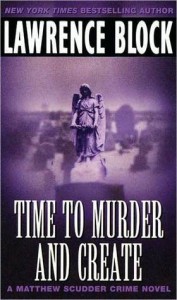
Time to Murder and Create by Lawrence BlockTitle: Time to Murder and Create (Goodreads)
Author: Lawrence Block
Series: Matt Scudder #2
Published: Orion, 1976
Pages: 170
Genres: Pulp
My Copy: Audiobook

Buy: AmazonBook Depository (or visit your local Indie bookstore)

Matthew Scudder is back and this time a small-time stoolie named Jake “The Spinner” Jablon has come to him for help. This informer has found a new line of business in blackmail but now one of his clients has figured it was better to kill than keep paying for his silence. After an attempt on his life goes wrong, The Spinner turns to Scudder to be his avenging angel if he ever does wind up dead. Only problem is when he eventually was found floating in the river, Scudder had to work out just who finally caught up to The Spinner and killed him.

Having just finished War and Peace (a review that is quite difficult to write) I felt the need to read something quick and easy. The Matthew Scudder series is just that, 1970’s hard-boiled with a gritty and fast paced style to it. Scudder is a former New York Police officer who now does ‘favours’ for people as he isn’t a licenced Private Investigator. One of the things I really like about Lawrence Block’s hard-boiled detective is the fact that there are signs that he isn’t what he claims to be. It’s revealed that Scudder was a corrupt cop and you can see the corruption start to seep into his PI work. Hard-Boiled characters normally walk that fine line between good and evil but with Matthew Scudder I get the sense that he can’t walk a straight line.

You might have noticed that I’ve been trying to write critical reviews lately but when it comes to a book like Time to Murder and Create it is hard to have in-depth criticism. This is pure escapism, a quick and entertaining read full of dark gritty characters that all have a secret to keep.  Like In the Midst of Death, Time to Murder and Create wasn’t as good as The Sins of the Fathers, the series started off strong but now it feels like those crime shows on TV where there is just a new case every time and nothing new or exciting.

If I ever need a quick easy palate cleaner, then I might return to the Matthew Scudder because sometimes you need mindless entertainment. I have an idea of what I would like to see with this character but I don’t think they will go in that direction. Sometimes I wish I had the skills to write a hard-boiled crime series, just because they are fun to read and I have never found a series that lived up to the excitement of Raymond Chandler’s Philip Marlowe series and I’m frustrated enough to want to create my own. If anyone has a recommendation for a great hard-boiled crime series, please let me know.


Monthly Review – February 2014

Posted February 28, 2014 by Michael @ Knowledge Lost in Monthly Reading / 0 Comments

And the mountains echoedThe Literary Exploration reading challenge is going so well; almost 2000 books have been read from the group so far. I’m so happy with the response and pleased to see people still had time to read And The Mountains Echoed. Some interesting thoughts have come out of this book from the group and while there were people that didn’t like the book (me included), I’m so glad to see so much great constructive criticism in the threads; this is what we live for. For those who don’t know about the reading challenge, there is still time to join in the fun, so check out my post here.

I’m so happy to see that the book club continues to be entertaining and as we move into March, I’m looking forward to seeing what people will say about Middlesex for our literary fiction theme. I’ve not read this book yet but I’m a fan of Jeffery Eugenides’ other book, so I’m excited to try this one. Currently I’ve read eleven books towards the Literary Exploration Reading Challenge and you can find my own record of the challenge here.

I thought I had a quiet month reading but I’m still happy with my effort of seven books (plus a few comics). Highlights this month include My Life as a Fake by Peter Carey, a post-modern take on one of the biggest literary hoaxes in Australia and War and Peace by Leo Tolstoy which I’ve been reading since October. One book I will most likely be talking about continuously for the rest of the year is The Dark Path by David Schlicker, a memoir about the battle between his desire to become a priest and his attraction to women. How was February for you and your reading life? Let me know in the comments below.

Read More


Why do I Avoid Big Books?

Posted October 5, 2013 by Michael @ Knowledge Lost in Literature / 0 Comments

I’ve talked a little about my fear of large novels previously but I think this time to revisit this topic once again. More and more large books are turning up in my to-read lists and while I’m excited to read them, a book so large often puts me off. I do read large books but it seems to be on a rare occasions. Yet there seems to be more large novels still waiting that haven’t been read. Is there any way to motivate myself or force myself to spend the time reading a book over 800 pages?

It is not the classics that have calling my name; sure I want to get to War and Peace, The Brothers Karamazov and even In Search of Lost Time but there are some very recent releases that look interesting too. Including A Naked Singularity by Sergio De La Pava, The Kills by Richard House, The Luminaries by Eleanor Catton and The Goldfinch by Donna Tartt. I’m sure there are books that aren’t classics or recent releases that are deserve to be read as well that are over 800 pages, they just feel like a huge investment.

This month I’m reading The Pillars of the Earth by Ken Follett which sits at 973 pages and while I’m enjoying it so far, that is a big investment of time. I have read some great big books, including Anna Karenina, Les Misérables and Infinite Jest but if I want to compare the time investment of those books compared to reading two books, it seems to take so much more time. Now it is your turn, let me know what your thoughts are about big books; have you read some good ones? Are there any on your shelves that are scaring you? And do you have any tips to motivate yourself.