Tag: William Shakespeare

Violent Delights: My Thoughts on Westworld

Posted December 12, 2016 by Michael @ Knowledge Lost in Film & Television / 2 Comments

One of the age-old questions that gets asked in science fiction revolves around artificial intelligence (AI). In particular, the existential risk from artificial intelligence that might result in human extinction or some global catastrophe. One of the most noticeable examples of an AI rebellion in pop-culture can be found in The Terminator series with Skynet, when it becomes self-aware and ultimately decides that humans are irrelevant. A more recent example is the HBO show Westworld created by husband and wife combo Jonathan Nolan (Person of Interest) and Lisa Joy (Pushing Daisies). The show is based on a 1973 film of the same name (written and directed by Michael Crichton) set in the future where people can visit this western themed amusement park populated by synthetic android, referred to as hosts.

Westworld is one of the most exciting TV shows I have seen in a very long time, and while at its core it explores the idea of artificial intelligence becoming self-aware, I feel like there is something much more interesting going on. To understand this, you need to be aware of the criticism towards HBO shows (in particular Game of Thrones) which often revolve around the over exposure of nudity and violence, claiming that it is just low-brow entertainment. However, I am of the opinion that this show, Westworld can be seen more as a social criticism.

“These violent delights have violent ends.” Romeo and Juliet, Act II, Scene VI by William Shakespeare

The patrons come to this amusement park to fully immerse themselves into an adventure without fear of consequences. Whether they are seeking their thrills with sex or violence, the show is questioning if this is healthy behaviour. While there are no physical consequences, what are the moral implications of these violent delights? The hosts in Westworld are so realistic, they have memories, thoughts and feel pain – this brings so many questions to mind. For example; where is the line between harmless fun and dangerous behaviour?

At the beginning of season one, I found myself wondering if it takes a certain type of person to visit Westworld. Are the patrons visiting to act out their more depraved fantasies? However, I slowly began to view Westworld as a highly advanced video game (similar to virtual reality). If you compare this amusement park with popular games like Grand Theft Auto, it opens up a whole different thought process, one of game theory. A player of Grand Theft Auto might shoot up the street, visit a prostitute or something similar to test out the boundaries of the game. Not out of morbid curiosity but rather to see if the game is a really an open world. While some players may take delight in these actions rather than following the narrative, there is no real evidence that these actions have any links to criminal behaviour (although there is evidence of an increase of aggressive behaviour).
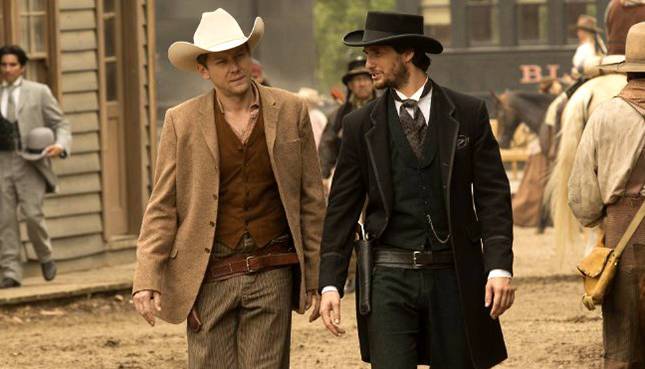
White Hats vs. Black Hats

Although when the ‘game’ is so realistic that you cannot tell the difference between host and human, the experience becomes more complicated. This show explores the idea of what happens when realism becomes too real, and while some patrons may test out the boundaries of this world, ultimately they get sucked into a narrative, what about the others? One of the taglines for Westworld is, “the dawn of artificial consciousness and the future of sin”. With this tagline in mind, we know the show wants to pay particular attention to what they call ‘the future of sin’, so it is asking the audience to think about the moral implications of these violent delights.

As you watch through season one of Westworld, you will discover that actions without consequences are just a myth. Starting with the discovery of lasting memories of the hosts and also the wounds. While these hosts are not humans, they show signs of emotions and pain. If they feel pain, do we not have a moral obligation to help them?

There are multiple scenes in the show depicting some close ups of a host’s eye, and if the eyes are the windows to the soul, what are they trying to say? I am inclined to think that this might actually be an exploration into how people treat each other. If you look at the history of the world, in particular colonialism, you will see that the first people are often treated as if they were different. Since this amusement park has a western theme, I would suspect we could make parallels between the treatment of hosts and the treatment of Native Americans.

The use of nudity in Westworld is very different to most TV shows. While nudity on television and movies is often used to sexualise a character, this show takes a very different approach. Often when you see nudity in this show, it is a host sitting in front of a scientist getting reprogrammed. The nudity has the effect of dehumanising the hosts – yet another example of the show trying to show you the difference between artificial intelligence and humans. Yet time and time again in the show it demonstrates that they these host are self-aware and conscious.

I have to say, I was completely immersed in the story being told in season one of Westworld and I really cannot wait for a new season. However, it was the philosophical questions that the show presented that really thrilled me. It was because I spent so much time thinking about what makes us human, the existential risk of artificial intelligence and game theory that I would consider Westworld one of the best TV shows of recent time. I feel like there is so much to say about this series, but I do not think I have the skill set to dive deeper. I wanted to get as many of my thoughts on Westworld down, and who knows I may even do more posts like this in the future.


The Gap of Time by Jeanette Winterson

Posted June 2, 2016 by Michael @ Knowledge Lost in Contemporary / 0 Comments

The Gap of Time by Jeanette WintersonTitle: The Gap of Time (Goodreads)
Author: Jeanette Winterson
Series: Hogarth Shakespeare
Published: Hogarth, 2015
Pages: 320
Genres: Contemporary
My Copy: Library Book

Buy: AmazonBook DepositoryKindle (or visit your local Indie bookstore)

I have not read many of Shakespeare’s plays. I remember in high school I did do Romeo and Juliet and all I remember is watching the movie. Since starting my reading journey, I have now read Macbeth and Antony and Cleopatra. Hogarth have announced that they will be releasing modern retellings (they are calling them cover versions) of Shakespeare plays in celebration of the 400th anniversary of his passing. This will be including books by Howard Jacobson, Anne Tyler, Margaret Atwood and Jeanette Winterson. The first novel in this series is Jeanette Winterson’s interpretation of The Winter’s Tale called The Gap of Time.

I had to read The Gap of Time for book club and I will admit I was nervous, having never read the original play, but was happy to finally check out something by Jeanette Winterson. I am not sure if not reading The Winter’s Tale, put me at a disadvantage but I approached this book as a new story, not knowing what parts are influenced directly from the original text. I noticed many themes of identity, jealousy, forgiveness, parenting, power, race and sexuality but unsure if this was the work of Winterson. I know Jeanette Winterson often explores sexual identity in her novels but that does not mean William Shakespeare did not have an interest in the topic.

I read this book more like a coming of age story, exploring the idea of family in a modern day setting. There are elements of romance but for the most part it was a story of discovery and identity. It was playful (with quotes from Shakespeare in the text) and at times tragic. I think this is a balance that Shakespeare does really well in the plays I have read and Jeanette Winterson seemed to capture this really well in The Gap of Time.

I found this to be an enjoyable novel even if I could not compare it to the original text. I am impressed with Jeanette Winterson but I would be more interested in checking out what she can do without being constrained to a pre-set plot. Oranges Are Not the Only Fruit and Sexing the Cherry are both books I would love to read in the near future. As for the Hogarth cover versions, I am not sure how many I will read. There are some great authors being selected but I think reading the original text beforehand would be a huge advantage. Only problem is, I have a huge reading list already and not sure when I will get a chance to read more Shakespeare.


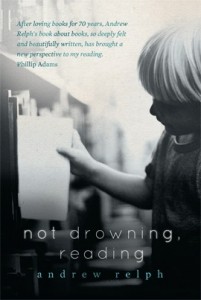
Not Drowning, Reading by Andrew Relph

Posted December 7, 2014 by Michael @ Knowledge Lost in Non-Fiction / 4 Comments

Not Drowning, Reading by Andrew RelphTitle: Not Drowning, Reading (Goodreads)
Author: Andrew Relph
Published: Fremantle Press, 2012
Pages: 184
Genres: Non-Fiction
My Copy: Library Book

Buy: AmazonBook DepositoryKindle (or visit your local Indie bookstore)

As a child Andrew Relph had a reading disability, but he never let that stop him. He realised the value and importance of reading and writing and worked harder to learn these skills. Now a psychoanalyst and professional conversationalist, Relph’s book Not Drowning, Reading explores his relationship with books and how they fit into his life experiences.

The title Not Drowning, Reading is a fascinating one and also comes with an interesting backstory. It references a time the author almost drowned but also is a perfect metaphor for how Relph felt during his school years struggling with a reading disability. A feeling of struggling to keep his head above water and not get lost in the depths of the educational waters seems to give me an idea of the battle he was having internally. It is interesting to think that he went from an internal battle into a career helping others with psychological struggles.

Divided into essays on his life, Andrew Relph explores the impact literature has had on his life with continual references to his career as a psychoanalyst. Considering I have an interest in psychoanalysing literature, this was a fascinating read for me and gave me plenty to think about. Relph shares his love for authors like Martin Amis, Saul Bellow, William Shakespeare, Virginia Woolf and to my disappointment D.H. Lawrence. In fact his thesis was centred on Lawrence and the psychoanalysis.

For those people who don’t know, I consider Lady Chatterley’s Lover by D.H. Lawrence as one of the worst books I have ever read. I will admit that I just didn’t get the appeal and have never returned to Lawrence again. There are plenty of reviewers I respect and trust that love the works of D. H. Lawrence and while I hate to admit this, I feel like I need help in understanding the appeal. Lady Chatterley’s Lover was read when I first started out as a reader and there would be a lot I missed but I also suspect that it wasn’t the best starting point for me as a reader.

Now I have had a rant about D.H. Lawrence, I should return to Not Drowning, Reading by Andrew Relph. This memoir is a very deep look at his life and literature through the lens of psychoanalysis;  this reminds me I need to learn about these literary theories but for others it might come across as a little dense. I was completely immersed and fascinated by what Andrew Relph had to say but I am well aware that compared to other memoirs about literature this might be too heavy on theory for some readers.


Tragedy of Macbeth by William Shakespeare

Posted December 4, 2014 by Michael @ Knowledge Lost in Classic / 2 Comments

Tragedy of Macbeth by William ShakespeareTitle: Tragedy of Macbeth (Goodreads)
, 1606
Pages: 249
Buy: AmazonBook DepositoryKindle (or visit your local Indie bookstore)

I probably don’t need to go into too much detail about the plot of Macbeth as most people are aware of what it is about. The Tragedy of Macbeth is obviously a tragedy the legendary playwright William Shakespeare, and is often considered his darkest play. Set in Scotland, the play explores the destructive psychological and political effects that form when evil is used as a method of gaining power. It is generally believed that this was written between the Elizabethan Era and the Jacobean Era, around about 1599 to 1606.

The Elizabethan Era was generally regarded as a ‘golden age’ for England. Colonialism was strong, England has dominating the seas (defeating the Spanish Armada) and there was great commercial wealth to be found in the ‘New World’. However the Jacobean Era was different; James VI of Scotland inherited the throne in 1603 and things seemed to change drastically. The ‘Gunpowder Plot’ of 1605 failed to assassinate the king and the plotters were executed. This possibly led to the King commissioning a new translation of the bible; the ‘King James Version’ was first published in 1611.

The reason I talk about these two eras is that there seems to be a connection to Macbeth. Set in Scotland, Macbeth seems to reflect the atmosphere of the Jacobean Era and there has been speculation to the play alluding to the Gunpowder Plot. However to try to draw direct correlations between Macbeth and the political situations of the time would require a lot of speculation. I just added this information into this review because there are connections that I feel would be relevant or interesting to readers of this play.

I was lucky enough to have experienced Macbeth as a play being performed before ever reading it for my university course. There is something about the performance that was essential to critically reading the text; I already understood the plot, the tone and the overall emotions behind the words and this allowed me to grasp a lot more out of the play. One thing that I picked up in reading Macbeth that I seemed to have missed was the importance of gender roles within the play.

Let’s look at one example which appears in Act 1 scene 7. Within the scene Macbeth is having second thoughts about killing the king and taking the crown. Lady Macbeth scolds Macbeth and manipulates him to go through with his original plan. How does she do this? Simply by calling him a coward and telling him he is not a man. She even suggested that she is more of a man and stated  she would kill her own child; taking that child from her breast and smash its head against a wall.

There are other themes that are prominent within Macbeth, but the idea of masculinity verses femininity seems to stick with me the most. This idea that claiming you are more of a man than someone else is a common occurrence but the way Shakespeare presented this graphic manipulation really stuck with me. Obviously feminist literary studies would have a field day with this play. I have been picking more and more issues to do with feminism within literature, but I would rather be looking at Marxism or psychoanalyst; why does this keep happening?

Macbeth is this wonderfully dark play that has a lot to offer; I can see why Shakespeare remains a legend. I am not really sure how to review a play like this; there is so much to talk about with plot and theme, however I would rather people discover that for themselves. I do feel like this review turned into something that would resemble a Jackson Pollock with random thoughts flicked onto a page but I wanted to get some of my thoughts down.


My Spring Reading List (for University)

Posted September 6, 2014 by Michael @ Knowledge Lost in What are you Reading / 0 Comments

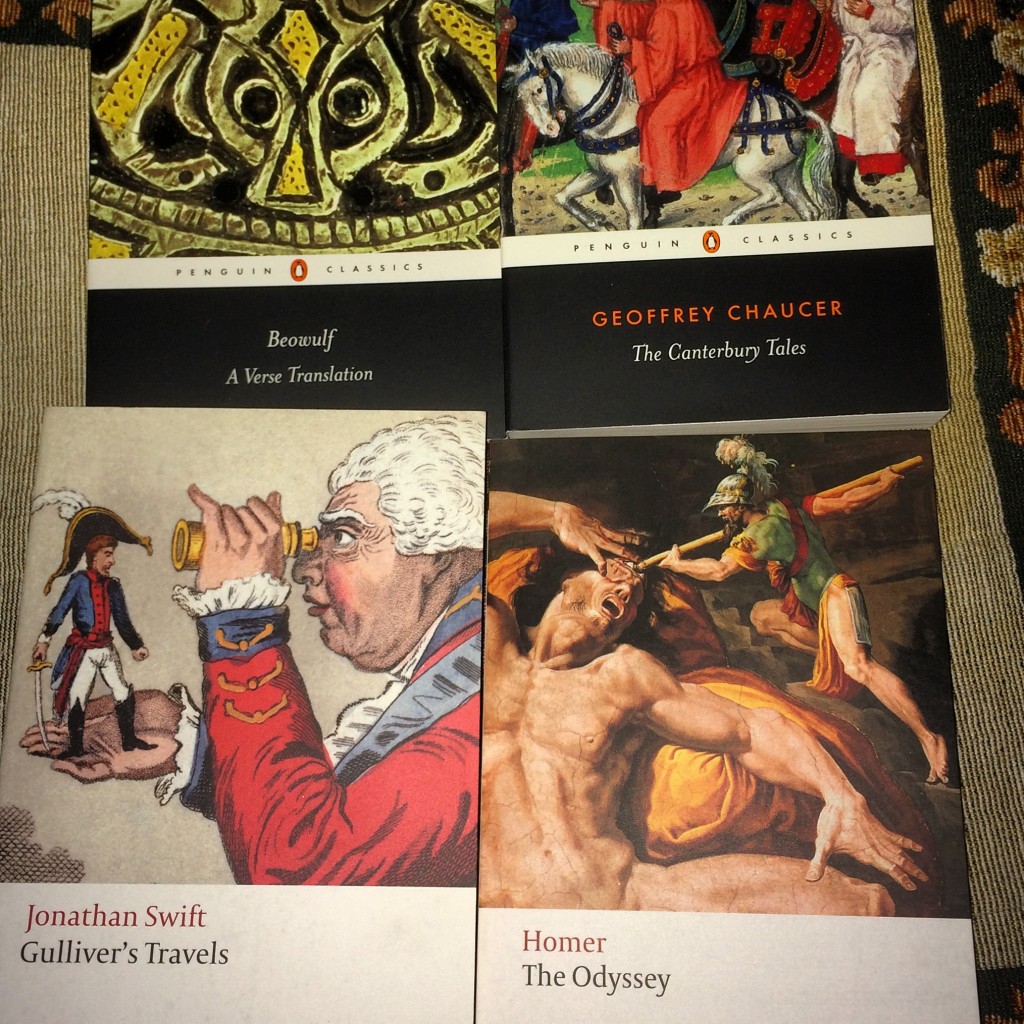
2014-09-04 17.00.12-2I’m back at university for another semester. This time I’m doing a course called Great Books part 1 (whatever that means). I’m actually very nervous and excited about this as I will be reading some very scary books. I’ve been doing an English Literature course part time and I feel like it will take me a very long time to finish this course. Studying online means I have a lot more flexible and that is hopeful for balancing my time between both work and study, however it also means it will take awhile. I thought I would share this list with you, not for sympathy but I’m hoping people might offer some advice (or encouragement) about getting through these books.

  • The Odyssey by Homer (translated by Walter Shewring)
  • Beowulf (translated by Michael Alexander)
  • Canterbury Tales by Geoffrey Chaucer (translated by Nevill Coghill)
  • Macbeth by William Shakespeare
  • Gulliver’s Travels by Jonathan Swift

I think this is going to be hard, I don’t often read anything that was released before the 1800’s.


The Portrait of Mr. W.H. by Oscar Wilde

Posted February 27, 2014 by Michael @ Knowledge Lost in Short Stories / 0 Comments

The Portrait of Mr. W.H. by Oscar WildeTitle: The Portrait of Mr. W.H. (Goodreads)
Author: Oscar Wilde
Published: Hesperus Press, 1889
Genres: Short Stories
My Copy: Personal Copy

Buy: AmazonBook DepositoryKindle (or visit your local Indie bookstore)

The fact that William Shakespeare’s Sonnets are dedicated to one Mr W.H. has been the source of much speculation. Eighteenth century critic Thomas Tyrwhitt suggests that the sonnets are written for a person known as William Hughes. He bases this theory on his interpretation of the Sonnets, lines like “A man in hue, all Hues in his controlling” (the 20th sonnet) where the word ‘Hue’ is capitalised and italicised and the multiple puns on the name ‘Will’ found in the sonnets.

The Portrait of Mr. W.H. is a short story by Oscar Wilde; it only took me about twenty minutes so I don’t think I’ll say much about it but it was a story I wanted to review. Yes, it was required reading for university but it was an interesting enough piece that getting my thoughts down seemed like a good idea. I remember reading The Picture of Dorian Gray a long time ago and not getting on with it; maybe I wasn’t for me or maybe I just hadn’t had the literary knowledge to get something out of it. In any case, I’m curious enough that maybe Dorian Gray will be a reread in the future.

I want to compare The Portrait of Mr. W.H. with My Life as a Fake because they both seem to talk about a similar topic. While My Life as a Fake covered a literary hoax, The Portrait of Mr. W.H. looks at a piece of literary criticism that has been around for a long time and is often talked about. I don’t agree with this theory and it is important to know that Oscar Wilde didn’t either, although by the end he almost did. What I really liked about this story is the fact that Wilde took a differing view of the Sonnets and tried to explore it. This is an excellent example of literary criticism because it got me looking at the Sonnets in another way, even if I didn’t agree with it.

The fact that Oscar Wilde managed to write this literary criticism in a form of a story was equally impressive. The whole story has this real gothic feel about it and the character of Willie Hughes showed vampiric characteristics in the way he destroyed lives, in particular Cyril’s. Yet another similarity to My Life as a Fake is the whole idea that literature or the author can be portrayed as a monster.

I read this story as social criticism, looking at the homo-eroticism of Shakespeare’s Sonnets and question if a particular piece of text has any effect on the value of the art form. I don’t know many people complaining about the homoerotic nature of Shakespeare but I’ve heard complaints about it when referring to Oscar Wilde. Wilde was a big believer in celebrating art as being art and not letting the opinion of the artist affect it. This means The Portrait of Mr. W.H. is a satirical look at the art, where you have to take a more literal approach and explore the life of William Shakespeare as an artist and its connection to the Sonnets.

Oscar Wilde tantalises the reader with his literary and social criticism, mix in the satirical nature of this story and the wit of the author and you have a compelling read. One thing I’ve been thinking about is the connection between this story and The Picture of Dorian Gray which I would like to leave you with. They both share very similar titles but in Dorian Gray you have a portrait that ages and the reader see the truth, of Gray and all his sins. While in The Portrait of Mr. W.H. the picture of Willie Hughes is a lie and I have to wonder the meaning behind this imagery when comparing the two.


My Upcoming Reading List

Posted November 22, 2013 by Michael @ Knowledge Lost in What are you Reading / 12 Comments

the sign of fourNext week I start a university course called Literature and Politics. I’m actually nervous and excited about starting this. I’ve been doing an English Literature course part time but work has been pretty full on so I’ve moved to online university. This will mean things will be a lot more flexible and should hopefully give me the time to manage both work and study without them interfering. What I wanted to share with you; the entire point of this post was my awesome reading list for the summer thanks to this course.

  • Antony and Cleopatra by William Shakespeare
  • Frankenstein by Mary Shelley
  • Heart of Darkness by Joseph Conrad
  • Loaded by Christos Tsiolkas
  • Robinson Crusoe by Daniel Defoe
  • The Sign of Four by Sir Arthur Conan Doyle

How awesome it this list? So many great books that I’ve read or excited to read. A reading list like this really does wonders to your nerves.