Tag: Yōko Ogawa

Distracted by Other Books

Posted May 1, 2018 by Michael @ Knowledge Lost in Monthly Reading / 2 Comments

My Thoughts and Reading in April 2018
Earlier in the month my wife was suffering from a major headache, so lying in the dark I decided to pick up my kindle to avoid disturbing her. I had The White Book on my Paperwhite and I knew it would not take me that long to read. Reading in the dark I was transfixed by the light of my Kindle. There is a line in the book that really stayed with me, “Certain objects appear white in the darkness. When darkness is imbued with even the faintest light…” There is something to be said about reading a book at the right time, because the experience alone made this book enjoyable. I love sitting in the dark but normally hate reading on my Kindle, the combination of darkness and talking about white just meshed well.

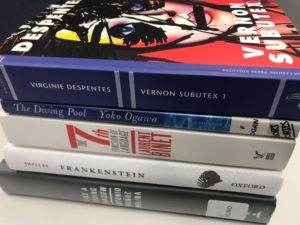
However that experience pales in comparison to reading The 7th Function of Language. Have you ever read a novel that you think has been tailor made for you? This was my experience with The 7th Function of Language. Everything about this book ticked my boxes, from the mystery element, to the literary criticism. I loved every minute reading this one and I cannot wait to re-reading it in the future. This reminds me of my favourite Umberto Eco book, Foucault’s Pendulum. I had to laugh at the fact so many people were calling this novel ‘too pretentious’ but others were comparing it to Dan Brown.

I often wonder if my literary tastes are the direct opposite to the norm, because I tend to love so many books others are regularly dismissed. Not that I mind at all. It helps with my pretentious literary credibility. Although I think The 7th Function of Language is not pretentious and would make for an exciting audiobook. I have not read hhHh but after reading this one, I am keen to find a copy. Although that novel is more war based, I am still very curious. It did get a lot of hype and attention, which might mean I will be disappointed by the novel.

This month marked the start of my very own podcast, Lost in Translations. My wife and I have been planning this for a very long time and by planning I mean procrastinating. But this we finally released the first episode which is an introduction episode. I was very nervous but beyond thrilled with just how well it turned out. I am surprised how much support I got on a project that has just launched. I am looking forward to releasing the first official episode where we discuss a book I loved last year (no spoilers into what it will be). My wife will be my first guest and while we have not recorded the episode yet, I hope to have it release in the middle of May.

I have loved reading the Man Booker International prize longlist and I am starting to see the light at the end of the tunnel, especially after finishing Like a Fading Shadow and Vernon Subutex 1. It has been a bit of a letdown for me. There are so many books on the list that I thought were so-so but not much I loved, besides The 7th Function of Language, Frankenstein in Baghdad and Die, My Love. I will read the next Vernon Subutex book, and I did have a lot of fun reading it but it was not a standout. I am starting to be distracted by other books and itching to read other things. I am not married to the idea of completing the entire longlist but I thought it was a great opportunity to be part of the community. I am yet to read Go, Went, Gone and Flights, which are on my TBR, so they will get read. I am in the middle of The Imposters and have not brought a copy of The Flying Mountain. So that is four books from the longlist that I would love to complete but the only one I am positive I will read soon is Flights.

The BTBA longlist is looking very tempting.

I re-read Frankenstein again, I received a beautiful edition of the 1818 text and thought it was time to read again. I did use this as an excuse to write a piece on how Frankenstein has impacted my life. Surprisingly I think I learnt a little about myself writing that piece and I am always astounded by what I discover about myself while writing. I think there is something therapeutic about writing and it often unlocks connections I have not thought were there. Writing about Frankenstein helped me understand a little more about my past. That piece will be in the next issue of The Literati which is released very soon.

Finally I picked up The Diving Pool to read, which is the pick for a bookclub I am apart of on Goodreads. I love being a part of a Goodreads group reading books in translation, but not many people are interested in communicating. I love a good forum but I think maybe they have run their course. People join but quickly lose interest. I love the idea of talking about books, especially translations but maybe Goodreads groups are not the right spot. What is the future for the forum format? Is it Discord? Or maybe it is a Facebook group.

I feel like this month has been less productive than other months. Only six books read and hardly any writing getting done. I am happy to see my podcast become a reality so I should not complain. I have The Lost Flowers of Alice Hart on the go, which I need to read for my IRL bookclub but I have not planned what else I will be reading. I like to read on a whim and maybe the Man Booker International prize longlist messed with that and has put me into a little of a slump. Although I hope to break out in May and get back to all the books that keep distracting me throughout the month. We are housesitting so I do not have access to all my books, which might mean a little control but I hope it does not keep my slump going any further.

Read More


Lincoln in the Bardo by George Saunders

Posted February 12, 2018 by Michael @ Knowledge Lost in Contemporary / 0 Comments

Lincoln in the Bardo by George SaundersTitle: Lincoln in the Bardo (Goodreads)
Author: George Saunders
Published: Bloomsbury, 2017
Pages: 343
Genres: Historical Fiction
My Copy: Audiobook

Buy: AmazonBook DepositoryKindleWordery (or visit your local Indie bookstore)

George Saunders’ long awaited debut novel has been surrounded by hype, and winning the Man Booker prize only helped to launch this book. Saunders is probably best known for his short stories that often share a vibe similar to the television show Black Mirror. I even called his last collection Tenth of December “contemporary witty, with an element of darkness”. Even comparing it to two other great collections that were released about the same time, Black Vodka by Deborah Levy and Revenge by Yōko Ogawa. Lincoln in the Bardo tells the story of Abraham Lincoln in 1862. The Civil War has been raging for almost a year while the President’s eleven year old son lies in bed gravely ill. Despite the predictions of a full recovery, Willie dies and his body is laid to read in a Georgetown cemetery.

Blending historical data collected while researching this novel, George Saunders blends in a narrative of the afterlife and grief. While the title suggest that Willie Lincoln is in the bardo, the narrative seems to fit more with purgatory. In some schools of Buddhism, bardo is known as the state of existence between death and rebirth, while purgatory is a state of purification before heading to heaven. This distinction is interesting as the characters in this limbo often are unwilling to let go of their physical remains and complete their journey into the afterlife. These characters are often faced with deformities representative of their mortal failures. Saunders does consider himself a student of Nyingma Buddhism but my understanding of theology is primarily Christian, so I tend to interpret the writing with that thought in mind.

The other part of this novel is set around the President and his family as they grieve the loss of Willie. It is here we see a lot of the historical documentation come into play. This includes excerpts from newspapers and biographies. This serves to drive the narrative of grief but also highlights the inconsistencies found in history. What made this book so appealing was the confliction in Abraham Lincoln. While grieving the loss of his own son, he was still responsible for the loss of so many others because of the Civil War. While the American Civil war may have led to many good things, the effects of war were truly felt throughout Lincoln in the Bardo.

The novel is told through different speeches; a narrative that closely resembles a play. This is what makes the audiobook such an alluring option. The publisher put a lot of effort in producing, with a cast of 166 voice actors, including Nick Offerman, Megan Mullally, Julianne Moore, Don Cheadle, Rainn Wilson, Susan Sarandon and George Saunders. I was worried that between the narrative style and the large cast, this would be too much of a gimmick but I think Saunders and the audiobook production managed to never go overboard. However I can understand why this would not work for some readers.

The end result of Lincoln in the Bardo was a dark comedy, ghost story and while I was a little worried (because of all the hype) I am glad my book club made me read this novel. At the moment I prefer George Saunders’ short stories but I can only compare Lincoln in the Bardo with Tenth of December. It does make me curious to try CivilWarLand in Bad Decline or Pastoralia. I know in the future Saunders will continue to be surrounded by hype but I am still interested to see what is next for this author.


Distracted by Other Books

Posted February 1, 2018 by Michael @ Knowledge Lost in Monthly Reading / 6 Comments

My Thoughts and Reading in January 2018

When midnight came around to usher in 2018 my first instinct (after celebrating with my wife) was to start reading. I had decided to go into the New Year with no reading goals and no long term plans except to enjoy my reading journey. I love the feeling you get at the beginning of the year where you are ready to achieve but I often find that feeling fades far too quickly. I wanted to see what it would be like to just read and have no reading goals, but here I am celebrating with friends and I just want to be reading.

I went into the year with two books on the go, The Devotion of Suspect X and Suburra. I know many people that will abandon the books and start fresh at the beginning of the year, but I am terrible at abandoning, especially if I am enjoying the books. The whole idea seems nice, in theory. Being distracted by other books is a constant struggle, especially at the beginning of the year.

I was given two books to read for book club over the Christmas break. We were unable to decide which to read and since we do not return till February, we had the time. One of the picks was Lincoln in the Bardo. I was excited for George Saunders’ first novel but since the release I think my interest in reading it died significantly. All the hype around the novel put me off reading it for a long time, but I was still curious. I enjoyed Tenth of December, so I wanted to dip into his writing further.

I ended up getting the audio book and had a wonderful time. The cast of a hundred narrators really worked for Lincoln in the Bardo. I did worry that it would end up being too much of a gimmick, Saunders managed to work with the unique style without going overboard. In the end, the conflict Lincoln had between grieving his son and knowingly sending sons, brothers and fathers to die in a civil war was what stood out. I will be interested to see where Saunders goes from here but I personally prefer his short stories; if I am only judging him based on Lincoln in the Bardo and Tenth of December.

The other book club book was Extinctions, which won the Miles Franklin award. So we ended up reading the Man Booker prize and the Miles Franklin, which is an Australian literary award. I started going to book club in 2012 as a way to push myself. For someone that is so introverted I am often surprised that the steps I take to interact with other people. In the five years attending book club I have been the only male to frequently attend and I tend to hate everything the club loves. If only I could learn to articulate my words better, we could have much better discussions. Then again, I go to practise. If it was not for the book club I may have never read books like The Dinner, Tigers in Red Weather, The Yellow Birds or Sweetland.

It is interesting to see how much the world around me influences my reading, my book club has pushed me to read many books I might not think to pick up but it is hard to say if I would discover them another way. I tend to spend a lot of time on social media with bookish people, from Twitter to GoodReads, from YouTube to blogs. Reading does not have to be a solitary act anymore and I love how easy it is to find people to discuss books with. We may all get distracted by literary prizes and the next over-hyped books but it is the people constantly discussing books that influence me the most.

These are the people that inspired me to try BookTube, another way to push myself and practise articulating my thoughts on what I have been reading. However, I prefer to consider myself a writer or blogger and my major goal for the year is to get back into the habit. I use to review every book I read and while this no longer seems practical, I want to write more. Between my blog and The Literati, my goal is more content; not necessarily reviews, rather I would like to focus on the personal essay. When I was a teenager I thought about writing fiction and all attempts to try my hand in this medium have been laughable. Although I have been with a story idea lately and while I have done my best to actively ignore it, I am yet to get it out of my head. I hold literature to a high standard and there is no way that I would be able to achieve that myself. I have written the idea down and if it continues to plague me then maybe I will not have a choice. I am not ready to try my hand at fiction, I still need to improve my craft.

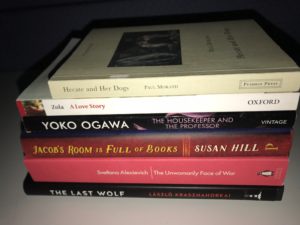
The idea was sparked by reading Hecate and Her Dogs, but not related to the story. Paul Morand wrote such a beautiful and disturbing novella but I have a hard time separating the man from the book. It is the type of prose that you want to write down and admire. He was modernist writer along with his friend Proust and is considered a cult favourite among the artistic avant-garde. Sadly he was also a vocal anti-Semite and a Nazi collaborator. A question that has been asked a lot lately with people speaking out against sexual assault; how can we love the art, when the artist is such an asshole? It has become difficult to pick a movie nowadays. I do not want to forgive Paul Morand for his inhumane thoughts, nor call him a product of his time but I struggle to find where to draw the line. Ideally I never want to support people with problematic views but if I did this, I would quickly run out of classics to read; although I would quickly get my TBR under control.

My wife went for a new job that would require making a significant move. This has led me to spend a lot of time looking at my shelves, I mean, more so than usual. If we make this move there would be a serious need to cull my bookshelves. While I have toyed with this idea before, I never liked the idea of culling anything I have not read. I may not be interested in reading all the books at the moment but this could change. A major cull would force my hand. I want my shelves to be reflection of the books I am interested in reading and the ones that define my reading life. Eventually I hope to have a very small TBR pile but currently most of the books I own are unread.

I use to buy books frequently however my book buying habits have been through a considerable change. Currently my reading has been focused on the books I have received for my birthday or Christmas, like The Housekeeper and the Professor. However my time gazing at my shelves has reminded me of all the books I would love to revisit. I reread The Elegance of the Hedgehog as a result. It is hard to find the right balance between reading the unread and all the books I wish to dip back into; with a smaller TBR, this might be easier to manage. I am constantly being distracted by all the books I have and wish to read.

I keep checking the price on Matt McIntosh’s novel, theMystery.doc but it is still sitting at $45 Australian dollars. Part of me worries that this post-modern novel will never be published in paperback but do I have the patience to tackle a 1600 page book at the moment? Another book for my wishlist. I suspect that while reading Jacob’s Room is Full of Books I will find more books to add to my wishlist. It did inspire me to start writing monthly wrap ups again. I am actually trying to use her style of mixing my personal and reading life into one. However I plan to try and highlight my bookish thought process as well. I enjoyed the book but I preferred her other, Howard’s End is on the Landing. I am inspired to write this because of the book and I hope that it is just leading me back to writing more frequently. Also with a monthly post like this, the need to review everything I read will be eliminated. Let me know if you like this style.

Read More


In the Miso Soup by Ryū Murakami

Posted October 4, 2015 by Michael @ Knowledge Lost in Horror / 2 Comments

In the Miso Soup by Ryū MurakamiTitle: In the Miso Soup (Goodreads)
Author: Ryū Murakami
Translator: Ralph McCarthy
Published: Kodansha International, 1997
Pages: 180
Genres: Horror
My Copy: Library Book

Buy: AmazonBook Depository (or visit your local Indie bookstore)

Kenji is a tour guide of the night, normally taking Americans to the sex clubs within Tokyo. Frank, an overweight business man that appears to have only one thing on his mind wishes to take advantage of Kenji’s knowledge of the sex industry, hires him to guide him for three days. However Frank’s strange behaviour begins to make Kenji suspicious and he quickly suspects that his client is in fact the serial killer currently terrorising Tokyo. In the Miso Soup is a fast paced, philosophical piece of translated fiction by the Murakami that does not often get talked about, Ryū Murakami.

Translated by Ralph McCarthy, this Japanese novel is a short punchy novel that really explores culture clash in a really interesting way. The attitudes towards sex between the Japanese and Americans are what really stands out to me while reading In the Miso Soup. The whole novel plays around with the cultural differences in an interesting way, exploring attitudes, personalities and even philosophical views. I enjoyed Ryū Murakami’s approach to these themes within In the Miso Soup, I think it was a unique take on East meets West, and I do not think I have seen the approach before.

One thing I like about Japanese fiction is the writing style, it is almost like a slow burn but novels like this still manage to build tension. I have read a few Japanese novels that explore really dark themes in this way; Revenge by Yōko Ogawa comes to mind. Be aware when reading In the Miso Soup, Ryū Murakami does not hold back and it can get descriptive in its depictions of sex and violence.

I really enjoyed reading Ryū Murakami’s In the Miso Soup and am eager to read more of his novels; in particular Coin Locker Babies and Audition. I am fascinated by the philosophical and psychological look into the darker side of humanity that seems to be a common theme within Japanese literature. Other novelists I am interested in checking out include Natsuo Kirino, Banana Yoshimoto and Kenzaburō Ōe. This does not include the authors I have already read, like Haruki Murakami, Yōko Ogawa and now Ryū Murakami. In the Miso Soup is a short novel but it packs a huge punch, not for the faint hearted but well worth reading. I have also done a video review of this book, if you are interested in checking that out.