Month: May 2013

Gatsby and My Hate for Movie Tie-In Covers

Posted May 9, 2013 by Michael @ Knowledge Lost in Literature / 0 Comments

gatsby

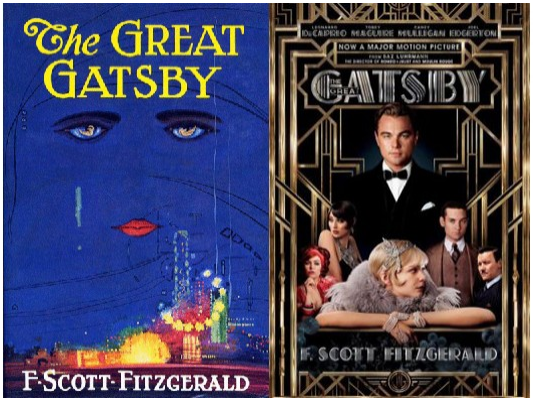
I had a little complaint about book covers changing a few days ago but now I feel the need to comment on something else cover related. Movie tie-in book covers are the worst thing out there, I know they help people recognise the book but they are just so ugly and should never be printed. The New York Times wrote an interesting article called Judging ‘Gatsby’ by Its Cover(s) in which they looked at the iconic Great Gatsby cover with the new movie cover.

Normally books go through different cover changes but when it comes to The Great Gatsby, the original cover is still the most recognised of all its covers. So when you see the movie tie-in cover it is a huge shock; do we really need a cover with Leonardo DiCaprio on it? The article is really interesting because it looks at how the original cover is out selling the movie tie-in and even an independent bookseller who refuses to sell the new cinematic edition. Saying “It’s just God-awful, ‘The Great Gatsby’ is a pillar of American literature, and people don’t want it messed with. We’re selling the classic cover and have no intention of selling the new one.”

There is even a little quote by Ernest Hemingway who called the original cover “garish” and wrote in his memoir A Moveable Feast that he was “embarrassed by the violence, bad taste and slippery look of it.” But that is probably a whole new blog post, maybe two (one to look at the complex relationship of F. Scott Fitzgerald and Hemingway).

I know I hate movie tie-in covers and go out of my way to avoid them at all cost. I know most people hate them, you can read The Week complain about them, even Books on the Nightstand had a conversation about them recently. But I want to know if there are any good movie-tie in covers out there and what you think about them?


Heart of Darkness by Joseph Conrad

Posted May 8, 2013 by Michael @ Knowledge Lost in Classic / 0 Comments

Heart of Darkness by Joseph ConradTitle: Heart of Darkness (Goodreads)
Author: Joseph Conrad
Published: Oxford World's Classics, 1899
Pages: 225
Genres: Classic
My Copy: Personal Copy

Buy: AmazonBook DepositoryKindle (or visit your local Indie bookstore)

Heart of Darkness tells the tale of Charlie Marlow’s journey on an ivory transporter down an unknown river in the Congo. What he sees horrifies and perplexes him, calling into question the very basis of civilisation and human nature. The story follows this commercial agent and the object of his obsession, the notorious ivory-procurement agent Mr Kurtz. This novella has become an important piece in the western canon for its range of themes and scholarly values.

I remember reading this book a few years back and while I thought it was an interesting book, I never really grasped it completely (and I’m not sure if I ever will) but for comparison to what I know now and then, check out my review here. To begin with we need to gain an understanding of Joseph Conrad’s life because there are a lot of life experiences in this book. Born Josef Teodor Konrad Walecz Korzeniowski in Russian-ruled Poland in 1857; this part of Poland is now part of Ukraine. Both parents were political activists and as a result of their participation in the Polish independence movement they were exiled to Northern Russia in 1863. At sixteen he dropped out of school to work on a French merchant ship, sailing the West Indies as an apprentice. Later he joined a British ship where he served as a merchant for ten years, during this time he gained the rank of captain and became a naturalized British citizen. During a trip in 1890 sailing through the Belgian Congo and Congo River he got really sick and had to retire from sailing and focused his energy on writing. This means Joseph Conrad must have grown up speaking Polish and Russian, learning French at some point and then English. Although he often struggled to write in his adopted language, he is now considered one of the greatest prose stylists in English literature.

There are many themes explored in this book, so much so that I think I would need to keep reading this book again and again to discover them. Though major themes include slavery (the effect the British had on Africa) as well the author’s problems with Colonialism and Imperialism. There are a few other themes I would much prefer exploring. First of all, the idea of alienation; both Conrad and Marlow are both outsiders. The entire novel questions what alienation and loneliness can do to a person over an extended period of time, especially since they are in hostile environments. Even the doctor warns Marlow prior to his departure of changes to his personality that may be produced by a long stay in another country.  Prolonged solitude seems to have damaging effects on the sailors, which leads me into another major theme; insanity. In the case of Kurtz, the loneliness lead to literal madness, while others like Marlow’s predecessor, Captain Fresleven was described as a gentle soul that transformed into a violent one.

There are other themes I really would love to talk about but for the sake of keeping this review a decent length I will just highlight them. Heart of Darkness also looks at the way Belgium is exploiting the Congo, order verse disorder, duty verse responsibility, doubt verse ambiguity, race verse racism and finally violence and cruelty. All these, plus many more, are reasons why this book has been studied. It is a very difficult book to explore, I found myself rereading passages trying to get more out of it. I know at one point near the start of reading this I thought I would never get enough meaning out of this book but eventually it opened up to me.

There are a lot of symbols within the book as well, beginning with the title and the setting; Heart of Darkness deep in the heart of the Congo, the centre of the deep dark Africa. Even the fact that the entire story is told in the late afternoon as the sun sets is a motif of Africa. There are a lot more in this novel but I want to quickly talk about the movie adaptation Apocalypse Now. Sure there are some similarities but not enough to really consider the movie to be based on this novella. There are more similarities with Coleridge’s The Rime of the Ancient Mariner in the way the book starts out, also with Bram Stokers’ Dracula with the suspension between life and death. So how are they the similar, since one is set in the Congo and the other during the Vietnam War? The very basic answer would be that both look at the deterioration of humanity as a result of conflict, one via imperialism and one by war.

I would love to talk about the narrative and how there are two narrators, Marlow and someone anonymous. And how all the scenes on the Nellie are obviously an introductory and critique to the story that it doesn’t go away after the intro. Marlow’s narrative is often interrupted by this unnamed narrator as they listen to the story as a way for Conrad to tell the reader to notice different themes. There are also the proses in the book, poetic and while difficult, you can get swept away and not really notice just what Conrad is trying to do. So many things I want to talk about but I have to cut this review short.

Heart of Darkness is a really complex book but if you take the time to break it apart and explore the text critically, you’ll find there is so much to appreciate. It’s like a fine meal, it can be enjoyed without any thought, but if you take the time to see how each element complements each other you end up enjoying the novella a whole lot more. It all comes together with a sense of satisfaction that while you might not know everything Joseph Conrad was trying to say, you know enough for the book to have real value.

Why Change the Book Cover Design?

Posted May 7, 2013 by Michael @ Knowledge Lost in Literature / 8 Comments

covers

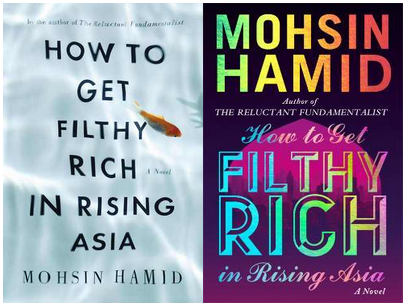
This week, something that really annoyed me was the new paperback book cover for How to Get Filthy Rich in Rising Asia by Mohsin Hamid. The originally cover was gorgeous, nothing too elaborate but it really stood out now the new cover looks too much like it’s trying to be a self-help book. Which I get, it looks almost exactly the same as the famous book on economics Rich Dad, Poor Dad by Robert T. Kiyosaki.  This got me thinking, why do they change the style of book designs, if they have something that works so well?

I’m sure there is a lot to do with marketing strategies and who owns the publishing rights for a book yet I still find myself annoyed. What is more annoying is when you see a book change cover designs halfway through a series. Are they just trying to make sure everyone has to go out and buy all the books again so they all match on the bookshelf? Good marketing strategy but that is just mean to the readers and book collectors out there. I have a series of books which I bought from a book website (which I will leave nameless) and when all the books came they were the same style but they are different heights, so it still looks weird on the book shelf. Sometimes book cover designers do things that really annoy me.

I’m sure there are many people out there that just don’t care that much about different covers or if the book is in hardback or paperback. For me, it is almost like they went out of their way to annoy me; I don’t think I’m OCD but little things like cover design and the different sizes of the books really set me off; especially when it’s on a bookshelf staring and teasing me all day long. How about you? Are there things that annoy you about book designs? Let me know in the comments below.


Shoot the Piano Player by David Goodis

Posted May 6, 2013 by Michael @ Knowledge Lost in Pulp / 0 Comments

Shoot the Piano Player by David GoodisTitle: Shoot the Piano Player (Goodreads)
Author: David Goodis
Published: Prion, 1956
Pages: 196
Genres: Pulp
My Copy: Library Book

Buy: AmazonBook Depository (or visit your local Indie bookstore)

Haunted by his past, Eddie plays to forget. Hiding from life, he plays nightly at a small joint on Skid Row; a place for hookers, lowlifes and crooks. A washed-up classical pianist, he finds himself bottoming out — he’s only care in the world is stroking the keys in this dive bar. When his brothers get in trouble with some gangsters, he finds himself being dragged into the chaos of his no-good family.

David Goodis really knows how to create a bleak world, which I did find myself being sucked into from the very start. Yet I tend to think that maybe Goodis missed the mark a little with this novel; there was something missing and the end result  was not as compelling as others in this genre. I think the narrative was a bit flat; do not get me wrong, I love the existentialism, alienation and angst that were coming from Eddie but I think it failed to be as melodramatic or psychological as I would like from a noir novel like this.

Eddie was suppose to be an empty shell, not even closely resembling his former self and I think here is where I had the problem. There was no real character development for Eddie as there was nothing really there.  He wasn’t hard-boiled, he was not witty or intelligent in any way; he just seemed to not care at all. Sure he tried to survive but as a character I thought of him as flat and boring. Lena, on the other hand, seemed like there was so much hidden from the reader but she never really got enough time in the book to explore that.

Another issue I found was the books was jammed back with dialogue and I feel like David Goodis was better at building atmosphere. I am not saying this is a bad book or that I did not enjoy it; I had a lot of fun reading this book. I just wanted to look at what let me down with the book as well as what worked. Shoot the Piano Player moves at a frenetic pace and if it wasn’t for the over use of dialogue to slow it down, this could of been a real page turner. This novel also feels really different to other noir novels; the style feels the same but there is something about this novel that makes it unique, possibly the execution of the plot but I cannot put my finger on it.

I have  mixed feelings about this novel, at times it is amazing then you turn the page and it almost flat lines. Almost like it had it’s own emotions and suffers from severe mood swings. This balance never felt right; I get the impression this would work a whole lot better as a movie. In fact I think the movie French noir classic directed by François Truffaut and starring Charles Aznavour in 1960 was what held this book firmly in place with the other great noir novels. I wonder if the movie was not a success would this book fade into obscurity like the rest of David Goodis’ novels.

I did not intend to be so hard on this novel, I wanted to enjoy it and to some extent I did. Just in the end the cons far outweighed the pros. I have yet to see “Tirez sur le pianiste” but if I get my hand on it I think I would be correct in assuming that it is better than the novel. Add more angst, existentialism, melodrama or psychological elements and fix my issues; that would be the perfect pulp novel. Although then you will be more likely be reading a Raymond Chandler, James M Cain or Jim Thompson novel.


Understanding Satire

Posted May 5, 2013 by Michael @ Knowledge Lost in Literature / 2 Comments

juvenalI was reading a review the other day, when I saw them say “being a satire, I expected it to be funny” which, at the time, really annoyed me: I wanted to become that guy who replies with “I don’t think you get it”. The truth of the matter is I was someone that thought satire was a form of comedy for a very long time too. I think it wasn’t until someone called 1984 a satirical novel did I actually think “hang on, maybe I need to look up this word”. So I thought instead maybe this could make a good blog post.

First of all, while satire can be funny, humour is not the essential component. The main purpose of satire (in a literary sense) is to offer a constructive social criticism or to shame society into improving. Using wit, irony and sometimes sarcasm to put a spotlight on issues the author feels need to be looked at; normally social, political or religion topics. This is only a brief explanation of my thoughts on satire; I might have missed something because it is a lot more complex than this anyway.

Satirical literature is often divided into two different categories as well; Horatian and Juvenalian (although not mutually exclusive). Horatian satire looks at some social vice through playful, light-hearted humour or wit. Named after the Roman satirist Horace, this form of satire uses wit, exaggeration and self deprecation to indentify stupidity (rather than major issues) within modern society. This is the type of satire more people think of when they think about satirical books; examples of this type of satire within literature can include Adventures of Huckleberry Finn by Mark Twain, The Screwtape Letters by C.S. Lewis, The Giver by Lois Lowry and Gulliver’s Travels by Jonathan Swift.

There is another form of satire named after Roman satirist Juvenal; this is the one that includes books like Fahrenheit 451 by Ray Bradbury, A Clockwork Orange by Anthony Burgess, American Psycho by Bret Easton Ellis, Lord of the Flies by William Golding, Brave New World by Aldous Huxley and 1984 by George Orwell. Juvenalian satire addresses social evil through scorn, fury and ridicule. This form of satire doesn’t often involve humour (though a book like Catch 22 by Joseph Heller would be included) but more a pessimistic, ironic or sarcastic nature towards moral and social indignation.

So, as you can see, there are two very different types of satire within literature, there is a lot more to look at regarding these types of novels. My hope with this post is that people understand the difference between Horatian and Juvenalian satire. Not only should we remember that satire is not always funny but we need to remember that it is not an indication of the satirist persona. Criticising Mark Twain as racist and calling Huckleberry Finn offensive is to miss the point completely. Jonathan Swift was not really suggesting that Ireland can ease their economical troubles by selling their children as food for the rich in A Modest Proposal (1729) and if you read it any other way what would you think of the author? He does say children are a delicious, nourishing and wholesome food, whether stewed, roasted, baked, or boiled; do you really think Swift was proposing cannibalism and infanticide?

I’m a big fan of satire, there are times where it is in bad taste or misses the mark but this is not the fault of the literary genre but the delivery of the message. I personally prefer Juvenalian satire in my literature but when it comes to movies and TV I think maybe a combination of both. I would really love to hear other people’s thoughts on satire; am I missing anything? Is there anything you feel needs to be added? Or what novels do you like in both Horatian and Juvenalian satire.


The People of Forever Are Not Afraid by Shani Boianjiu

Posted May 4, 2013 by Michael @ Knowledge Lost in Young Adult / 0 Comments

The People of Forever Are Not Afraid by Shani BoianjiuTitle: The People of Forever Are Not Afraid (Goodreads)
Author: Shani Boianjiu
Published: Hogarth, 2012
Pages: 320
Genres: Young Adult
My Copy: ARC from Publisher

Buy: AmazonBook Depository (or visit your local Indie bookstore)

Lea, Avishag and Yael grow up in a small town on the Israel/Lebanon border leaving normal teenage lives. The People of Forever Are Not Afraid tells the story of these three normal Israeli girls from passing notes in school, talking about boys to turning eighteen and being conscripted into the army. Winner of the National Book Foundation’s “5 Under 35” authors to watch list in 2011, Shani Boianjiu’s debut novel is a coming of age novel unlike any before. Growing up in this intense war torn world changes everything, even for three normal teenage girls.

First thing I would like to say is I was hugely impressed with The People of Forever Are Not Afraid, I never expected to find a New Adult novel that offers so many different elements. While this seems to be marketed as a Young/New Adult novel, I think this is because the old “coming of age” formula seems to go hand and hand with these two genres. Though this is so much different; these three girls are plucked from their normal teenage lives, put into the army and forced to grow up rather quickly.

There are some really interesting themes throughout this novel. Firstly there are the major themes of growing up as an Israeli girl and conscription, and Shani Boianjiu is the voice of experience here; at the age of 18, she entered the Israeli Defence Forces and served for two years. So you get the sense that maybe this novel is semi-autobiographical but not knowing much about the author I wonder which of the three girl’s best resembles her. Though I have a feeling that Lea, Avishag and Yael all have an element of Boianjiu in them; I like how she has the three different personalities within the book to help show the how war really effects a person.

This brings us to the theme of War; while for the most of the book they are living in a perpetual state of war, the conflict between Israel and Lebanon still puts them into real danger. Though the reader has to ask themselves if eighteen too young to deal with war; they are still in a state of self-discovery when they are thrown into such an extreme situation. I know it is part of their heritage but when you talk about war and even RPG children (“children who tried to shoot RPGs at soldiers and ended up burning each other because they were uninformed, and children”) you really have to wonder how old is old enough to deal with war.

Finally, the book looks at the influence western society has on the Middle Eastern culture; I’m sure girls thought about boys and sex but there is a definite changing that comes through in the novel. References to Dawson’s Creek and Mean Girls and the whole attitude towards relationships (breaking up every week) and sex really feels more like something from an American teen drama than an Israeli town. I don’t know much about their culture but I know enough about pop-culture and the difficulties that western society has on Muslim and Jewish heritage to notice this real culture clash.

The People of Forever Are Not Afraid really is an interesting New Adult novel; it is smart and thought provoking and yet it’s really funny as well. I remember the cheesy lines made me chuckle like the idea of a mother not wanting her daughter to have a party because she was worried that her friends will break her hymen. All these elements seem to work together to produce a novel that is both easy to read and unlike anything I’ve read before.

I was never sure what to make of The People of Forever Are Not Afraid but I’m glad I had a chance to read this novel. It’s a debut novel that shows us that Shani Boianjiu is an author to watch in the future. It’s not without its flaws, the repetitiveness got to me a little but in the end all the good aspects of this book outshined any problems. It’s the type of novel that made me want to turn back to page one and start reading it again. I’m not a fan of Young Adult and New Adult novels in general but I can’t help but recommend this one to all readers.


Burial Rites by Hannah Kent

Posted May 3, 2013 by Michael @ Knowledge Lost in Historical Fiction / 0 Comments

Burial Rites by Hannah KentTitle: Burial Rites (Goodreads)
Author: Hannah Kent
Published: Picador, 2013
Pages: 352
Genres: Historical Fiction
My Copy: ARC from Publisher

Buy: AmazonBook Depository (or visit your local Indie bookstore)

In a small town in northern Iceland 1829, Agnes Magnusdottir is waiting her execution for her part in the brutal murder of two men. District Officer Jon Jonsson, his wife and two daughters have been appointed to act as Agnes jailors leading up to her death. Horrified to have a convicted killer living with them leads to the drama that is Hannah Kent’s Burial Rites.

I remember hearing about this book when Waterstones released their Waterstones Eleven list for 2013. This list is their picks for the most promising Fiction debuts of the year. While I’ve never really known of this list till this year I was very interested to discover some books that I thought I would need to get my hands on. Books that I immediately added to my list included Idiopathy by Sam Byers, The Universe Versus Alex Woods by Gavin Extence, Pig’s Foot by Carlos Acosta and of course Burial Rites. Hannah Kent is an Australian author and Deputy Editor for Kill Your Darlings, an independent literary publication. I was surprised how much buzz this book got leading up to its release and the fact that she sold the manuscript to so many countries before people had a chance to read it and talk about it.

Burial Rites is told from multiple perspectives.  There is a first person narrative from Agnes which appears to be unreliable as she doesn’t seem to have a clue about some of the things going on around her. Then there are all the other perspectives which are told in third person, I thought I would get annoyed with the switching perspective and the reliable third person verse the unreliable first but really it didn’t bother me at all. The way the story progresses you don’t really notice too much in the change and it really helps the reader to understand what is happening in this little town even if Agnes is unaware.

The differing opinions towards Agnes were really fascinating, in this sense I found myself being reminded of Crime and Punishment. The psychology of each character gets explored, from Agnes’ acceptance and waiting for her fate to Jon’s fear of corruption to the compassion, understanding and a whole range of issues. As the novel progresses and people learn more about Agnes and/or the crime, you can see the way they change in behaviour. I was so drawn to the way Hannah Kent really explored her characters and the way they behave towards Agnes as they learn more about the whole situation.

This is based on real events; Agnes Magnusdottir was the last application of capital punishment in Iceland and while I didn’t find much about the crime and the execution, I did feel like Kent has researched enough for this novel. Using historical events to write fiction is a trick thing to do, sometimes you can get it right, like in the case of this novel and Wolf Hall, but sometimes you just mess too much with the personalities of who you want to portray and it doesn’t feel authentic, A Treacherous Likeness is a good example of this. I’m sure it helps that a quick search of Agnes Magnusdottir doesn’t give you much information apart from being convicted for the murders of Nathan Ketilsson and Pétur Jónsson so it is hard to tell just how accurate this novel is. Though I feel like I know a little more about the last execution in Iceland than originally (which was nothing); even if it was learnt from a historical novel.

Burial Rites was a great read, I found myself being sucked into the world and enjoying the way each character was explored. Trying to pronounce the Icelandic names is always hard but I’m pleased to see there is a little guide at the start of the book to help with pronunciation. A brilliant debut novel from Hannah Kent and she will be one Australian author I will be watch in the future. This psychological novel really is worth reading, but then again I do enjoy a novel that explores the psychological elements of murder.