Author: Michael @ Knowledge Lost

My Literary Wall of Shame

Posted June 15, 2011 by Michael @ Knowledge Lost in Listology / 17 Comments

As most of you know, I’ve turned into a big reader; in 2009 I set myself a goal of reading 12 books and managed to read 14 books. In 2010, I thought I would try to read 24 books for the year, in which I completed 88; so this year my goal is 100 books. Seems like a big goal but I’ve become very addicted to reading and keep finding other books I want to read now. However I still have a pile of shame; a group of authors and books that I really should read but haven’t read yet. So for something different, I thought I’d talk about what I haven’t read.

Top 5 Unread Authors


5. Agatha Christie

The more I read, the more I discover my love of Crime and Mystery novels. I’ve been focusing mainly on the pulps as these books have been my favourites. I really should take some time to read some books from the master of mystery.

4. Charlotte Bronte

I’ve read a book by both Emily and Anne Bronte, but never Charlotte. I don’t know why; I think I focussed on the less known sisters as I heard they were darker stories but I will eventually have to read some Charlotte Bronte.

3. Jane Austen

Most people are expected to read one Jane Austen book in their lives and I need to read Pride and Prejudice soon. I haven’t been overly excited about reading Austen, though I’ve enjoyed the Gothic and Romantic books that came before her, I’ve never really dove into Victorian literature.

2. Charles Dickens

Charles Dickens has been put off for the same reason as Jane Austen. Victorian literature hasn’t excited me enough yet to want to read. I do try to read all the greats in English Literature but I’ve got a lot to read.

1. Shakespeare

I didn’t even read any Shakespeare while I was a school. The only book related subject at school I remember doing was Romeo & Juliet but even then we didn’t read the whole play, just some excerpts and then watched the movie. What was wrong with my high school?

Top 5 Unread Classics


5. War and Peace

I’ve been meaning to read this mammoth of a book; I read and enjoyed Anna Karenina and look forward to reading some more Tolstoy. I really think the size is the main thing that is holding me back.

4. Lord of the Flies

While I’ve read that this book is very disturbing, this only makes me want to read this more. I picked this book to put on this list, simply because it is one of the books people read in High School, so are surprised to know I haven’t read it.

3. Cloud Street

I had to pick some classic Australian literature to add to the list and I think Tim Winton is one Australian author I would like to read. I live in Australia and haven’t read much of its literature, but it’s on my to-read list.

2. Moby Dick

Not the number one book but this white whale does need to be read soon. If we look at the great novels of the 20th Century I think Moby Dick would be one of the books sitting on the top of the list.

1. Crime and Punishment

With my love of what little Russian literature I’ve read, Crime and Punishment has been a must read for me for a very long time. My wife hates Russian literature but I adore it and can’t wait to start this book (when I finish all the other books waiting to be read).

If you have any recommendations I’d love to hear them and if you are on Goodreads, I hope we are friends. I know there is heaps of books that need to be read, but this was just a glimpse in the major books that I need to read and a good excuse to try something different on this blog. What is on your reading wall of shame?


What is Wrong with Dark YA Novels?

Posted June 9, 2011 by Michael @ Knowledge Lost in Literature / 0 Comments

As most of you have heard, a few days ago The Wall Street Journal released an article about Young Adult (YA) fiction been excessively dark and parents being concerned about the effects of this on their children. While I’ve not read much YA, I do feel the need to defend it as I am a fan of dark imagery. For starters, this is nothing new; parents have been concerned about their children and what they do for a very long time (possibly forever) and teens will always feel an attraction to doing something their parents don’t approve of; whether it’s to rebel or just  curiosity. Apart from that, controversial YA books are nothing new; The Catcher in the Rye is the first book that comes to mind, being the one most censored book in the world and always getting complaints from parents when their children have to read it. In the 1970’s, there was Go Ask Alice which to this day has been slammed for been too controversial for teens to read.

In the world today teenagers are exposed to a lot of questions and getting very little answers. While they may not all be abused, a lot of them have to deal with being harassed, neglected or even the feeling of being misunderstood. Sometimes a parent or a teacher can help but sometimes they are just too embarrassed to ask, so they are drawn to these books because they are looking for answers.

Some are just reading these books for information, they may not have questions that need answering. They are just curious; either about things they’ve experienced (loneliness, heart break, pain) or about things they haven’t experienced yet (sex, drugs, suicide).

So from what I can gather; Teenagers read dark YA fiction for three main reasons;

1. They are dealing with similar issues as the characters in the book.

2. Even if they don’t have a similar life as the characters, they share similar feelings.

3. They read books for the same reasons that adults read books: for fun; to explore another world.

While these books may seem dark, I’ve noticed the hashtag #YASaves going around twitter, where people talk about how reading these books may have helped them and even saved their lives. The main reason for this (from what I can gather) is that these books are showing them why certain behaviours are dangerous. Literature connects us and these YA novels just act as a bridge between the darkness of our thoughts and reality. It can save us by showing the dangers of the thoughts we may be having and the effect they would have on yourself and others around you.

This whole discussion about dark novels, feels close to the discussions of censorship (to me). We have to remember while these young adults read books like this, it doesn’t mean they are going to turn into something bad, it is more likely to do them good than harm. (At least they are reading.) I feel the need to read more young adult fiction (not the ones about fairies) and see just how dark they are, but I have a huge to-read list and may not get to a YA book for awhile. However I know many adults that do read these books and none have ever mentioned them being harmful. I would love to know what others think of the Wall Street Journal article and YA novels in general. What do you like/dislike about them and what is your favourite?


Is there Pre-Tolkien Fantasy?

Posted June 3, 2011 by Michael @ Knowledge Lost in Literature / 0 Comments

Last night at Trivia, I was having a conversation about The Lord of the Rings and its effect on literature and fantasy. I asked the question ‘What fantasy was there before Tolkien?’ A question that I thought I would get some interesting answers but it was a question that they didn’t know how to answer. Was there fantasy before Tolkien? While J.R.R. Tolkien and C.S. Lewis would be the ones responsible for making fantasy popular; the genre isn’t really that new. While the concept of a fantasy genre may seem new, a lot of it draws from Epic Poems such as The Odyssey & Beowulf, but also from Fairy Tales, Fables and Myths. I’m not a huge fan of fantasy as a genre, so I might be missing some information, but from what I can find the first Fantasy novel was by George MacDonald but writers like Lord Dunsany have been writing short stories beforehand. For more about pre-Tolkien fantasy, check out this list from Goodreads.

Another thing I’ve noticed about fantasy, while this is often a new world with commonly known races; Tolkien’s Elves, Hobbits, Orcs, etc have been used time and time again. I know there are probably people that differ from Tolkien’s world but it seems to be a template that is being used far too often. While I haven’t read the Lord of the Rings books, I’ve seen the movie and can see similarities between Tolkien and other books, movies and games in the fantasy genre.

We owe a lot to J.R.R. Tolkien for everything he has done for speculative fiction; I would like to know, can books step out of his shadows and reinvent the races or the genre successfully? Also I would love to know more about the fantasy genre and all its subgenres. What would fantasy novel would you recommend to people?


The Eucatastrophic Ending

Posted May 17, 2011 by Michael @ Knowledge Lost in Literature / 0 Comments

Is it just me, or do eucatastrophic*, Hollywood or happy endings always seem like we are wrapping things up in a tiny little bow. I know there is a time and a place for this but I’ve found that life is not neatly wrapped up, so why do it in books or movies. I’m a big fan of noir and books like Wuthering Heights, Anna Karenina & Frankenstein, so maybe my opinion is biased. But I’ve been thinking about this a lot lately (especially in the aspect of movie adaptations changing the ending to make the story come together) and while I think there are many decent books with a happy ending (To Kill a Mockingbird, Shipping News or The Lord of the Rings) they just don’t sit well with me.
So why do I prefer a book with a more realistic ending? Apart from the fact that I like dark/gothic imagery, I think the fact that a book that ends on a less than happy note often has a more lasting effect on the reader, giving the reader something to ponder, talk about and even make them feel more superior than the protagonist.  Sure, happy endings leave their audiences happy; if only for a little while. For a lot of people, happiness is hard to come by and they like to escape at any chance. I think my major issue with happy endings is this simple fact; happy endings tend to be too predictable, and I like to be thrown off guard with an unexpected twist or plot turn.

I know there is a time and a place for a happy, sad or realistic ending. I would like to know what you think in regards to the advantages and disadvantages of happy endings.


*Eucatastrophe is a term coined by J. R. R. Tolkien which refers to the sudden turn of events at the end of a story which result in the protagonist’s well-being.

Autodidact Vs. Higher Education

Posted May 5, 2011 by Michael @ Knowledge Lost in Education / 0 Comments

While I love considering myself as an autodidact, my thirst for knowledge is growing so strong, that now I am considering going to uni to study a Bachelor of Arts focusing in English Literature – there are probably heaps of subjects I would love to study, but I think this one will suit me best.

For those who are unsure autodidacticism is learning on your own and an autodidact is someone that teaches themselves. I have developed my own education philosophy, in which I try to learn or make sense of something every week and then write about it in a blog post. I have this fear that I might be wrong or missing interesting elements of a topic. The other draw card to studying this via a university is the degree; who knows, it might get me a job, working in a field I’m passionate about.

The drawback of going to study – for me – is the fear that the classroom may kill my passion for learning. Over the past few years, this passion has been growing and growing; what started with Culture, expanded into Art History, Literature, Philosophy and now Educational Theories. I know that all these topics go hand in hand, but if I lose my passion, what will I do then?

I’ve been left with a difficult decision and while I’m worried about it, I think my thirst for knowledge far outweighs my fears. Though I think I will start out small; I will start with something basic (as I will need to study part time) and just take the subject in Critical reading.

I would love to know others’ thoughts in Autodidact verses Higher Education and I would love to know how others journey into higher learning went.


The Dystopian World of Super Sad True Love Story

Posted April 29, 2011 by Michael @ Knowledge Lost in Literature / 0 Comments

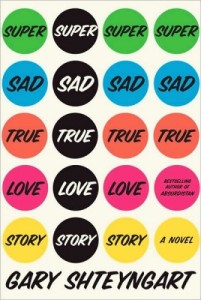
I love the dystopian genre; the feeling of hopelessness that needs to be overcome makes a great backdrop for a novel. But unlike most books in the dystopian genre, Super Sad True Love Story really stuck with me, more than any other. I’ve been pondering this for a while and I have come to the conclusion that the reason is the fact that this dystopian world feels so close to our future that it feels like this is what our future will be like.

For those who have not read Super Sad True Love Story, I highly recommend it. The novel is set in a very near future—oh, let’s say next Tuesday—where the world is dominated by the Media. The story is centred on a thirty nine year Russian immigrant, Lenny, and what could likely be the world’s last diary. As well as the object of his affection; Eunice, who has her side of the story to by a collection of e-mail correspondences on her “GlobalTeens” account.

While this may be a story of a modern relationship; there is so much more in the novel worth exploring. This dystopian back drop mixing in some very interesting concepts;

Media and Retail

The world is controlled by the media, telling everyone how to think, feel and act. No one reads anymore, they are all feed their information from all the shows streaming to them. Like the media today, this is teamed up with the Retail industry. Media and Retail are the high powered jobs of this world; everyone is a slave to fashion.

The Apparatus

The iPhone is gone, replaced with the Apparatus, a device that is required to be worn at all times. This device is the connection to the world, streaming all the news, storing all your personal information; credit rating, personal history and preferences. But this device is so much more powerful than that, it monitors the heart and blood pressure and calculates your attraction to a mate based on history, preferences and the way your body reacts to them. Giving everyone a rating in the following categories; Finances, Personality, Attractiveness and Fuckabililty.

Lack of Privacy

In a world of commercialisation – even porn is mainstream – the Apparatus mixed with reading posts around the world allows all information to be collect and public record. These reading posts will display your credit rating as you walk past. But as this is a world of controlled by Retail and the media telling people to spend, the credit rating is a catch 22; spending money will increase your social rating but decrease your credit rating therefore decreasing your social rating.

There is so much in this book that is worth discussing; it’s a light and humorous read but under the surface it is a witty and intelligently written book. I probably could go on further writing about the dystopian world, including Privatisation of the military and immigration check points, etc. but I have tried to keep this spoiler free. All in all, this world is so close to the direction the world is moving, you can almost feel this coming.

Support Knowledge Lost and my reading habits, If you wish to get a copy of Super Sad True Love Story: A Novel do so here.


Burning Realisation: I Can't Write

Posted April 7, 2011 by Michael @ Knowledge Lost in Writing / 0 Comments

Over the past few weeks I’ve had to come to terms with the fact that I really not very good at writing. I think I’m getting better at blogging, but for someone that aspires to be a writer, I’m not good at it. I’ve had to take a step back and evaluate what I’ve been doing wrong.

If you don’t have the time to read, you don’t have the time or the tools to write.

Stephen King, On Writing, p. 147

I’ve been reading a lot and I’ve been getting lots of great ideas on what I want to do with my writing, from style, plots, metaphors. But when I go to write a novel, I really do lack the skills to get very far. I’ve decided I have to change my approach. I have to learn the art of writing. I can’t give up; I still have a burning desire to write.

The only reason for being a professional writer is that you just can’t help it.

Leo Rosten

So I’ve reached a decision to give up trying to write a novel for now. I need to practise my craft, and build up to attempting to do something like a full novel. I read an interview with Carlos Ruiz Zafón (who wrote the brilliant book The Shadow in the Wind) that he always had this book sitting in the back of his mind but he needed to gain the skills to attempt writing it. So Carlos Ruiz Zafón began his career writing books for young adults. While I don’t think I have the skills to write a full length novel, I think the idea of starting small and building up is a smart move.

A writer is somebody for whom writing is more difficult than it is for other people.

Thomas Mann

So I’ve decided to set myself a new writing goal; to focus not on completing a full length novel, but to focus on honing my craft. To do this, I’ve decided to focus on writing short stories (not limiting myself to a word count); I’m hoping this will help develop the skills to write more complete and interesting stories. Currently I’m aiming at a short story a quarter, but I will see how I go.


What is a Cult Book

Posted April 1, 2011 by Michael @ Knowledge Lost in Listology / 0 Comments

Recently I watched a show about Cult books, yet I still don’t really understand the concept of Cult followings. So I thought I would do some research and this blog post on the topic.

A broad strokes definition would be: “A cult following is a term used to refer to a group of fans who are highly dedicated to a specific area of pop culture.” But it is much deeper than this and it’s a fine line between Cult and Mainstream. Normally a cult follower is passionate and devoted to their subject, but not always for positive reasons. Film Director Ed Wood has a cult following, not because they enjoy his movies, but because they consider them so bad that they become funny and curiously fascinating. Generally, Cult followings normally involve books, movies, etc that originally are not very successful but grow in popularity at a later date (eg. Firefly).

It seems that everyone has a different definition of what would make a cult book, while some may include best sellers like The Lord of the Rings, others would consider these as mainstream. But one thing that seems to be consistent is the fact that a cult book is a book that we share a special bond with, it grips our imagination and you never want to let go of it. I would love to know how you would define a cult book and what your top five cult books would be.

My Top Five

1. Frankenstein
2. Slaughterhouse-Five
3. Catch-22
4. Brave New World
5. Foucault’s Pendulum

The Romantic Celebrity

Posted March 25, 2011 by Michael @ Knowledge Lost in Poetry / 0 Comments

Lord Byron pioneered a new form of living to give meaning to his own existence. His poem Childe Harold’s Pilgrimage was an instant best seller, and the crowds loved it, and him. The poem gave Byron a lot of followers, all wanting to be Romantics; dissatisfied with the world, yearning for something else.

His house, his home, his heritage, his lands,
The laughing dames in whom he did delight,
Whose large blue eyes, fair locks, and snowy hands,
Might shake the saintship of an anchorite,
And long had fed his youthful appetite;
His goblets brimmed with every costly wine,
And all that mote to luxury invite,
Without a sigh he left to cross the brine,
And traverse Paynim shores, and pass earth’s central line.
–          Childe Harold’s Pilgrimage 1812

With all his followers, came the proposals, many of which Byron took up (making him one of the first celebrities to have groupies), resulting in a scandal when his marriage fell apart; which Byron fed on, even drawing inspiration from it. But as the scandals grew, public accusations of incest and sodomy, Lord Byron fled from England, never to return. But for the public, Lord Byron had redefined the idea of a poet, making his life a living poem of passion and scandal.

Lord Byron’s life in the public may have made him the first rock star, but did his life of passion have a greater effect on his poetry than John Keats life of brooding or Percy Bysshe Shelley’s life rebelling for liberty? Did Byron find the sublime? He may have redefined the way we view a poet, but his life’s quest for passion and freedom was the real poem.


The Romantic Bad-Boy

Posted March 18, 2011 by Michael @ Knowledge Lost in Poetry / 0 Comments

In Oxford in 1811, an anonymous pamphlet was distributed to every clergy man and the heads of all the colleges. It was called The Necessity of Atheism and in it one of the key points was without proof of God’s existence, how can we believe he exists. The Pamphlet was written by Percy Bysshe Shelley and though he was committing blasphemy and attacking the very existence of civilisation, Shelley was standing up against the authoritarianism of the Church. The result of his pamphlet; expulsion.

With this liberty from the Church, Shelley began a life in pursuit of a new way of living. Shelley was married to Harriet Westbrook but his heart belonged to his lover Mary Wollstonecraft Godwin. Shelley wrote to his wife claiming his ‘heart belonged to another’ and ended up running away with Mary, making him one of the pioneers in the ‘Free Love’ movement.

Whilst thou alone, then not regarded,
The … thou alone should be,
To spend years thus, and be rewarded,
As thou, sweet love, requited me
When none were near — Oh! I did wake
From torture for that moment’s sake.
–          To Mary Wollstonecraft Godwin

If poetry was the new religion, then the poet would be a god. This idea led Shelley into a dark place, seeing visions of phantoms all around him. He began to question the worth of his own existence, becoming haunted by his own ideas. With death, his poetry will live on in the sublime way that Keats poems did. When Percy Bysshe Shelley died, he was found on the beach with a copy of John Keats poems in his pocket. He was burned on the beach by Byron and other friends, who claimed his heart was not consumed; a final act against the church.