Category: Literature

What is Wrong with Dark YA Novels?

Posted June 9, 2011 by Michael @ Knowledge Lost in Literature / 0 Comments

As most of you have heard, a few days ago The Wall Street Journal released an article about Young Adult (YA) fiction been excessively dark and parents being concerned about the effects of this on their children. While I’ve not read much YA, I do feel the need to defend it as I am a fan of dark imagery. For starters, this is nothing new; parents have been concerned about their children and what they do for a very long time (possibly forever) and teens will always feel an attraction to doing something their parents don’t approve of; whether it’s to rebel or just  curiosity. Apart from that, controversial YA books are nothing new; The Catcher in the Rye is the first book that comes to mind, being the one most censored book in the world and always getting complaints from parents when their children have to read it. In the 1970’s, there was Go Ask Alice which to this day has been slammed for been too controversial for teens to read.

In the world today teenagers are exposed to a lot of questions and getting very little answers. While they may not all be abused, a lot of them have to deal with being harassed, neglected or even the feeling of being misunderstood. Sometimes a parent or a teacher can help but sometimes they are just too embarrassed to ask, so they are drawn to these books because they are looking for answers.

Some are just reading these books for information, they may not have questions that need answering. They are just curious; either about things they’ve experienced (loneliness, heart break, pain) or about things they haven’t experienced yet (sex, drugs, suicide).

So from what I can gather; Teenagers read dark YA fiction for three main reasons;

1. They are dealing with similar issues as the characters in the book.

2. Even if they don’t have a similar life as the characters, they share similar feelings.

3. They read books for the same reasons that adults read books: for fun; to explore another world.

While these books may seem dark, I’ve noticed the hashtag #YASaves going around twitter, where people talk about how reading these books may have helped them and even saved their lives. The main reason for this (from what I can gather) is that these books are showing them why certain behaviours are dangerous. Literature connects us and these YA novels just act as a bridge between the darkness of our thoughts and reality. It can save us by showing the dangers of the thoughts we may be having and the effect they would have on yourself and others around you.

This whole discussion about dark novels, feels close to the discussions of censorship (to me). We have to remember while these young adults read books like this, it doesn’t mean they are going to turn into something bad, it is more likely to do them good than harm. (At least they are reading.) I feel the need to read more young adult fiction (not the ones about fairies) and see just how dark they are, but I have a huge to-read list and may not get to a YA book for awhile. However I know many adults that do read these books and none have ever mentioned them being harmful. I would love to know what others think of the Wall Street Journal article and YA novels in general. What do you like/dislike about them and what is your favourite?


Is there Pre-Tolkien Fantasy?

Posted June 3, 2011 by Michael @ Knowledge Lost in Literature / 0 Comments

Last night at Trivia, I was having a conversation about The Lord of the Rings and its effect on literature and fantasy. I asked the question ‘What fantasy was there before Tolkien?’ A question that I thought I would get some interesting answers but it was a question that they didn’t know how to answer. Was there fantasy before Tolkien? While J.R.R. Tolkien and C.S. Lewis would be the ones responsible for making fantasy popular; the genre isn’t really that new. While the concept of a fantasy genre may seem new, a lot of it draws from Epic Poems such as The Odyssey & Beowulf, but also from Fairy Tales, Fables and Myths. I’m not a huge fan of fantasy as a genre, so I might be missing some information, but from what I can find the first Fantasy novel was by George MacDonald but writers like Lord Dunsany have been writing short stories beforehand. For more about pre-Tolkien fantasy, check out this list from Goodreads.

Another thing I’ve noticed about fantasy, while this is often a new world with commonly known races; Tolkien’s Elves, Hobbits, Orcs, etc have been used time and time again. I know there are probably people that differ from Tolkien’s world but it seems to be a template that is being used far too often. While I haven’t read the Lord of the Rings books, I’ve seen the movie and can see similarities between Tolkien and other books, movies and games in the fantasy genre.

We owe a lot to J.R.R. Tolkien for everything he has done for speculative fiction; I would like to know, can books step out of his shadows and reinvent the races or the genre successfully? Also I would love to know more about the fantasy genre and all its subgenres. What would fantasy novel would you recommend to people?


The Eucatastrophic Ending

Posted May 17, 2011 by Michael @ Knowledge Lost in Literature / 0 Comments

Is it just me, or do eucatastrophic*, Hollywood or happy endings always seem like we are wrapping things up in a tiny little bow. I know there is a time and a place for this but I’ve found that life is not neatly wrapped up, so why do it in books or movies. I’m a big fan of noir and books like Wuthering Heights, Anna Karenina & Frankenstein, so maybe my opinion is biased. But I’ve been thinking about this a lot lately (especially in the aspect of movie adaptations changing the ending to make the story come together) and while I think there are many decent books with a happy ending (To Kill a Mockingbird, Shipping News or The Lord of the Rings) they just don’t sit well with me.

So why do I prefer a book with a more realistic ending? Apart from the fact that I like dark/gothic imagery, I think the fact that a book that ends on a less than happy note often has a more lasting effect on the reader, giving the reader something to ponder, talk about and even make them feel more superior than the protagonist.  Sure, happy endings leave their audiences happy; if only for a little while. For a lot of people, happiness is hard to come by and they like to escape at any chance. I think my major issue with happy endings is this simple fact; happy endings tend to be too predictable, and I like to be thrown off guard with an unexpected twist or plot turn.

I know there is a time and a place for a happy, sad or realistic ending. I would like to know what you think in regards to the advantages and disadvantages of happy endings.


*Eucatastrophe is a term coined by J. R. R. Tolkien which refers to the sudden turn of events at the end of a story which result in the protagonist’s well-being.

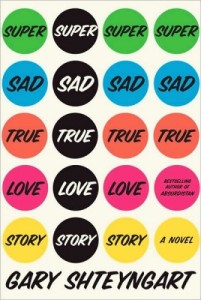
The Dystopian World of Super Sad True Love Story

Posted April 29, 2011 by Michael @ Knowledge Lost in Literature / 0 Comments

I love the dystopian genre; the feeling of hopelessness that needs to be overcome makes a great backdrop for a novel. But unlike most books in the dystopian genre, Super Sad True Love Story really stuck with me, more than any other. I’ve been pondering this for a while and I have come to the conclusion that the reason is the fact that this dystopian world feels so close to our future that it feels like this is what our future will be like.

For those who have not read Super Sad True Love Story, I highly recommend it. The novel is set in a very near future—oh, let’s say next Tuesday—where the world is dominated by the Media. The story is centred on a thirty nine year Russian immigrant, Lenny, and what could likely be the world’s last diary. As well as the object of his affection; Eunice, who has her side of the story to by a collection of e-mail correspondences on her “GlobalTeens” account.

While this may be a story of a modern relationship; there is so much more in the novel worth exploring. This dystopian back drop mixing in some very interesting concepts;

Media and Retail

The world is controlled by the media, telling everyone how to think, feel and act. No one reads anymore, they are all feed their information from all the shows streaming to them. Like the media today, this is teamed up with the Retail industry. Media and Retail are the high powered jobs of this world; everyone is a slave to fashion.

The Apparatus

The iPhone is gone, replaced with the Apparatus, a device that is required to be worn at all times. This device is the connection to the world, streaming all the news, storing all your personal information; credit rating, personal history and preferences. But this device is so much more powerful than that, it monitors the heart and blood pressure and calculates your attraction to a mate based on history, preferences and the way your body reacts to them. Giving everyone a rating in the following categories; Finances, Personality, Attractiveness and Fuckabililty.

Lack of Privacy

In a world of commercialisation – even porn is mainstream – the Apparatus mixed with reading posts around the world allows all information to be collect and public record. These reading posts will display your credit rating as you walk past. But as this is a world of controlled by Retail and the media telling people to spend, the credit rating is a catch 22; spending money will increase your social rating but decrease your credit rating therefore decreasing your social rating.

There is so much in this book that is worth discussing; it’s a light and humorous read but under the surface it is a witty and intelligently written book. I probably could go on further writing about the dystopian world, including Privatisation of the military and immigration check points, etc. but I have tried to keep this spoiler free. All in all, this world is so close to the direction the world is moving, you can almost feel this coming.

Support Knowledge Lost and my reading habits, If you wish to get a copy of Super Sad True Love Story: A Novel do so here.


BBC Magazine's — Frankenstein: 10 Possible Meanings

Posted March 15, 2011 by Michael @ Knowledge Lost in Literature / 0 Comments

I stumbled across this story (thanks to twitter) by BBC Magazine and though it was absolutle brilliant and had to share it with everyone I know. All credit should go to Tom Geoghegan who wrote this article.

Frankenstein: 10 possible meanings

The idea emerged from a summer that didn’t happen.

Due to the largest volcanic eruption for more than 1,600 years, in Indonesia in late 1815, the northern hemisphere was plunged into a freakishly cool and sunless summer the following year.

On the shores of Lake Geneva, the miserable weather kept five British tourists cooped up inside a villa for days, where they passed the time in a horror story-writing competition. The 19-year-old Mary Godwin, in Switzerland with poet Percy Shelley, envisioned “the hideous phantasm of a man” and turned her contribution into a novel published anonymously in 1818.

It told the story of a Swiss scientist, Victor Frankenstein, who is so horrified by the ugly creature he brings to life from assembled body parts that he abandons him, with terrible consequences.

Within a few years, the novel was being adapted for the stage, and in the 20th Century there were many memorable film versions that took the work in different directions. This week, a production by Slumdog Millionaire director Danny Boyle at London’s National Theatre is being screened live to 400 venues in 22 countries.

Nearly 200 years after that sunless summer, the novel is considered a landmark work and every decade brings a new interpretation. Here is a selection – some include plot details.

1. Science can go too far

The term “Frankenstein foods” – applied to genetically modified products – suggests the name of the novel has become a byword for bad science. But this metaphor is unfair, says Angela Wright, a lecturer in Romantic literature at the University of Sheffield.

“There’s evidence that she was very conversant with the scientists of her day. But she believed in the sanctity of human life and knew the work of Lawrence and Abernethy, who were working in Edinburgh in the 1810s in dissection theatres, on the re-animation of corpses. [Her husband] Percy Shelley was also very interested in that.”

She thought these people had crossed a line, says Wright, but she had a lot of admiration for scientific thought in general.

2. Actions have consequences

Boris Karloff in the 1931 film Frankenstein

It’s not just the responsibility of creating life that Shelley wants to emphasise, says Wright, and this is clear in the letters of Robert Walton that frame the Frankenstein story – the wider narrative that is often overlooked.

Walton is the seafarer who rescues Frankenstein from an ice float deep in the Arctic, as the scientist pursues the monster. Encouraged by Frankenstein, the captain ignores the pleas of his crew to to turn back, actions that Shelley appears to condemn.

“Walton doesn’t take responsibility for the safety of his men and that is criticised within the novel. He comes round but regretfully, simply because the atmospheric conditions are against him, not out of concern for his men.

“He seems to be a very shadowy double of Victor Frankenstein in many ways, because he pants for tales of romance and adventure in the same way.”

3. Don’t play God

“As suggested by the novel’s subtitle, The Modern Prometheus, Victor Frankenstein is an example of the Romantic over-reacher, who transgresses boundaries between the human and the divine,” says Marie Mulvey-Roberts, author of Dangerous Bodies: Corporeality and the Gothic.

According to Greek myth, Prometheus stole fire from the gods and gave it to man, and suffered eternal punishment. The sense that Frankenstein has pursued forbidden knowledge is further underlined by the references to Milton’s Paradise Lost, a work the creature reads and recites. His rejection by his creator can be seen as a second Fall of Man.

4. A warning about freed slaves

Mary Shelley

Shelley was writing the novel a mere 10 years after the abolition of the slave trade in the British Empire, and she did so in Bath, not far from the port of Bristol, where many of the slaving ships departed the country. There are references to it in the novel, says Mulvey-Roberts.

“Frankenstein says he is enslaved to his work, and the creature escapes like a refugee slave, pursued by his master. But then there’s a power shift, so you get a hegemonic master-slave dialectic where the slave is a master and the master is a slave to his work and to his obsession.

“Mary Shelley was certainly no supporter of slavery but she did not protest when [Foreign Secretary George] Canning used the analogy of the Frankenstein as a spectre warning of the danger of slaves being emancipated too quickly. In the novel when the creature assumes mastery, he causes mayhem leading to the loss of life.”

5. Shelley’s maternal guilt

Many critics think the novel is shaped by the tragic events in Shelley’s own life. Her mother died days after she was born and Shelley herself lost her first child, born prematurely.

The first feminist interpretation of Frankenstein was by Ellen Moers, who read Shelley’s novel as a sublimated afterbirth, says Diane Hoeveler, from Marquette University in Wisconsin, US.

“The author expels her own guilt both for having caused her mother’s death and for having failed to produce a healthy son for Percy, as his legal wife Harriet had done three months earlier.

“For Moers, the novel’s strength was to present the ‘abnormal, or monstrous, manifestations of the child-parent tie’ and in so doing, ‘to transform the standard Romantic matter of incest, infanticide, and patricide into a phantasmagoria of the nursery’.”

6. Post-natal depression

The feminist movement has championed the elevation of Mary Shelley to canonical rank, says Prof John Sutherland, former Booker Prize judge and an expert on Victorian fiction. And there are moments when the creation appears to be presented as a birth and Victor Frankenstein as a stricken mother.

“It was on a dreary night of November, that I beheld the accomplishment of my toils… It was already one in the morning; the rain pattered dismally against the panes, and my candle was nearly burnt out, when, by the glimmer of the half-extinguished light, I saw the dull yellow eye of the creature open; it breathed hard, and a convulsive motion agitated its limbs. How can I describe my emotions at this catastrophe, or how delineate the wretch whom with such infinite pains and care I had endeavoured to form?” (Frankenstein by Mary Shelley, Chapter five)

Is this, asks Sutherland, inventor’s remorse or post-natal depression?

7. Monsters are not born monsters

The creature’s initial innocence suggests you are not born a monster, says Vic Sage, a professor at the University of East Anglia who has written extensively on the Gothic tradition.

“When he looks into the pool and sees himself, you want to shout out at him ‘You’re not a monster, you’re OK.'”

Many of the Hammer films didn’t even give the monster a voice, he says, only capable of grunting the odd word.

“Even with [director] James Whale, it doesn’t ever feel like history could ever be on Boris Karloff’s side. They are thought to be great films but they missed the point of the book.

“Mary Shelley gave him a voice. It’s great that he talks like an 18th Century philosopher because then you have this disparity between his appearance and his speech, which tests the viewer.”

8. Difference should be celebrated, not shunned

Today’s society has a greater understanding of the notion of difference, says Dr Sage, so the scene where Frankenstein rejects his creation, so repulsed is he by his disfigurement, has a wider resonance.

“Everyone reading it now knows that she’s dramatising difference in the most absolute way possible. Differences in race and class. That’s why it’s very important to think that the creature is a creature and not a monster, and that he has a voice.”

9. Vive la revolution

Frankenstein’s creature has been interpreted as symbolic of the revolutionary thought which had swept through Europe in the 1790s, but had largely petered out by the time Shelley wrote the novel.

Critics said the creature’s failure to prosper and the havoc unleashed was evidence that Shelley was anti-revolution, unlike her radical parents and husband, and supportive of the old order.

But by applying modern values to the narrative, it is clear that the failings lie with man, the creator, and not the creature, says Dr Sage.

“That’s the notorious riddle: Who is the ‘new Prometheus’ of the title – Victor or his creature? You can read into it that it’s a failure of the revolution that he represents, but only if you don’t have the psychological and social attitudes of today.”

10. Christian allegory

The book is really a dialogue between reactionary and progressive points of view, says Sage, and this applies to the question of the presence of Milton and the Christian story – the treatment of the Fall – which it puts under the glass.

“The creature has read Milton but, as he says, he feels more like the fallen angel than Adam in that story, because he has to play the part of the outcast. Mary Shelley dramatises the conflict between the Romantic view of Satan as a Promethean hero, out to take God’s place, which was the projection of a set of male poets – Blake, Shelley, Byron and Goethe, for example – and the havoc that such idealistic projects wreak domestically, in people’s actual lives.”


Why Study Literature?

Posted February 18, 2011 by Michael @ Knowledge Lost in Literature / 0 Comments

Recently I posted a blog post about what I would teach if I was to do a class on English Literature 101.  The topic sparked a lot of debate and I was very happy with the post. But I was asked this week, why I read so much and why I would want to teach English literature. The short answer is the fact I love reading and it’s an exciting topic; but I’ve been pondering the question and trying to get a deeper more extensive answer.

As most people know, I never was much of a reader until recently, when I started my journey into educating myself; I discovered a real joy in reading. It’s easy to just look at reading as just an activity to do for enjoyment but I believe there is so much more to reading and there is a lot to gain from studying literature.

To benefit from others beliefs, bias, insight & knowledge

The world of literature has a wealth of knowledge we can learn from and if we take the time to study and analyse what we read, we have access to some interesting points of views. This information can give us access to many different aspects, from first-hand accounts of history, their personal understanding of the world and even a different take on the philosophy and culture we live by and in. While it’s important to remember that what we read is in the view point of someone else, this bias view can help us redefine or strengthen ourselves.

Self Improvement

I can think of so many ways reading can help you improve; from simple things like improve vocabulary, exercising our brains, learning from others mistakes and helping to define a writing style. While I think these are great; there is one more reason why reading can help you improve and I want to focus on this one. Reading encourages us to question “accepted” knowledge; in school we are taught that we have to accept what we are taught as fact, and those basic hypotheses are the building blocks of knowledge. However the human progress doesn’t work this way. When we get older we begin to question things more and more. The main problem is we often just form assumptions based on what we know and don’t take the time to analyse the information. When we read (especially nonfiction) we are forced to look at information from other points of view and while we don’t always agree with it, inevitably we are forced to look at ourselves. While people “say what they mean and mean what they say” ultimately we need to learn to open our minds to the ambiguities of world.

Exploration

While most people say they read as a form of escape, it is important to remember that we are able to learn while we are escaping our world. We can be learning empathy just by reading a tragic story; we can be learning about other cultures and their views and even into the mindset of a different type of person. There is so much about the world we can discover.

Maybe we don’t take the time to analyse what and why we are reading but maybe subconsciously we are learning something new. I’d like to think every book I’ve read is teaching me something different and while I don’t take the time to analyse every book, I do try to understand and judge the books content for myself.


What Would You Read in an Introduction to Fiction Course?

Posted February 1, 2011 by Michael @ Knowledge Lost in Education, Literature / 16 Comments

Currently on the curriculum for the Ohio State University course, An Introduction to Fiction is Twilight by Stephanie Meyer. I’ve also heard of some other high schools and universities using it as an introduction to fiction or gothic fiction courses. At first I felt sorry for all the future English majors who will have to read this book. But I thought, instead of bad mouthing the book (which is so easy to do), I would take some time and think about what I would want to see in an introductory course of fiction.

I started by compiling a list of topics I would want to cover if I ever did a course about fiction. I narrowed it down to ten key topics when looking at fiction;

  1. Plot
  2. Characterisation
  3. Dialogue
  4. Point of view
  5. Setting
  6. Style
  7. Narrative
  8. Themes
  9. Genres
  10. Concepts/Issues


It was the last point that stood out to me more than any of the other topics. When looking at good fiction, I would want to look at the issues that drive the discussions about these books. With this I picked out five books that would explore moral, social, philosophical or intellectual issues. When picking the books, I also tried to pick different genres and writing styles that make for a great read.


So if I was to create an introduction to Fiction course, my reading list would include;

I would love to know what you would pick for a reading list if you were to lead a similar course.


Is The Book Always Better Than The Movie?

Posted January 11, 2011 by Michael @ Knowledge Lost in Literature / 0 Comments

Book-into film-adaptations is a tricky subject.  Sometimes it’s easier to take the hard line and say the book is always better than the movie, but this isn’t always the case. With some interesting choices for adaptations coming out this year (Pride and Prejudice and Zombies, The Dark Tower & the upcoming TV series; Game of Thrones) as well as some classics redone (The Hobbit, Jane Eyre & The Three Musketeers), I thought that we should see if we can work out, what makes a good adaptation?

I don’t think it’s fair to say all books are better than the movie.  There have been some great examples to prove this isn’t the case such as Bridget Jones Diary & High Fidelity. In fact, one of the first blockbuster movies was adapted from a very ordinary book (Jaws).

But it doesn’t stop there; sometimes great books do make great movies. These books normally have a strong narrative drive; The Road is a really dense novel, full of ideas, very exuberant prose and great language, yet it made a great movie, surprising many, because of the narrative.

A great adaptation also needs to capture the essence of the book; we want fidelity between the book and the film but there is a problem with this. If a filmmaker does a faithful adaptation to the book the people will say you lack imagination, but if you make a movie without perfect fidelity you run the risk of been chastised by the fans of the book.

One of the major problems with adaptations is the fact that as a novel there are all these different ways of expressing character but as a film writer there is only action. A novel can have thousands of ideas and perspectives but in a film it needs to be distilled into one central idea.  There was a quote from someone who worked on the Harry Potter movies that really explained this; “We’re not trying to hit all the bases and reproduce all the favourite characters and the favourite scenes cos that, in itself, is not enough. The film has to have meaning. And you need to distill that and that’s your job as an adaptor.”

On a rare occasion there comes a movie that takes a creative spin on their adaptation and does it really well. From a modern retelling of Romeo + Juliet & the BBC series Sherlock to the ground-breaking Bladerunner which ignores the central theme of the book almost completely. Taking a completely different direction on a book is often risky but can have surprising results.

‘The book is better than the movie’ may not be a golden rule, (but I think there should be a rule that “You need to read the book before seeing the movie”) however, movie adaptations can successes or failures, and more often than not they do fail. On a side note, I think graphic novels adapt a lot better than a novel ever does, is this because it’s almost a screenplay already? I would love to know some examples of good and bad adaptations, as well as your opinions on the subject.


William S. Burroughs & Surrealist Writing Methods

Posted November 19, 2010 by Michael @ Knowledge Lost in Literature, Writing / 2 Comments

Post-modern author, William S. Burroughs is best known for his experimental writing style.  He was a primary figure of the Beat Generation and a major influence in popular culture as well as literature.

In 1959, he released Naked Lunch which he described as “Automatic writing gone horribly wrong”. Previously, I have posted about Automatism, but it is a process of writing where the writer tries to avoid conscious thoughts.  Burroughs has said that Naked Lunch wasn’t a book he wanted to write, but he had no choice but write it: he couldn’t write anything else.  When it came to using André Breton’s method of automatism; where the subconscious focuses on one image or phase, Burroughs found his subconscious was taken over by a hostile entity. The results speaks for its self, Naked Lunch is not only full of obscene language but completely weird.

William S. Burroughs moved to Paris in the 1960’s where he met a painter named Brion Gysin. The two of them are often credited for rediscovering an old surrealist method known as Cut-up. This technique is when you take a finished piece of text, cut it up and rearrange it for a completely new novel. Burroughs experimented with this technique, which resulted in The Nova Trilogy; also known as The Cut-up Trilogy. The first book in the trilogy, The Soft Machine, was the result of the two on a journey (with the aid of some recreational drugs) to find hidden meanings in Naked Lunch. Using the cut-up technique, Burroughs wanted to find the answer to the question that had been plaguing him; the question of control; why did he have no control over the writing of Naked Lunch? The Soft Machine was first published with 182 pages; though in the second edition Burroughs removed 82 pages, replacing them with another 82 pages & with the other 100 pages, he rearranged and restructured using further cut-ups.

William S. Burroughs will always be known for his Beat influences, political trenchancies, cultural influences, his satirical writing and hopefully his experimental use of surrealist writing methods.


Olympia Press; Controversy & Erotic Fiction

Posted November 16, 2010 by Michael @ Knowledge Lost in Literature / 4 Comments

It’s hard to imagine a life without a freedom to talk openly about sex. Before the sexual revolution things were completely different and there were two publishers that pushed the boundaries. In 1929 an English man named Jack Kahane formed Obelisk Press, based out of Paris. His goal was to publish books other publishers would not touch for fear of prosecution. Though Obelisk Press went bankrupt, it paved the way for dbs (dirty books) later known as Erotic Fiction. Obelisk Press published books like Henry Miller’s Tropic of Cancer, DH Lawrance’s Lady Chatterley’s Lover & James Joyce’s Haveth Childers Everywhere (often considered a working progress of Finnegans Wake).

While Jack Kahane laid the ground work, it was his son Maurice Girodias, who pushed the envelope on censorship. In 1953 Maurice started Olympia Press, a rebranded Obelisk Press which came under fire straight away for Austryn Wainhouse’s English translations of Marquis de Sade’s Justine. In a move that put Olympia Press under a lot more fire, Maurice started offering good money for dbs, though most of these books were eventually banned they were able to make a small profit before being removed from the shelves. Obelisk Press were responsible for such books like Lolita by Vladimir Nabokov, The Naked Lunch by William S. Burroughs & The Ginger Man by J. P. Donleavy.

Though both publishers ended in bankruptcy, they did pave the way with controversy and erotic fiction in English literature. Apart from the controversy it start the ball rolling for other authors and took the risk in publishing book others wouldn’t. What would books be like nowadays if no one printed books like Lolita, The Naked Lunch or James Joyce’s works?