Category: Literature

Why I Think Liar is Tone Deaf to Today’s Environment

Posted September 14, 2019 by Michael @ Knowledge Lost in Literature / 0 Comments

Nofar was an ordinary teenager but one statement has flung her life into the spotlight. Taking her from a girl that felt invisible in the world to the focus of the media. The only problem was, she lied; what she said was just a slip of the tongue. Liar is a novel by psychologist Ayelet Gundar-Goshen that explores the fallout of lies in a contemporary world.

I wanted to write this review to vent about this book and turned to writing to try and understand my own feelings. Just as a warning, I need to spoil the lie in order to talk about the novel as a whole, so if you do not want spoilers, this is your warning. Nofar said she was raped by famous singer, Avishai Milner. Liar wants to explore the ripple effects of a false accusation. Which sounds like an interesting topic to explore, until you stop to think about it.

I feel like tackling this topic is a little tone deaf, particularly in a time where the #MeToo movement is still a big issue. Not only that, the fact that women struggle to be believed when it comes to sexual assault. When I think about the statistics, this novel makes me angry. Look at the amount of rape cases that end in a conviction verse the amount reported, and then there is the fact that three out of four victims don’t report their attack. Finally, but not really as important, if this novel was written by the man, can you imagine the outrage?

I think the topic is interesting and I can imagine a false accusation would destroy someone’s reputation completely but so much needs to change in the justice system first. Putting aside these thoughts, and judging the book as a novel, I cannot say that I enjoyed the style, there were too many unnecessary similes to be found. One cringe worthy example is; “Nofar took the key that was hanging on a hook like a suicide”. I am not a fan of this style of writing, I much prefer a minimalistic approach, keeping the sentences sharp and to the point.

Please remember this is my opinion, written in the heat of the moment, right after finishing the novel. I wanted to get my thoughts down, because I worried that I might have been overreacting and reviews are the best way for me to explore my feelings towards literature. I did finish Liar because I was curious about the direction the novel took. If the novel sounded interesting to begin with, please try it, I am curious to see what others think.


#100BestWIT: My Nominations

Posted August 23, 2019 by Michael @ Knowledge Lost in Literature / 0 Comments

This Women in Translation Month, Meytal (Biblibio) has decided to include another project to find the 100 best women in translations. She asked everyone to nominate their top ten WIT books and will compile a list to be released at the end of the month. I was excited for this project but quickly found it difficult to narrow down my choices. At first, I thought about making strategic choices to ensure some great books make the list but since there are over 650 books nominated from over 1200 votes, I just went for my favourites. This however did mean I had to painstakingly narrow a list of twenty books down to get to these ten. Unfortunately books like The Lover by Marguerite Duras (translated by Barbara Bray), Belladonna by Daša Drndic (translated by Celia Hawkesworth), La Bastarda by Trifonia Melibea Obono (translated by Lawrence Schimel) and Crimson by Niviaq Korneliussen (translated by Anna Halager) are not listed even though they probably deserve a spot.

So, here are my official nominations for the #100BestWIT

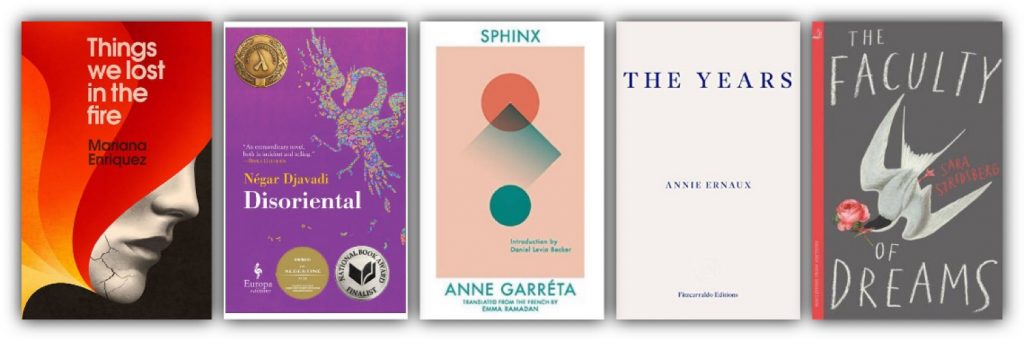
Things We Lost in the Fire by Mariana Enríquez (translated by Megan McDowell)

Let’s start with the obvious one, while contemplating my nominations, I found myself re-reading Things We Lost in the Fire, and it still holds up as a great short story collection. I love the way that each story is unique but work together to explore the theme of violence towards women. If you like the film Get Out and the way Jordan Peele used horror tropes to explore social issues, then this collection is for you.

Disoriental by Négar Djavadi (translated by Tina Kover)

For the people that know me, most of these nominations are no surprise, particularly my first three. Disoriental is one of those books that should have got more attention that it did; it should have won more literary awards. This novel explores the life of Kimiâ Sadr, who fled Iran at ten years old and is now sitting in fertility clinic looking into her options.

Sphinx by Anne Garréta (translated by Emma Ramadan)

I may have read Sphinx by Anne Garréta back in November last year but there has not been a day go by where I have not thought about this amazing book. Anne Garréta was the first female to join the Oulipo, an experimental literary group that likes to put constraints on their writing to force themselves to be more creative. In Sphinx, the constraint is the fact that the narrator and their love interests’ gender are never revealed. This makes it read like a non-binary love story.

The Years by Annie Ernaux (translated by Alison L. Strayer)

This memoir explores Annie Ernaux’s life from 1941 to 2006. Paris is changing drastically and Ernaux is growing up. I loved the way this book explores the changing lifestyle of both the writer and the city. From post-World War II, existentialism, and the huge advances in technology. This memoir is very French, but it was an amazing read, so much so that I had to include it on this 100BestWIT list.

The Faculty of Dreams by Sara Stridsberg (translated by Deborah Bragan-Turner)

This is a fictionalised account of the last years of extreme feminist Valerie Solanas. She wrote the SCUM Manifesto, in which the SCUM is believed to mean the Society of Cutting Up Men. She attempted to assassinate Andy Warhol and this book follows her life from the trial until her death. What I love about this novel is the character of Solanas, she is a witty, intelligent and angry feminist. I thoroughly enjoyed reading about her, but never want to meet her in real life.

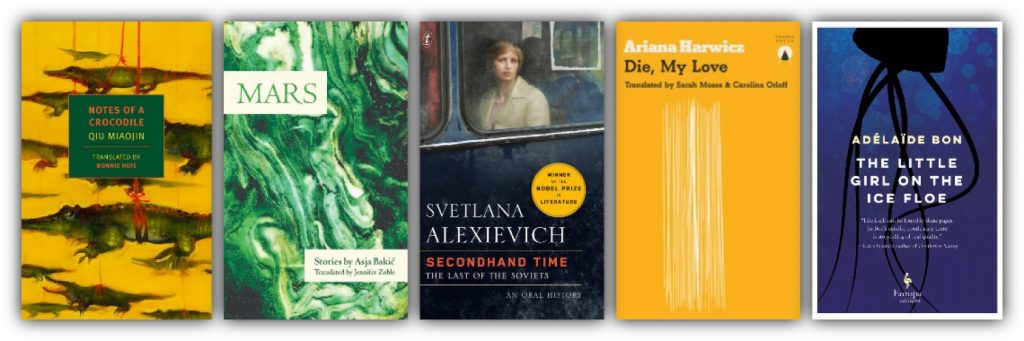
 Notes of a Crocodile by Qiu Miaojin (translated by Bonnie Huie)

This is the most recent book I have added to my favourites list. This cult classic is a satirical post-modern piece of autofiction, in which queer people are depicted as crocodiles disguised as humans. Qiu Miaojin uses this metaphor to explore her feelings of being an outsider in society. This is an exploration into queer people struggling to find their place in the world, or to make connections with each other. The raw emotions playing out in this novel are only amplified by the fact that Qiu Miaojin suicided at 26.

Mars: Stories by Asja Bakić (translated by Jennifer Zoble)

Do I have to say more than Mars is a feminist collection of science fiction short stories from Bosnian? There is something about the way Mars blends the speculative with humour, gender politics and the post-Soviet style that really stayed with me. I read this after reading the entire Man Booker International longlist this year, I thought I was reading a palette cleaner, but I got so much more than I expected from Mars.

Secondhand Time by Svetlana Alexievich (translated by Bela Shayevich)

One of the few women to win the Nobel Prize for Literature, Svetlana Alexievich has a unique approach for interviewing people and creating a narrative. I could recommend any of her books here, but I chose Secondhand Time because of my interest in the Soviet era and its collapse. I learnt so much from reading the differing opinions around Russian history and I think Alexievich has an amazing ability in collecting differing opinions.

Die, My Love by Ariana Harwicz (translated by Sarah Moses and Carolina Orloff)

I love Argentine literature and I am a little surprised that there isn’t more on this list. What I love about Die, My Love is the intense raw emotion found within the 128 pages. I can’t think of many other novels that can pack so much emotion so tightly. The narrative that Ariana Harwicz is able to weave is so affecting; we are able to follow this vivid portrayal of a mother and experience every single emotion and thought, no matter how dark or disturbing it may be.

The Little Girl on the Ice Floe by Adelaïde Bon (translated by Tina Kover)

This memoir explores the effects of sexual assault on a women’s life. The experience Adelaïde Bon had as a child was so traumatic that her brain blocked it out. However, while trying to understand, through therapy, why certain words or smells triggered her, she was able to uncover the root of her trauma. A third person perspective allows her to experience her own life while feeling like she has no control over it. This narrative style is what stood out in the book. As disturbing as the topic may be, this is an important piece of literature and the writing style is so beautiful, it really is a must read.


Podcasting for a Year

Posted April 18, 2019 by Michael @ Knowledge Lost in Literature / 9 Comments

It is hard to believe that it was a year ago when I first started my podcast Lost in Translations. For a long time, I had considered starting the podcast, but I was also hoping someone else would create a podcast dedicated to translated literature. It feels like it is always the way, you go searching for content you want to consume not finding any, leaving you with no choice but creating it yourself (with the help of my wife). Normally that is then when you find all the same type of content, it happened when I started BookTube, but I still haven’t found a podcast similar.

Starting this podcast was stressful, there was a lot of time thinking about the best way to format everything, not to mention imposter syndrome. I am still relatively new into the world of translations, but I have found my niche; I love this corner of the literary world. I predominately read books in translation now, to the point where I normally avoid English books completely. I have a passion for books in translation, so I am always finding new ways to try and promote this form of literature, from this blog, to BookTube, the news/collaborative project in Translated Lit and the podcast Lost in Translations. If I can find other ways to promote translations, you can be sure that I will look into it, I do have Instagram and Tumblr where I also post about translations.

Now a year after starting Lost in Translations, I can honestly say that I am glad it exists in the world. I still have imposter syndrome, which does not help when trying to find guests for the podcast, in fact that is probably the biggest struggle. I like the way that the podcast feels more like a casual conversation about translations, rather than a deep dive into a book. In the future I would love to expand the podcast to more than just book discussion episodes. There are a few episodes that are currently taking on a different format, from the introduction episode, the 2018 WITMonth recommendations, best of 2018, and the 2019 Man Booker International longlist. I hope to do more like this in the future. My ultimate goal would be able to get a wide range of guests, enough to turn the podcast into twice a month. The first episode being a discussion about the guest’s experiences with translated literature or a particular theme while the second being a recommendation or book discussion episode. However, that feels like a long way off.

I am hoping that this next year will continue to be great for Lost in Translations, with growth and new and exciting guests (let me know if you are interested). I want to thank all the listeners and guests; without them this podcast would not exist. But I also need to give a special thank you to our Patreon supporter Miriam from BetweenLinesAndLife, her support has helped cover some of the costs of hosting this podcast. Hopefully this will be the year the podcast has it costs fully covered by Patreon, which will mean expansions can happen, but I am just grateful for all support.


The Longlist for the 2019 Best Translated Book Award

Posted April 15, 2019 by Michael @ Knowledge Lost in Literature / 0 Comments

Adding the longlist for the Best Translated Book Award (BTBA) to track which books I have read. As the longlist for fiction is 25 books long, I will not be trying to complete the entire list, but I would love to complete as many as possible. It is a great list, which is to be expected from the BTBA.

Here is the longlist for fiction;

  • Congo Inc.: Bismarck’s Testament by In Koli Jean Bofane, translated from the French by Marjolijn de Jager (Democratic Republic of Congo, Indiana University Press)
  • The Hospital by Ahmed Bouanani, translated from the French by Lara Vergnaud (Morocco, New Directions)
  • A Dead Rose by Aurora Cáceres, translated from the Spanish by Laura Kanost (Peru, Stockcero)
  • Love in the New Millennium by Xue Can, translated from the Chinese by Annelise Finegan Wasmoen (China, Yale University Press)
  • Slave Old Man by Patrick Chamoiseau, translated from the French by Linda Coverdale (Martinique, New Press)
  • Wedding Worries by Stig Dagerman, translated from the Swedish by Paul Norlen and Lo Dagerman (Sweden, David Godine)
  • Pretty Things by Virginie Despentes, translated from the French by Emma Ramadan, (France, Feminist Press)
  • Disoriental by Negar Djavadi, translated from the French by Tina Kover (Iran, Europa Editions)
  • Dézafi by Frankétienne, translated from the French by Asselin Charles (published by Haiti, University of Virginia Press)
  • Bottom of the Sky by Rodrigo Fresán, translated from the Spanish by Will Vanderhyden (Argentina, Open Letter)
  • Bride and Groom by Alisa Ganieva, translated from the Russian by Carol Apollonio (Russia, Deep Vellum)
  • People in the Room by Norah Lange, translated from the Spanish by Charlotte Whittle (Argentina, And Other Stories)
  • Comemadre by Roque Larraquy, translated from the Spanish by Heather Cleary (Argentina, Coffee House)
  • Moon Brow by Shahriar Mandanipour, translated from the Persian by Khalili Sara (Iran, Restless Books)
  • Bricks and Mortar by Clemens Meyer, translated from the German by Katy Derbyshire (Germany, Fitzcarraldo Editions)
  • Convenience Store Woman by Sayaka Murata, translated from the Japanese by Ginny Tapley Takemori (Japan, Grove)
  • After the Winter by Guadalupe Nettel, translated from the Spanish by Rosalind Harvey (Mexico, Coffee House)
  • Transparent City by Ondjaki, translated from the Portuguese by Stephen Henighan (Angola, Biblioasis)
  • Lion Cross Point by Masatsugo Ono, translated from the Japanese by Angus Turvill (Japan, Two Lines Press)
  • The Governesses by Anne Serre, translated from the French by Mark Hutchinson (France, New Directions)
  • Öræfï by Ófeigur Sigurðsson, translated from the Icelandic by Lytton Smith (Iceland, Deep Vellum)
  • Codex 1962 by Sjón, translated from the Icelandic by Victoria Cribb (Iceland, FSG)
  • Flights by Olga Tokarczuk, translated from the Polish by Jennifer Croft (Poland, Riverhead)
  • Fox by Dubravka Ugresic, translated from the Croatian by Ellen Elias-Bursac and David Williams (Croatia, Open Letter)
  • Seventeen by Hideo Yokoyama, translated from the Japanese by Louise Heal Kawai (Japan, FSG)


Here is the longlist for poetry

  • The Future Has an Appointment with the Dawn by Tenella Boni, translated from the French by Todd Fredson (Cote D’Ivoire, University of Nebraska)
  • Dying in a Mother Tongue by Roja Chamankar, translated from the Persian by Blake Atwood (Iran, University of Texas)
  • Moss & Silver by Jure Detela, translated from the Slovenian by Raymond Miller and Tatjana Jamnik (Slovenia, Ugly Duckling)
  • Of Death. Minimal Odes by Hilda Hilst, translated from the Portuguese by Laura Cesarco Eglin (Brazil, co-im-press)
  • Autobiography of Death by Kim Hysesoon, translated from the Korean by Don Mee Choi (Korea, New Directions)
  • Negative Space by Luljeta Lleshanaku, translated from the Albanian by Ani Gjika (Albania, New Directions)
  • Scardanelli by Frederike Mayrocker, translated from the German by Jonathan Larson (Austria, Song Cave)
  • the easiness and the loneliness by Asta Olivia Nordenhof, translated from the Danish by Susanna Nied (Denmark, Open Letter)
  • Nioque of the Early-Spring by Francis Ponge, translated from the French by Jonathan Larson (France, Song Cave)
  • Architecture of a Dispersed Life by Pable de Rokha, translated from the Spanish by Urayoán Noel (Chile, Shearsman Books)

Man Booker International Predictions

Posted March 6, 2019 by Michael @ Knowledge Lost in Literature / 6 Comments

There is a part of me that looks down at literary prizes. I have been thinking about this since reading The Parrots by Filippo Bologna (translated by Howard Curtis), the politics that goes into selecting a list and a winner really detracts from literary merits. I agree there needs to be a better balance in representation when making a longlist for a prize, but every judge has their own tastes and opinions, it becomes more about compromise than merit. Is there a perfect solution? No, we have to do the best with what we have.

At the same time, I love to be part of the conversation, I want to read the Man Booker International list and talk about the books selected. Whether it is to just to speculate, or just complain. It is just nice to be part of a community talking about the same books. My love for books in translations, means that it isn’t often that I am able to talk about the same books as other people. This is why I follow a prize like the Man Booker International Prize.

I get the feeling that the longlist will feature the few translations that have actually had more of a commercial success. From the deserving (Convenience Store Woman), to the not so deserving (The Last Children of Tokyo) and everything in between (Codex 1962). Haruki Murakami might make the list for simply having a book translated this year, Killing Commendatore. Olga Tokarczuk won last year’s prize, which could mean Drive your Plow over the Bones of the Dead is longlisted.

After that, there are just some books that will make the longlist because it will help balance things out. For your gritty, hard hitting bro-lit, you might see Vernon Subutex 2 make the longlist. We need a book from the Middle East, so let’s add The Baghdad Clock. There is nothing from the Americas so in goes The Shape of the Ruins. Finally, for something considered high art, add Tell Them of Battles, Kings and Elephants.

Or you can save yourself all some time and just give the Man Booker Prize to the deserving Disoriental. This book feels like the perfect winner. It has a multi-generational story and deals with both immigration and LGBTQI themes. Besides all that, it is just an amazing novel.

I wanted to share my predictions for the Man Booker International prize as well as try to express my opinions about literary prizes in general. This post did not turn out the way I expected, more tongue in cheek than intended but then again, we can take this prize too seriously. I do not know if I will read the entire longlist, but I will try and be a part of the conversation. I hope I have read enough books that make the longlist, to ease the pressure of trying to complete 12-13 books. Also, please do not let Karl Ove Knausgård make the longlist.

Read More


To All The Books I Loved Before

Posted January 17, 2019 by Michael @ Knowledge Lost in Literature / 14 Comments

Dear Jeff Lindsay,

When I first got serious about reading nine years ago, I was never sure what books would interest me. One of the first things I turned to was Darkly Dreaming Dexter, you know, the first book in the series you created. I was loving the television series and I thought reading the books was a natural progression. You wrote a wonderfully complex character, DexterI read the series because of the show but I knew that the books took a very different direction.

When I picked up Darkly Dreaming Dexter, I was so fascinated by Dexter. It is rare to find such a complex character that toed the line between good and evil. A character that you can sympathise with and yet feel totally disgusted by their actions. As you know, Frankenstein was the book that ignited my passion for reading. It was the dual narrative that really stuck with me, there are two sides to every story and Frankenstein used these two characters to explore a range of different ideas but the one that I identified with is the one where society turned Frankenstein’s creation into a monster. This similarity to the Dexter series is what drew me to the show and the books.

I admit, at first I loved the books; Dexter was just an amazing character. I told myself that I wish I could write like this and in many ways it helped shape me. However the writing is so bad, cringe worthy in fact. Turns out it was not the writing I wanted to emulate; it was the great character. I read all eight books in the series because of the writing, but I cannot tell if I improved as a reader, or if you never improved as a writer. The character of Dexter was enough to sustain me through the series but I can never go back. I have moved on in my reading journey and I have no time for this type of writing anymore.

I will admit that I still love crime books, I love a good antihero but I am yet to find a good series that is able to replace Dexter. It is such a shame to see such an amazing character go to waste. I still have Raymond Chandler, James M. Cain and Jim Thompson to sustain my love for crime literature, I do not need formulaic and terrible writing anymore.

Best of luck in the future

Michael


Dear Haruki Murakami,

What has happened to you? Has fame gotten to you? I rather enjoyed some of your older novels in the past, but now it feels like you have decided an editor was not for you…or maybe you just know whatever you write will sell. I have no idea what 1Q84 was meant to be but I have a hard time appreciating anything about it. In fact, I do not know if any of your more recent works are even worth reading. Sure, I did enjoy Colourless Tsukuru Tazaki and His Years of Pilgrimage as a palate cleanser but I used to turn to you for the surreal and the Kafkaesque.

I know your most notable novel is the very straight-laced Norwegian Wood, so I wonder if you are just trying to relive the success but do you have to continuously remind us of your obsession with younger women? It is getting to the point where we have to wonder if you suffer from Lolita syndrome. I know it is not just you, there are so many writers that make me cringe every time they write about a woman, Ken Follett and Mario Vargas Llosa both come to mind. Maybe it is just an old man writer kink.

I want to read about the surreal, to explore the inner workings of someone’s mind, or even look at the concept of loneliness. You did this so well in the past, Murakami, but now I think it is time for me to move on with my life and find a new author to satisfy my needs. Do you have any suggestions?

I hope you find pleasure in the books you write because I cannot bring myself to read you anymore.

Michael


Dear John Green,

Honestly, I must have gotten sucked into the hype. I very much enjoyed Looking for Alaska, and The Fault in Our Stars made me cry. But when you think about it, it is a little weird for a thirty year old man to read about the romantic endeavours of teenagers. To enjoy reading the characters like Hazel and Alaska, on reflection, makes me cringe. I do not know how you feel about writing these books, you are older than I am. I know they have made you a lot of money and you have single handily revolutionised both Young Adult literature and YouTube, so you should be proud of that.

As for me, I cannot read your books anymore, I liked them in the past, but I was a young reader, I was exploring the world of literature and trying anything and everything. I even read Twilight. I have recently started to find my own niche in the world of books but I am very away that I will have to continue to pay attention to the rest of the literary world. I just will not be reading more of your books.

The concept of Young Adult literature is amazing, it gets people reading and it allows them to explore interesting concepts. In fact I once wrote a blog post about Twilight and tied it to literary theories. I am pretty proud of my review I wrote about Divergent. I have grown as a reader and I am pretty sure Young Adult literature will be left behind. There may be some in my future, the sequel to Grasshopper Jungle perhaps but I am not the right demographic for these books anymore.

There is an obvious discussion to be had about people that never progress pass these books, but it is not one I want to explore here. Looking for Alaska and The Fault in Our Stars no longer have a place on my shelves, I need to make room for books I love and plan to re-read. So goodbye John Green and good luck

Michael


I have grown so much as a reader, it is clear that there will be plenty more books that I enjoy now that in the future would make this list. I wrote this as a way to show that I grew as a reader, and while I enjoy a book, it does not mean that it will remain well loved. I think it is important to remember that growth is a part of the reading journey. Let us not be ashamed of the books we have loved in the past, but reflect on them and see just how much we have grown.


New Translated Lit Project

Posted January 10, 2019 by Michael @ Knowledge Lost in Literature / 4 Comments

I have been wanting to do more to promote translated literature for a very long time. I have a blog, a podcast and have even attempted BookTube. My obsession grew from the need to step away from reading just American authors. My reading stats told me 95% of the reading I was doing was American, and I am an Australian. Starting with the 1001 Books list I quickly discovered Russian classics and then French philosophy. Soon I was challenging myself to read 20, then 50 percent translations.

It wasn’t until last year when I told myself ‘no reading goals’ that I discovered just how much I loved books in translation. I am exclusively reading world literature and if it wasn’t for book club, I might have avoided books originally written in English all together. So, with this newly found obsession, I began trying to learn more about the world of translated literature. I quickly discovered, for an outsider, it was difficult to know what was happening. The common statistic talked about when it comes to world lit is, 3 percent of all books published (in the English-speaking world) are translations. However, for an outsider just getting into translated lit, it felt smaller. To me it felt like most of that was classics; I was not aware of how much contemporary literature was being translated.

With this thought in mind, I started trying to think of ways I could help promote translated lit. I kept coming back to this idea of having a resource where I could find news and information about the world of translated lit. Granted there are sites out there doing their part but places like LitHub, Electric Literature and Book Riot only had a small focus. What if there was something similar but just for world lit?

I believe that we are on the verge of a break out when it comes to books in translation. So many people are trying to understand the world we live in, and people are reading more in translation as a result. The Man Booker International Prize (in its current form) is relatively new, and last year the National Book Award added a prize for translated literature. People are starting to take notice, and what happens when the need to learn more about what is happening in this corner of the literary world? It was with that in mind, the idea was formed for Translated Lit.

This is a huge project and what I would love to see is a resource that help guide people into this world. With news about what is happening, information about literary prizes, recommendations and even long form essays and reviews. A project like this will need voices from around the world, people passionate about translations that want to help share their passion and promote world literature. We need contributors and I do think with enough people, we can help guide anyone interested, we can be a resource for world literature.

My personal goals for 2019 were to write better and to promote translated literature. This felt like the best way to achieve both these goals and the reason for this site was to encourage others to participate. I don’t want this to be considered my site, I want this to be a collaboration and a tool for the people interested. I am still a newcomer to books in translation and I hope this will become a valuable tool for me as well.

With a few people already helping out, I believe we are off to a great start. I hope we can promote many aspects of world lit, offer the latest in news and even recommendations. I personally have ideas I would like to see happen on here, including a way to explore the site by country or publisher. Sometimes you want recommendations for a country, and this could be a way to help with that. Also, there are so many great small presses out there publishing books in translation, we want to be able to support them by promoting their books.

With that in mind, welcome to Translated Lit and please consider becoming a contributor. For established bloggers out there, if you have any essays or reviews that you would love to share, we would love to have that opportunity. We are still working on the design of the site and we want to be able to promote the writers as well as the content. This is to allow others to discover bloggers to follow based on their writing and literary tastes. Any help would be appreciated, and we look forward to making this the start of something great.

Check out Translated Lit


My Favourite Reads of 2018

Posted January 1, 2019 by Michael @ Knowledge Lost in Literature / 15 Comments

I went into 2018 with no real reading goals; I wanted to see where that would lead me. It, in fact, pushed me into my own corner of the bookish world. I love translated literature and I want to promote it more than I already do. Reflecting back on the year, all my favourite books were works of translation. Just over 75% of my reading was translations and it probably would have been higher if it was not for book clubs. From that 75%, I did focus on trying to keep a gender balance and it seems that I achieved that, with 52% being women in translation. I am happy with the direction of my reading in 2018 and I am hoping to see a continuation in 2019.

Now is that time where people start posting their favourite lists. I am tempted to do a count down with music, films and television shows but I am unsure those lists will be as interesting as this post. So, for now here are my favourite reads from 2018.

15. The Door by Magda Szabó (translated by Lex Rix)

Episode four on my podcast, my wife and I listened to the audiobook while on a road trip. Magda Szabó is a great writer and I loved the way she blended auto fiction with what I read as an allegory of the state of Hungary under a collapsing Soviet rule. I am yet to pick up more Szabó but I know she is someone that I need to get back to in the near future (but I am sure I could say the same about many authors.

14. Purge by Sofi Oksanen (translated by Lola Rogers)

I had read Sofi Oksanen in the past and I found her writing overly complex, to the point where I almost dismissed her for the future. Not that When the Doves Disappeared was a bad book, I just felt like I was not smart enough and the writing fragmented in a weird way. Purge, on the other hand, was a much better book; a literary thriller, which is right up my alley, which you will soon discover from the rest of this list.

13. Flights by Olga Tokarczuk (translated by Jennifer Croft)

Winner of the Man Booker International Prize means this book hopefully is getting the attention it deserves. I read this while trying to complete the entire longlist and what drew me to this novel is the unique blend of travel writing and philosophical musing. Sure, this is a work of fiction in the loosest way possible, but who cares, this was just a joy to read. I have my next Olga Tokarczuk ready and waiting, and I have high hopes, 2019 is going to be a great reading year.

12. The Sound of Things Falling by Juan Gabriel Vásquez (translated by Anne McLean)

Can I call 2018 the year of Juan Gabriel Vásquez? I read two amazing novels by this author and I now consider myself a huge fan. There is something about the way he writes himself into his novels about Colombian history. In The Shape of the Ruins we get to learn about the political history of Colombia, and The Sound of Things Falling explores the effects the cartels had on him and Colombia. I am now watching Narcos just to learn more.

11. Convenience Store Woman by Sayaka Murata (translated by Ginny Tapley Takemori)

A book I still think about and it pleases me that it has plenty of literary buzz around it. I am not sure if this is auto fiction but I know Sayaka Murata worked in a convenience store, that is beside the point. Keiko Furukura is happy in her role as a convenience store woman, but social pressures expect more from her. This book challenges social expectations and tries to remind us that we should never judge anyone, not even a fictional character.

10. The Unwomanly Face of War by Svetlana Alexievich (translated by Richard Pevear and Larissa Volokhonsky)

There is not enough translated non-fiction on my list, and I know I need to read more. The Unwomanly Face of War was such an amazing book, but my love for Svetlana Alexievich might make me bias. I really like the way Alexievich collects stories from the people to create a narrative. In this one, we explore just how many women helped Russia in World War II despite the amount of criticism they received from the men around them. Truly these are the unsung heroes of war, stepping up to serve and help in any capacity possible.

9. La Bastarda by by Trifonia Melibea Obono (translated by Lawrence Schimel)

Episode five on my podcast, & quite possibly on of my favourite episodes, but maybe that is because my wife & sister-in-law did most of the talking. The first novel by an Equatorial Guinean woman to be translated into English is an accomplishment alone, but to have this book explore the queer journey from an African view point makes it extra special. I do not know much about Fang culture, their struggles are not that different to those of a Westerner. Even looking at coming of age journey from a western perspective, there is so much to get from this novel.

8. Die, My Love by Ariana Harwicz (translated by Sara Moses and Carolina Orloff)

I have probably talked about my love for Argentinian literature too much, but this short little novel is a great example of why I love it. In under 150 pages Ariana Harwicz was able to pack so much more raw emotion into her book than I thought was possible. This is so intense & emotional, it will hit you hard, but I think it is worth it. I have never experienced post-natal depression/psychosis, but I now have a small idea of what it must feel like. Female Argentinian writers are doing amazing things for the literary world, I recommend you pay them attention.

7. Aetherial Worlds: Stories by Tatyana Tolstaya (translated by Anya Migdal)

Yes, this was another episode of my podcast (episode seven), thank you for noticing. Tolstaya must be living in the shadow of her family name, can she ever compare to Leo Tolstoy? She has proven to me at least that she can carry this huge legacy. Her stories are unique in the way it combines her own thoughts with the aetherial world. The highlight in this book will have to be Smoke and Shadows, it really brings out her wicked sense of humour.

6. Fever and Spear (Your Face Tomorrow 1) by Javier Marías (translated by Margaret Jull Costa)

This may only be book one in the Your Face Tomorrow trilogy but there is something about the writing that makes me want everything ever written by this author. I love a good literary thriller but there is so much more to this novel. It is a metaphysical novel with some of the most elegant writing I have ever read in a thriller-like novel. At times you are not sure if you are reading a spy novel or a work of philosophy and I loved every moment I had with this book.

5. Disoriental by Négar Djavadi (translated by Tina Kover)

If you ask me, the wrong book won the first National Book Award for Translated Literature. Disoriental was my pick and I did read the entire longlist. Not to argue but if you are going to debut a new literary prize, your first winner really speaks to the tone of the award. Obviously, Flights could never win because the National Book Foundation needed to distinguish themselves apart from the Man Booker, but you picked the same author that won the inaugural Warwick Prize for Women in Translation last year. I am not bitter about this choice.
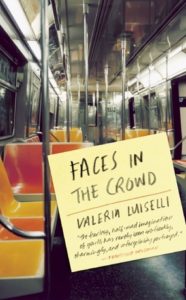
4. Faces in the Crowd by Valeria Luiselli (translated by Christina MacSweeney)

Yes, this was episode two on my podcast, do you see a trend? I think I just love being able to talk about books with people. This book feels like it is diving into the world of translating and as you can see, I read a lot of books in translation. You can see plenty of trends in my reading from this list along, women in translation and Latin American literature for example. When the first page has a line like “I worked as a reader and translator in a small publishing house dedicated to rescuing ‘foreign gems.’ Nobody bought them, though, because in such an insular culture translation is treated as suspicion. But I liked my work and I believed that for a time I did it well.” I know I am hooked.

3. The Seven Madmen by Roberto Arlt (translated by Nick Caistor)

This Argentinian classic has an afterword by Roberto Bolaño, which gives you a sense of the style and was the reason I picked this book up. The gritty pulp-like writing, is one of my favourite styles of writing to read. What elevated it to the top of my list is just how relevant this book is, ninety years later. Exploring the fanaticism of extremist politics, the book is described as “an uncanny prophesy of the cycle of conflict which would scar his country’s passage through the twentieth century” but really this feels prophetic to the rest of the world as well.

2. Sphinx by Anne Garréta (translated by Emma Ramadan)

I have a top fifteen list prepared for the end of the year, but then I read Sphinx and good bye Out by Natsuo Kirino (trans. by Stephen Snyder). I was so close to putting this at number one, it is that good. Sphinx is a non-binary love story from one of the few female members of Oulipo. I love experimental literature and Garréta challenged my gender expectations by never revealing the gender of the narrator or their love interest. Impressive, but can you imagine trying to avoid genders when you write in French?

1. The 7th Function of Language by Laurent Binet (translated by Sam Taylor)

Have you ever read a book and thought this was written just for me? This is how I feel about The 7th Function of Language. This is a literary thriller that explores the world of literary criticism. Roland Barthes, Jacques Derrida, Umberto Eco, Gilles Deleuze, Michel Foucault, Judith Butler, and Julia Kristeva all play a role in this book and I love the way Binet explores literary criticism without making it difficult for the reader to follow along. I am sure a literary expert might get annoyed by all the explanations of literary theories, but I really appreciated it.


Organising My New Book Shelves

Posted December 13, 2018 by Michael @ Knowledge Lost in Literature / 4 Comments

My new bookshelves

A week ago, I was made redundant, a feeling from which I have still not fully recovered. For the last four weeks I was told that I had to show up to work and prepare for this transition. It is meant to be a time where the company can offer support and help try and find new work. Basically, it is a period of time where you are stuck feeling unwanted, not wanting to do any work and waiting to exit from the company. I thought that maybe I could use this time to write and catch up on my blogging or reading but this was not the case. The emotional rollercoaster left me feeling like I was in a slump and not wanting to do much of anything. Every call I got to check up on my felt like I was on suicide watch. It was far more difficult that I could even put into words.

However, I knew I did not want to be there, I was somewhat excited to leave this company. I have been there for twelve years and it felt like the only way I would step out and try something new. So I was excited for the change as well as constantly feeling unwanted. It was a weird cocktail of emotions. It was never really worried about my future, I think I have a plan, I just have to see how it plays out. It was never about the unemployment, I was actually looking forward to some time off, and I had plenty of tasks I wish to complete. It was just the complete combination of everything else and not really knowing how to express everything going on in my head.

Writing about it is not even helping. Usually I find that I am able to fully understand my thoughts when I try to write them down. I have often realised that I felt a particular way while writing. It is weird to discover an emotion you did not know you were having. I am just not very good at expressing myself. Maybe growing up as an outsider has dulled my ability to fully understand my emotions. I know I am not very good at social interactions, so maybe there is a connection.

One of the main tasks for the first week of my redundancy was to sort out some bookshelves. My wife gave me a new bookshelf for my birthday and I had decided to use the two bookshelves in the study as my primary shelves. These are the shelves you see when I film a video for BookTube, so maybe I should fill them with all my books in translation. Obviously, I am new to this niche, so I have combined it with books I love and books I know I want to read. However, the majority of the books on these shelves, I have not read yet, so it pretty much my TBR shelves. I do have a priority pile of books to read in the bedroom, but these are all the other books I want to read. Let’s call it my aspirational reading list.

I added all these books to the shelves in alphabetical order, and it filled up quicker than I expected. The plan is to cull the English books first, but I am hoping this will be a way to start building my library. In other words, if all my other books were to be culled, I would be okay with that. These are the ones I want to keep more than the others. Obviously, I am not going to cull my other books, there are three other shelves full of books, but I am planning to do a major purge. I know I have changed as a reader, and some of these books are never going to be read.

This is my starting point, and I already realise there are gaps that need to be filled. I am missing some Bulgakov, Dostoevsky, and Bolaño. These are authors I love and want to read everything they have written. I have discovered books I have completely forgot about, books I want to re-read right now and books that bring back good memories. A collection of John Keats poetry that remind me of my honeymoon, a Dashiell Hammett novel that I read in Paris, or a beautiful edition of Frankenstein that my wife gave me for our wedding anniversary. These memories and books are all safe together.

My other shelves were never organised in any way and I just love looking through the shelves not knowing what I will discover but with these new shelves I did want the organisation. During the process of sorting the books, I left a whole shelf for a letter that I expected to fill up quickly, like the M’s and N’s but it was never those selves that took up so much space. It was the K’s or the B’s that I was surprised to find the most books. I know it is going to be a lot of work to sort when adding new books to the shelves, but part of the pleasure is going through my shelves.

My dream would be to sort my books out by continent, but I do not own enough books for that, yet. I would easily fill a bookshelf of North American literature but my focus in books in translation would be neglected. I know Europe would be easy to manage but I never want to forget about the rest of the world. I have been focusing on South America lately, but I think more of the books I have read came from the library. Which I will have to start to do more now I do not have a regular income, but these two shelves are there to remind me that I need to read these books and that I need to start filling the gaps. Which will mean, eventually I will need more bookshelves and then I may have enough to sort by continent. These are dreams and goals with my books, I might even have to go through and categorise all these books like a library. Keep track of them in a database, I have the time to do that.

One of the things I love to do is to go to my shelves and look at the books, I know it does not help me keep to my own reading plans, but I just like to be distracted by other books. I am that kind of nerd that is obsessed with literature. You know I am just looking for new ways to talk books with the world.


The Melbourne Writers Festival 2018

Posted September 13, 2018 by Michael @ Knowledge Lost in Literature / 3 Comments

I talked a little about my vacation to Tasmania but I want to take some time to talk about Melbourne. After spending two wonderful weeks exploring what Tasmania had to offer, we finished off with a weekend in Melbourne to attend the Melbourne Writers Festival. There has been sparks of negativity going around about the festival, often directed at the new artistic director, Marieke Hardy. Most of the complaints were directed towards how different the program was this year. The festival had adopted a theme of ‘a matter of life and death’. Which was interpreted as a grim topic but in reality there was so much to discuss.
I know we struggled to pick what events we wanted to attend and had to make some heavy sacrifices in order to accommodate everything. The biggest sacrifice was missing out on seeing J.M. Coetzee. However the events we did attend were all amazing and well worth our time. Starting with Written on the Body, a conversation with essayist Ashleigh Young. I wanted to see this event because I want to find new ways to improve my writing and I was looking for inspiration. Ashleigh Young runs a blog called EyelashRoaming and I have to admit that I think this helped me spark my passion. I feel the need to devote more time writing essays rather than reviews, maybe in the style of journalist articles or just creative non-fiction. I need to practise and craft my skills. I probably should write about a topic and see where it takes me. I am obsessed with literature but maybe I need to write about other topics as well. We shall see where this leads me or if I will fall back into old habits.

Next we heard Masha Gessen talk about her new book The Future is History: How Totalitarianism Reclaimed Russia in her talk The Fifth Estate. I admit I have not read anything from Gessen but I am interested in learning about Russian history. Again this was an event to understand more about the process involved in non-fiction writing. While this event did not give me any writing sparks, it was worth hearing Masha Gessen speak. How do you get to a point where you can be considered an authority of a topic? I will pick up some Gessen books in the future, I think there is so much to learn and she just seems like a writer I should be following.

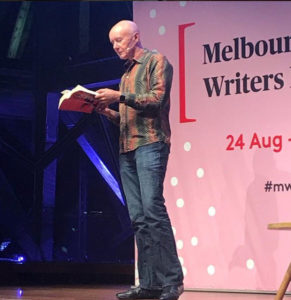
Irvine Welsh reading from Dead Men’s Trousers

Irvine Welsh was next, with his event Redemption. I have read Welsh before and while I have not read Trainspotting I thought it would be good to see him talk about his new book Dead Men’s Trousers. Besides, he was being interviewed by the amazing Omar Musa, and this was my chance to see him speak as well. I am completely clueless about drug culture so when Irvine Welsh started talking about Dimethyltryptamine (DMT), I had no idea what he was talking about. I am a fan of transgressive literature, so a chance to see Irvine Welsh was one I had to take, though I can honestly say I may never read his novels in the future. From the outside, I feel like Welsh is a little self-destructive but that is very judgemental, however it feels like it links with his writing style. Although I think maybe Welsh has slowed down in his old age. If I wrote fiction, I have an idea to write about someone who wishes to be a writer and thinks that being self-destructive is the way to approach that dream (sort of an auto-biographical look at my past but taking it much further).

I feel like I was the only male in the next event, which was called Sacred Texts: The Book That Made Me a Feminist. This had writers Neko Case, Maxine Beneba Clarke, Michelle Law, Hollie McNish and Emily Nussbaum all in conversation with Zoya Patel about literature, television, music and movies. I love an event that is just a casual conversation about books, it is what I look for when picking an event, as well as picking a podcast. I was pleased to discover Emily Nussbaum who gave plenty of great TV show recommendations. We actually watched Claws on her recommendation. This is the type of event that made me excited to talk about literature and disappointed not many men showed up. The first book that made me a feminist was probably Frankenstein.

Leigh Sales was hosting an event called A Toast: Leigh Sales’s Dream Dinner Party. Being a fan of her podcast Chat 10 Looks 3, we made sure we had tickets. This event had Leigh talking to Lachy Hulme (Romper Stomper), Tony Martin (Martin Molloy), Jan Sardi (Shine) and Samantha Winston (Wentworth) about movies. While I would have preferred to have a talk about literature, like I said before, I like the casual conversation approach. The final event was a conversation about the SBS mini-series Homecoming Queens. Yumi Stynes talks with show creators Corrie Chen and Michelle Law as well as Yassmin Abdel-Magied. This was an amazing event, it was just nice to see four women talking about representation and their own thoughts on the state of the media and pop-culture. If you have never seen Homecoming Queens, I highly recommend you checking it out. I believe it is still on SBS On Demand. We may not have met the amazing Michelle Law but we did meet her mother. Before the event we were casually talking about Michelle and Benjamin Law, when we discovered their mother was standing in front of us.

The Melbourne Writers Festival, to me seems to be doing something far more interesting than the standard writer’s festival. The themed events offered a continuity between the events but still leaving it up to interpretation. I was pleased to see a lot of diversity in the events and speakers. I hope Marieke Hardy continues on as the artistic director, I expect a lot of great events in the future. I just hope I get a chance to see some of them.