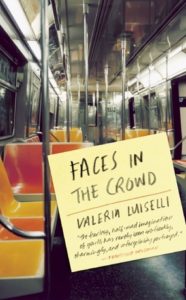
Faces in the Crowd by Valeria Luiselli

Posted July 21, 2018 by Michael @ Knowledge Lost in Contemporary / 0 Comments

Faces in the Crowd by Valeria LuiselliTitle: Faces in the Crowd (Goodreads)
Author: Valeria Luiselli
Translator: Christina MacSweeney
Published: Coffee House Press, 2011
Pages: 146
Genres: Contemporary
My Copy: Paperback

Buy: AmazonBook DepositoryKindleWordery (or visit your local Indie bookstore)

Faces in the Crowd is the story of a young mother living in contemporary Mexico City who is trying to write a novel. She recounts her time living in New York as a translator. Her novel is based on the bohemian life of Mexican poet Gilberto Owen, mainly focusing on his time in Harlem. Valeria Luiselli’s first novel to be published into English, Faces in the Crowd is a spectacular novel dealing with multiple perspectives and a shifting reality.

I have already recorded and released a podcast about this novel, with Lia from Hyde and Seek but I felt that I needed to put in a short review as well. If you are interested, most of my thoughts about this book are better discussed on that episode. Needless to say, I loved this book. Faces in the Crowd is the second Luiselli novel I have read. Having read The Story of My Teeth last year but this one stood out more. This is the novel that turned me into a fan and made me determined to read everything she has written, assuming it has been translated into English.

“…a horizontal novel told vertically”

The different perspectives made for a unique reading experience, one that made me slow down and take my time trying to understand what was going on. This really is a horizontal novel told vertically in the sense that you read down the page but there are so many layers of which you need to keep track. First you have her life as a married woman with a child in modern Mexico. Then you have her time as a translator in New York. The third thread is around Gilberto Owen’s life. However the narrative fractures and reality shifts, and the narrative threads get complicated, leaving the reader to try and decide between reality and fiction, the fiction that this unnamed woman is writing.

I knew I loved this novel from the start because it felt like a real approach to translated literature. “I worked as a reader and translator in a small publishing house dedicated to rescuing ‘foreign gems.’ Nobody bought them, though, because in such an insular culture translation is treated as suspicion. But I liked my work and I believed that for a time I did it well.” This statement happened on page one, and I felt like Valeria Luiselli had captured something real. I often feel that people treat translations as suspicious or something inaccessible.

I treated this novel as a peek into the world of translations and I felt like it captured it well. I think there was so much more going on that helped me fall in love with Faces in the Crowd and I hope that more people pick it up. Like I said earlier, check out the Lost in Translations episode on this book. I do not want to put too many details into my review because I legit want people to listen to the podcast. I have Sidewalks on my shelf, which is also translated by Christina MacSweeney, so I will probably pick that up soon.


August by Romina Paula

Posted July 19, 2018 by Michael @ Knowledge Lost in Contemporary / 2 Comments

August by Romina PaulaTitle: August (Goodreads)
Author: Romina Paula
Translator: Jennifer Croft
Published: Feminist Press, 2009
Pages: 224
Genres: Contemporary
My Copy: Paperback

Buy: AmazonBook DepositoryKindleWordery (or visit your local Indie bookstore)

Twenty-one- year old Emilia travels home to rural Patagonia to scatter the ashes of her friend Andrea. Her death was a surreal experience from her new home in Buenos Aires. However returning home five years later is a confronting experience. Once back home Emilia finds herself face to face with her adolescence, as she immerses herself with her memories. August is a blend of the grief narrative mixed with a coming of age story.

What really stuck me with this novel is the way Romania Paula was able to capture that feeling of nostalgia, with the raw emotions of her grief. Blending the constant references to music and pop culture helped drive my own feeling of nostalgia. The angst of being home reminded me of my own younger days. Then there is that feeling of grief, a feeling I have not experienced with such intensity but felt real with a raw intensity. The combination of all these elements really brought this novel together perfectly.

It was a profoundly real experience and the combination of Romania Paula’s writing style and the translation by Jennifer Croft really helped to drive the reading experience. I have been impressed with the work being done by Croft, having recently translated Flights by Olga Tokarczuk from the Polish, which won this year’s Man Booker International Prize. It is at a point where I will pick up anything she translates in the future. Both Flights and August have been both great reading experiences for me, yet the styles are completely different.

It is hard to review a book like August. It is one of those books you need to experience. The novel was published by Feminist Press whose mission statement is to “advance women’s rights and amplify feminist perspectives”. My experience with Feminist Press has been a very positive experience and so much of their catalogue sounds great. With more of a focus on reading women in translations, I know that Feminist Press will provide some raw and gritty experiences. I do not want to say more about August, I just hope I have said enough to convince people to read it.


The Seven Madmen by Roberto Arlt

Posted July 17, 2018 by Michael @ Knowledge Lost in Classic / 3 Comments

The Seven Madmen by Roberto ArltTitle: The Seven Madmen (Goodreads)
Author: Roberto Arlt
Translator: Nick Caistor
Published: Serpent's Tail, 1929
Pages: 323
Genres: Classic
My Copy: Paperback

Buy: AmazonBook DepositoryKindleWordery (or visit your local Indie bookstore)

Remo Erdosain is a typical middle-class man; that is until he finds himself going down the rabbit hole of conspiracies. The mysteries surrounding The Astrologer finds Erdosain going from a recently unemployed accounting clerk to a follower of a political fanatic. Under the charismatic sway of The Astrologer, The Seven Madmen follows the downwards spiral of Remo Erdosain, a path that could be fatal for the people of Buenos Aires.

One thing that really stuck out with this novel is the way Roberto Arlt wrote the character of The Astrologer. He could be a fanatic religious leader, a socialist revolutionary or just a fascist. No matter how you view this character, his vile thoughts are harmful to both Remo Erdosain and others. This opens the book to explore extremist behaviour without making a political stand. The political turmoil that has rocked Argentina during this time, lead to dangerous ideas from multiply parties or factions and I thought The Seven Madmen brilliantly explores the destructive nature without picking a side.

Written as an existential novel, The Seven Madmen is a realistic depiction of the social issues facing Argentina during the early twentieth century. While this is an early example of magical realism, using fantastical elements to explore myth and reality, the novel became a prophetic depiction of the cycle of violence that would plague the country for the rest of the twentieth century. The novel remains a modern classic today because of its ability to depict the political turmoil but also because it still remains relevant today. If this is not enough to convince you, this is probably one of the best apocalyptic novels I have read in a long time.

However The Seven Madmen is not a full novel, it is only the beginning. Still waiting for the second half of the story The Flamethrowers to be published into English. Fortunately The Seven Madmen does stand on its own. There is so much to explore in this book, and I will probably re-read it again before reading The Flamethrowers. There is so much to explore and with a little more knowledge about Argentinian history, this book just continues to open up. I love the political and economic turmoil in the novel and thankfully the afterword by Roberto Bolaño helped to understand so much more (seriously more publishers need to switch to an afterword instead of an introduction). Roberto Arlt has that 1920s style of written that reminds me of the great pulp writers like Raymond Chandler and James M. Cain, which only served to add to my enjoyment of this book. Seriously, this is a must read.


The Impostor by Javier Cercas

Posted July 10, 2018 by Michael @ Knowledge Lost in Historical Fiction / 4 Comments

The Impostor by Javier CercasTitle: The Impostor (Goodreads)
Author: Javier Cercas
Translator: Frank Wynne
Published: MacLehose Press, 2014
Pages: 430
Genres: Historical Fiction
My Copy: eBook

Buy: AmazonBook DepositoryKindleWordery (or visit your local Indie bookstore)

Longlisted for the Man Booker International Prize 2018

One of the problems I faced with reading the entire Man Booker International longlist is that the judges tended to pick similar types of books. This year there was a real focus on novels that blurred the line between fiction and memoir. This means that some of the picks felt too similar. Take for example, The Imposter by Javier Cercas (translated by Frank Wynne), which I read right after reading Like a Fading Shadow by Antonio Muñoz Molina which was translated by Camilo A. Ramirez. Both books seem to be a hybrid that deal with real historical events as well as the author’s life.

The Imposter is centred on Enric Marco, a man who claimed he was a prisoner in Nazi German concentration camps Mauthausen and Flossenbürg during World War II. He was awarded the Creu de Sant Jordi (one of the highest civil distinction awards) by the Catalan government, as well as writing a book about his experience. He even became the president of Spain’s leading Holocaust survivor movement. However, it was a lie, in which he responded by saying “I am an impostor, but not a fraud”. A decade later Javier Cercas is investigating Spanish history and then looks into the impact Enric Marco had on the world.

This is a look into human nature and self-deception, while a fascinating concept, this just fell flat for me. This was one of the books I was looking forward to reading on the longlist. The idea of digging yourself into such a lie fascinated me. I truly think I picked this one at the wrong time. It became a struggle to read and I am unable to tell if it was the book itself or the timing. Both The Imposter and Like a Fading Shadow just blended together completely.

I am really unsure if I will re-read this book at a future date, but it has made me rethink reading the Man Booker International longlist in the future. Ideally, I would have read a few of the books on the long list before it is announced. I am getting more and more into books in translations and I hope in 2019 when the longlist is announced I will already have some of the books crossed off. Have you had this experience before? For those who have read this one, is it just a case of bad timing? I am curious to know from others.


Distracted by Other Books

Posted July 4, 2018 by Michael @ Knowledge Lost in Monthly Reading / 0 Comments

My Thoughts and Reading in June 2018

Being able to reflect on my reading month is one of the reasons I do these wrap ups. It is surprising how much my perception on my month is different to the reality. Like last month, I thought I had a slow reading month, but completing eight books is amazing. I have been trying to slow down my reading to focus on the reading I am doing and I am sure I am doing just that. However, the fact that I finished so many books makes me thing otherwise. We have been housesitting for the past few months and this affected my reading drastically but in reality, not so much.

I started of this month with August by Romina Paula. I originally wanted to read this book because I have been into Argentinian literature at the moment but since it was also translated by Jennifer Croft, it had to be read. As you know, Jennifer Croft translated Flights from the Polish which went on to win the Man Booker International Prize. August was a vastly different novel and while I enjoyed it, it was not the experience I expected. This combination of grief and nostalgia made for an interesting narrative. One I hope to explore in a review soon. Longlisted for the BTBA award, I was interested in trying something from this prize that is a relatively new discovery for me. Also, there is something about all the books being published by Feminist Press the appeal to me. It seems to be a lot of women writing dark and gritty literature that deal with femininity and the treatment of women in their own countries.

I seem to be dedicating some time to crime novels lately, this month it included In the Darkness by Karin Fossum and The Gunman by Jean-Patrick Manchette. I found In the Darkness pretty generic and I am still struggling to find some Scandinavian crime that I enjoy. I love noir style novels so I thought Nordic noir would be the perfect choice. I am very particular about crime novels and turns out that Jean-Patrick Manchette fits my taste perfectly. While The Gunman was not amazing, I was able to test out his writing style and discovered it was a perfect fit for me. I read The Gunman because it was the only Manchette in my library, now I plan to pick up some of his better known novels. The Gunman has been adapted into a movie starring Sean Penn, but I do not think I will watch it, it feels very B-grade.

I also managed to do some re-reading this month. Picking up both The Possessed by Elif Batuman and The Shadow of the Wind. I was not a fan of The Possessed originally but I could not remember why. It seemed like a book that would suit me perfectly, as it is a book about Russian literature. While I did enjoy it a little more the second time around, it turns out that I felt this way because I never really understood her literary criticism and she never took any time to explain it. For example, I do not know how Batuman connected Anna Karenina to Alice’s Adventures in Wonderland, it feels like a stretch because it never was explained. I had the opposite reaction to The Shadow of the Wind where I loved it the first time but not so much this re-read. I have grown so much as a reader and have found what I love and hate in literature, so re-reading this novel, I discovered it lacked the depth that I crave. I will re-read the other books in the series and eventually finish off the series but I am in no rush.

I do not want to talk too much about Soviet Milk because I still feel like I am piecing together my thoughts. It was a great read, but work was so busy at the time, I found myself lacking focus. I could only read a few pages at a time before I needed to put it down. I want to re-read the novel because I think there is so much to gain from this book, so maybe I will just reserve my judgement until I have read it again. Also, I am unsure how I feel about The Order of Time, it think a lot of the science was well over my head. Carlo Rovelli has given me a lot to think about and he has challenged the how I think about time, so maybe the book has had its intended effect.

June was the month of first for me, my first time reading Manchette, but also my first time reading the great authors Juan Gabriel Vásquez and Mario Vargas Llosa. The Sound of Things Falling was a great novel and I loved Vásquez’s writing style. This is the type of novels I love to read and it reminded me a little of the style of Bolano. While Llosa had a great writing style with his novel The Neighborhood, I felt conflicted about my feelings. So much so, that I have not been able to finish the book yet. Firstly, the sex scenes in this book are so cringe worthy I struggled to get through them, but also his treatment of LGBTQIA characters felt creepy. The lesbian relationship was such an interesting part of the plot, but it often felt more like the author fantasising about them having sex rather than focusing on the relationship. There is so much political intrigue going on in the background, it was a shame that all this was ruined when it came to the sex, which unfortunately was a huge part of the plot and therefore happening all the time.

I am very pleased with the way this month turned out, as stated in last month months wrap-up, I was housesitting which meant I was not distracted by other books. I only had access to the books I had with me. I will be finishing up The Neighborhood this month as well as Purge by Sofi Oksanen. I have no idea what I will be reading next, probably La Bastarda by Trifonia Melibea Obono, They Know Not What They Do by Jussi Valtonen and The True Deceiver by Tove Jansson but you never know, I could be distracted by the other books on my shelves. Also, I plan in participating in Spanish and Portuguese Literature Month this month and then Women in Translation month in August. I hope this will motivate me to blog more. I have so many books I want to review, and I want to get back into a habit of writing more frequently. So, fingers crossed that July is the month that gets me writing again.

Read More


How Frankenstein Changed My Life

Posted June 14, 2018 by Michael @ Knowledge Lost in Literature / 2 Comments

Two hundred years ago, a book was published that literally changed my life. It is very rare to say that a book could have such a life changing effect on someone but in my case it is actually true. It happened about nine years, without going into too many details, I was not happy with myself. I was directionless and went through a self-destructive phase. While it was not just literature that saved me, I do have to give credit to my wife as well. Books ignited the spark in me that made everything else click into place. I am a very different person to who I was back then, I suddenly turned into a passionate and voracious reader thanks to Mary Shelley’s Frankenstein.

It all started with when I discovered a little radio show called The Culture Club by Craig Schuftan. This show explored similarities between music and the art world. This peaked my interest and I started reading his book Hey, Nietzsche! Leave Them Kids Alone which looked at the similarities modern rock had with the Romantic period. Looking at bands like My Chemical Romance, Weezer, and The Smashing Pumpkins. The Romantic poets were the rock stars of their time, and their angst felt very similar. I knew I had to read Frankenstein and it all fell into place from there. Reading this classic, I quickly identified with the creature Victor Frankenstein had created. Although his pain was far more real than my angst, I have people who care about me, I was just an outsider.

My feeling of not belonging in this world was similar to what I was reading in this novel. Frankenstein was the first book I picked up because of Hey, Nietzsche! Leave Them Kids Alone and I did that because of one of my favourite Smashing Pumpkin songs, Disarm. In this song Billy Corgan fantasises about cutting his parents limbs off, because he hated them for bring him into the world.

“It’s about chopping off somebody’s arms.. The reason I wrote Disarm was because, I didn’t have the guts to kill my parents, so I thought I’d get back at them through song. And rather then have an angry, angry, angry violent song I’d thought I’d write something beautiful and make them realize what tender feelings I have in my heart, and make them feel really bad for treating me like shit. Disarm’s hard to talk about because people will say to me ‘I listen to that song and I can’t figure out what it’s about.’ It’s like about things that are beyond words. I think you can conjure up images and put together phrases, but it’s a feeling beyond words and for me it has a lot to do with like a sense of loss. Being an adult and looking back and romanticizing a childhood that never happened or went by so quickly in a naive state that you miss it.”  — Billy Corgan on Disarm (RAGE, 1993)

This tenderness that Corgan reflects in Disarm is not dissimilar to the creatures own feeling. One of the most common themes I get while re-reading Frankenstein is this feeling of how society treats people who are different. For the creature, he came into this world and was immediately rejected by his creator. He was also rejected by everyone he encounters. He pleads with Victor Frankenstein to create him a companion; that is all he wants. He came into this world with love in his heart, but was denied it at every turn. Most of my early reading life focused on this idea of an outsider and how the world treated them. Books like American PsychoPerfume by Patrick Suskind and the Dexter Morgan series all deal with these monstrous characters and how the world and their situation has shaped them. I found comfort in the exploration of the outsider in literature. The idea of blaming society for the way I was felt good, but with my new found thirst for literature came a better understanding of myself and the way the world works. Nowadays I like to read transgressive fiction because it is very different to my own life but while writing this article I cannot help but wonder if it was originally because I identified with them more than with a protagonist that gets a happy ending.

Re-reading Frankenstein again I cannot help but reflect on how different each reading experience really is. There are so many different ways to read Frankenstein, commonly there is the idea of science taking things too fast, or the dangers of playing God. Or perhaps Mary Shelley wants to simply say actions have consequences. When I studied Frankenstein in university I knew a little more about Mary Shelley, so I was looking at Frankenstein with some context.

Before Shelley wrote Frankenstein she had given birth to a daughter, two months premature. This daughter only lived a few weeks, a year later she gave birth to William Shelley. After the birth of her son she suffered from postnatal depression. The birth of William happened a few months before the story of Frankenstein was conceived, so it wasn’t too surprising to see William’s name in the novel. William was Victor Frankenstein’s youngest brother, who was strangled to death by the monster. So, either Mary Shelley’s depression manifested an urge to strangle William, or there is something far more complex happening in the novel. Looking at the story arc of William’s death, we know a young woman is accused of the murder. So maybe there is something here to be said about the mother-child relationship, especially with the idea of maternal guilt and thinking about her lost daughter.

Maybe you want to explore this idea of creating life without the need of a woman, or maybe this is just a parody of creationism. Even the subtitle of ‘the Modern Prometheus’ means you can look at the similarities between this novel and Greek mythology. Paradise Lost by John Milton is another piece of literature that is often explored in relation to Frankenstein. I am struck by how many different ways we can look at Frankenstein and as I develop my own skills in analysing literature, I often return to this classic and see what I can find with a re-read. Mary Shelley is a very interesting person to read about, and I have picked up a few biographies on her, including The Monsters: Mary Shelley and the Curse of Frankenstein by Dorothy & Thomas Hoobler and Young Romantics: The Shelleys, Byron and Other Tangled Lives by Daisy Hay (my next one will be Romantic Outlaws: The Extraordinary Lives of Mary Wollstonecraft and Her Daughter Mary Shelley by Charlotte Gordon). I find knowing the context only enhances my enjoyment of a book. I know people read for many different reasons but for me it is all about educating and improving myself. I do read for escapism but I tend to enjoy a novel more if there is some interesting themes to explore.

For someone who has only been a reader since 2009, I feel like I have a lot of literature to catch up on but I still feel the urge to revisit my favourites over and over again. I started off wanting to re-read Frankenstein every year but that quickly faded away, but I still like to revisit the text, it still remains one of my favourites. Did you know there are two different editions of Frankenstein out there? The book was originally published in 1818 but it was then republished in 1831 with revisions made by Mary Shelley. While the 1831 edition is commonly the one that gets published, I like to switch between the two different editions.

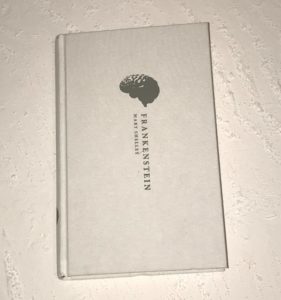
I have lost count of how many copies I own of Frankenstein. I own some beautiful editions including a new hardcover of the 1818 text from Oxford World Classics which I am currently reading. The book means so much I have copies all over the house, and one at work. Plus there is the ebook and audiobook edition I can access from my phone at any time. Literature plays such a huge part of my life, even I have trouble imagining my life without them. Frankenstein played a big part in my own transformation. All I can hope is that people continue to find something in this piece of classic literature. I will be re-reading this for years to come and I hope it continues to make an impact to people over the next two hundred years.

This beautiful edition of the 1818 text of Frankenstein was sent to my by Oxford World Classics

This review was originally published in the literary journal The Literati


Distracted by Other Books

Posted June 5, 2018 by Michael @ Knowledge Lost in Monthly Reading / 6 Comments

My Thoughts and Reading in May 2018

When I first came to reading I was not sure what I liked and I turned to the 1001 Books You Must Read Before You Die list to help me. I saw myself as a literary explorer (hence my previous blog name) and I was willing to try anything and everything. With this in mind I joined a real life book club as a way to explore and practice talking about literature. Fast forward to now, and I have found my niche and I know what I like, so now sometimes book club feels like a chore more than a joy. Having to read The Lost Flowers of Alice Hart by Holly Ringland for May and The Italian Teacher by Tom Rachman for June have been challenging. It feels like they are picking pretty covers but the content has not been that desirable, for me anyway. I want more from my literature than what is provided in these novels. I feel like The Lost Flowers of Alice Hart was too similar to so many other stories, like The Choke, Nest and Deep Water; all three were novels read because of the book club. I do love being the one that dislikes the books but at what point does it stop being worth attending? I do not plan to quit, but I have been thinking about this since I have not enjoyed a pick in a very long time.

Besides my contemplations on book clubs, I have been thinking about the Man Booker International prize as well. I am very pleased to see Flights win; I thought it was an amazing book. I was able to complete the entire longlist except two books which I might read later but I feel a little burnt out by the experience. While I loved being part of a community reading these books and it really sparked my passion for blogging again I felt very restricted by the task. I am very much a mood reader and to have assigned books can put me in a reading slump. This is not to say I would not attempt to read the longlist again in the future. I just hope to have read some of the books on the list next time. Out of all the books on the list Die, My Love was the one I still think about but I also loved The 7th Function of Language and Frankenstein in Baghdad.

Mexican literature seems to be the flavour of the month having read both Like Water for Chocolate and Faces in the Crowd. There is something about Latin American magical realism that seems to work for me, something that I have not found in other forms of magical realism. I have not been able to put my finger on why I enjoy it more but I will keep exploring. I absolutely adored Faces in the Crowd, which is a book you might hear me talk about in the near future. I think Valeria Luiselli might be one of those authors I will be watching closely in the future. I did read The Story of My Teeth but it was not until I read Faces in the Crowd that I realised just how brilliant she is.

Also this month I read Cop Hater, an old school police procedural and Lullaby, a novel that felt like the author was letting her own fears play out on the page. The final book I want to talk about is Packing My Library. I loved The Library at Night by Alberto Manguel and I expected that Packing My Library would bring me the same amount of joy. Though one book was able to blend his personal narrative eloquently with the history of the library, the other just felt more like digressions from his topic. To be fair the subtitle to Packing My Library is An Elegy and Ten Digressions, so maybe I should have expected this. I love reading books about books but I tend to enjoy the ones that are able to blend the personal with something more which is normal literary criticism.

I went a little overboard with my book buying this month and I told myself it was mainly for my podcast. I do not know how this works but I will defend myself by saying that yes, some are for my podcast and most of them have been read now as well. I do not think I was distracted by other books this month. This might be because I am currently housesitting and only have a handful of books to choose from. I thought it was a rather slow reading month for me as well, but this turned out to be untrue. I was sure I spent too much time watching Netflix instead of reading but the statistics prove otherwise.

Read More


Flights by Olga Tokarczuk

Posted May 17, 2018 by Michael @ Knowledge Lost in Literary Fiction / 3 Comments

Flights by Olga TokarczukTitle: Flights (Goodreads)
Author: Olga Tokarczuk
Translator: Jennifer Croft
Published: Fitzcarraldo Editions, 2017
Pages: 410
Genres: Literary Fiction
My Copy: Paperback

Buy: AmazonBook DepositoryKindleWordery (or visit your local Indie bookstore)

Winner of the Man Booker International Prize 2018
Shortlisted for the National Book Award for Translated Literature 2018
Longlisted for the Warwick Prize for Women in Translation 2018
Longlisted for the BTBA 2019

Flights by Olga Tokarczuk was the final novel I have to read for the Man Booker International Prize shortlist, and what a book to go out on. Tokarczuk is a Polish writer that has not gotten much attention in the English-speaking world until recently. She has won the Nike Award (which is a Polish literary award) twice for her novel Bieguni in 2008 and Księgi jakubowe (The Books of Jacob) in 2015. Curiously, Flights is the English title for Bieguni which I believe roughly translates to Runners.

Sitting here, I find it very difficult to write a review of Flights, it feels more like a novel that should be experienced rather than written about. It is an experimental novel that focuses more on travel writing rather than an actual plot. The narrative is musing on what it means to travel the world rather than her story. However, this works really well, and I wonder if this is the type of book that should be in the seat pocket of every plane for the travellers to read and reflect on their own experiences.

I am a fan of the postmodern novel so I am never disappointed if there is a lack of plot or character development, provided that the author is doing something interesting enough to keep my attention. If I was to compare this to any other book on the Man Booker International Prize longlist, I would compare it to The White Book. Simply because this is the fragmented musings of a writer on a particular topic, in this case travel. Exploring the oddness of modern travel, the airports, hotels, public transport and even guide books. There is so much to meditate one, I am actually surprised she was able to spend so much time with this one topic and cover so many different aspects.

The narrator describes herself as a pilgrim and I found myself to be her companion. I had an intimate knowledge of every thought and feeling she had. I have heard that this book shares so many similarities to Moby Dick and I have never wanted to read this Herman Melville classic more. Although I might simply read Moby Dick just so I can reread Flights.

To say I was enchanted by Flights might be an understatement, at times I was transfixed, and I never wanted to leave this book. I know Jennifer Croft probably has a busy life but I really hope she translates some of Olga Tokarczuk’s other novels. I recently found out that she was a founding editor of The Buenos Aires Review (which has not released new content since December 2017) along with Pola Oloixarac (who wrote the amazing Savage Theories) and Heather Cleary (who has translated a few Sergio Chejfec novels for Open Letter). My love of Argentinian literature is pleased to find that this is bilingual magazine. Croft has also translated August by Argentinian author Romina Paula, which I have recently ordered from Feminist Press. Now that I have finished being distracted by the translator, I cannot recommend Flights enough, especially if you are interested in travel writing.


Like a Fading Shadow by Antonio Muñoz Molina

Posted May 16, 2018 by Michael @ Knowledge Lost in Historical Fiction / 4 Comments

Like a Fading Shadow by Antonio Muñoz MolinaTitle: Like a Fading Shadow (Goodreads)
Author: Antonio Muñoz Molina
Translator: Camilo A. Ramirez
Published: Tuskar Rock, 2017
Pages: 320
Genres: Historical Fiction
My Copy: Library Book

Buy: AmazonBook DepositoryKindleWordery (or visit your local Indie bookstore)

Shortlisted for the Man Booker International Prize 2018

In 1968, James Earl Ray evaded the authorities after shooting Martin Luther King Jr. by using a fake passport and making his way to Portugal. During his last days of freedom, he wanders around Lisbon rehearsing his fake identities. In Like a Fading Shadow, Antonio Muñoz Molina reconstructs Ray’s final days, but it is also a meditation on the city that also inspired his first novel A Winter in Lisbon. Turning this into a blend of historical fiction and memoir, Muñoz Molina’s tries to weave his own experiences in with that of a man on the FBI’s Most Wanted list.

Everything about this novel sounded so appealing from the premise but reading it was so difficult. First of all, I thought the idea of having the James Earl Ray narrative interwoven with that of Antonio Muñoz Molina’s did not work as well as the author might have hoped. In hindsight, it would have been better to just read A Winter in Lisbon and then search the internet about Earl Ray’s final days. Secondly, I felt like this book kept going in circles and never really progressing in any satisfactory way. Which is disappointing because I think this was one of the books on the Man Booker International Prize longlist that I was excited to read.

This is so disappointing, the idea to make a fictionalised account of what might have happened when James Earl Ray was in Portugal sounds amazing. I was fascinated that he was able to sneak across the border to Canada and use a fake passport to get to London and eventually make it all the way to Lisbon. He spent his time trying to get to Angola, which alone would have made for an interesting narrative; why is a pro-white supremacist trying to get to Africa? Then you have this memoir-like narrative of Antonio Muñoz Molina trying to write his first novel, A Winter in Lisbon. Separately this could be stimulating to explore the writer’s process and the emotions behind creating a novel. However, as a combination it ended up to be too little of each and together it never came together.

The Man Booker International Prize longlist has been focusing on narratives the blend fiction and non-fiction and I can see why this book was picked but I do not see the appeal for it to make the shortlist. I wanted to love this book; I went in with high expectations but I ended up struggling through this. Between this and The Imposters (which is very similar in many ways) I almost found myself in a reading slump. Thankfully Flights by Olga Tokarczuk was there to save me.


Vernon Subutex, 1 by Virginie Despentes

Posted May 15, 2018 by Michael @ Knowledge Lost in Contemporary / 0 Comments

Vernon Subutex, 1 by Virginie DespentesTitle: Vernon Subutex, 1 (Goodreads)
Author: Virginie Despentes
Translator: Frank Wynne
Series: Vernon Subutex #1
Published: MacLehose Press, 2017
Pages: 352
Genres: Contemporary
My Copy: Paperback

Buy: AmazonBook DepositoryKindleWordery (or visit your local Indie bookstore)

Shortlisted for the Man Booker International Prize 2018
Longlisted for the Warwick Prize for Women in Translation 2018

Having read Virginie Despentes previously (Apocalypse Baby) I have to say I was a little worried about reading her Man Booker International Prize shortlisted book. I was worried that Despentes was aiming for to shock, but this novel seems to be a cutting-edge social novel looking directly at the punk sub-culture in France. The book is the first in the trilogy and it focuses on Vernon who is feeling ambivalent about his fast approaching half century. He started working at Revolver, a hip Parisian record store in his twenties but now he is reflecting on his own life. Vernon Subutex, 1 explores the rapidly changing social scene of music and the punk rock lifestyle.

The record store once boasted a legendary status but now, in the 2000s, it is struggling. However, in a throwaway comment, the internet believe that Vernon is in possession of the last filmed recordings of the famous musician Alex Bleach. Beach recently died from a drug overdose and now people from all walks of life are after Vernon and this supposed recording.

I view Vernon Subutex, 1 as the beginning of an epic journey. Often, we read an epic as a story that follows a family through their generations but this is more of a social epic. It follows both Vernon and the music industry as their worlds rapidly change. What drew me to this novel is the music references, there are so many bands and songs referenced in this book that I remember fondly. Before becoming a book nerd, I spent a lot of time listening to music, and the punk scene was one I closely followed. While I still listen to music, I do not have a finger on the pulse anymore. I have borne witness to the changes the internet brought to the music industry. Music stores closing everywhere as the rise of piracy and streaming quickly spread. However, it is important to remember that the revival of vinyl has helped indie record stores survive nowadays.

For me, there was just too much that I could relate to in Vernon Subutex, 1 and I found myself loving the reading experience. While I was never into the drugs and alcohol consumption that is associated with this sub-culture, I could identify with the social disconnect, music obsession and laziness that characterised Vernon. Then Virginie Despentes starts to dive into a darker side of the sub-culture, dealing with violent tendencies, racism and sexual identity. Despentes previously was a sales clerk in a record store and a freelance rock journalist, which plays a big part in helping shape this novel. Although her past careers as a sex worker and pornographic film critic have also influenced the plot. She seems to explore themes of youth marginalisation, the sexual revolution lived by Generation X, music and pornography within Vernon Subutex, 1 and Apocalypse Baby, which leads me to suspect this is common in all her novels.

Virginie Despentes may have found a place with French authors like Emmanuel Carrère and Michel Houellebecq and while I was not blown away by Vernon Subutex, 1, I will be continuing with book two when it is released into English later this year. I feel like there is still more of the story left to explore and I hope that it all comes together in the end. Right now, it feels incomplete and something I would not recommend to anyone, unless they love the music. There is a Spotify playlist which features all the songs and artist mentioned in the trilogy which has lead to discovering some new French bands. If it was not for the Man Booker International Prize longlist, I may have never given Virginie Despentes another chance, but I am glad I have.