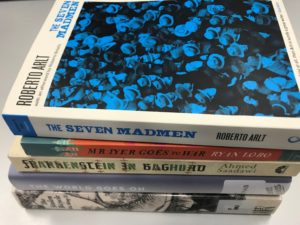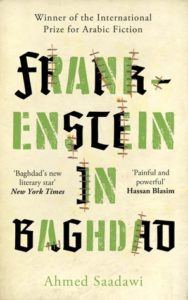
Frankenstein in Baghdad by Ahmed Saadawi

Posted May 14, 2018 by Michael @ Knowledge Lost in Horror, Literary Fiction / 4 Comments

Frankenstein in Baghdad by Ahmed SaadawiTitle: Frankenstein in Baghdad (Goodreads)
Author: Ahmed Saadawi
Translator: Jonathan Wright
Published: Oneworld Publications, 2018
Pages: 272
Genres: Literary Fiction, Horror
My Copy: Paperback

Buy: AmazonBook DepositoryKindleWordery (or visit your local Indie bookstore)

Shortlisted for the Man Booker International Prize 2018

There has been a lot of buzz around Frankenstein in Baghdad, even before being spotlighted on the Man Booker International Prize longlist and now shortlist. Ahmed Saadawi’s novel is an intense portrayal of Iraqi life in post invasion Baghdad. The violence never stopped after the American invasion and junk dealer Hadi collects body parts lying on the streets and patchworks them together. However when a wandering spirit of a guard who was a victim of a car-bomb explosion finds the corpse, he is quick to possess it, giving birth to a monster known as Whatsitsname, who sets out to seek vengeance for all the victims that make up this monster.

Two hundred years ago Mary Shelley published Frankenstein and Ahmed Saadawi’s nod to this classic serves as celebration of the genre Shelley has created. I am often sceptical about a remake or reimagining of a classic, especially when that book is so close to my heart. However I was drawn to Frankenstein in Baghdad, but that might be my love for books in translation. There are elements of this novel that almost mirror Frankenstein but with a more modern spin. Take for example the opening chapter, rather than Captain Robert Walton writing to his sister to setup the story, we have an activity report from the Tracking and Pursuit department. Letter writing is a dying art form but a military report perfectly modernised the novel’s setup.

The war on Iraq is a topic that is often talked about in western society. A war that President George W Bush claimed was successful in the Mission Accomplished speech held on the USS Abraham Lincoln in 2003. Yet it was not until the end of 2011 when all U.S. troops were officially withdrawn. I say ‘officially withdrawn’ but the U.S. have still had troops in Iraq, most notably the American-led intervention of the Islamic State of Iraq and the Levant in 2014 and Operation Conquest in Mosul in 2016. The war on Iraq lead to the Iraqi Civil War which led to America’s involvement again in what they call the war on terror. I do not know much about the conflicts in Iraq apart from the information shared on the news.

I cannot expect the news to portray an unbiased account of everything happening in Iraq so it was nice to learn a little more with Frankenstein in Baghdad. While this is a surreal and fantastical novel, the book did confirm what I have always suspected. That war and violence do not lead to peace. Everything I knew about the war on Iraq had always made it out to be that America is spreading democracy and peace to the Middle East. However all the evidence points to a creation of a new monster, one that wreaks havoc on Baghdad, one that used the power vacuum and hatred to gain a foothold. Not Whatsitsname, but the Islamic State of Iraq and the Levant (ISIL), which is also known as the Islamic State of Iraq and Syria (ISIS).

Frankenstein in Baghdad transforms from a novel of pure horror based on the actual horrors faced every day. However this novel is not as depressing as you might expect. Ahmed Saadawi has managed to convey so much of the world he lives in without scaring the reader away. Frankenstein in Baghdad reads more like a black comedy, a satire of the current state of the Middle East. Taking the themes found in Frankenstein of the way society turned a creature into a monster and turning it back onto the world showing us all the monster that has been created.

While this may not be a direct connection, it is a connection I found in the novel. While Whatsitsname is possessed by righteous fury, going about slaughtering those who have turned Baghdad into a slaughterhouse, this might work for the real life Frankenstein. Although we could argue that they are bound by the same motivation. I will leave any political opinions up to the reader to interpret. This is a stunning novel that I have spent a lot of time thinking about. There is something about Ahmed Saadawi’s story that makes this a must read. Whether his attentions were to compare Frankenstein with that of ISIS is entirely up to the reader. Novels are always subjective, this is the connections I made. I am left with anger towards the U.S. treatment of Iraq and I never had a high opinion in the first place. Without getting too political I want to leave you with one question to think about, should any country force their own values on a culture that is vastly different from their own?

This review was originally published in the literary journal The Literati


Do Reading Statistics Inform My Reading?

Posted May 8, 2018 by Michael @ Knowledge Lost in Literature / 4 Comments

The only advantage to becoming obsessed with reading so late in my life is that I have been able to track all the books I have read. However I often wonder if this is an advantage at times, does tracking my reading have value? When I load up my reading spreadsheet, I see a list of every book I have read since 2009 – all 1020 books. It is pretty impressive, and I do love looking at statistics, my main concern is the simple fact that these stats are starting to inform my reading life too much. I do agree that it is useful to be balanced in my reading but worry that it is dictating all my reading.
I have become obsessed with reading books in translation and in 2017 one of my goals was to read 50% translations. An admirable goal, except the only reason I started reading more books in translation was because I saw that 50% of all books read were from American born authors. Only 5% were from my home country of Australia. I thought it was strange that my reading life was so out of balance and I set out to rectify that. Now the stats are slightly better with only 46% from American authors (20% in 2017).

The main reason I question the stats is because I feel like I am letting the statistics inform my reading choices rather than allowing myself to pick up books I want to read. If I was to be completely ignorant of how many male authors I read verse how many female authors I read (overall 70/30) would I focus on closing the gap. I am not saying that reading diversely is bad, I just wonder how much of my reading choices are based on restoring the balance.

For me, I would love to read to have an even balance between male and female authors, I would love to read less books from America but should this be my primary focus. I have to admit to myself that without knowing about this imbalance I might never have discovered how much I love books in translation. I do believe that being able to see the imbalance has lead me to make better choices, I have started to actively seek out women in translation and I am aware of the imbalance in the publishing world.

In 2018 I decided that my reading goal for the year would be no reading goal. I have thought about removing my statistics so I would not be influenced by it but I do want to have a better balance between male and female authors. In 2017 I managed to achieve 45% female authors and I hope that in 2018 that will be better (I am yet to find a non-binary author to read). I want to use my spreadsheet to keep myself accountable. But do I want to I want to be influenced in any other ways.

Looking at my spreadsheet I see non-fiction makes up only 12% of my reading. I have only re-read 3% and my fascination with Russian literature only equals 3.3% of my reading. 20% of the books I’ve read are from the library and 34% are audiobooks. 70% of all books read are from a new author I have never read before, which means I rarely read another book from an author I really enjoyed. 45% of the books I’ve read are published after 2010 and only 9% are books longer than 500 pages. 15% are books from the 1001 Books you Must Read before you Die list, which means I have a long way to go before achieving my life long goal of reading all the books on this list.

I look at all these statistics and I cannot help but wonder if they are necessary. Sure, it is nice to have reading goals but do the goals and the statistics get in the way of reading what you want to read? When I first got into book blogging and then BookTube, the amount of books I read greatly increased. In 2011 I read 150 books or 41580 pages, and these numbers increased in 2012 and 2013. While it is awesome to be reading so much, I think the problem was I was picking quantity over quality. In fact 50% of all my reading are books under 300 pages. I was a new reader who did not know what I liked so I explored many different genres and read the books I thought I should read.

Reflecting back on this time, I know that being a literary explorer was a good way to discover what I like and do not like but I hate the fact that I have read more YA (3%) than I have read short stories or poetry (1% each) combined. The fact that I have read more pages in fantasy than memoir shocks me because I don’t even like fantasy. I am not saying that reading these genres are wrong, they are just wrong for me. I have explored all the genres and I now know what I like. I am fully aware that these stats will change as I read more and eventually it will be a better reflection of my own reading tastes, I just mourn all that lost reading time.

If I had no idea about all the statistics, how different would my reading be? I wonder this far too often. I have learnt so much on my reading journey and I am pleased to discover new things on the way. There is far too much to read and not enough time to worry about balancing out all the statistics. Will my year of reading with no goals be fruitful? I am not sure but I am sure I will read some good books along the way.

I write this because I am curious to know how many others track their own reading statistics and has that informed your own reading. I do hope that the balance with translated books remains in my reading life but I probably need to focus a little more on the gender balance. Apart from that, I hope that no other stats inform my reading. I want to read what I want, when I want. I want to be able to consume quality over quantity and not be influenced by the hyped books.

Happy reading everyone.

This article was originally published in the literary journal The Literati


Distracted by Other Books

Posted May 1, 2018 by Michael @ Knowledge Lost in Monthly Reading / 2 Comments

My Thoughts and Reading in April 2018

Earlier in the month my wife was suffering from a major headache, so lying in the dark I decided to pick up my kindle to avoid disturbing her. I had The White Book on my Paperwhite and I knew it would not take me that long to read. Reading in the dark I was transfixed by the light of my Kindle. There is a line in the book that really stayed with me, “Certain objects appear white in the darkness. When darkness is imbued with even the faintest light…” There is something to be said about reading a book at the right time, because the experience alone made this book enjoyable. I love sitting in the dark but normally hate reading on my Kindle, the combination of darkness and talking about white just meshed well.

However that experience pales in comparison to reading The 7th Function of Language. Have you ever read a novel that you think has been tailor made for you? This was my experience with The 7th Function of Language. Everything about this book ticked my boxes, from the mystery element, to the literary criticism. I loved every minute reading this one and I cannot wait to re-reading it in the future. This reminds me of my favourite Umberto Eco book, Foucault’s Pendulum. I had to laugh at the fact so many people were calling this novel ‘too pretentious’ but others were comparing it to Dan Brown.

I often wonder if my literary tastes are the direct opposite to the norm, because I tend to love so many books others are regularly dismissed. Not that I mind at all. It helps with my pretentious literary credibility. Although I think The 7th Function of Language is not pretentious and would make for an exciting audiobook. I have not read hhHh but after reading this one, I am keen to find a copy. Although that novel is more war based, I am still very curious. It did get a lot of hype and attention, which might mean I will be disappointed by the novel.

This month marked the start of my very own podcast, Lost in Translations. My wife and I have been planning this for a very long time and by planning I mean procrastinating. But this we finally released the first episode which is an introduction episode. I was very nervous but beyond thrilled with just how well it turned out. I am surprised how much support I got on a project that has just launched. I am looking forward to releasing the first official episode where we discuss a book I loved last year (no spoilers into what it will be). My wife will be my first guest and while we have not recorded the episode yet, I hope to have it release in the middle of May.

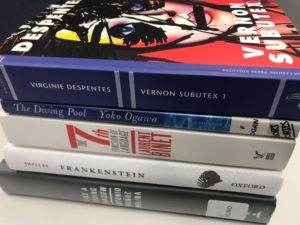
I have loved reading the Man Booker International prize longlist and I am starting to see the light at the end of the tunnel, especially after finishing Like a Fading Shadow and Vernon Subutex 1. It has been a bit of a letdown for me. There are so many books on the list that I thought were so-so but not much I loved, besides The 7th Function of Language, Frankenstein in Baghdad and Die, My Love. I will read the next Vernon Subutex book, and I did have a lot of fun reading it but it was not a standout. I am starting to be distracted by other books and itching to read other things. I am not married to the idea of completing the entire longlist but I thought it was a great opportunity to be part of the community. I am yet to read Go, Went, Gone and Flights, which are on my TBR, so they will get read. I am in the middle of The Imposters and have not brought a copy of The Flying Mountain. So that is four books from the longlist that I would love to complete but the only one I am positive I will read soon is Flights.

The BTBA longlist is looking very tempting.

I re-read Frankenstein again, I received a beautiful edition of the 1818 text and thought it was time to read again. I did use this as an excuse to write a piece on how Frankenstein has impacted my life. Surprisingly I think I learnt a little about myself writing that piece and I am always astounded by what I discover about myself while writing. I think there is something therapeutic about writing and it often unlocks connections I have not thought were there. Writing about Frankenstein helped me understand a little more about my past. That piece will be in the next issue of The Literati which is released very soon.

Finally I picked up The Diving Pool to read, which is the pick for a bookclub I am apart of on Goodreads. I love being a part of a Goodreads group reading books in translation, but not many people are interested in communicating. I love a good forum but I think maybe they have run their course. People join but quickly lose interest. I love the idea of talking about books, especially translations but maybe Goodreads groups are not the right spot. What is the future for the forum format? Is it Discord? Or maybe it is a Facebook group.

I feel like this month has been less productive than other months. Only six books read and hardly any writing getting done. I am happy to see my podcast become a reality so I should not complain. I have The Lost Flowers of Alice Hart on the go, which I need to read for my IRL bookclub but I have not planned what else I will be reading. I like to read on a whim and maybe the Man Booker International prize longlist messed with that and has put me into a little of a slump. Although I hope to break out in May and get back to all the books that keep distracting me throughout the month. We are housesitting so I do not have access to all my books, which might mean a little control but I hope it does not keep my slump going any further.

Read More


The White Book by Han Kang

Posted April 15, 2018 by Michael @ Knowledge Lost in Poetry / 6 Comments

The White Book by Han KangTitle: The White Book (Goodreads)
Author: Han Kang
Translator: Deborah Smith
Published: Portobello Books, 2017
Pages: 161
Genres: Poetry
My Copy: eBook

Buy: AmazonBook DepositoryKindleWordery (or visit your local Indie bookstore)

Shortlisted for the Man Booker International Prize 2018
Longlisted for the Warwick Prize for Women in Translation 2018

Han Kang’s The White Book comes across as something different from this author’s Man Booker International Prize winner (The Vegetarian) but still feels very much the same. The White Book is a reflection of the colour White; part meditation, part poetry, Han Kang explores a range of connections with the colour. Weaving an autobiographical narrative, Kang is able to explore her feelings in this emotional book.

“At times my body feels like a prison, a solid, shifting island threading through the crowd. A sealed chamber carrying all the memories of the life I have lived, and the mother tongue from which they are inseparable. The more stubborn the isolation, the more vivid these unlooked-for fragments, the more oppressive their weight. So that it seems the place I flee to is not so much a city on the other side of the world as further into my own interior.”

When I think about these emotions, like grief and despair, I often then of the colour black. For Han Kang it is more “black waters shifting beneath the thick sea fog”. This fog is such an amazing metaphor, it is that looming cloud that shadows over our dark feelings. It is cold, if not chilling. The White Book, really challenged my thoughts on the colour white being warm and happy.

I like the way Han Kang was able to combine all her thoughts and emotions and associate it with the one colour. She led me on an emotional journey that was different to anything I have ever read. Yet, at the same time, it felt like her style and I cannot help but compare it to The Vegetarian. I would be interested to see if she is able to pull off something similar in the future, maybe with a different colour.

Despite the fact that I enjoyed the journey The White Book took me on, I do not think it is deserving of a place on the Man Booker International Prize shortlist. My main concern is that this blurs the line of fiction too much, this is an autobiographical meditation. While I appreciate everything it does, I wonder how it managed to meet the criteria for this prize. It is not just this book that blur the line between fiction and non-fiction, I just think this is one that is the furthest away from fiction. Having said that, this is a book that needs to be experienced rather than analysed; there is some literary merit here, but this is more an emotional journey.


The World Goes On by László Krasznahorkai

Posted April 12, 2018 by Michael @ Knowledge Lost in Short Stories / 0 Comments

The World Goes On by László KrasznahorkaiTitle: The World Goes On (Goodreads)
Author: László Krasznahorkai
Translator: Ottilie Mulzet, George Szirtes, John Batki
Published: Tuskar Rock, 2017
Pages: 320
Genres: Short Stories
My Copy: Library Book

Buy: AmazonBook DepositoryKindleWordery (or visit your local Indie bookstore)

Shortlisted for the Man Booker International Prize 2018

I normally struggle to review short story collections, do I go through every story and share my opinions? Reading The World Goes On, all I could think is ‘I have no clue how to analyse and review this’. Rather than a review, I am going to just share my thoughts on this book, and hopefully it will eventually resemble a review.

The World Goes On is actually my second László Krasznahorkai, having read The Last Wolf / Herman earlier this year. I was struck with the thought that this might be the first Krasznahorkai that people might read. László Krasznahorkai won the Man Booker International Prize in 2015, before it was repackaged and combined with the Independent Foreign Fiction Prize (IFFP). However the publicsity around that award is nothing like it is today. This could be a combination of the older prize awarding an author for their contribution to fiction rather than a specific book and the rise of social media. Which brings me back to my original point, The World Goes On has been longlisted for the prize but it is not a good place to start for this Hungarian author. This feels like fragments of stories and ideas rather than an actual piece of fiction.

I think the judges for the 2018 Man Booker International Prize has gone out of their way to pick a longlist that showcases interesting narrative structures. While I appreciate the surprising entries on the list, it does make it less accessible. Having said that, I would be so mad if the Man Booker International Prize followed the trend of the Man Booker Prize and Women’s Prize for Fiction and just picked the most popular books. I want to see a balance between discovery and introducing new people to books in translation. I would hate to think how many people will not read more László Krasznahorkai because of The World Goes On.

László Krasznahorkai is a very talented writer; he has a post-modernist style, and it feels like he gets so bored, he has to set limitations on his own writing. In The World Goes On, you will find plenty of examples of him writing a one sentence story. I have to admit after reading this book and The Last Wolf, I wonder what Krasznahorkai has against the full stop. Like I said before, this feels more like a collection of ideas rather than short stories.

While I enjoy László Krasznahorkai as a writer, even I think I was not ready for The World Goes On. I am not giving up on this author, this is a book for the fans. Read The Last Wolf / Herman first, discover some of his novels and if you like his style and his view on the world, then read The World Goes On. I do not think this should have been on the longlist, and I hope it does not stop many people from enjoying László Krasznahorkai in the future.


The Stolen Bicycle by Wu Ming-Yi

Posted April 4, 2018 by Michael @ Knowledge Lost in Contemporary / 6 Comments

The Stolen Bicycle by Wu Ming-YiTitle: The Stolen Bicycle (Goodreads)
Author: Wu Ming-Yi
Translator: Darryl Sterk
Published: Text, 2015
Pages: 416
Genres: Contemporary
My Copy: Library Book

Buy: AmazonBook DepositoryKindleWordery (or visit your local Indie bookstore)

Longlisted for the Man Booker International Prize 2018

According to the main character Ch’eng, the word someone uses for ‘bicycle’ can tell you a lot about a person. The term ‘jitensha’ (self-turn vehicle) might indicate a Japanese education, while ‘tanche’ (solo vehicle), ‘chaiotache’ (foot-pedalled vehicle) and ‘zixingche’ (self-propelled vehicle) indicate different parts of China. For Ch’eng, he prefers to use the Taiwanese word ‘thihbe’ (iron horse). The Stolen Bicycle is a novel about family history, and the history of the Japanese military in World War II, which was waging the same times.  However the book is centred of the iron horses in their lives, especially trying to uncover the mystery of a stolen bicycle.

Wu Ming-Yi is obsessed with bicycles, this whole book is full of the history of the bicycle industry. When he is not talking about the history of bicycles, Taiwan or the Japanese in World War II, he manages to weave in a compelling narrative that explores the bonds of family. The story turns into a meditation of memory, loss and life living in war times. Then it all comes back to bicycles, and that often feels tedious.

Throughout the narrative there are these ‘bicycle notes’ which are used to provide detailed history in regards to bicycles and the war. While I enjoyed the way Wu Ming-Yi used these sections to give the reader context, it was the way the information bleed into to other text that became a problem. Rather than being a meditation of life and family it felt more like an obsession with bicycles. Personally I think if this information remained in the ‘bicycle notes’, it would have been a stronger book.

Wu Ming-Yi is a literary professor and nature writer. He has written two books on butterflies in the past; The Book of Lost Butterflies (2000) and The Way of Butterflies (2003). To me, this feels like he is passionate about topics and it spills into his writing. I think Ming-Yi is a very strong writer and there is a lot to like about this, it just got harder and harder to motivate myself to finish the book. I had to petal through and now I never want to talk about bicycle ever again.

I am of two minds with this book, there is a lot to like about the novel; the writing, the narrative and the style were all great. It was just the constant talking about bicycles that made me want to run over cyclists in my car. If this was half the size, this would have been almost perfect. However, I am stuck in a place of love and hate when thinking about The Stolen Bicycle. I do suspect others will have a better reaction but I never want to see another bicycle in my lifetime.


Distracted by Other Books

Posted April 3, 2018 by Michael @ Knowledge Lost in Monthly Reading / 0 Comments

My Thoughts and Reading in March 2018

I live in a city that often does not get much rain. So when we get two weeks of constant rain it is a rare treat. There is nothing better than curling up in bed with a cup of tea and a good book, while thunder and lightning is raging outside. I was able to spend those two glorious weeks reading Frankenstein in Baghdad. Most people know about my obsession with Frankenstein, the book that literally changed my life. Normally I am apprehensive about any take on this classic novel but Ahmed Saadawi was able to deliver something sensational. His take on the classic was able to compare the tale with post-invasion Iraq in a unique way. Since it has been two hundred years since Mary Shelley’s novel, I cannot help but think about revisiting the book once again. Oxford World Classics did send me a beautiful hardback edition, so a reread is in my very near future.

Thinking about Frankenstein got me thinking about other books that have helped shape my life, which obviously leads me to my obsession with Russian literature. The Anna Karenina Fix seemed like the perfect bibliomemoir for me. As someone with a love for Russian lit, I found myself easily drawn to Viv Groskop’s memoir. One day I will write about all those books about books that I love and I have no doubt The Anna Karenina Fix will make that list. It made me want to reread so many of my favourites and then the ones I have missed, then go back to this book and read it again.

I am the type of reader that reads to learn about the world, to experience different cultures and explore new ideas. However there are times when I need to just switch off and read some palette cleansers. For me, this is crime fiction, but I am very particular about what I like. For the most, I will read an entire crime novel even if I was not enjoying it. Luckily there was something about Babylon Berlin that I loved. This is the first book in the Gereon Rath series and what drew me to this book was that it was set in 1929 Berlin. So in the background of this crime investigation we see Berlin as it changes, with the fears of communism and the newly emerging Nazi Party. I cannot help but compare it the Bernie Gunther series. While I have only read March Violets, since Philip Kerr passed way this month, I think I need to return to this detective and read The Pale Criminal. I did also read The Spellman Files at the suggestion of everyone who compared it to Veronica Mars.

The crime fiction I am attracted to the most is the old pulp era, the stuff from the 1920s to the 1940s. There is something about that writing, it is sharp and to the point, but still remains beautiful. Even forgotten classics like The Seven Madmen from Argentina seem to adopt that same style. The Seven Madmen is the kind of book that will remain with me for a long type and I am tempted to reread it, but I will get distracted by other books. After reading this book, I felt like staying with Argentinian literature and I was able to do that with the next book I read, Die, My Love.

The Man Booker International Prize longlist was announced and like many of my fellow book nerds, I was excited to see what would make the list. I had read Frankenstein in Baghdad but it was the only one on the longlist I have actually read. I would love to read the entire longlist but time and availability is always a factor. My library only had four of the thirteen from the longlist but I owned one already. So I thought I would make use of a Kindle Paperwhite to help. I have often struggled to get into ebook reading but the accessibility was my only hope to read the longlist. I will always prefer physical books, but maybe I will be convinced to read more ebooks. My constant distractions with other books and an ereader might be a deadly combination.

Obviously the first book I read was Die, My Love. The fact that it was Argentinian literature, made this an easy choice. This was such an affecting read, I will have to get a physical copy. After completing this novel, all I wanted to do was stay in Argentina forever. I think I could live a happy life only reading Argentinian lit, it has similarities to Russian literature but still feels very unique. I am also pleased to see a strong literary scene of Argentinian women; from Die, My Love, to books like Things We Lost in the Fire, Fever Dream and Savage Theories.

Unfortunately there were a few books that followed that I was not able to connect with, and left me unmotivated to read. Two were Man Booker International Prize longlist picks, The Dinner Guest and The Stolen Bicycle, but the third was this month’s bookclub pick. It was a modern take on Don Quixote set in India called Mr Iyer Goes to War and all I could think was about rereading Don Quixote. My problems with The Dinner Guest and The Stolen Bicycle were as followed; the first felt too similar to another book, while the later just went overboard with the one topic and that frustrated me.

The Man Booker International Prize longlist left me pondering translations. I love reading from around the world, to the point where I am considering turning it into a podcast. I discovered I do not know as much about translation theory as I would like. Maybe I need to explore some Walter Benjamin or as I discovered, Edith Grossman (who translated Don Quixote) wrote a book called Why Translation Matters. Do I need to know another language to explore translation theory in great detail? I know Umberto Eco also has a book on translations too, it is called Experiences in Translation. This might be another rabbit hole to go down in the new future.

I managed to have a very productive reading month, I finished it off with my second László Krasznahorkai book, which was his short story collection The World Goes On. This made ten books for March, and I am presently surprised, especially since I had three books that were a struggle. The only thing I currently have on the go is The 7th Function of Language, which is another book from the longlist. At this rate, I may be able to read the entire longlist before the prize is announced in May. However the availability of the last seven books is the major factor. I own two and waiting on one from the library, so it is becoming more of a possibility. I am having a hard time guessing what will make the shortlist, so I have delayed a few that I think might be on the list. That way I can still remain in the conversation.

Read More


The Dinner Guest by Gabriela Ybarra

Posted March 29, 2018 by Michael @ Knowledge Lost in Contemporary / 4 Comments

The Dinner Guest by Gabriela YbarraTitle: The Dinner Guest (Goodreads)
Author: Gabriela Ybarra
Translator: Natasha Wimmer
Published: Harvill Secker, 2018
Pages: 160
Genres: Contemporary
My Copy: eBook

Buy: AmazonBook DepositoryKindleWordery (or visit your local Indie bookstore)

Longlisted for the Man Booker International Prize 2018

In 1977, three terrorists broke into the home of Gabriela Ybarra’s grandfather, taking him by force. The first half of The Dinner Guest follows her research into what actually happened. This book blurs the lines between true crime and fiction to create a unique narrative. However, The Dinner Guest doesn’t stop there; the book is also centred around Gabriela Ybarra’s mother dying of cancer.

The story goes that in my family there’s an extra dinner guest at every meal. He’s invisible, but always there. He has a plate, glass, knife and fork. Every so often he appears, casts his shadow over the table, and erases one of those present.

The first to vanish was my grandfather.

I have a feeling that the judges of the Man Booker International Prize are focusing on unique narrative styles, particularly when it comes to exploring grief. Of the four books I have read so far from the long list, these have been the similarities. Whether or not we call this a memoir of grief with fictional elements or an autobiographical novel is not something that I choose to debate. However this book evokes too many similarities to War and Turpentine by Stefan Hertmans, with the latter being a much stronger book.

It is almost impossible to talk about this book without looking it as a piece of non-fiction. The fact her grandfather was taken at gun point is wrapped throughout the narrative. The rest of The Dinner Guest is around witnessing her mother’s heath deterioration and her eventual passing. The two tragic events shapes the majority of the book. Evoking many powerful images but ultimately I never felt it really came together.

There is an idea that seemed to stick with me that never played out to my satisfaction. That was the idea of a person viewed differently, not just after their passing. For Gabriela Ybarra, her mother stopped being her mother long before her death. Her identity was stripped away and all that was left was cancer. There is a line in the book that says, “The last time I saw her, she had already stopped existing.” Even after her death, the press suddenly became interested in her.

At first I couldn’t understand why my mother’s death was of interest to the press. Then I was frustrated, because some of the reflections shared had nothing to do with the way I remembered her.

If it was not for the Man Booker International Prize longlist, I may have never have picked up The Dinner Guest. There is some interesting and notable parts within this book but the more I think about it the less I am satisfied. I love trying to read through the longlist to join in on all the conversations but you cannot expect me to like all the picks. I doubt this will make the shortlist, so instead of reading this one, may I recommend War and Turpentine by Stefan Hertmans which was translated by David McKay.


Die, My Love by Ariana Harwicz

Posted March 28, 2018 by Michael @ Knowledge Lost in Contemporary / 4 Comments

Die, My Love by Ariana HarwiczTitle: Die, My Love (Goodreads)
Author: Ariana Harwicz
Translator: Sarah Moses, Carolina Orloff
Published: Charco Press, 2017
Pages: 128
Genres: Contemporary
My Copy: eBook

Buy: AmazonBook DepositoryKindleWordery (or visit your local Indie bookstore)

Longlisted for the Man Booker International Prize 2018

Ariana Harwicz’s book Die, My Love is the type of novel that will leave you emotionally drained. Translated from the Spanish by Sarah Moses & Carolina Orloff, this is a powerful portrayal of a woman trapped in motherhood. Having recently given birth to her second child, all she yearns for is freedom. Never have I read a novel that is so raw with emotion.

Whether or not this woman is suffering from postnatal depression or not is not something I wish to debate. I wonder if trying to diagnose her would sell this book short. She is going through so many different emotions and never holds back with her feelings. Die, My Love feels like a gut punch of emotions. A novel that is to be experienced more than analysed.

There is no doubt in my mind that this is an autobiographical novel. I cannot imagine Ariana Harwicz being able to write this without living the experience. There is an intensity in the writing that never feels fake. The conflicting emotions of yearning for freedom mixed with her motherly instincts hold the narrative together. The connection with nature stems from her constant desire to be free but also a reference to a child’s carefree nature.

“I think about how a child is a wild animal, about another person carrying your heart forever.”

The narrative that Ariana Harwicz is able to weave is so affecting; we are able to follow this vivid portrayal of a mother and experience every single emotion and thought, no matter how dark or disturbing it may be. There are many times where I feel like this protagonist is over sharing but that just adds to the raw and intense honesty. I was left in awe and have not been able to get the images from this novel out of my head. It will be a book that I will come back to again and again.

I have been going down a rabbit hole of Argentinian literature and Die, My Love seems to invoke a common style, often found in recent novellas from this great literary scene. It pleases me to see how many Argentinian women writers are getting their moment to shine and I expect to see more in the future. There is something about these books that are able to explore so much in such a short novel. For great Argentinian books by women including Die, My Love, look no further than Things We Lost in the Fire by Mariana Enríquez, Fever Dream by Samanta Schweblin and Savage Theories by Pola Oloixarac.


The Last Wolf / Herman by László Krasznahorkai

Posted March 20, 2018 by Michael @ Knowledge Lost in Literary Fiction / 2 Comments

The Last Wolf / Herman by László KrasznahorkaiTitle: The Last Wolf / Herman (Goodreads)
Author: László Krasznahorkai
Translator: George Szirtes, John Batki
Published: Tuskar Rock, 2009
Pages: 120
Genres: Literary Fiction
My Copy: Hardcover

Buy: AmazonBook DepositoryKindleWordery (or visit your local Indie bookstore)

László Krasznahorkai is one of those authors that has been on my radar for a long time. Not because I always wondered how to pronounce his name (I know now) but because this Hungarian author’s books were always labeled as difficult or demanding. I like a challenge but I thought I might start with something small. I was told that The Last Wolf was a good introduction to László Krasznahorkai and it was not because of the blurb by Sjón on the cover.  The edition pairs two novellas together, The Last Wolf and Herman.

The Last Wolf is a 70 page long sentence, which means you really need to read it in one sitting. I myself turned back to page one and reread the whole thing the next day. Not because it was dense (it is) but because I was captivated by the writing. How often are you able to find a sentence that long that flows so smoothly?

The novella is about a failed philosophy professor who is asked to write about the last wolf in the Spanish region of Extremadura. Although it is another who is conveying the tale to a bartender in Berlin. This narrative is an interesting journey, full of philosophical musing and some self-loathing. It left me wondering if László Krasznahorkai just wrote a satirical jab at himself. It is hard to say more about these stories, you really need to experience them yourself.

While Herman does share similarities, they were originally published twenty-three years apart. Told in two parts, firstly you learn about a master trapper who is clearing a forest of ‘noxious beasts’ in ‘The Game Warden’. While the other story (‘Death of a Craft’) is from the perspective of visitors to the same region. Trust me, these two parts sound like they do not go together but they do.

I am finding it really hard to talk about book, not just because both stories are dense and require many rereads but because it is difficult to express what happens in the books. I am not interested in giving a plot summary, you just have to experience László Krasznahorkai and this does seem like a good place to start. László Krasznahorkai won the last Man Book International Prize in 2015 before it was reincarnated into its current from. Originally the prize was awarded to an author for his entire body of work and he was recognised for his achievement in fiction on the world stage.