Girl at War by Sara Nović

Posted September 15, 2015 by Michael @ Knowledge Lost in Historical Fiction, Literary Fiction / 0 Comments

Girl at War by Sara NovićTitle: Girl At War (Goodreads)
Author: Sara Nović
Published: Little Brown and Company, 2015
Pages: 336
Genres: Historical Fiction, Literary Fiction
My Copy: Paperback

Buy: AmazonBook Depository (or visit your local Indie bookstore)

Ana Jurić is a carefree young girl, running and playing through the streets of Croatia’s capital city Zagreb. This was the summer of 1991, and this is the summer that will change everything, not just for Ana, but also for all of Croatia. The country has declared its independence from Yugoslavia, which has sparked civil unrest and quickly became the Croatian War of Independence. Girl at War tells the story of Ana as a ten-year-old in 1991 and then ten years later while living in New York City.

The Croatian War of Independence lasted from 1991 to 1995, between the Croat forces local to the government and the Serb-controlled Yugoslav People’s Army (JNA). This war started when the Croatian government declared independence from the Socialist Federal Republic of Yugoslavia (SFRY). The majority of Croatians wanted to become a sovereign state, but Serbs remained loyal to Serbia’s wish to remain apart of Yugoslavia. This cost Croatia between 6,000 – 8,000 soldiers and almost as many citizens were killed (or missing) during the conflict as well. However they estimate about 220,000 people were displaced during this period.

Girl at War is a coming of age story of a girl living through the crumbling soviet state and trying to move on. She founds herself in New York City when 9/11 happens, which forces her to confront her past and deal with the part of her life she has tried to bury. Sara Nović’s debut novel is a perfect novel, reminding me of books like A Constellation of Vital Phenomena by Anthony Marra and All That is Solid Melts into Air by Darragh McKeon. This is an unflinching look at a crumbling Yugoslavia and a country unsure of their future.

This is a heart-breaking debut, that was flawlessly executed, many people might be familiar with my love for novels set in a crumbling soviet state and this was my chance to explore the history of Yugoslavia. I hope there will be many more novels like this released in the future, and I am eagerly anticipating the next Girl at War as well as a new novel by Sara Nović. There is not much about Nović to be found online, but I suspect some autobiographical elements within this novel because the emotions just felt too real. Do you know any other books similar to this that I might enjoy?


The Russian Debutante’s Handbook by Gary Shteyngart

Posted September 12, 2015 by Michael @ Knowledge Lost in Contemporary, Russian Lit Project / 0 Comments

The Russian Debutante’s Handbook by Gary ShteyngartTitle: The Russian Debutante's Handbook (Goodreads)
Author: Gary Shteyngart
Published: Riverhead Trade, 2002
Pages: 476
Genres: Contemporary
My Copy: Paperback

Buy: AmazonBook DepositoryKindle (or visit your local Indie bookstore)

Vladimir Girshkin is not your typical hero, but the unhappy and sickly, twenty-five year old bureaucrat is just that in The Russian Debutante’s Handbook. His mother gave him the nickname “Little Failure”, he spends his days as a clerk for the Emma Lazarus Immigrant Absorption Society. An encounter with an old Russian war hero leads Vladimir on an adventure away from his job on the Lower East Side of New York to Prague. Surrounded by a Prava expat community Vladimir launches a scheme so ridiculous that it is actually brilliant.

Czechoslovakia was a satellite state of the Soviet Union, ever since the coup d’état of February 1948 when the Communist Party of Czechoslovakia seized power of the country with the help of the USSR. The Soviets call this Victorious February but most people are more familiar with the Velvet Revolution of 1989. This non-violent protest against the one-party government of the Communist Party of Czechoslovakia saw the end of a 41 year rule by the Communist party. Then finally the dissolution of Czechoslovakia into Czech Republic and Slovakia as of 1 January 1993. In the 1990s Prague saw an invasion of expats and the city was often referred to as the “Paris of the 1990s” or “the Eastern European Paris”.

As many people are aware, I am a bit of a fan of Gary Shteyngart, he has a way about writing humorous and satirical novels, and I am all too quick to recommend Super Sad True Love Story to anyone that is willing to listen, especially since it is very relevant to today’s society. After reading his memoir Little Failure I was surprised to find just how autobiographical his novels were, I had an idea of some of it but not to this extent. Since reading Little Failure, I was determine to read all of Shteyngart’s novels starting with his debut The Russian Debutante’s Handbook.

This is a highly imaginative novel blending satire with some bizarre humour. I really enjoyed the use of language within this debut but found the rest lacking, although this is a testimony of the growth of Gary Shteyngart as a writer. I have to say that The Russian Debutante’s Handbook is a novel for people that enjoy and know what to expect from Shteyngart and I would recommend starting with Super Sad True Love Story (obviously) or maybe his memoir Little Failure. Shteyngart is a brilliant writer and while I did enjoy The Russian Debutante’s Handbook, now I need to try his next novel, Absurdistan.


The UnREAL Reality of Reality TV

Posted September 10, 2015 by Michael @ Knowledge Lost in Film & Television / 0 Comments

unreal_tv_series_posterA new TV show discovery for me is the Lifetime show UnREAL, which chronicles a dating reality show (similar to The Bachelor) called “Everlasting”. This is told mostly from the perspective of Rachel Goldberg (Shiri Appleby), a producer of the show who was brought back by the executive producer (Constance Zimmer) after an epic breakdown during the previous season. Rachel has to find the balance between rebuilding her reputation, the high demands of producing the show and her own mental health.

Let’s face it, Shiri Appleby will always be Liz Parker (Roswell) in my eyes, but it was good to see her back acting. I had a quick look and it seems like she never stopped acting, with a main role in Life Unexpected and in a few episodes of Girls. Also does anyone remember her web series Dating Rules from My Future Self? Anyway, despite the lack of alien love interests, UnREAL is a dark comedy that really dives into the psychological manipulation of reality TV.

I can honestly say I have never thought about reality TV as much as I had while watching UnREAL. I have never watched The Bachelor but from what I have seen in advertising, it seems to be a horrible distorted concept of romance and love. Essentially you have one bachelor dating twelve woman at once, and the show documents all the melodrama that happens between the contestants. However if you think about it, there is a lot of manipulation and distortion of people’s lives all in the name of trying to make good (this work is subjective) TV. UnREAL plays a lot with this behind the scenes look at a show called Everlasting and the way producers force these intense displays of emotions in the hope to capture it on screen.

However the show focuses on producer Rachel Goldberg, who had an emotional breakdown in the last season of Everlasting. The show starts at this new season of Everlasting and Rachel has been brought back because she is very good at her job. Despite the fact she is good at her job, it becomes quickly evident that the show is not good for her and UnREAL documents this struggle between career and mental stability.

I am excited that UnREAL will be returning for a second season; I was not sure if it was possible but I hope that it will be another satirical look at the state of reality TV. I do not know how I discovered this show, I think it was because of Shiri Appleby but my wife and I binge-watched this too quickly. Binge-watching is a lot of fun but when it is over it leaves you wanting more. Have you seen UnREAL, and if so what do you think it says about the Television industry? Let me know in the comments below.


Sweetland by Michael Crummey

Posted September 8, 2015 by Michael @ Knowledge Lost in Contemporary / 0 Comments

Sweetland by Michael CrummeyTitle: Sweetland (Goodreads)
Author: Michael Crummey
Published: Corsair, 2014
Pages: 320
Genres: Contemporary
My Copy: Paperback

Buy: AmazonBook Depository (or visit your local Indie bookstore)

Moses Sweetland is a grumpy old retired lighthouse keeper with strong ties to his home and town. For twelve generations, Sweetland’s family have made this Newfoundland town their home; in fact the town is named Sweetland.  However now the fishing industry has dried up and the town is falling apart. The Canadian government has decided it is more cost effective to offer resettlement packages to everyone in Sweetland than try to maintain the town. There is one condition, everyone has to accept the offer for resettlement or no one will get a payout.

This novel was picked for my in-real-life book club, and it is not a book I would have picked up on my own. I started off not loving this novel; I wanted the author to explore all the secondary characters a little more. I thought they were all far more interesting and I could not see why the focus was on Moses Sweetland so much. I knew there was the exploration into the heritage but I thought that a look into a range of characters in this little town would make for a far more interesting novel.

I obviously did not understand what Michael Crummey was trying to do with Sweetland but it was not long before I was fully aboard. The book took a turn and there was something different happening within the novel that I was not expected. If I did some research into the premise of Sweetland, I would have discovered the plot but I like to go into a book not knowing. What I loved about this novel is the way it explores isolation and being haunted by memoires and the past.

I should explain that Moses Sweetland refused to leave Newfoundland and when everyone else left he was stuck in Sweetland alone. As a retired lighthouse keeper he thought he was prepared to live a life or solitude and isolation but that is nothing like living alone. Michael Crummey did a wonderful job exploring the idea of living alone and the descent into madness. Think Cast Away, except done well; sure, that movie did portray madness pretty well but Sweetland is on a whole new level.

I think the way Sweetland surprised me, really affected me more than the book itself. I really appreciated the way Michael Crummey wrote this book and really enjoyed all the themes that he explored. I need to read some more of Crummey’s novels, I think he is a bit of a hidden talent that needs more exposure. I hope all his other books are just as great as Sweetland and I plan to find out soon.


Story of the Eye by Georges Bataille

Posted September 6, 2015 by Michael @ Knowledge Lost in Erotica / 4 Comments

Story of the Eye by Georges BatailleTitle: Story of the Eye (Goodreads)
Author: Georges Bataille
Translator: Dovid Bergelson, Joachim Neugroschal
Published: Penguin, 1928
Pages: 127
Genres: Erotica
My Copy: eBook

Buy: AmazonBook DepositoryKindle (or visit your local Indie bookstore)

Georges Bataille’s 1928 novella Story of the Eye has often been read for the graphic details of an increasingly inexplicable adventures of a pair of teenagers and their sexual perversions. Narrated by an unnamed male in his late teens, the book tells the story of his passionate affair with Simone, his primary partner. Throughout the book their relationship involves other people including a mentally ill sixteen year-old girl and a voyeuristic English émigré aristocrat. To say this book is risqué might actually be an understatement, but is the book really about fornication?

With a little help from French literary theorist Roland Barthes and his accompanying essay “The Metaphor of the Eye”, I quickly discovered that Story of the Eye is far more complex than I originally thought. However if you do read Georges Bataille’s introduction before the book like I did you will discover a few titbits that help decipher the surrealist nature of the novella. In this introduction Bataille talks about his love/hate relationship with his father, a man who went blind on account of neurosyphilis. He shares a memory he remembers clearly in his head of his father urinating and the vacant look in his milky eyes.

The reason this story is important to Story of the Eye is because the novella often references urination and eyes in the midst of the sexual acts. As Barthes explains in his essay, “Although Story of the Eye features a number of named characters with an account of their sex play, Bataille was by no means writing the story of Simone, Marcelle, or the narrator”. The act of sex is often accompanied with some form of violence. The eyes, milk, urine can all be seen as a reference to his memory of his father and any reference to testicles and eggs could be interpreted as metaphors to the creation of life.

While Roland Bathes goes into a far deeper analysis of the metaphors found in Story of the Eye, a slight understanding of the content changes this books topic from sexual perversions to an angry rant directed towards Bataille’s father. There are other reference found in the novella that connect to his life; for example the priest. Georges Bataille went into the seminary in the hopes of becoming a priest, however he had to drop out to find a job to support his mother, killing his dream. A topic I believe is discussed in more detail in his non-fiction book Eroticism.

I found myself being absorbed in Story of the Eye (which was translated by Joachim Neugroschel, Dovid Bergelson); although difficult to read, the symbolism really intrigued me. So much so that I had to order my own copy of the book in the hopes to re-read it soon. I read this as an ebook and I now own a physical copy which features the essays “The Pornographic Imagination” Susan Sontag and of course “The Metaphor of the Eye”. I am fascinated by the surreal erotic style of Bataille; I think he is an author I need to explore in greater details.


Belle de jour by Joseph Kessel

Posted September 4, 2015 by Michael @ Knowledge Lost in Erotica / 0 Comments

Belle de jour by Joseph KesselTitle: Belle de Jour (Goodreads)
Author: Joseph Kessel
Translator: Geoffrey Atheling Wagner
Published: Overlook Books, 1928
Pages: 188
My Copy: eBook

Buy: AmazonBook DepositoryKindle (or visit your local Indie bookstore)

Belle de Jour is the story of Séverine Sérizy, a beautiful young housewife married to a successful doctor. Her life is pretty great, except she feels like she cannot fulfil her sexual affinity for masochistic desires with her husband. She gets a job as a prostitute under the pseudonym Belle de Jour, only working from two to five each week day, so she can return before her husband gets home. Her job gets her involved with a young gangster named Marcel who allows her to explore all her sexual fantasies. However this relationship of thrills becomes far too much and life gets complicated for Séverine.

Most people will know the story of Belle de Jour as it also a classic piece of French cinema from 1967. Directed by Luis Buñuel and staring Catherine Deneuve, the film explores the exact same story in a richer and interesting way. Buñuel is a Spanish director who has worked on movies in Spain, Mexico and France; he is also acclaimed for his avant-garde surrealist style. I was blown away by this movie and I only saw the movie recently. The concepts of the movie kept swimming through my mind that I needed to read the book to find out more.

What I have found is that the story in the novel is very similar but the surrealist nature of the movie was not there. I did however gain a few insights into the life of Séverine Sérizy that I never picked up on. There is some interesting observations to be made between the connection in literature and fetish, especially with sexual sadism and sexual abuse. This has been a common problem found in books like Fifty Shades of Grey and other novels that deal with BDSM. It is a little sad to think this trope steams all the way to 1928 and maybe further. I think French erotica is really interesting and it is weird to think this was written so long ago.

If you have seen the movie Belle de Jour, then reading the book is not really beneficial. Joseph Kessel does not offer anything interesting and I think everything that made the movie great was all original content from the mind of Luis Buñuel. I plan to re-watch the film sometime so I can write a review of it. As for French erotica, I plan to read more and I am not sure what to read.  I think might have to read The Story of O, but I am open to more suggestions.


September’s Reading List of Doom

Posted September 1, 2015 by Michael @ Knowledge Lost in What are you Reading / 10 Comments

It turns out I have way too many books on my reading list that I need to get read in the month of September. I do not know if I will be able to complete them and I know I will be distracted with other books but I thought I would share a whole list of different books waiting for me. A lot of these books are books from the library or just books I have agreed to read as part of a buddy read or a read-along. I am excited about many of the books I am going to be reading but this TBR is just beyond ridiculous. Let us see how many I do complete.

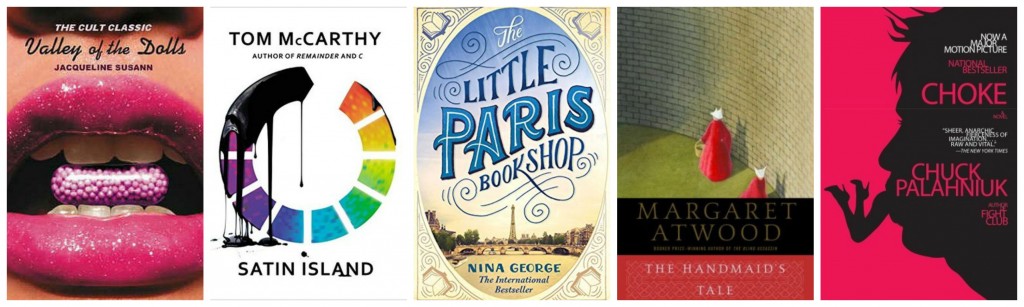
sept TBR 1

  • Valley of the Dolls by Jacqueline Susann (currently reading)
  • Satin Island by Tom McCarthy (library book & currently reading)
  • The Little Paris Bookshop by Nina George (translated by Simon Pare) (in real-life book club book for September)
  • The Handmaid’s Tale by Margaret Atwood (re-read and BookTube read-along)
  • Choke by Chuck Palahniuk (library book & BookTube read-along)

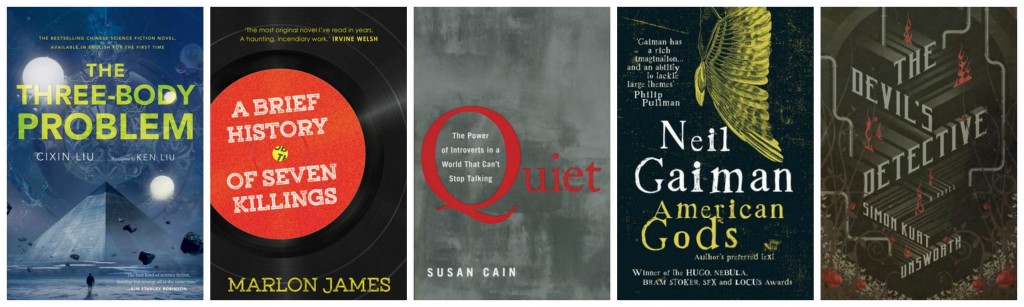
sept TBR 2

  • The Three-Body Problem by Liu Cixin (translated by Ken Liu) (potential buddyread with Riv)
  • A Brief History of Seven Killings by Marlon James (library book)
  • Quiet by Susan Cain (audiobook)
  • American Gods by Neil Gaiman (Literary Exploration Goodreads group)
  • The Devil’s Detective by Simon Kurt Unsworth (library book)

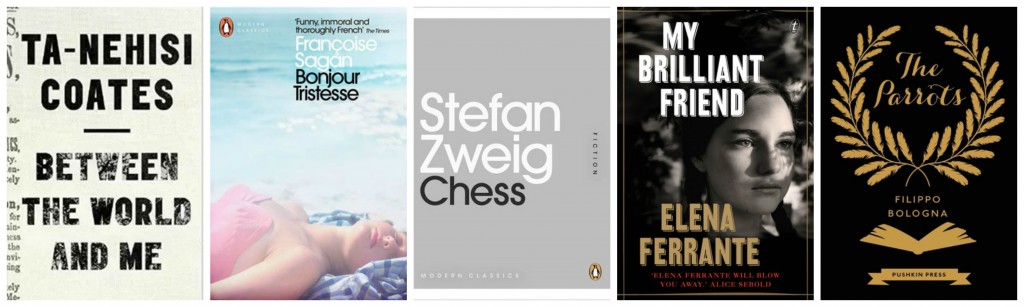
sept TBR 3

  • Between the World and Me by Ta-Nehisi Coates (library book)
  • Bonjour Tristesse by Françoise Sagan (translated by Heather Lloyd) (potential buddyread with Time to Read!)
  • Chess by Stefan Zweig (translated by Anthea Bell) (potential buddyread with Time to Read!)
  • My Brilliant Friend by Elena Ferrante (translated by Ann Goldstein) (in real-life book club book for October)
  • The Parrots by Filippo Bologna (translated by Howard Curtis)

I know I am not going to complete all these books, but I will try. If you are interested in buddyreading any of these, please let me know and I shall see what I can do.


Monthly Review – August 2015

Posted August 31, 2015 by Michael @ Knowledge Lost in Monthly Reading / 0 Comments

Motherless BrooklynAs most people know, last month I was feeling very stressed about work and I found it was really affecting my reading. I am pleased to say that this month my reading was better than average and this is thanks to the BookTubeAThon. If you are not aware, I am a BookTuber as well as a blogger and I have been creating videos most of the year in an effort to improve myself. I found it has built confidence and really helped my ability to articulate all my bookish thoughts. I hope it might help with all thoughts, but only time will tell. BookTubeAThon is a week long readathon where people in the BookTube community come together to read and complete challenges.

This event happened in the first week of August from the 3rd to the 9th. I was unsure if I should take part in the readathon but decided I need to push myself a little bit and created my TBR video in preparation for the week. While one of the challenges was to complete seven book for the week (which I failed) I think it did a world of good. I also managed to finish six books in the week. The first book I read was Mislaid by Nell Zink which I found problematic, I did talk a bit about my issues in my BookTubeAThon Vlog video, so I will not go into too much details here and you can wait for my review (I am very behind so might take a while) for that. The next book I read was Bad Nature, or With Elvis in Mexico by Javier Marías, which was translated by Esther Allen. Now this was for a challenge were a read a book without letting go of it (which is a stupid challenge) but obviously I needed something quick. I am not sure who recommended this novella so I cannot thank them but this was an amazing read. It explored some interesting ideas of translations, and the relationship between the translator and everyone else. This was written in Spanish, translated into English and it talked about a Spanish translator, which gave it a very meta feel.

After that, I read Where I’m Reading From by Tim Parks and this book is different than I expected, I thought it was a memoir about reading but it turned out to be a collection of essays. I also finished another non-fiction book on audiobook; The Lucifer Effect: How Good People Turn Evil by Philip Zimbardo which just reminds me I want to read so many more books on psychology. This book sparked a blog post recently too. I then read In Watermelon Sugar, the first of three books I read as part of a Richard Brautigan read-along for the month, and after that was an espionage novel called Leaving Berlin by Joseph Kanon and these were all the book I managed to read for BookTubeAThon. The last book would have been Motherless Brooklyn by Jonathan Lethem but I got so sucked into this novel, I wanted to take my time and savour all it; it ended up being my favourite for the month.

This readathon was a lot of fun; I read a decent amount of books, even if I did not complete all the challenges. It really got be back into reading, and I managed to keep a decent amount of momentum for the rest of August.  The next book I did complete was The Windup Girl by Paolo Bacigalupi, which was for a buddy read. I do not know if I am any good at buddy reading but it is fun to have someone to talk to about a particular book; it also makes it a more social activity. For my in-real-life book club we had to read The Green Road by Anne Enright and that was recently long listed for the Man Booker Prize. I really enjoyed the way Enright took fragments of each person’s life and combined it into this domestic drama; some people in the book club had a bit of a problem with that style of writing but for me it just worked.

I have already mentioned In Watermelon Sugar but I also read a collection of poetry call The Pill Verse the Springhill Mine Disaster by Richard Brautigan. I like his poetry style; they are short poems that often pack a big punch. I then read Trout Fishing in America by Richard Brautigan to finish off my Brautigan read-along, I plan to read more of his books in the future but this was a great introduction to this author.

I then went onto a bit of a non-fiction kick when I read Bonk by Mary Roach, You’re Never Weird on the Internet (Almost) by Felicia Day, Postmodernism: A Short Introduction by Christopher Butler and My Reading Life by Bob Carr. All very different books but I am starting to love non-fiction books and I think books like Bonk and Postmodernism: A Short Introduction are good ways to do that. Mary Roach is a wonderful writer and I think I have found an example of the writer I would like to become in her book. I will have to practice more and read everything Mary Roach has written but it is nice to have a goal. Also Felicia Day’s memoir talked a lot about goals and failures so Never Weird was really helpful in that aspect.

The last novel I read this month was the final book in Jeff Lindsay’s Dexter series, Dexter is Dead; I have been reading these books all my reading life and it is a little sad that the series is ended. Lindsay’s writing style is not that strong but he helped me get into reading. At one point I did want to write like him, I love the inner struggle of Dexter and the moral questions that are explored but the series was a bit of a hit or miss. However there is a real sense of nostalgia going back to those books for me, and this is one of the few series that I have actually completed.

That was my reading for the month of August; I am very pleased with my progress. You might have also known I have fully migrated over to Knowledge Lost and am now blogging about more than books. I hope to catch up on my reviews (I think I have 30 to write) but I might do some mini reviews. My goal is to explore more than just literature on my blog and on my YouTube channel. It is weird to think I have become addicted to YouTube but I think it has been great for me. Next month I plan to read Valley of the Dolls by Jacqueline Susann, Satin Island by Tom McCarthy, Choke by Chuck Palahniuk and reread The Handmaid’s Tale by Margaret Atwood. There are so many other books I want to read but lets see how I go. Let me know what your August was like in the comments below.

Read More


Smoke by Ivan Turgenev

Posted August 27, 2015 by Michael @ Knowledge Lost in Classic, Russian Lit Project / 2 Comments

Smoke by Ivan TurgenevTitle: Smoke (Goodreads)
Author: Ivan Turgenev
Translator: Michael Pursglove
Published: Alma Books, 1867
Pages: 256
Genres: Classic
My Copy: Library Book

Buy: AmazonBook DepositoryKindle (or visit your local Indie bookstore)

Set in Baden-Baden, a small spa town in the foothills of the black forest, in the south west of Germany, near the border of France and Switzerland. Grigory Mikhailovich Litvinov has arrived in the town after spending years in the west; here he plans to meet up with his fiancée Tatyana. While there, he bumps into Irina an old flame, who is now married to a prominent aristocrat General Valerian Vladimirovitch Ratmirov. This chance meeting derails all Girgory’s plans for the future and sends his life into turmoil. Smoke is a melancholy novel of an impossible romance and an apogee of Ivan Turgenev’s later novels.

I know what my wife would say, this is a typical Russian novel about a man that has a fiancée that has waited for him all these years while he was out west but then an old flame turns up and he doubts his relationship. This is a common trope in classic Russian literature but this is also autobiographical for Ivan Turgenev. At the time of writing this novel, Turgenev was living in Baden-Baden to be near his lover Opera singer Madame Viardot. Creepily, he moved next door the singer and her husband. His relationship with Madame Viardot turned into a lifelong affair that resulted in Turgenev never marrying, although not sure what her husband thought of it all.

Smoke is a satirical novel aimed to highlight the problems Ivan Turgenev found with mother Russia. The conservatives are unwilling to change and adapt to the help modernise Russia, while he believed that the revolutionaries were glorifying a Slav mysticism, which we all know as the Union of Soviet Socialist Republics. With one novel, Turgenev managed to alienate the majority of Russia in one hit; the book even sparked a heated feud with fellow writer Fyodor Dostoevsky.

While this satirical exposé into his fellow countrymen was met with a lot of criticism within Russia, Smoke was still published in the March 1867 issue of The Russian Messenger. The Russian Messenger is one of the best Russian literary magazines during the 19th century publishing the majority of the great pieces from this country. Smoke may not be the best Ivan Turgenev novel to start with but it was an interesting book to read none the less. The amount of debate it sparked was fascinating to explore and I believe Smoke holds a well-deserved spot in the Russian canon.


Movie Review: Cinema Paradiso (1988)

Posted August 25, 2015 by Michael @ Knowledge Lost in Movie-Drama / 0 Comments

Cinema ParadisoTitle: Cinema Paradiso
Released: 1988
Director: 
Giuseppe Tornatore
StarsJacques Perrin, Philippe Noiret, Leopoldo Trieste, Marco Leonardi
Genre: Drama

Italian masterpiece Cinema Paradiso tells the story of the life of fictional film director Salvatore Di Vita. This is often seen as an example of nostalgic post-modernism, exploring the evolution of cinema in the form of a coming of age story. Writer and Director Giuseppe Tornatore has spoken out as saying that Cinema Paradiso was his eulogy to the death of cinema, however after the success of the movie he never mentioned this again.

The 1988 movie is set in the small Sicilian town of Giancaldo where Salvatore (Toto) Di Vita grows up. He befriends the local film projectionist Alfredo and the movie follows this development through the ages of cinema. The theme of censorship plays a big part of the movie, often depicting scenes where the local priest would watch the movies prior to release in order to remove all kissing scenes or anything else that is considered inappropriate. This is in a time where the whole town came together to watch a movie and get the latest news. So there was not much choice in what to see and with the whole family there it needed to be appropriate for all ages. However this does spark many debates on the necessity of censorship and one day I hope to do a blog post on the Hays Code that nearly destroyed America cinema as well as the Legion of Decency, an organisation that would boycott any movie they deemed inappropriate.

While Cinema Paradiso likes to take a hard look at the censorship, it does not take itself too seriously. Stand out scene for this was when a kissing scene finally makes the screen and the priest in an outrage says he would not watch this pornographic movie. Despite the fact that he has spent many hours watching all these movies in the past. As well as looking at censorship I could not over look the nostalgic value of this movie. Depicting scenes from many great movies including; The Adventures of Robin Hood (1938), Carmela (1942), The Outlaw (1943), It’s A Wonderful Life (1946) and so much more. I am no expert in classic cinema but I really enjoyed the nostalgic approach found within the movie.

I have never seen this movie before and I feel a little shame to admit this. In the future I plan to watch more of the movies found on the 1001 Movies to Watch Before You Die list and blog about them all. Who knows, I might actually get a chance to watch them all. I know I am just a beginner when it comes to critically analysing movies but I am looking forward to seeing the progress I make in the future. I have not talked about the acting or the dramatic use of lighting in the review, I may revisit this film in the future. If you have never seen Cinema Paradiso and are a fan of cinema I highly recommend getting a copy as soon as possible.