Boardwalk Empire by Nelson Johnson

Posted April 25, 2014 by Michael @ Knowledge Lost in Non-Fiction / 0 Comments

Boardwalk Empire by Nelson JohnsonTitle: Boardwalk Empire (Goodreads)
Author: Nelson Johnson
Narrator: Joe Mantegna
Published: Plexus Publishing, 2002
Pages: 312
Genres: Non-Fiction
My Copy: Audiobook

Buy: AmazonBook DepositoryKindle (or visit your local Indie bookstore)

Atlantic City has quite a history, from the rocky beginnings to its colourful characters like Louis “Commodore” Kuehnle and Enoch “Nucky” Johnson. Boardwalk Empire by Nelson Johnson (subtitle: The Birth, High Times, and Corruption of Atlantic City) tells the history of this US city. While this book inspired the current HBO series of the same name, this is not a reason to read this. The HBO show tells the story of a fictional character based on Nucky Johnson (called Nucky Thompson in the show). If you were to base a show on this non-fiction book it would turn out more like House of Cards.

There was a big chapter of Boardwalk Empire devoted to Nucky Johnson, who was an interesting guy. If you know the plot of the HBO series you might be aware of the type of character Nucky was, despite being only loosely based on him. His rise to power came thanks to the Volstead Act, but he wasn’t just a mob boss, he was a political powerhouse. Corruption never seemed so complex and scary; using the Republican Party to control the city all the while using extortion to fund the party. This technique helped control Atlantic City, keeping it corrupt well into the modern era.

While the history of Atlantic City is fascinating, it is sad to see just how big of an impact organised crime had on a growing city. I have an interest in the Volstead Act and how prohibition helped organised crime get a foothold in America. Boardwalk Empire shed some interesting insights into the cultural impact it had on a large scale.

I have started a new phase in my reading life where I’ve become very interested in non-fiction. While Boardwalk Empire wasn’t the greatest book, there was a lot to learn about politics and organised crime. This period of time interests me and I plan to read a whole lot more reading on the Volstead Act and organised crime, so I need recommendations. If you know good non-fiction books on these topics let me know.


The Sorrows of Young Werther by Johann Wolfgang von Goethe

Posted April 24, 2014 by Michael @ Knowledge Lost in Classic / 1 Comment

The Sorrows of Young Werther by Johann Wolfgang von GoetheTitle: The Sorrows of Young Werther (Goodreads)
Author: Johann Wolfgang von Goethe
Translator: David Constantine
Published: Oxford World's Classics, 1771
Pages: 160
Genres: Classic
My Copy: Paperback

Buy: AmazonBook DepositoryKindle (or visit your local Indie bookstore)

The Sorrows of Young Werther is an epistolary novel that has influenced the Romantic Movement. Often known as the original ‘emo’, a term that I hate, this novel is a semi-autobiographical novel that brought huge success to Johann Wolfgang von Goethe. The novel is a collection of letters written by Werther to his friend Wilhelm. These letters are an intimate account of his attraction towards the beautiful Lotte; a young woman he meets in the village of Wahlheim. Despite knowing that she is already engaged to a man 11 years her senior, Werther falls for her and attempts to develop a friendship between the two in an effort to get closer to Lotte.

You can probably guess how this story goes; Werther, an artist of highly sensitive and passionate nature heading down a road that can only lead to heartbreak. I’m not one to enjoy a novel that revolves around a love triangle but when it is done properly it can be an effective plot device; I’m thinking of books like those mentioned in this post. There is no denying the cultural impact The Sorrows of Young Werther has had on the world; unfortunately the ‘Werther effect’ is the most common reference to the novel nowadays.

I’ll be honest, I wanted to read this novel because Frankenstein’s monster finds this book in a leather portmanteau along with Plutarch’s Lives of the Noble Greeks and Romans, and John Milton’s Paradise Lost which gives you an interesting insight into FrankensteinLives of the Noble Greeks and Romans is a series of biographies of famous men to illustrate their common moral virtues or failings, while Paradise Lost is an epic poem on creationism and the fall of man. The Sorrows of Young Werther embodies the Romantic ideals; Werther being a sensitive intellect with an obsession of nature and values emotion over reasoning. All three novels represent different themes that Shelley wants the reader to explore when reading Frankenstein.

While this may sound like a morbid and depressing novel, Goethe shows the beauty behind the tragedy. One thing I loved about this book is the wording, and permit me to post a few quotes from the book to just show you the beauty in the novel.

 “Sometimes I don’t understand how another can love her, is allowed to love her, since I love her so completely myself, so intensely, so fully, grasp nothing, know nothing, have nothing but her!” 

The major theme obviously is love; a look in how it can defy all logic. Werther can’t stop his heart from falling for Lotte, even if he knew it would lead to pain. The idea that the heart has more control over someone’s actions than their head is often evident in life and The Sorrows of Young Werther captures it perfectly. For me, that is what makes this novel spectacular and significant.

“I am proud of my heart alone, it is the sole source of everything, all our strength, happiness & misery. All the knowledge I possess everyone else can acquire, but my heart is all my own” 

However, you can look at this novel as something other than love; the idea that Goethe is portraying the decline in Werther’s mental health is also a vital angle that needs to be considered. The reason I hate the term ‘emo’ I won’t go into at this time but Werther’s overly emotional journey could also be symptoms of a bi-polar depression, though not a known diagnosis of the time. We have to consider the idea that his joy and sorrow is not just unrequited love but a deeper issue. The love triangle would have added fuel to his depression and we cannot ignore that this could be the root cause of Werther’s sorrow.

For such a small novel, The Sorrows of Young Werther packs a huge punch. This is the type of book I can see myself reading again and again, not just because of the Romantic ideas but what it has to say about love and mental illness. I can’t help but think that The Sorrows of Young Werther is just a better version of The Catcher in the Ryein the sense that is a journey of a self-absorbed protagonist, but maybe too difficult for high-school student. The Sorrows of Young Werther is an important book, not only did it influence the greatest literary movement we’ve seen but it still relevant today, almost 250 years later.


My Plans for the 24 Hour Read-a-thon

Posted April 23, 2014 by Michael @ Knowledge Lost in Bloggers Event / 9 Comments

The Dewey’s 24 Hour Read-a-thon is a mini reading challenge that happens twice a year in April and October. Traditionally I’m never prepared or often hear about a reading challenge like this too late. This time I made an effort to participate; I want to be more involved in the book blogging community. As this is my first 24 hour read-a-thon I’m not sure what to expect and how much I need to prepare. I may have gone overboard, but I’m planning on focusing on cleaning up my NetGalley list. I’m not going to get through all these ARCs but it would be good to clear of a few of these books. The read-a-thon starts at 11pm Saturday here in Australia, who what I’ll finish but here is a list of the books on my reading list in order of priority.

  1. Shovel Ready by Adam Sternbergh
  2. The Fever by Megan Abbott
  3. Summer House with Swimming Pool by Herman Koch
  4. My Salinger Year by Joanna Rakoff
  5. The Love Affairs of Nathaniel P. by Adelle Waldman
  6. The Lowland by Jhumpa Lahiri
  7. Constance by Patrick McGrath
  8. Celebromancy by Michael R. Underwood

Top Ten Tuesday: Great Femme Fatales

Posted April 22, 2014 by Michael @ Knowledge Lost in Top Ten Tuesday / 8 Comments

toptentuesdayIt’s Tuesday again which means time for another round of Top Ten Tuesday; I like joining in on this meme because I have a set topic to work with. Top Ten Tuesday is a book blogger meme that is hosted by The Broke and the Bookish and this week the theme is: Great femme fatales. I love a good femme fatale, they are mysterious, seductive and often deadly.

  • Brigid O’Shaughnessy – The Maltese Falcon by Dashell Hammett (without spoiling the story, Brigid is the ultimate femme fatale)
  • Phyllis Nirdlinger – Double Indemnity by James M. Cain (like Brigid O’Shaughnessy, Phyllis embodies the perfect archetype of a femme fatale)
  • Cleopatra – Antony and Cleopatra by William Shakespeare (Cleopatra is possibly one of the original femme fatales)
  • Dolores – Lolita by Vladimir Nabokov (while we may not want a 12 year old femme fatale. You can’t deny she doesn’t embody the characteristics of a femme fatale)
  • Vivian Sternwood – The Big Sleep by Raymond Chandler (I can’t over look Chandler and Vivian is his best example of a femme fatale)

  • Daisy Buchanan – The Great Gatsby by F. Scott Fitzgerald (no explanation needed)
  • Rebecca – Rebecca by Daphne du Maurier (just because she’s dead doesn’t stop Rebecca from being a great femme fatale)
  • Joan Medford – The Cocktail Waitress by James M. Cain (Cain is the king of the femme fatale and I struggled to only name one of his characters in this list)
  • Laurel Gray – In a Lonely Place by Dorothy B. Hughes (sassy, strong minded with a little mystery to her)
  • Veronica Mars – The Thousand-Dollar Tan Line by Rob Thomas & Jennifer Graham (if you’ve seen the TV show you’ll know how great Veronica Mars is; part hard-boiled detective part femme fatale)

The Goldfinch by Donna Tartt

Posted April 20, 2014 by Michael @ Knowledge Lost in Contemporary / 8 Comments

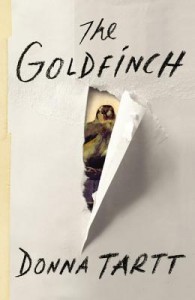
The Goldfinch by Donna TarttTitle: The Goldfinch (Goodreads)
, 2013
Pages: 771
Buy: AmazonBook DepositoryKindle (or visit your local Indie bookstore)

Carel Fabritius was a talented Dutch painter who was considered Rembrandt’s most gifted pupil. His paintings often featured delicately lit subjects against a light coloured background. He moved away from Rembrandt’s renaissance focus and developed his own painting style, with a strong interest in the technical. In 1654 he was injured in The Delft Explosion; 30 tonnes of gunpowder exploded destroying most of the city. Fabritius soon died from his injuries at the age of 32. Possibly one of the last paintings he ever painted, The Goldfinch depicts a goldfinch (a popular pet of the time) on light background. This piece shows his control over a heavily loaded brush as well as demonstrates his interest in lighting and texture.

Donna Tartt’s new novel The Goldfinch tells the story of Theo Decker, who survived a terrorist attack on a New York museum. Moments before the explosion his mother was pointing out Fadritius’ painting and telling Theo why she loved it; in all the confusion Theo manages to take the painting. Orphaned and alone, Theo struggles to find his place in this world while also trying to avoid being taken by the city.

While The Goldfinch is essentially a coming of age story, there are some interesting social observations being played out with the help of the stolen painting. On one hand, the painting represents Theo’s love for his mother and his need to hang on. I also feel that the painting represents that part that you keep hidden from the world; the secrets and shames that you tend to think will destroy friendships if revealed. This also serves a purpose when it comes to Theo’s friendship with Boris further in the novel.

While this is a novel about art and its seedy underbelly, I found myself a little disappointed in the lack of art history, art forging or art heists (technically there is a heist but that wasn’t thrilling). When I discovered my love of literature and learning, I also discovered an interest in art and art history, an itch that I’ve not scratched. I was hoping that Tartt’s novel would give me both entertainment and art history lessons but I was left disappointed. I expected Desperate Romantics but all I got was a bulky Catcher in the Rye.

I’m not saying that I didn’t like The Goldfinch, my expectations for the novel was different to what I got. Donna Tartt spends a lot of time looking at the idea of terrorist attacks and the lasting effects they have on the families of the victims and survivors. This grief serves as a baseline for Theo throughout the novel. Often it can be forgotten about but then you catch glimpses of the scars that remain and while they don’t justify his behaviour it really serve as evidence of the emotional rollercoaster he is stuck on. Tartt’s character development is the key to this book; she has created richly complex and flawed characters that feel so real. Theo, in particular, serves as both the narrator and protagonist; his voice throughout the novel manages to be both direct and reflective.

Donna Tartt’s The Goldfinch is complex but over padded; there is a lot that could be cut out to make this a shorter book. I can appreciate the way she captured the life of Theo Decker; making this a sweeping saga, packed with emotion and growth, still would be achievable with a hundred or more pages removed. This is a tragicomedy in every sense of the word but my biggest problem was that there were some situations where things resolved themselves a little too conveniently; it happens but not that often.

 In the end, I found myself sitting on the fence with The Goldfinch. On one hand the characters and development of this novel was spectacular. The other hand is the fact my initial expectations weren’t met and the novel dragged on too much. I know that expectations should never get in the way of a good book and my head is telling me that I should jump on the bandwagon, however my heart just isn’t in it. I’ve heard good things about The Secret History but I have reservations about it now.


Where is the Overall Story Arc in a Crime Series?

Posted April 19, 2014 by Michael @ Knowledge Lost in Literature / 2 Comments

One thing that annoys me about reading a crime series is the lack of an overall story arc. I’m not saying that this is the case with all book series but it seems to be for the majority of them. Within crime fiction especially, the overall story arc is often very basic and often feels like a crime of the week format. This isn’t the case with romance, science fiction and fantasy they are more likely to have a continuous story line and have huge success with it.

When I read a series it is more than often a crime series and I wish the ‘new novel, new crime’ wasn’t the norm. When I watch TV, I often enjoy a series with an ongoing story; Veronica Mars is a prime example on television of what I want in a crime novel. A case that needs to be solved in every book but a bigger mystery that lasts over a couple of novels. Why can’t they do that in a novel series? I know a book is a bigger investment but I often read one book in a series and never continue because there is nothing to keep me reading.

The problem is that everything seems to be a series at the moment; I like the idea of returning to a great character but I need more. I like hard-boiled and noir crime novels but I find myself reading them less and less. I don’t want to read a series if there is nothing to keep me reading. A character has to be amazing to keep me reading, or they could just give me an unanswered mystery. Does anyone know of a good crime series that develops characters over a long period of time and also has an overall story arc?  Let me know. I wish I could write, I have been developing a concept in my head but I have no idea how to put it onto a page.


Big Bad Wolf by Nele Neuhaus

Posted April 17, 2014 by Michael @ Knowledge Lost in Crime / 0 Comments

Big Bad Wolf by Nele NeuhausTitle: Big Bad Wolf (Goodreads)
Series: Bodenstein & Kirchhoff #6
, 2014
Pages: 404
Buy: Book Depository (or visit your local Indie bookstore)

After finishing The New York Trilogy I needed something light, something I didn’t have to analyse. I picked up Big Bad Wolf because I enjoyed Snow White Must Die so much. I’m not saying that I can’t analyse a novel like this one (you can analyse every text), I just think at times some light reading is needed. Big Bad Wolf tells the story of a crime that happened on the river Main near Frankfurt. Investigators Pia Kirchhoff and Oliver von Bodenstein are back to investigate the crime, as the case progresses they find it taking them into a pit of evil and cruelty in the midst of a middle class utopia.

I am trying to make an effort to read more translated fiction; I loved Snow White Must Die which is book four in the series but only the first one to be translated into English. This is book six in the same series and I have to wonder why a publisher would publish books in such a weird order; this was a similar issue that happened with Jo Nesbø. I understand that a publisher would want to translate the novels that will sell the best but if Nele Neuhaus’ popularity continues to grow at this rate we will have another Nesbø situation.

Everything I loved about Snow White Must Die is absent in Big Bad Wolf; I think the problem is that Pia Kirchhoff and Oliver von Bodenstein are considered the main protagonists while Snow White Must Die focused more on the life of a man who served ten years for a crime he didn’t commit. That is what fascinated me but Big Bad Wolf is just another crime novel.

I’ve read so many great crime novels now that I find most of them clichéd and formulaic, Big Bad Wolf isn’t that bad but I’m looking for books that do something different and fresh with the genre. There are some decent moments in Big Bad Wolf, some unexpected twists but I wanted more. The novel is darker than most popular crime novels but keeps to the standard formula. One thing I did find difficult about this novel was the amount of view points, making it difficult at times to understand what was going on but this is an acceptable method for building suspense.

I highly recommend Snow White Must Die, if you haven’t tried some German translated crime before then this might be a good starting point. As for Big Bad Wolf, I’m disappointed with the end result but others might enjoy it more than I do. I hope Nele Neuhaus’ other novels are more like Snow White Must Die but I won’t be in a hurry to try her works again.


Top Ten Tuesday: Love Triangles

Posted April 15, 2014 by Michael @ Knowledge Lost in Top Ten Tuesday / 9 Comments

toptentuesdayIt’s Tuesday again which means time for another round of Top Ten Tuesday; I like joining in on this meme because I have a set topic to work with. Top Ten Tuesday is a book blogger meme that is hosted by The Broke and the Bookish and this week the theme is: Bookish Things (That Aren’t Books), which I’m not going to do. Instead I’m going to high-jack this week’s Top Ten Tuesday and give you a list of novels with a decent love triangle within them.

ttt-14-04-1

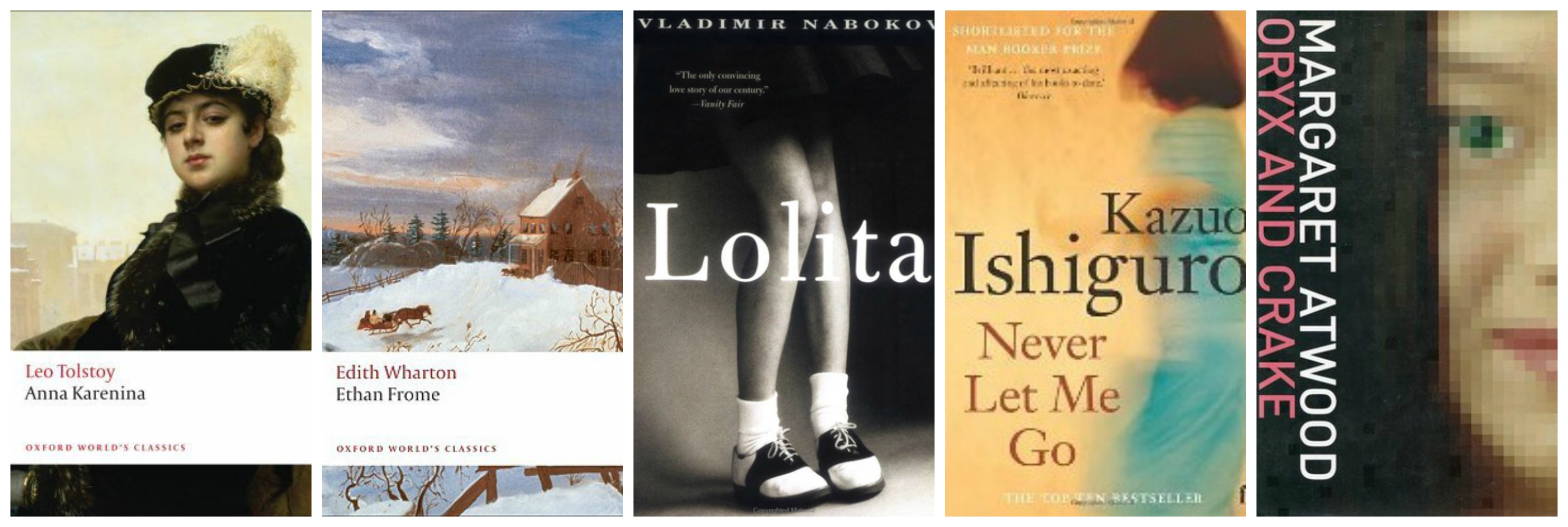
  • Anna Karenina by Leo Tolstoy — Alyosha Vronsky, Alexei and Anna Karenin
  • Ethan Frome by Edith Wharton — Zeena, Ethan, and Mattie
  • Lolita by Vladimir Nabokov — Clare, Dolores, and Humbert Humbert
  • Never Let Me Go by Kazuo Ishiguro — Ruth, Tommy, and Kathy
  • Oryx and Crake by Margaret Atwood — Oryx, Crake, and Snowman

ttt-14-4-2

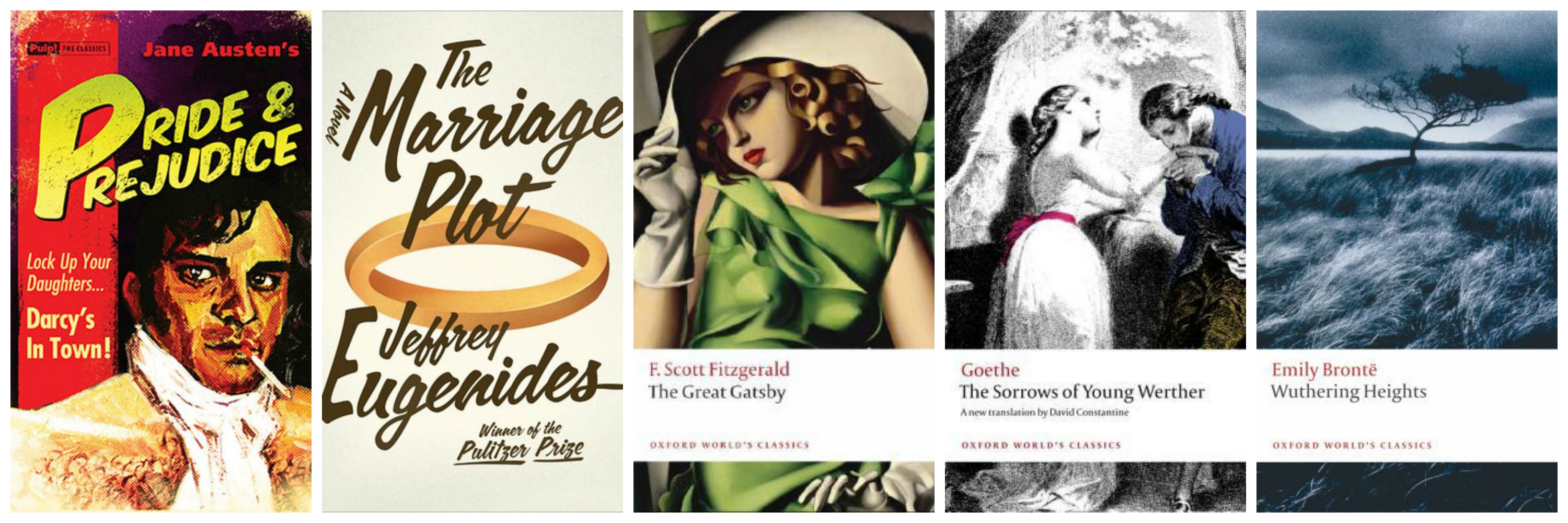
  • Pride and Prejudice by Jane Austen — Wickham (or Mr Collins), Mr Darcy, and Elizabeth Bennet
  • The Great Gatsby by F. Scott Fitzgerald — Tom, Daisy, and Jay Gatsby
  • The Marriage Plot by Jeffrey Eugenides — Madeleine, Leonard, and Mitchell
  • The Sorrows of Young Werther by Johann Wolfgang von Goethe — Albert, Lotte, and Werther
  • Wuthering Heights by Emily Bronte — Linton, Catherine, and Heathcliff

The New York Trilogy by Paul Austen

Posted April 13, 2014 by Michael @ Knowledge Lost in Crime, Literary Fiction / 2 Comments

The New York Trilogy by Paul AustenTitle: The New York Trilogy (Goodreads)
Author: Paul Auster
Published: Penguin, 1987
Pages: 308
Genres: Crime, Literary Fiction
My Copy: Audiobook

Buy: AmazonBook DepositoryKindle (or visit your local Indie bookstore)

If you want to try a metafictional detective novel, then look no further than The New York Trilogy by Paul Austen. Originally published sequentially as City of Glass, Ghosts and The Locked Room, these three interconnecting stories have been since collected into a single volume. Heavily influenced by the post-modernist movement, this novel blends elements of neo-realism, soft-boiled fiction and of course, metafiction. Even the pulp style cover (illustrated by Art Spiegelman) has a metafictional style to it.

I really wish I had a better grasp on post-modernism; there is a lot of literary theory that must go into fully understanding a novel like The New York Trilogy. My level of understanding of post-modernism might hinder this review but I will do my best to add something valuable here. Starting with a look at any example of one of the narrators; such as the one known as Peter Stillman, or is he? Maybe his name is something entirely different; maybe it is Paul Auster. This gives you an idea of just how you have to read this book; continuously questioning everything and assuming things are not as they have been told. This does make the novel difficult to read, I had to take my time with it and reread almost everything.

The first story City of Glass follows a detective fiction writer that becomes a private investigator. This unnamed narrator explores layers of identity and reality; often to Paul Auster (the author), Paul Auster (the writer), Peter Stillman (the mark), the other Peter Stillman (the son) and finally Daniel Quinn (the protagonist). The story follows this narrator as he descends into madness as the reader follows close behind. This is story that explores the relationship between the author, characters and the reader in a twisted kind of way. Essentially asking us to consider who has the real power in this relationship?

Ghosts follows the story of a private eye called Blue who is hired to follow Black; he has been hired by White to write down everything Black does. Only problem is that Black doesn’t do too much apart from sit and write all day, which means Blue spends all day sitting and writing. This is a story that explores the issue of who has the real power, the author or their characters. Paul Auster is showing us his views towards writing (sitting and watching what the character does).

Finally in The Locked Room, the title suggests that the story is referencing the locked room mystery archetype. It tells the story of a writer that doesn’t have the creativity to produce any fiction. When a childhood friend disappears, he has been hired to write his works and determine if they should be published. While one this job he finds himself taking the place of his friend and becoming husband and father to his family. This final story looks at the relationship between character and reader and asks us to consider if we are under the control of the author or do we interpret what is happening for ourselves.

It is interesting that a novel like The New York Trilogy can leave you perplexed and confused but when you try to articulate what happened and slowly dissect the novel into its three parts it all makes sense. I’m often surprised with how much I get out of a post-modern novel, especially since I often freak out and feel like I have not understood it. Then it all makes sense and I often wonder how I did not pick up on this while reading or after reading the novel. I hope I’ve made enough sense out of The New York Trilogy, a bizarre novel that requires very close attention but I’ve conquered it and I feel proud.


Is Formalism still Relevant?

Posted April 12, 2014 by Michael @ Knowledge Lost in Literature / 2 Comments

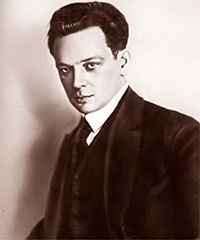
Yuri Tynianov

In a time of revolution a new form of literary theory also emerged. Russian Formalism was an influential school of literary criticism that involved a number of influential scholars including Viktor Shklovsky, Yuri Tynianov, Vladimir Propp, Boris Eichenbaum, Roman Jakobson, Boris Tomashevsky and Grigory Gukovsky. The movement may have been short lived from the 1910’s to the 1930’s but it played a big part in influencing modern criticism, including structuralism and post-structuralism.

The idea of Formalism is to study the mode, genre, discourse and forms of literature. Ignoring the social or cultural influences, Formalism choices to analyse the structure rather than analyse the meaning behind it. The approach takes a more scientific look at literature over the others at the time, but still influenced by other schools of thought like Ferdinand de Saussure’s linguistic theories and Symbolism.

While I don’t know much about literary theory, the concept of Formalism has been on my mind lately, and even been the subject of an interesting debate on Twitter. While this an out-dated school of thought, I do believe it is a useful form of literary criticism. While I wouldn’t recommend focusing on Formalism, it can serve as a basis into diving into the world of literary criticism. I have to wonder, is it just my university or does Formalism get taught as an early concept in other English lit courses?

By developing a basic understanding of mode, genre, discourse and forms, it allows us to ask questions we may not normally ask. Why is the text written in one perspective over another? What does the form say about its content? How does paradox, irony, ambiguity, or tension work in the text?  The idea is to help to develop critical thought, giving students a basis to work with.

Formalism is not a term used in the current subject I’m taking; it’s called Approaches to English Literature but the concept is the same. However recent trends in academic literary criticism suggest that maybe Formalism making a comeback. While I would never focus on Formalism, I think it is a useful skill to learn; I believe there is a use for this school of literary criticism. It may only be to develop skills needed for future studies. What are your thoughts on Formalism? Do you believe its useful or making a comeback? If you’ve studied it, do you believe it helped develop critical thinking?