Format: Audiobook

Heart of Darkness by Joseph Conrad

Posted July 6, 2012 by Michael @ Knowledge Lost in Classic / 0 Comments

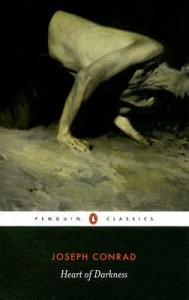
Heart of Darkness by Joseph ConradTitle: Heart of Darkness (Goodreads)
Author: Joseph Conrad
Published: Penguin, 1899
Pages: 200
Genres: Classic
My Copy: Paperback

Buy: AmazonBook Depository (or visit your local Indie bookstore)

When you think of books required to consider yourself ‘well read’, one book that is often in that list is Joseph Conrad’s Heart of Darkness. I’ve been told that watching Apocalypse Now doesn’t count; however if you have read the book and seen the movie, fun can be found spotting the similarities. Heart of Darkness is a difficult book to read but if you stick with it, there is a certain elegance in the novel, as well as the fact that it’s heavily symbolic.

One of the more interesting aspects of this novel is the narrative style. It’s not narrated by the protagonist Marlow but an unnamed listener of his stories. Almost like the narrator is the reader, standing there listening to Marlow tell his tales. This is happening while the boat is anchored on the River Thames near London, though his tales are of him captaining a steamship in Africa.

The blend of feeling like a shipmate listening to the tales, and the fact that Marlow struggles to talk about the torments, makes this an excellent representation of the duality of human nature. While it was a fantastic book, the writing style did make it difficult to enjoy this book as much as I wanted.


Empire State by Adam Christopher

Posted July 4, 2012 by Michael @ Knowledge Lost in Pulp, Science Fiction / 0 Comments

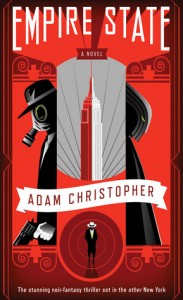
Empire State by Adam ChristopherTitle: Empire State (Goodreads)
Author: Adam Christopher
Series: Empire State #1
Published: Angry Robot, 2012
Pages: 445
Genres: Pulp, Science Fiction
My Copy: Audiobook

Buy: AmazonBook DepositoryKindle (or visit your local Indie bookstore)

During the last great superhero fight, a blast of energy rips a hole in reality, the result is Empire State; a twisted parallel prohibition-era New York City. But now the rift is starting to close and both parallel worlds have to fight for the right to exist. Adam Christopher’s Empire State tells the story of Rad Bradley a private detective investigating the disappearance for Sam Saturn which leads him to uncover something a whole lot bigger. This book is everything you expect in a pulp style superhero novel; you have the super villains, airships, robots, organised crime and prohibition (to make it feel more like a pulp novel). This is all a brilliant back drop for the main plot; the case the gets Rad Bradley tangled in a complex web of robotic killers, inter-dimensional doppelgangers and science.

The whole tone of this book feels very much like a superhero novel but never loses sight of the noir style narrative. The whole story cast is wonderfully unique and mystery that will keep the readers on the edge of their seats while reading this book. There are some things that didn’t quite work within the story and the constant world shifting can get the reader lost. I think in the end there turns out to be at least three different worlds; Prohibition New York, Empire State and New York 1950’s. The world, the crime and the characters show potential for a lot of great stories to follow.

Adam Christopher and publisher Angry Robot Books have invited others to create works based in the world of Empire State. Writer, artist, musician, sculptor, puppeteer, interpretive dance major, or poet, are invited to create their own stories with what they are calling WorldBuilder as long as you stick to their Guidelines and Instructions. They are authorising fan-created content to be created under a Creative Commons Attribution-NonCommercial-ShareAlike 3.0 Unported License which means content can be posted on the internet or beyond as long as it’s in a non-commercial way; publication rights of the stories are still in the hands of the publisher. There are plans for an eBook or Print-on-Demand anthology of the best stories which is pretty exciting; I’ve never seen a novel do anything like this, making for some interesting stories to follow. I think this world is capable of millions of other great stories whether superhero, science fiction, alternate history, organised crime or even pulp stories.

I’m curious to see what the results of this creative common might lead to but as for this book, if you want a fun, exciting novel with twists and mystery, then you really should give Empire State ago. There’s a certain uniqueness within this book while remaining familiar with the writing style. I feel nostalgic towards a good pulp novel and this blends that with science fiction elements with such ease. This genre is often called neo-noir (a genre that blends pulp with updated themes, content, or style, often blended with Science Fiction) and there have been some great books that have come out in this style, but Empire State is definitely one of the better ones.


The Picture of Dorian Gray by Oscar Wilde

Posted June 28, 2012 by Michael @ Knowledge Lost in Book of the Month, Classic, Gothic / 0 Comments

The Picture of Dorian Gray by Oscar WildeTitle: The Picture of Dorian Gray (Goodreads)
Author: Oscar Wilde
Published: Barnes & Noble Classics, 1890
Pages: 248
Genres: Classic
My Copy: Personal Copy

Buy: AmazonBook Depository (or visit your local Indie bookstore)

I feel perplexed about The Picture of Dorian Gray by Oscar Wilde. On one hand, the story is well written about a young man being moulded and shaped. On the other hand, this book was incredibly flowery and doesn’t really start for 100 pages. Dorian doesn’t really know about life and meets an artist and an aristocrat that help him though his journey into manhood. The artist paints his portrait, subsequently making him keep his youth. The aristocrat had the biggest influence on Dorian Gray, though Lord Harry Wotton is very annoying. He talks and talks the whole way through this book, thinking he’s so witty.

Dorian Gray starts off in this novel as a blank slate, an easily influenced young man. Throughout the rest of the story he gets moulded and pushed into shape. After Basil paints his portrait Dorian starts to unravel, afraid to show the picture, he locks it way in a room and never lets anyone see it, protecting it at all costs. The whole thing symbolising the way we hide our real selves from the rest of the world, scared of what they may think.

The Picture of Dorian Gray would have been controversial in its day, with strong homosexual themes. Though the book itself is more about the life and morality, Oscar Wilde did a brilliant job of capturing this element of the book. For me the biggest downfall of this book was that Lord Wotton was too loud and dominates throughout the entire book.


The Deep Blue Good-By by John D. MacDonald

Posted June 24, 2012 by Michael @ Knowledge Lost in Pulp / 0 Comments

The Deep Blue Good-By by John D. MacDonaldTitle: The Deep Blue Good-By (Goodreads)
Author: John D. MacDonald
Series: Travis McGee #1
Published: Ballantine Books, 1964
Pages: 384
Genres: Pulp
My Copy: Personal Copy

Buy: AmazonBook Depository (or visit your local Indie bookstore)

I’ve never read a John D. MacDonald book before and I’ve read a lot of good things about his Travis McGee novels, so I thought I might start at the beginning for this series. This is the first in what is now a 21 book series and the first time we meet Travis McGee, a self-described “salvage consultant”, almost like a treasure hunter but instead he recovers the property of his clients for a fee; half.  He is hired and has to go up against the pathologically evil antagonist Junior Allen, who may seem friendly but has a very sinister agenda.

For a hard-boiled style “salvage consultant” McGee seems to be very ordinary; I felt like all the guys liked him (except the antagonist) and all the girls wanted him. There wasn’t much depth in the character at all except in one scene where he was ready to torture someone for information and I saw a glimpse of a sociopath in McGee. This just made me want to read a book with a sociopath hard-boiled detective, so if you have any recommendations let me know.

The story felt very predictable, it was more of a quick enjoyable story being told to me. I think, while this series might work well as filler reading to  help recover from something heavy, there are much better books out there to read instead of this series. The sex and violence that was in this book was pretty intense for a book written in 1964 so I really don’t want to just write off the entire series because of predictability; so if you share a different opinion or can recommend me one of the Travis McGee books that could change my mind, please let me know.


Love in the Years of Lunacy by Mandy Sayer

Posted June 22, 2012 by Michael @ Knowledge Lost in Historical Fiction, Romance / 0 Comments

Love in the Years of Lunacy by Mandy SayerTitle: Love in the Years of Lunacy (Goodreads)
Author: Mandy Sayer
Published: Atria Books, 2011
Pages: 320
Genres: Historical Fiction, Romance
My Copy: Library Book

Buy: AmazonBook Depository (or visit your local Indie bookstore)

I admit historical romance is not something you’d expect me to read but I’m all for literary exploration, so I thought I would give this Australian novel a go. Love in the Years of Lunacy is a typical story of forbidden love, set in war time Sydney. Eighteen year old Pearl is an alto sax player in an all girl jazz band that one day meets African American and jazz legend James Washington and quickly fall in love. While Australia didn’t have any laws to prevent them from falling in love or marrying, like America did, their love was taboo. While there is a lot more that I could probably say to summarise this book, you get the picture and probably can predict what happens. What I want to do is vent all my frustrations about this book (potential spoilers from here on out).

1. Historically Inaccurate
I’d probably enjoy this book a lot more if it wasn’t for the huge inaccuracy that happens in the book. The scene happens while the two love birds are at Luna Park, air raids sound and Sydney is under attack; but wait, there were no bombing in Sydney during World War 2, there was the submarine attack but this book made it sound like Sydney was getting bombed. Why? Most likely wanting to use this as an excuse for the two characters to have sex.

2. Misdiagnosis
So when the two are inevitably separated, Pearl tries to commit suicide; she says she doesn’t want live in a world without him. The Master of Lunacy (this title is government appointed to act as the authority in civil commitment proceedings) diagnoses her of having a fear of dying but when he talked to her and asked her, she told him that she was afraid of dying.

3. Faking it
You know the typical ‘fake that you’ve gotten better’ to stop having to be constantly under supervision? Pearl does this to stop herself from being bored but she did it so well that I think even the writer forgot about her depression after that paragraph ended.

4.  The Marriage Proposal
Pearl fakes her recovery so well, she ends up dating the Master of Lunacy; what? Does this not seem like an issue, an irresponsible doctor/patient relationship? Let alone the fact that Pearl was faking being over her depression and over James, so much so she falls in love with the doctor.

5. Cross Dressing Soldier
I get that a woman can fake being a man but faking being a solder in a war zone seems like a huge stretch. Especially when the writer likes to remind the reader just how beautiful Pearl is through the book. But tuck your hair under a hat and bandage her breasts up to make herself look flatter; that would work. How about when she got her period and the blood stained her pants? No one noticed that?

There is so much more I can think of that didn’t sit write with me in this book. I think there was a point I only found out Pearl was a blonde when she showed off her pubic hair to prove she wasn’t a male soldier. I did like the way this book was told in a way that a fictional Indigenous crime writer was listening to the tape recordings of his mother (who he thought was his aunt and also thought he was indigenous at the same time). But apart from that, I have too much I disliked about the book to really enjoy the story. I’ve had my rage about this book now; I can finally get it out of my mind.

Wolf Hall by Hilary Mantel

Posted June 18, 2012 by Michael @ Knowledge Lost in Historical Fiction / 0 Comments

Wolf Hall by Hilary MantelTitle: Wolf Hall (Goodreads)
Author: Hilary Mantel
Series: Wolf Hall #1
Published: Harper Collins, 2009
Pages: 651
Genres: Historical Fiction
My Copy: Personal Copy

Buy: AmazonBook Depository (or visit your local Indie bookstore)

Told through the eyes of Thomas Cromwell, Wolf Hall is a wonderful take on Tudor history. Hilary Mantel sets out to write a fictionalised biography of the rise to power of Cromwell, as well as the fall of Cardinal Thomas Wolsey, Henry VIII’s desire to divorce and the opposition of Thomas More. Mantel puts her take on the characterisation of these historical figures and went to painstaking lengths to make sure her version of the story lines up with the historical events as accurately as possible.

Just for the sake of understanding the history behind the book, I did a bit of research before reading this book. I believe this book is set between 1500 and 1535; King Henry VIII has no heir and his chief advisor Cardinal Wolsey is trying to secure his divorce which the Pope refuses to grant. Thomas Cromwell, the son of a blacksmith rises to power by becoming Cardinal Wolsey’s clerk and then later his successor. Wolf Hall takes a look at the history and the morality behind the English Reformation; the English church’s break with the Catholic Church in Rome.

With the success of The Tudors TV show and The Other Boleyn Girl by Philippa Gregory, I’m not surprised how popular this book was but I’m a little surprised that it ended up winning the Man Booker prize in 2009. However, this book is a beautiful read and I found it fascinating that Hilary Mantel gave Thomas Cromwell a real sense of humanity when most recordings seem to vilify him. I’m a little confused why this book was called Wolf Hall when Wulfhall was the manor that was the seat of the Seymour family and yet there wasn’t much in this novel to do with Jane Seymour.

Fans of historical fiction, especially of this period of history, this is the book for you. Don’t be too worried about the sheer size of this novel, you won’t be disappointed. For anyone that has no interest in the period then, I’m not sure if you would want to read this. Personally I don’t have much of an interest in the Tudor’s dynasty but I’m interested in books that tackle morality and that drove me through this book but I did end up developing an interest in the history. I’m keen to read the next book in this planned trilogy; Bring Up the Bodies which only covers 1535 to 1556 and centres around the downfall of Anne Boleyn.


We by Yevgeny Zamyatin

Posted June 10, 2012 by Michael @ Knowledge Lost in Classic, Dystopia, Speculative Fiction / 0 Comments

We by Yevgeny ZamyatinTitle: We (Goodreads)
Author: Yevgeny Zamyatin
Translator: Clarence Brown
Published: Penguin, 1921
Pages: 226
Genres: Classic, Dystopia, Speculative Fiction
My Copy: Library Book

Buy: AmazonBook Depository (or visit your local Indie bookstore)

Yevgeny Zamyatin wrote his seminal dystopian novel We (1921) based on his personal experiences during the two Russian revolutions (1905 and 1917) and the first World War. The book ended influencing dystopian authors like Aldous Huxley and George Orwell. This book not only influenced the dystopian genre but could also be the influence towards the post-apocalyptic genre as this was set in a world where all was wiped out but “0.2% of the earth’s population”.  The book is set in ‘One State’ which has been organised to be a workers’ paradise; everything has to work like clockwork and everything is based on logic and mathematics. This society is heavily surveillanced, has martial law and is heavily censored; a totalitarian world.

The protagonist, D-503, is an engineer who begins writing a journal (much like in 1984) to document Integral, the spaceship being built to invade other planets. D-503 is under constant surveillance by the Bureau of Guardians (the secret police) as is everyone else. He is assigned a lover O-90, but ends up having an uncontrollable attraction to I-330. This leads to nightmares and furthermore into what could be considered a mental illness. I-330 reveals to D-503 a world that was previously unknown to him. Will he hang onto hope or will reason get the better of him?

We was an impressive novel; not only with the themes that it explores but also with the technology and the simple fact that it was years and years ahead of its time. While some say We was released in 1920 and others 1921, there is no denying that, because of the subject matter, this was an impressive piece of literature. If it wasn’t for this book we may never of been able to enjoy Aldous Huxley’s Brave New World (1932), George Orwell’s Nineteen Eighty-Four (1949) or even Kurt Vonnegut’s Player Piano (1952). By today’s standards this book would be overlooked but something innovative and so complex to be written so long ago makes this worth a read.


The Adventures of Sherlock Holmes by Arthur Conan Doyle

Posted May 30, 2012 by Michael @ Knowledge Lost in Book of the Month, Classic, Crime / 0 Comments

The Adventures of Sherlock Holmes by Arthur Conan DoyleTitle: The Adventures of Sherlock Holmes (Goodreads)
Author: Arthur Conan Doyle
Series: Sherlock Holmes #3
Published: Penguin, 1892
Pages: 307
Genres: Classic, Crime
My Copy: Audiobook

Buy: Amazon (or visit your local Indie bookstore)

It’s often really hard to review classic literature; simply because it’s already stood the test of time and that makes it difficult to be critical of the book. I’m not really a fan of reading a collection of short stories, especially over a few days; but I really did enjoy reading through The Adventures of Sherlock Holmes. I’m not sure why I haven’t read more of Sir Arthur Conan Doyle’s novels; this is my second with the first being A Study in Scarlet. I think I need to pick up my act and read more of his books; ideally all of the Sherlock Holmes novels.

Sherlock really is a great character, with some interesting quirks. I think at one point I thought he was taking cocaine to get over the monotony of not having a case to work on and then later in the book he was taking it because he was bored with a case. He really has an eye for detail and often it is really impressive the way he solves a case with the details that he discovers. Dr Watson; while you don’t get too much information about him, having him narrate the stories gives these books the extra boost it needs. The unreliable narrator is the perfect way to hide aspects of each case, without having the reader think the author is withholding on purpose.

There is not much I can say against this book apart from the fact it’s a collection of short stories. I feel like each story only gives you a quick glimpse into the brilliance of Sherlock and then the case is solved. I do like the way that this book does flow together without making the reader needing to reset the mind in preparation for the next story. This may be simply the fact that each story is in the same style and the characters are the same, but when it comes to reading a collection of short stories, this is often what I prefer. I probably should have read The Sign of Four in preparation for this month’s book club read but it will be the next Sherlock Holmes novel I get to.


Crime and Punishment by Fyodor Dostoevsky

Posted May 26, 2012 by Michael @ Knowledge Lost in Classic / 0 Comments

Crime and Punishment by Fyodor DostoevskyTitle: Crime and Punishment (Goodreads)
Author: Fyodor Dostoevsky
Translator: David McDuff
Published: Penguin, 1866
Pages: 671
Genres: Classic
My Copy: Personal Copy

Buy: Amazon (or visit your local Indie bookstore)

While I often find it hard to review a classic novel because we already know it’s stood the test of time, it is even harder to review one that has been translated into English as well. Some of the beauty in the writing could have been lost in the translation and because there is so many different translations out there, how do you choose which one to read. This version of Crime and Punishment was translated by David McDuff and I must admit I didn’t really notice anything wrong with the translation at all. It was only upon reflecting that I realised that something could have been lost in the translation.

I have to admit I really love Russian literature and Crime and Punishment will be the front runner for my favourite Russian piece of literature. Raskolnikov is a conflicted character; he is showing a lot of interest in the classes and thinking he is of a higher class than others believes he has the right to commit murder. Contrary to the title, this novel doesn’t really focus on the crime or the punishment but rather the inner turmoil of Raskolnikov as well as the impact on his intellect and emotions. It is not until the very end that the sense of guilt overwhelms him and he confesses and ends his alienation.

Despite the rest of the characters in this book, the bulk of this novel plays out in the mind of Raskolnikov. Fyodor Dostoevsky must have been a very skilled writer to be able to get into the mindset of such a deranged mind. While the murder of two people is definitely a crime, I think the moral that comes across in this book is that the biggest crime was that Raskolnikov placed himself above his fellow man. I wonder if Dostoevsky was trying to also show the reader the dangers of rationalism and maybe utilitarianism.

I’m really surprised how fast I got through this book and the fact that I really enjoyed this book even though I was warned time and time again that this was a very difficult book and not to expect to enjoy it. I’m a huge fan of a book that deals with the inner turmoil of a person especially in a macabre way. It reminded me so much of Markheim by Robert Louis Stevenson and makes me wonder if books like the Dexter series by Jeff Lindsey were influenced by this classic novel. I have a feeling that I will be thinking about this book for a long time and might have to reread it one day.


Drive by James Sallis

Posted May 24, 2012 by Michael @ Knowledge Lost in Pulp / 0 Comments

Drive by James SallisTitle: Drive (Goodreads)
Author: James Sallis
Series: Drive #1
Published: Houghton Mifflin Harcourt, 2006
Pages: 168
Genres: Pulp
My Copy: Personal Copy

Buy: Amazon (or visit your local Indie bookstore)

I’ve been thinking about this book a bit lately and I’ve put off reviewing the book for a week because I wanted some time to collect my thoughts. First of all, most people who know me know how much I love the old hard-boiled and noir novels. But modern noir has been a little off putting for me simply because I never feel they can get the tone and style right and for the most part, they don’t. Now when I think of James Sallis’ Drive, I don’t think this at all. To put it simply, I love and adore the way he went about writing this book.

Drive tells the story of a man simply known throughout the book as Driver; a stunt driver for Hollywood and a getaway driver on the side. This book is so non-linear that I do worry if I tell more about the story I might be giving away something that should be discovered by reading this book. This is a short novel that is jammed pack full of a fantastic noir story that could hold its own against Noir greats like The Postman Always Rings Twice or The Killer Inside Me.

There was so much to like about this book but there were also some things that really bugged me as well. Driver is a mysterious protagonist but I felt he talked far too much for something that would have been more suited as the strong silent type. I’m not sure if he was supposed to be written that way but for me, the impression I received from the character and whenever he spoke, didn’t seem to fit my image of him. There has been a recent movie made about this book and I’m keen to see it but I have a feeling there will be a huge difference between the book and movie. I can see a linear story (which I’m ok with) but I can also see them doing the Hollywood thing and try to make a romantic connection between Driver and one of the women from this book. All in all, this book is well worth reading and I’m looking forward to reading the sequel Driven.