Format: Audiobook

Super Sad True Love Story by Gary Shteyngart

Posted May 16, 2012 by Michael @ Knowledge Lost in Dystopia, Literary Fiction, Speculative Fiction / 0 Comments

Super Sad True Love Story by Gary ShteyngartTitle: Super Sad True Love Story (Goodreads)
Author: Gary Shteyngart
Published: Random House, 2010
Pages: 334
Genres: Dystopia, Literary Fiction, Speculative Fiction
My Copy: Personal Copy

Buy: Amazon (or visit your local Indie bookstore)

While this may be a story of a modern relationship; there is so much more in the novel worth exploring. This Dystopian American back drop mixed with some very interesting concepts; including the fact everyone is ranked based on their Finances, Personality, Attractiveness and Fuckablilty, makes this a fresh and different style of novel. Gary Shteyngart offers a witty and very humorous novel but this book goes much deeper than this; I found many interesting concepts in this book, which were well thought out and made for an opportunity to make in-depth conversations based on this book.

By reading this review you are denying the existences of this review.


The Redbreast by Jo Nesbø

Posted May 6, 2012 by Michael @ Knowledge Lost in Crime / 0 Comments

The Redbreast by Jo NesbøTitle: The Redbreast (Goodreads)
Author: Jo Nesbø
Translator: Don Bartlett
Series: Harry Hole #3
Published: Harvill Secker, 2000
Pages: 368
Genres: Crime
My Copy: Personal Copy

Buy: Amazon (or visit your local Indie bookstore)

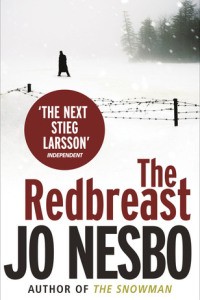
When they advertise Jo Nesbø as ‘The Next Steig Larsson’, I’m inclined to pass on this author. But since a lot of people seem to be raving about this author, I thought I better check him out, especially when they class his Harry Hole series as hard-boiled. I’ve found the only reason they are calling him the next Larsson is simply because he is another Scandinavian crime writer; which means some overly graphic murders, Nazis and an expected twist. The Redbreast is the third book in the Harry Hole novel but the first available in English. Hole is investigating neo-Nazi activity which leads him to further explore Norway’s activities on the Eastern Front during WWII.

Throughout the book it switches between telling the story of Harry Hole in 1999 and the man he is hunting Daniel Gudeson during the World War II. I like how Nesbø switched between the two times and characters to flush out the back story that was leading up to a much bigger current day threat. But that is where I stopped liking this book; I just felt this book was generic and too predictable for my liking. I want to be shocked, excited and enjoy myself when reading crime novels; one out of three just doesn’t cut it.

Now to address the genre issue; Harry Hole could be classed as a hard-boiled detective, as he drinks, smokes and seems to be a very bitter man. However, this novel seems to missing some of the elements that makes hard-boiled novels what they are; for starters where was the dark and gritty realism that I’ve come to love in pulp novels. Also the book was missing a femme fetale as well as the strong dialogue with hints of wittiness and/or irony. This felt more like the generic bestseller crime formula and if we are going to call Jo Nesbø ‘hard-boiled’,  we would have to let Michael Connelly in as well; and we don’t want that.

While this was in fact a fun book to read, I went into this book expecting something more pulp like and ended up getting generic. I’m sure there are plenty of people that will love this book, just don’t expect pulp; you’ll be sadly disappointed. If you are interested in knowing more about pulp fiction,  check out my blog entries on pulp for recommendations.


For The Win by Cory Doctorow

Posted May 1, 2012 by Michael @ Knowledge Lost in Young Adult / 0 Comments

For The Win by Cory DoctorowTitle: For The Win (Goodreads)
Author: Cory Doctorow
Published: Tor, 2010
Pages: 480
Genres: Young Adult
My Copy: Audiobook

Buy: Amazon (or visit your local Indie bookstore)

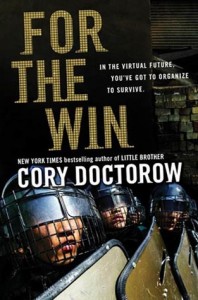
I’m not sure if I’ve just read a novel or had a lesson in economics. Cory Doctorow’s dystopian novel For the Win tells the story of the exploitation of an online role playing game’s economy. In the running of what could be classed as electronic sweatshops throughout Asia, gold farmers suffer from very poor work conditions in the effort to mine gold and find virtual treasure to sell to first world customers. The novel has a typical ‘unite and rise against authority to improve our lifestyle’ plot but add a Massively Multiplayer Online Role Playing Game (MMORPG) this book makes for some interesting concepts. While this book is a book about slave labour, gangsters and forming a revolution, this book also dives into the world of global finance in a very educational way.

This book reminds me of Neal Stephenson’s novel Reamde, in the sense that it explores the world of gaming from the perspective of gold farming. While Stephenson focused on all the aspects of creating a MMORPG for the purposes of gold farming and money laundering, For the Win focuses on the concept of the in-game financial system and how fragile global economy can be. The author floods the book with many different financial theories and uses the games economy to help the reader understand just how global finances work. While this novel focuses on the in-game aspects of economics, the theories taught are very real.

Like Reamde, For the Win made me thing of an aspect of gaming that I never released existed. While Reamde hired a geologist to create the world of T’Rain’s mining system; For the Win had an economist working for the game developers. This book was a real eye opener while still making a great story. To begin with I had trouble keeping up with all the characters Doctorow tried to introduce, characters from USA, India and China; but slowly I started to get a feel for which character was which. I don’t think Cory Doctorow spent enough time exploring his characters, I felt like I only got a glimpse of each character and I would have liked more. For the Win is a book for gamers, but non-gamers might also enjoy the thrilling ride this takes the reader on. It is more than just a lesson in economics and it is more than a novel about unionising Gold Farming. While very predictable this ended up being a great read.


Reamde and my Fears of Large Novels

Posted February 15, 2012 by Michael @ Knowledge Lost in Literature, Thriller / 5 Comments

reamdeI don’t normally read books that are over 1000 pages and after reading Reamde, I’m a little reluctant to read something this big again. Not that there was anything wrong with this book; but sitting at over 1100 pages, it was a big task chipping away through this book. Neal Stephenson provides a story full of nerdism, thrills and a lot of action, dipping into aspects of organised crime and terrorism. My first thought of this book was the MMORPG (Massively Multiplayer Online Role-Playing Game) game that this book is based around; every aspect of this game is covered in this book. It takes all the aspects he liked about World of Warcraft and gave it a face lift, threw out all the parts he didn’t like, even going to the extent of making the world geographically accurate for people interested in mining. But the underlining reason for T’Rain, is the gold farming market; while Blizzard tries to crack down on farming, this game is based around a potential money laundry scheme. While T’Rain was created for sinister reasons, the creation of the game and the employee of popular fantasy writers turned the game into a huge success. Just reading about this game made me want to play it. This game serves as a background for the main plot in Reamde.

While there is a lot happening in Reamde, the main plot is centred around a virus, which encrypts files and hold them for ransom for T’Rain gold. This virus affects a computer containing sensitive documents of the Russian Mob, who do not wish to pay the ransom but set out to hunt down the people behind the virus and make an example of them. Along the way many people become involved including the T’Rain founder, a T’Rain employee, some Chinese gold farmers/hackers, a Russian mercenary, a Hungarian hacker, the CIA, MI6 and some international terrorists.

While I enjoyed the ride that Reamde took me on, I can’t help thinking that there is a lot of fat that needs to be trimmed. I’m not sure if being a bestselling author Neal Stephenson had the freedom to fatten this book up, or the editors didn’t do a good job, or they intentionally left the book this long; but I think that this book could haveeasily been turned into a 700-800 page novel without losing any of the plot. While this book was really enjoyable for a nerd like me, I still can’t help but wonder; does it need to be this big?

Which brings me to the point of this blog post; do you find big novels daunting? I know some people prefer a longer novel, because they are not ready to leave a world so quickly; it’s possible these people are fast readers or not so easily distracted. I often think that I tend to get bored with the world, often wishing for it to end. This could be because I’m easily distracted, or because I’m impatient and want to move onto a new book; I often procrastinate reading by reading another book. I’m just curious how people view large novels; would you prefer them or do you try to avoid them? In the past I think I would avoid them, often dreading reading books that are more the 600 pages but I’ve come to the realisation that I can’t put them off for too long. My to-read pile is growing at an alarming pace and the amount of larger novels are making me feel a little uneasy.

In the past I think my average novel is about 280-300 pages long (thank goodness for pulp novels and their need to wrap up in under 300 pages) but I’ve had to push myself to tackle some of the bigger novels. There are too many classics that need to be read and there are a few recent releases that seem to be critically acclaimed that I’ve got my eye on. Personally my reading goal is 100 books a year but maybe next year I should focus on a page count instead of trying to push myself to read 100 books. Please let me know your thoughts of larger novels; I would love to know the pros and cons of them.


To Kill A Mockingbird by Harper Lee

Posted July 28, 2010 by Michael @ Knowledge Lost in Classic / 0 Comments

To Kill A Mockingbird by Harper LeeTitle: To Kill A Mockingbird (Goodreads)
Author: Harper Lee
Published: Harper Collins, 1960
Pages: 323
Genres: Classic
My Copy: Personal Copy

Buy: Amazon (or visit your local Indie bookstore)

To celebrate 50 years of publication this month, The newly formed Literary Exploration Book Club decided to read Harper Lee’s classic To Kill A Mockingbird. The book has been described as a southern gothic novel which gave the book a certain appeal to me and was one of the main reasons I decided to read this book. What I found left me a little disappointed.  To begin with, I found the book didn’t start to get interesting till chapter 11. I know the back story was needed, it was a different time, but I didn’t much care for the childhood of Jean Louise, Jem or even Boo. To me it felt like it dragged on and could have used some cutting down, but some people like to hear about life in the 1930’s. When I did eventually get to chapter 11, I did start to enjoy the book a lot more and finally at chapter 17 we started to get into the real story of To Kill A Mockingbird; The Court Case.

Atticus was the only truly enjoyable character for me.  He was a wise and fair man, though he never wanted to take Tom Robinson case he did his upmost to make sure he was treated fairly and got the best representation possible. Atticus was the shining light throughout this book; he was a scholar and gentlemen through thick and thin. Once the court case was over and Atticus no longer had to deal with Tim Robinson the book again went back to its original slow pace and eventually fizzled out.

The book wasn’t all bad, it was well written and tackled some important topics, including racial injustice, class and even sexuality. I can see why this is a classic book and I think Harper Lee did a fantastic job at shedding light on some important social issues, the story just felt to slow for my liking, but I can understand why so many people enjoy this book.


The Great Gatsby by F. Scott Fitzgerald

Posted July 21, 2010 by Michael @ Knowledge Lost in Classic / 0 Comments

The Great Gatsby by F. Scott FitzgeraldTitle: The Great Gatsby (Goodreads)
Author: F. Scott Fitzgerald
Published: Scribner, 1925
Pages: 184
Genres: Classic
My Copy: Personal Copy

Buy: Amazon (or visit your local Indie bookstore)

One of the most interesting aspects of The Great Gatsby is the Point of View. I don’t think I’ve read a book in the point of view of an onlooker, which was written as well as this F. Scott Fitzgerald classic. The book does a decent job at shedding light on the egotistical, desire driven tendencies of human nature. Nick Carraway tells the story of a group of destructive personalities. Carraway starts out starry eyed towards high society but slowly becomes more and more uncomfortable with the unrestrained materialism and lack of morality that comes with it.

F. Scott Fitzgerald paints a unique literary picture of the time and life style, with interesting, snooty and slightly annoying characters. Everyone seems so self absorbed and never think of each other; which helped drive the story beautifully. The book is very familiar to the movie, though the book is far superior. I thoroughly enjoyed this book.