Format: eBook

Let the Right One In by John Ajvide Lindqvist

Posted August 23, 2015 by Michael @ Knowledge Lost in Horror / 10 Comments

Let the Right One In by John Ajvide LindqvistTitle: Let the Right One In (Goodreads)
Author: John Ajvide Lindqvist
Translator: Ebba Segerberg
Published: Quercus, 2009
Pages: 519
Genres: Horror
My Copy: eBook

Buy: AmazonBook DepositoryKindle (or visit your local Indie bookstore)

Twelve-year-old boy, Oskar is having a hard time with life. While he has a loving mother, his alcoholic father is very absent in his life. At school, Oskar is the constantly being bullied. One day he meets Eli, and a friendship is formed between the two. However Eli is not a normal girl and it is quickly revealed that she is in fact a vampire. Let the Right One In by Swedish writer John Ajvide Lindqvist is a horror novel unlike any other that I have read before.

While Let the Right One In is a gothic horror that explores the unusual relationship between a 12-year-old boy and a vampire, for me this novel was something completely different. I found this to be a book that explores the darker side of humanity; looking at issue of alcoholism, divorce, bullying, abuse, self-mutilation, murder and paedophilia. Think of it more of an existential look at life and the horrors of the world around us.

I do not want to go into too much detail about what to expect when reading this novel. I just enjoyed the way it looked at the way we handle the horrors of the world from the view point of a struggling boy trying to cope with his situation. The relationship between Oskar and Eli is complicated, and unusual. This allows John Ajvide Lindqvist to explore so many interesting issues and push the reader to contemplate more of the world around them.

Most people would be familiar with the plot of this novel by the movie adaptation done in 2008, which was then horribly remade again by Hollywood in 2010 under the name Let Me In. I saw the Swedish version many years ago and felt it to be a brilliant movie but I have not re-watched it since reading the novel. I did however watch the American addition and it made me very angry. I feel like Hollywood is too afraid to deal with the dark side of humanity if it involves a twelve year old boy. Also America has a terrible habit of trying to remake movies that are already brilliant, I understand some people do not want to read subtitles but they do it to movies that are already in English as well. Soon there will also be a TV show based on this novel, which is set to air on A&E later this year.

I am so glad to have read Let the Right One In; I had a great time exploring the world. This is an extremely dark novel and this will not be everyone. I am curious to see what the TV show will be like but I will not be holding my breath. If you are willing to explore the dark side of humanity you will find Let the Right One In to be a compelling and thought provoking novel.

Fun Home by Alison Bechdel

Posted January 2, 2015 by Michael @ Knowledge Lost in Graphic Novel, Non-Fiction / 0 Comments

Fun Home by Alison BechdelTitle: Fun Home: A Family Tragicomic (Goodreads)
Author: Alison Bechdel
Artist: Alison Bechdel
Published: Houghton Mifflin Harcourt, 2006
Pages: 234
Genres: Graphic Novel, Non-Fiction
My Copy: eBook

Buy: AmazonBook DepositoryKindle (or visit your local Indie bookstore)

Fun Home: A Family Tragicomic is a graphic memoir that chronicles the childhood of Alison Bechdel, growing up in rural Pennsylvania and her complicated relationships with her father. Alison Bechdel is best known as the person whom the Bechdel test was named after. The Bechdel test is a simple method that can be used to determine if a work of fiction (or movie) is gender biased. To pass the Bechdel test there must be at least two women, who talk to each other about something other than men.

Fun Home is a non-linear account of Alison Bechdel’s childhood with a strong focus on her relationship with her father. A complex relationship, Bruce Bechdel was a funeral director and a high school English teacher. He was obsessed with restoring the family’s Victorian home and often viewed his children as free labour. He was often cold and prone to abusive rage, Alison’s relationship with her father was a difficult one. At 44, he stepped in front of a truck and was killed; while never confirmed, Alison believed her father completed suicide.

After his death, Alison discovered her father was a closeted homosexual who had sexual relationships with his students and babysitters. Alongside this, Fun Home follows Alison’s own struggle with her sexual identity,coming out to her parents before actually knowing her sexual preferences. The graphic novel centres on Alison Bechdel’s thoughts about whether her decision to come out triggered her father’s suicide.

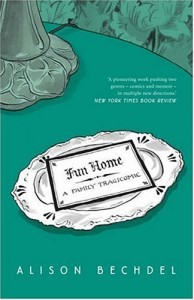
This is a fascinating insight into the mind of Alison Bechdel, not only as a memoir but the struggles that she faced while trying to understand her own identity. Drawn in a gothic style, Bechdel uses blue shading to give her art a dramatic feel. She even uses childhood diary entries to help capture the mood and feel. The dramatic artwork and emotionally charged writing complement each other and really help drive the story.

While I enjoyed Blue is the Warmest Color more as a coming of age story and a struggle with sexuality, Fun Home still remains a wonderful graphic memoir than really packs an emotional punch. Graphic novels and memoirs often get pushed aside and disregarded as works of literature but every now and then comes a work of art that proves this idea wrong. It happened with Art Spiegelman’s Maus and Persepolis by Marjane Satrapi; but Fun Home seemed to be the most common example that comics (I use the term comic as a catch all for graphic novels and memoirs as well) need to be taken more seriously.

I have been reading more comics of late and I have been impressed with the way art and writing can work together to tell a story. I like these graphic novels/memoirs that capture raw emotion, in the writing or art and I am trying to find more like this. While comics by Marvel and DC are a lot of fun, there are so many other works out there that explores this art from an interesting and new way. I really enjoyed Fun Home, it wasn’t a comfortable read but the experience was well worth the effort.


Night of the Living Deadpool by Cullen Bunn

Posted November 11, 2014 by Michael @ Knowledge Lost in Graphic Novel / 0 Comments

Night of the Living Deadpool by Cullen BunnTitle: Night of the Living Deadpool (Goodreads)
Author: Cullen Bunn
Artist: Ramon Rosanas
Published: Marvel Comics, 2014
Pages: 96
Genres: Graphic Novel
My Copy: eBook

Buy: AmazonBook Depository (or visit your local Indie bookstore)

Deadpool is a Marvel Comics mutant anti-hero best known for his dark humour (he is sometimes referred to as “Merc with a mouth”) and breaking the fourth wall in his comic. He is a mentally unstable mercenary, weapons expert and has regenerative healing abilities. The perfect hero to put into a zombie apocalypse and in Night of the Living Deadpool this is what happens.

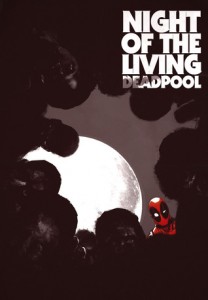
The series begins with a nod to The Walking Dead, which is a homage to that classic opening scene in The Day of the Triffids. Deadpool wakes up from a food coma a few days later and finds that he has awoken to the zombie apocalypse. This four issue series goes on to make multiple references to the genre.

Writer of Deadpool Killogy, Cullen Bunn joins forces with a relative new artist, Ramon Rosanas. The series is a stylised black, white, and red (for Deadpool) with a very warped sense of humour. What stuck with me through this series was not just the references to classic zombie movies or macabre nature but the short, straight to the point approach to the genre. Comic book series can often go for a long time and while that is good, it was nice to start and end a series in one sitting.

I loved the art within this book; I liked how Ramon Rosanas avoided using colours within the comics. It highlights Deadpool as a character not like all the others, while leaving the focus on the drawings rather than the colours. This style is different to what is seen in Sin City but it works; flashbacks are in full colour so really it portrays the apocalypse as a dark time for humanity.

Because this series was only four issues, I find it hard to talk about this comic book. Everything happened so fast and then it was over. I enjoyed the short and sweet experience as stated before but the lasting effects are very small. I was left with memories of the references and art but nothing much more. I think this means that it will be a good series to revisit again; it is just a weird experience.


Archie: The Married Life, Vol. 1 by Michael Uslan

Posted October 26, 2014 by Michael @ Knowledge Lost in Graphic Novel / 0 Comments

Archie: The Married Life, Vol. 1 by Michael UslanTitle: Archie: The Married Life, Vol. 1 (Goodreads)
Author: Michael Uslan
Artist: Norm Breyfogle
Published: Archie Comics, 2011
Pages: 320
Genres: Graphic Novel
My Copy: eBook

Buy: AmazonBook DepositoryKindle (or visit your local Indie bookstore)

When I was young tween, the only real reading I did was Archie comics. We had them in our house all the time; my parents must have thought they were safe enough because no one ever gets any action. There has been news recently about Archie being shot to death in the graphic novel Death of Archie which is the last book in The Married Life series. This news got me curious so I had to pick up the first trade paperback which covers the first six issues of this series.

I have always been on the side of Betty and never could understand why Archie would choose Veronica over her. Archie: The Married Life is split into two different timelines; almost like a Sliding Doors scenario, or, if you are a fan of Broadway, If/Then. This series follows the life of Archie married to Veronica and then Betty. There are some situations that are different in each timeline but mostly follow the same events. Unfortunately nothing much has changed since they were in high school.

Archie: The Married Life does try to look at the normal day-to-day issue facing adults but it holds back too much. For example, Midge finally breaks up with Moose because she is scared of his violent outbursts. This story arch could have gone into some interesting themes of emotional and physical abuse but it treads lightly around the topic. Moose does try and work on his anger issues but there is just so much more they could have done.

My favourite character was always Jughead and I enjoyed it when he hard a love life, luckily this is inserted into this series but not very well. He is getting married. I won’t tell you to who, but the only romance I saw between them was when they shared a milkshake at Pop’s Treat. This brings me to my next issue; why are they still hanging out at Pop’s Treat? I am sure it would be nice to have a place to hang but they could go to a bar or something different every now and then. They are working adults now, but they all still act like teenagers.

I think my biggest problem is the fact that this series is a sugar coated interpretation of what adult and married life would be like. No one has sex; although there was some alluding to an affair between Veronica and Reggie, but nothing happened. The series is still marketed to young tweens and this disappoints me, I thought Archie: The Married Life would have been a more adult look at the Archie world, I was wrong. I don’t even know if I want to continue, I might just read Afterlife with Archie instead.


Rocket Girl, Vol. 1: Time Squared by Brandon Montclare

Posted October 5, 2014 by Michael @ Knowledge Lost in Graphic Novel / 0 Comments

Rocket Girl, Vol. 1: Time Squared by Brandon MontclareTitle: Rocket Girl, Vol. 1: Time Squared (Goodreads)
Author: Brandon Montclare
Artist: Amy Reeder
Published: Image Comics, 2014
Pages: 120
Genres: Graphic Novel
My Copy: eBook

Buy: AmazonBook Depository (or visit your local Indie bookstore)

Dayoung Johansson is a teenage cop from a high-tech future investigating a megacorporation for crimes against time. She goes back to New York in 1986 to investigate the Quintum Mechanics Corporation. What she finds is far different to what she expected. As she slowly pieces the clues while trying to navigate a different place and time. Discovering that what she knows about her home is really an alternate reality that shouldn’t exist.

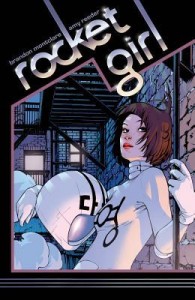
Rocket Girl: Time Squared is the first five issues of this bright and quirky series that combines high-tech gadgets in a time where New York wasn’t exactly a safe place to live. Just a quick search of New York in the 1980s and I found that the subway system saw over 250 felonies committed every week. It was a dark and gritty time to live in this great city. So when you read a comic that is full of bright art work set to this gritty backdrop the contrast really stands out.

The past and future also play off each other within this series, Dayoung Johansson is a teen cop and when she lands in 1986 she meets a police petrol. She bosses them around like she would normally do in her 2014 reality but obviously gets a different response from these police officers. It is obvious to say that Rocket Girl is all about clashing; the vibrant colours against a gritty city, past and future, and the list goes on.

While this is a lot of fun to read sometimes I found that the series attempted to get too complex, which can often raise questions about the science. The artwork was too busy at times that you had to spend extra time on once panel just to absorb everything and make sense of it. This tended to throw the flow off but only remains a minor setback.

I would have liked to see more of an exploration into the moral issues of time travelling and alternate realities but I know this is only the beginning of the series and that there is still time for this. I’m not sure where this is going to go, I can imagine that Dayoung would want to return to her alternate reality but to what lengths would she go to make sure that reality will happen? Brandon Montclare has set up a good premise and teaming up with Amy Reeder for the art means we will continue to see vibrant colours in this strange little story.


Black Widow, Vol. 1: The Finely Woven Thread by Nathan Edmondson

Posted September 14, 2014 by Michael @ Knowledge Lost in Graphic Novel / 2 Comments

Black Widow, Vol. 1: The Finely Woven Thread by Nathan EdmondsonTitle: Black Widow, Vol. 1: The Finely Woven Thread (Goodreads)
Author: Nathan Edmondson
Artist: Phil Noto
Published: Marvel Comics, 2014
Pages: 144
Genres: Graphic Novel
My Copy: eBook

Buy: AmazonBook Depository (or visit your local Indie bookstore)

Is it weird that I am drawn to heroes in comics that don’t have any powers? Batman and Iron Man’s only power is the power of money but I tend to be more interested in people like The Punisher (maybe his power is the power of not dying). So recently I read Matt Fraction’s series featuring Hawkeye and I wanted to explore my favourite Avenger, Black Widow. Thanks to a recommendation, I have now started the new Marvel Now! Black Widow series by Nathan Edmondson and illustrated by Phil Noto.

Natasha Romanov is Black Widow, a Russian soldier of fortune/assassin with a strict moral code. Her back story is a little sketchy. Through the course of the series there are hints that she once was a Soviet super spy but Nathan Edmondson intentionally keeps her past a mystery. Yet we still get a better idea of the character that is Black Widow and she really knows how to kick ass.

The Finely Woven Thread combines the first six issues of the new Marvel Now! series that follows Natasha on her different jobs which slowly start to piece together. Further into the comic Black Widow finds herself facing the Hammer of God, a mad Russian Orthodox monk wreaking havoc on the world. Soon Natasha is hired by Maria Hill and S.H.I.E.L.D. and together they work towards uncovering just what is going on.

It is hard to summarise the plot of this series as there is so much going on and I don’t want to give too much away. It all seems random but in the game of espionage these things start to come together and you get the sense that there is something bigger lurking in the shadows. In all honesty I’m about ten issues into the series and I can’t remember which other heroes or villains appeared in the first six issues but there are some great cameos.

At times the writing by Nathan Edmondson is a little weak and clunky, you get the feeling that he is all over the place but then I also suspect that it will start to make sense and come together in future issues. However what stands out in this series is the art; Phil Noto has done an amazing job and I’m not quite sure how to explain it. It reminds me of water colour paintings, with rich and vibrant colours throughout the pages. It is just stunning to look at the art and yet it still feels very much like a comic book.

Recently I asked for some recommendations into the world of comics and I am happy with what I have in my wish list so far, but keep them coming. I will be continuing this series of Black Widow and I’m curious to see where it goes. It is a real joy to read a superhero that is not only a woman but also someone without superpowers.


Ms. Marvel, Vol. 1: No Normal by G. Willow Wilson

Posted August 14, 2014 by Michael @ Knowledge Lost in Graphic Novel / 14 Comments

Ms. Marvel, Vol. 1: No Normal by G. Willow WilsonTitle: Ms. Marvel, Vol. 1: No Normal (Goodreads)
Author: G. Willow Wilson
Artist: Adrian Alphona, Sara Pichelli
Published: Marvel Comics, 2014
Pages: 120
Genres: Graphic Novel
My Copy: eBook

Buy: AmazonBook Depository (or visit your local Indie bookstore)

The new series of Ms. Marvel brings about an exciting new direction for Marvel Comics. Kamala Khan is the fourth character to take on the name Ms. Marvel and for the first time ever, we see a Muslim headlining the pages. Co-created Sana Amanat (editor), G. Willow Wilson (writer), and Adrian Alphona (artist) the new Ms. Marvel was created out of the need for a strong Muslim superhero. However, this is not only a hero that deals with struggling with their superpowers but a minority struggling to fit in with the American culture.

The comic depicts a 16 year-old Pakastani-American Muslim in New Jersey struggling with fitting in, family, religion, school and all the normal teenage struggles. Then one day she has an encounter with Ms. Marvel and she confesses that she wishes she was like her. This wish was granted and now Kamala has to work out not only what it means to be a Muslim woman in America but how to use her new shape shifting powers.

“This is not evangelism. It was really important for me to portray Kamala as someone who is struggling with her faith. Her brother is extremely conservative, her mom is paranoid that she’s going to touch a boy and get pregnant, and her father wants her to concentrate on her studies and become a doctor.” – G. Willow Wilson

What I found exciting about the new Ms. Marvel is the way this series tries to break the stereotypes. As a teenage Muslim living in America, Kamala has all these ideals and stereotypes projected onto her and she has to navigate through it all and work out who she is. Ms. Marvel represents everything she wants to be; a strong, beautiful woman standing for good. However when she becomes Ms Marvel she quickly realises that being a superhero doesn’t solve the struggle of a misfit. This new Ms. Marvel series isn’t just a struggle with new found powers; it is the everyday struggles she faces. Kamala slowly works out that her new powers, religion or heritage is not what defines her but they do play important roles in the person she wants to be.

“As much as Islam is a part of Kamala’s identity, this book isn’t preaching about religion or the Islamic faith in particular. It’s about what happens when you struggle with the labels imposed on you, and how that forms your sense of self. It’s a struggle we’ve all faced in one form or another, and isn’t just particular to Kamala because she’s Muslim. Her religion is just one aspect of the many ways she defines herself” – Sana Amanat

Interestingly there are a few mentions where Ms. Marvel is referred to as Captain Marvel, unfortunately I don’t know the back story of this but I think it is a positive step. Ms. Marvel was originally created as the female counterpart to Captain Marvel. The move to turn Ms. Marvel into Captain Marvel means that the female superhero is no longer considered the counterpart but a strong and dominate hero in her own right.

You may noticed that I haven’t mentioned anything about the art work and this is because I’m new to reviewing graphic novels and have not learned how to talk about art yet. I hope to learn to critically analyse the art but for now I’m leaving it out of this review, not because it is bad but because I don’t know what to say apart from it being good. No Normal is the conclusion of the first arc (first 5 issues) and I’m really looking forward to seeing where this series goes. I think it is fresh and exciting change for the better in the world of comics.


Critical Theory: An Introduction by Jennifer Rich

Posted July 24, 2014 by Michael @ Knowledge Lost in Non-Fiction / 0 Comments

Critical Theory: An Introduction by Jennifer RichTitle: Critical Theory: An Introduction (Goodreads)
Author: Jennifer Rich
Published: Humanities-Ebooks, 2010
Pages: 97
Genres: Non-Fiction
My Copy: eBook

For me Critical Theory: An Introduction by Jennifer Rich was everything I wanted Literary Theory: A Very Short Introduction by Jonathan Culler to be. It had a logical format and it went through a few different literary movements and talked about the key people and theories involved with each school of thoughts. But then it got me wondering; what is the different between Critical Theory and Literary Theory? There seems to be no real difference and I’m not entirely sure why they would use two different names to talk about the exact same thing. I might be ignorant and not fully understanding the differences but if there is a difference please let me know in the comments below.

The book starts off with Russian Formalism, a topic I spent a bit of time exploring before continuing the rest of the book. The idea of formalism is something that I feel may be a good foundation for any literary student. To be able to understand genres, tropes, metering, grammar and syntax can provide you with some questions to ask every piece of literature. Asking why a piece of text is written in one perspective and not another and what the focalisation is focusing on can help develop some useful skills. Some people are saying that formalism is making a comeback and I tend to agree, I recently completed a university subject that went though the basics of this school of thought (even if there was no mention of formalism). If you understand these basic concepts, I think you develop a decent tool base for critical reading and future studies of literary theories.

Critical Theory: An Introduction also looked at Structuralism, Semiotics, Post-Structuralism, Deconstruction, Psychoanalytic and Postcolonial Theory. I have a feeling my interest will psychoanalysis and Marxism and this book seemed to verify this very thought, even if it only went into Marxism in passing. The major problem I found is that Psychoanalytic Theory is going to be a huge undertaking, more so than most of the others. I feel that I will need to develop, not only an understanding in psychology, but also a bit of a focus into semiotics as well. I am not too bothered by this thought; this is more of a blinding realisation of how much work is ahead of me.

While Critical Theory: An Introduction may have taken a more textbook type approach to literary theory than Literary Theory: A Very Short Introduction, I think the format is better suited if I ever need to refer back to the book. Literary Theory: A Very Short Introduction was a little all over the place and it works well for reading the book from cover to cover but if I need to look up what the book says on a topic it won’t be easy. I prefer to have chapters dedicated to one literary theory; makes things easier when I refer back to this book in the future.

I’m really enjoying exploring the world of literary theory and I’m beginning to understand the different types of theories on a very fundamental level. The only downside to this is the realisation that there is so much more to learn. I have to remind myself that I’m not going to be able to become an expert in all these fields and I need to focus. I’ve chosen my preferred fields but I will continue to learn the basics of all literary theories and see if something else pops out. I’m still shopping around, while psychoanalysis and Marxism seem like the right fit for me, I’m open to the possibility of finding something better (and maybe easier). Also, learning the basics in literary theory will have the added bonus of been able to see a book from different schools of thought. If you are looking for a good, quick introduction to literary theories, Critical Theory: An Introduction by Jennifer Rich is a good pick, it is short and only covers a few theories but will give you a decent understanding of them.


The Portrait of Mr. W.H. by Oscar Wilde

Posted February 27, 2014 by Michael @ Knowledge Lost in Short Stories / 0 Comments

The Portrait of Mr. W.H. by Oscar WildeTitle: The Portrait of Mr. W.H. (Goodreads)
Author: Oscar Wilde
Published: Hesperus Press, 1889
Genres: Short Stories
My Copy: Personal Copy

Buy: AmazonBook DepositoryKindle (or visit your local Indie bookstore)

The fact that William Shakespeare’s Sonnets are dedicated to one Mr W.H. has been the source of much speculation. Eighteenth century critic Thomas Tyrwhitt suggests that the sonnets are written for a person known as William Hughes. He bases this theory on his interpretation of the Sonnets, lines like “A man in hue, all Hues in his controlling” (the 20th sonnet) where the word ‘Hue’ is capitalised and italicised and the multiple puns on the name ‘Will’ found in the sonnets.

The Portrait of Mr. W.H. is a short story by Oscar Wilde; it only took me about twenty minutes so I don’t think I’ll say much about it but it was a story I wanted to review. Yes, it was required reading for university but it was an interesting enough piece that getting my thoughts down seemed like a good idea. I remember reading The Picture of Dorian Gray a long time ago and not getting on with it; maybe I wasn’t for me or maybe I just hadn’t had the literary knowledge to get something out of it. In any case, I’m curious enough that maybe Dorian Gray will be a reread in the future.

I want to compare The Portrait of Mr. W.H. with My Life as a Fake because they both seem to talk about a similar topic. While My Life as a Fake covered a literary hoax, The Portrait of Mr. W.H. looks at a piece of literary criticism that has been around for a long time and is often talked about. I don’t agree with this theory and it is important to know that Oscar Wilde didn’t either, although by the end he almost did. What I really liked about this story is the fact that Wilde took a differing view of the Sonnets and tried to explore it. This is an excellent example of literary criticism because it got me looking at the Sonnets in another way, even if I didn’t agree with it.

The fact that Oscar Wilde managed to write this literary criticism in a form of a story was equally impressive. The whole story has this real gothic feel about it and the character of Willie Hughes showed vampiric characteristics in the way he destroyed lives, in particular Cyril’s. Yet another similarity to My Life as a Fake is the whole idea that literature or the author can be portrayed as a monster.

I read this story as social criticism, looking at the homo-eroticism of Shakespeare’s Sonnets and question if a particular piece of text has any effect on the value of the art form. I don’t know many people complaining about the homoerotic nature of Shakespeare but I’ve heard complaints about it when referring to Oscar Wilde. Wilde was a big believer in celebrating art as being art and not letting the opinion of the artist affect it. This means The Portrait of Mr. W.H. is a satirical look at the art, where you have to take a more literal approach and explore the life of William Shakespeare as an artist and its connection to the Sonnets.

Oscar Wilde tantalises the reader with his literary and social criticism, mix in the satirical nature of this story and the wit of the author and you have a compelling read. One thing I’ve been thinking about is the connection between this story and The Picture of Dorian Gray which I would like to leave you with. They both share very similar titles but in Dorian Gray you have a portrait that ages and the reader see the truth, of Gray and all his sins. While in The Portrait of Mr. W.H. the picture of Willie Hughes is a lie and I have to wonder the meaning behind this imagery when comparing the two.


The Castle of Otranto by Horace Walpole

Posted September 19, 2013 by Michael @ Knowledge Lost in Classic, Gothic / 0 Comments

The Castle of Otranto by Horace WalpoleTitle: The Castle of Otranto (Goodreads)
Author: Horace Walpole
Published: Penguin, 1764
Genres: Classic, Gothic
My Copy: Audiobook

Buy: AmazonBook DepositoryKindle (or visit your local Indie bookstore)

Conrad, the heir to the house of Otranto, died under mysterious circumstances on the day of his wedding. His father, Manfred, lord of the castle, who feared the end of his dynasty, was determined to marry his son’s betrothed. However as Manfred tries to marry Princess Isabella, she escapes to a church and a number of supernatural events stand in his way. These terrifying omens soon threaten this unlawful union, as the curse placed on Manfred’s ancestor, who usurped the lawful Prince of Otranto, begins to unfold.

The Castle of Otranto established the Gothic as a literary genre and inspired Ann Radcliffe, Bram Stoker, Daphne Du Maurier and Stephen King. The Castle of Otranto has a unique blend of psychological realism, supernatural terror, guilty secrets and unlawful desires but I read this book as a critic on marriage. In 1773 The Marriage Act was passed, an act that is also known as “An Act for the Better Prevention of Clandestine Marriage”. The act was successful in preventing marriages not performed by an Anglican clergyman but also this act didn’t apply to royalty.

This act was passed eleven years before The Castle of Otranto was published and considering the fact that Horace Walpole was the Member of Parliament for Callington (1741–1754), Castle Rising (1754–1757) and King’s Lynn (1757–1768), I get the sense that he would have had strong opinions on the topic. From some quick research on Horace Walpole, I know that he had a strong interest in social and political issues. We can’t overlook his sexuality either, Walpole never married or had relationships with women; some claim he was asexual but I tend to side with the people that claimed he was a homosexual. Some of his closest friends including Anne Seymour Damer and Mary Berry are apparently lesbians as well. This information and the reading of this novel led me to interpret the fact that Walpole was against The Marriage Act.

Let’s look at the novel, Manfred was planning on ending his marriage with Hippolita and marry the much younger Isabella. The introduction of the Marriage Act (despite this book being set sometime between 1000 and 1200) meant that the marriage would have been easier to achieve and Isabella’s fear of Manfred more realistic. Putting aside Isabella’s reluctance to the marriage, there were also the supernatural events (the Church) standing in his way, in which I interpreted as the church still being against clandestine marriage despite it being possible for Manfred. I read the entire book as a metaphor of society and the church standing in the way of a desired marriage. This brings me to an interesting thought; Lord Manfred is considered the antagonist on the novel, portrayed as being deranged but I viewed this as the social view of homosexuality at the time.

There is so much more I can talk about here, like the archetype of Gothic characters (involving heroes and anti-heroes) and the setting (the Castle). While I have talked about Manfred, I want to quickly talk about Isebella and the castle. When Isebella tried to escape she turned into the outsider, a person thrown out of her community; this could also be used as a metaphor for Walpole’s feelings and sexuality. When she escaped she used the underground passages of the castle, which invokes all the characteristics of the Gothic genre; the darkness, obscurity, vastness, and the terror that may arising. Yet the castle and its mysterious characteristic could be a motif for Horace Walpole’s loneliness in the universe.

I won’t go into any more symbols, themes or motifs or this would turn into a really long review. My main interpretation of this novel is clear and I hope I have given you enough to back up my claims. While this isn’t my favourite example of Gothic literature, it was a great read and while short, there is a lot to digest. For all Gothic fans, I recommend checking out The Castle of Otranto; this is an excellent example of the gothic form.