Format: Paperback

The Zone of Interest by Martin Amis

Posted May 16, 2015 by Michael @ Knowledge Lost in Historical Fiction / 2 Comments

The Zone of Interest by Martin AmisTitle: The Zone of Interest (Goodreads)
Author: Martin Amis
Published: Jonathan Cape, 2014
Pages: 320
Genres: Historical Fiction
My Copy: Library Book

Buy: AmazonBook Depository (or visit your local Indie bookstore)

Angelus Thomsen is an officer working at Auschwitz; on August 1942 he gains his first sight of Hannah Doll, the wife of the camp’s commandant. After a few encounters, their relationship becomes more intimate. Despite their attempts to be discreet, Hannah’s husband Paul becomes suspicious. He threatens a Jewish Sonderkommando into killing his wife. However things are not that simple and life is far more complex.

The Zone of Interest is Martin Amis’ fourteenth novel and the second to focus on the holocaust (his 1991 novel Time’s Arrow being the other). The novel is told from prospective of three narrators; Angelus Thomsen, Paul Doll and Szmul the Sonderkommando. This allows Amis to explore the three different sides of this budding romance and betrayal, however what it does not talk about is far more interesting. Thomsen and Doll are so focused on Hannah, while Szmul is unwillingly dragged into this complex situation.

I found the plot to be a bit flat and the ending of this novel anti-climactic but it was Martin Amis was not saying that really stuck out to me. The way Amis told the story allowed the reader focus on the melodrama of this love triangle but we have to remember this was set in Auschwitz. We can explore the indifference towards human suffering and the prisoner’s general psychology without the need to talk too much about this situation. Szmul’s narrative does focus more on the life in the concentration camp from a Jewish point-of-view but it is the Germans’ lack of interest that stuck with me. The more I think about this novel, the more I admire the way Amis wrote this book. I cannot think of another novel that explores an issue like this by actively trying to avoid the topic.

At the time of reading this book, I found this novel to be average. However, it was the post-reading experience that really stuck with me, and I really appreciate the satirical approach Martin Amis took. I am determined to try some more of his works; I need to find out if he uses satire consistently in his novels. I would love to know which novel I should check out next from Martin Amis.


The Whispering City by Sara Moliner

Posted May 15, 2015 by Michael @ Knowledge Lost in Crime, Thriller / 2 Comments

The Whispering City by Sara MolinerTitle: The Whispering City (Goodreads)
Author: Sara Moliner
Translator: Mara Faye Lethem
Series: Martí #1
Published: Little Brown and Company, 2013
Pages: 416
Genres: Crime, Thriller
My Copy: Paperback

Buy: AmazonBook Depository (or visit your local Indie bookstore)

General Franco was at the height of his power in Barcelona, 1952. When a wealthy socialite is found murdered in her mansion, the police scramble to seize control of the investigation. An over eager journalist named Ana Martí Noguer is assigned the task of shadowing the lead investigator, Inspector Isidro Castro. However, Ana discovers a bunch of letters that dramatically contradict the official statement made by the police. Now she is in mortal danger; her information can expose a conspiracy of murder and corruption.

The Whispering City (originally title: Don de lenguas) is a Spanish novel written by Sara Moliner and translated into English by Mara Faye Lethem. Sara Moliner is the pseudonym of the writing duo of Spanish author Rosa Ribas and former German philosophy professor Sabine Hofmann. This is their first book together and, with their backgrounds and the premise, I went into this novel with high expectations. Sadly, this turned into a run-of-the-mill thriller novel which is not a bad thing; I just was hoping for so much more.

The back drop of a fascist government, known for their shadowing tactics, mixed with the philosophical background of Sabine Hofmann meant I was hoping for some interesting insights. I was hoping to learn about the cultural landscape and the political impact of Barcelona in 1952 but the main focus on this book was the murder and the conspiracy. Having recently read Red April by Santiago Roncagliolo (translated by Edith Grossman), which explored the political and cultural issue in Peru at the time, I was expecting something similar with The Whispering City.

The Whispering City is in no way a bad novel, and I found it incredibly entertaining and worked as a palette cleanser for me while I was reading The Zone of Interest by Martin Amis and The Stranger by Albert Camus. One of the main reasons I am drawn to books in translation is the insight into the cultural life and I did not get that with this book. The Whispering City reminds me a bit of The Millennium series by Stieg Larsson, with a journalist as a protagonist investigating murder and corruption. While it was not as dark as The Girl with the Dragon Tattoo, I found it a lot more enjoyable but still the same thriller formula.


A Young Doctor’s Notebook by Mikhail Bulgakov

Posted May 14, 2015 by Michael @ Knowledge Lost in Russian Lit Project, Short Stories / 0 Comments

A Young Doctor’s Notebook by Mikhail BulgakovTitle: A Young Doctor's Notebook (Goodreads)
Author: Mikhail Bulgakov
Translator: Hugh Aplin
Published: Alma Classics, 1926
Pages: 155
Genres: Short Stories
My Copy: Paperback

Buy: AmazonBook Depository (or visit your local Indie bookstore)

A Young Doctor’s Notebook (also known as A Country Doctor’s Notebook) is a semi-autobiographical collection of short stories published early in Mikhail Bulgakov writing life in Russian medical journals. Bulgakov was educated at the Medical Faculty of the Kiev University, though his interest lied in theatre. When World War I broke out, he volunteered with the Red Cross. He was sent directly to the front lines to work as a medical doctor and was badly injured on two separate occasions.

In 1916 Mikhail Bulgakov graduated and was quickly appointed as a provincial physician to the Smolensk province. He found himself performing procedures he had only seen once or twice while at medical school. The seven stories in this collection explore the ignorance or stubbornness of people towards medical treatment, an issue that is still very relevant today. While A Young Doctor’s Notebook was set in the small village doctor in revolutionary Russia, the stories were all written in the 1920s.

Like most editions of A Young Doctor’s Notebook, my copy of the book came with one extra story called ‘Morphine’. This was also published in a medical journal and is much different to the other stories. ‘Morphine’ is yet another semi-autobiographical story that explores Mikhail Bulgakov’s own struggles with a morphine addiction. His injuries in the war lead to chronic stomach pains and the easy access to pain relief quickly lead to a morphine addiction. Bulgakov did end up leaving the medical profession to pursue a career in writing stage plays and was able abandon the use of morphine.

A Young Doctor’s Notebook is a wonderful collection of stories that illustrate Mikhail Bulgakov’s humour and writing style. If you have seen the TV adaptation, you may notice some similarities to the story, blending the seven short stories and his other story ‘morphine’ together to deliver a fabulous dark comedy. I binge watched the show over a weekend and I was not ready for it to end, so I picked up this collection and this quickly started an obsession with the life of Bulgakov.

While Mikhail Bulgakov is mainly known for his book The Master and Margarita (a book I recently re-read), A Young Doctor’s Notebook may be a more accessible book. It allows you to get a taste of Bulgakov’s style and humour with the seven short stories. I read an edition that was translated by Hugh Aplin and he is quickly becoming a favourite of mine and I will be hunting down everything he has translated (he translated mainly Bulgakov and Dostoevsky). Learning more about Mikhail Bulgakov’s life does give me extra enjoyment and context when reading his books. I am slowly reading a collection of his letters and diaries in a book called Manuscripts Don’t Burn, so you may see a lot more about Bulgakov on this blog.


Mr. Kiss and Tell by Rob Thomas & Jennifer Graham

Posted May 6, 2015 by Michael @ Knowledge Lost in Crime / 0 Comments

Mr. Kiss and Tell by Rob Thomas & Jennifer GrahamTitle: Mr. Kiss and Tell (Goodreads)
Author: Jennifer Graham, Rob Thomas
Series: Veronica Mars #2
Published: Random House, 2015
Pages: 336
Genres: Crime
My Copy: Paperback

Buy: AmazonBook DepositoryKindle (or visit your local Indie bookstore)

Veronica Mars is back, and this time she is investigating what might be her most challenging case. The Neptune Grand has hired her to investigate a woman’s claims of assault and rape in one of their hotel rooms. This is a high-profile scandal that has the potential to ruin this ritzy hotel. Mr. Kiss and Tell is a mystery that finds Veronica working for the ‘big guy’ investigating something she has personally experienced, how will she cope with this type of case?

Most may be aware that I am a big fan of the Veronica Mars series and I was so excited that they were continuing the story in book form. Now the books are slightly different, switching from first person to third, but the characters and setting are all there. If you have seen the TV series you know that sometimes Veronica can get involved in a case that can challenge her own values. The show and book have an interesting exploration into the class struggle and Mr. Kiss and Tell has Mars working for the people (this time Neptune Grand) with the money.

What I enjoyed about this book is the way that Rob Thomas and Jennifer Graham explored that struggle between Mars’ own personal experiences and the nature of the case. Rob Thomas often did this in the TV show and it was nice to see this conflict returning for the book series. Veronica Mars is a strong independent woman and I love this about her but I like to see that little bit of vulnerability coming through in this book, it really helps humanise her.

It is hard to talk about mystery novels without giving away the plot but what I will say is that I did not enjoy this one as much as The Thousand Dollar Tan Line. This book does feature a lot more of Logan Echolls but I always ship Veronica Mars and Mac Mackenzie (who featured heavily in book one). I am so happy to read more about Veronica’s life and I will be anxiously waiting for the next book in this series.


The Stranger by Albert Camus

Posted May 2, 2015 by Michael @ Knowledge Lost in Classic / 6 Comments

The Stranger by Albert CamusTitle: The Stranger (Goodreads)
Author: Albert Camus
Translator: Matthew Ward
Published: Vintage, 1941
Pages: 123
Genres: Classic
My Copy: Paperback

Buy: AmazonBook DepositoryKindle (or visit your local Indie bookstore)

The Stranger (also known as The Outsider or L’Étranger) tells the story of Meursault, an unsympathetic French Algerian, who after attending his mother’s funeral, finds himself killing an Arab man. The novel follows a first-person narrative that explores the events before and after this murder. Albert Camus said is best when he said “I summarised The Stranger a long time ago, with a remark I admit was highly paradoxical: ‘In our society any man who does not weep at his mother’s funeral runs the risk of being sentenced to death.’ I only meant that the hero of my book is condemned because he does not play the game.”

On the surface The Stranger is the story of an emotionless protagonist; Meursault does not care about anything and could be considered a sociopath. However, this novel is often cited as an example of Camus’ philosophy on the absurd and existentialism. So in order to fully grasp the intent behind this classic novel, we must look into just what existentialism is and more practically absurdism.

The absurd is often referring to the conflicting philosophy that humans have a tendency to seek out value and meaning in life. However absurdism believes it is logically and humanly impossible to find any meaning of life. Philosophers may have very different doctrines but they generally believe that philosophical thinking begins with the human subject. Though existentialism comes from the disorientation or confusion that we are living in a meaningless (or absurd) world.

For Albert Camus, The Stranger is an exploration into the meaning of life and if life has no meaning what is the purpose of morality. Meursault’s detachment from the world is a result of his conclusion that life is meaningless; “The chaplain knew the game well too, I could tell right away: his gaze never faltered. And his voice didn’t falter, either, when he said, ‘Have you no hope at all? And do you really live with the thought that when you die, you die, and nothing remains?’ ‘Yes,’ I said.” Paradoxically, it was only after being sentenced to death, that Meursault was able to obtain some sense of happiness.

Without an understanding of Albert Camus’ philosophical ideas, I do not think that the reader will have any hope in truly understand or appreciating this novel. However I have heard that The Stranger has been an option for high school students (especially in America) to study. I wonder how many students fall into the trap of picking this novel thinking it was short only to discover how difficult it is to analyse. I do not have enough of an understanding of absurdism or existential philosophy to full appreciate The Stranger. However re-reading this novel has helped me understand this enough to enjoy the Camus’ philosophical ideas.


Kafka on the Shore by Haruki Murakami

Posted April 29, 2015 by Michael @ Knowledge Lost in Book of the Month, Magical Realism / 0 Comments

Kafka on the Shore by Haruki MurakamiTitle: Kafka on the Shore (Goodreads)
Author: Haruki Murakami
Translator: Philip Gabriel
Published: Vintage, 2002
Pages: 480
Genres: Magical Realism
My Copy: Library Book

Buy: AmazonBook DepositoryKindle (or visit your local Indie bookstore)

Kafka on the Shore tells the story of a fifteen year old book named Kafka who runs away from home to find his mother and sister. Although the alternate chapters tell the story of Nakata; a strange old man who has the ability to talk to cats. Like many of Haruki Murakami’s books, Kafka on the Shore blends pop culture with magical realism in order to explore the psyche of the characters involved.

It is often hard to try and give an overview of a Murakami book because they tend to come out weird and I do not want to give the impression that his novels are not worth attempting. For Kafka on the Shore, the magical realism allows the reader to explore the psychological mind of fifteen year old Kafka Tamune. Not only is Kakfa a young man discovering his sexuality, Sigmund Freud would probably suggest that he also has an Oedipus complex and has developed an unhealthy obsession with his mother and sister.

According to Freud, an Oedipus complex stems from the unconscious mind and normally caused by the repression of a mother (or father) figure. Freudian psychoanalysis theory suggests that this is a key psychological experience needed for normal sexual development. However if it is unsuccessful at resolving it may lead to neurosis, paedophilia, or homosexuality. Without going into the problematic thinking of Sigmund Freud, this does make for an interesting analysis of Kafka’s journey throughout the book, especially with his interactions between Sakura and Miss Saeki.

If we continue looking at this novel through the lens of psychoanalysis theory, we might even get some interesting insights into Nakata. I always thought the loss of mental faculties was due to the psychological trauma, he experienced as a young boy. He was one of sixteen schoolchildren picking mushrooms in a field trip towards the end of World War II, when they were all rendered unconscious from a mysterious light in the sky. However it has also been suggested that maybe Kafka and Nakata are two different parts of the same person.

Every time I read a Haruki Murakami, I am reminded of his brilliance (with the exception of 1Q84), and I want to explore more of his works. I am also reminded that I need to learn a whole lot more about psychoanalytical theories, and how much it would help with books like Kafka on the Shore. For me this was a bildungsroman book about sexual development and memories. However, I found myself more interested in the chapters centred on Kafka over those about Nakata but maybe that was because I understood them a little better.

Yet again Haruki Murakami has impressed me with Kafka on the Shore and I am eager to pick up more of his books. I know magical realism can be scary for some people but I love the way Murakami uses it to explore the mind. My only real criticism of this book is that it was a little bloated and could have been trimmed down a little and still achieve the same. This might be due to an aversion to big books that I really need to overcome and not a true reflection on Murakami. I highly recommend giving this author a go if you have never tried him but Kafka on the Shore is not a good starting point; may I suggest trying Norwegian Wood first.


The World According To Garp by John Irving

Posted April 14, 2015 by Michael @ Knowledge Lost in Contemporary / 6 Comments

The World According To Garp by John IrvingTitle: The World According To Garp (Goodreads)
Author: John Irving
Published: Black Swan, 1978
Pages: 603
Genres: Contemporary
My Copy: Library Book

Buy: AmazonBook Depository (or visit your local Indie bookstore)

This is the story of T.S. Garp, named after his biological father Technical Sergeant Garp. His mother, Jenny Fields was a determined nurse who wanted a child but not a husband. She eventually becomes a feminist icon before being killed by a crazed man for what she said in her autobiography A Sexual Suspect. Garp went on to become a writer as well and The World According to Garp tells the story of his life.

This is my first attempt into the writing of John Irving’s writing and I was impressed with what I read. Many people recommend starting with some of his other books (A Prayer for Owen Meaning or The Cider House Rules) but I think I made the right choice with The World According to Garp. What stood out to me within the book was the constant struggle that T.S. Garp experienced his entire life. Even his decision to become a writer was made in the effort to get a girl. This was a struggle with lust and the way it took over his whole life. It was like he had no control over his own sexual desire but then again he never really tried. Lust took over everything within Garp’s life but other characters also struggled as well. I really enjoyed the way that Irving explores the beauty and destructiveness of sex and desire.

This is not just a novel the focuses on lust, this is also a book that explores life and death. It is fair to say that T.S. Garp had a fascination with death, especially when his book The Pension Grillparzer saw seven of the nine main characters die. Even his third novel The World According to Bensenhaver featured many death scenes. There are so many more scenes about death, you can look at the death of Garp and his mother and see the similarities and symbolism.

There were moments where I was worried that this book would turn transphobic but the way John Irving treated the character Roberta was done really well. Gender roles play a big part in this book, starting from Garp’s mother rejecting a man and deciding to raise her child alone. The novel also explores feminism, the women’s rights movement and misogyny.  What I loved about this book is that there are so many issues tacked within the pages, when I thought I understood the major theme it offers something different.

I like how The World According to Garp explored the whole life of Garp from birth to death. Written like Garp was telling the story, it still covers parts of his life that he could not possibly know, including his birth and his death. I was really impressed with John Irving’s style of writing that I plan to read so many more of his books. I hear A Prayer for Owen Meaning is the next book I should tackle but I would love other suggestions too.


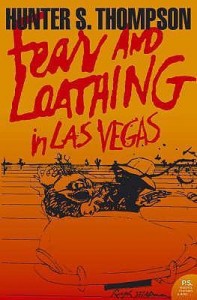
Fear and Loathing in Las Vegas by Hunter S. Thompson

Posted March 30, 2015 by Michael @ Knowledge Lost in Book of the Month, Classic / 2 Comments

Fear and Loathing in Las Vegas by Hunter S. ThompsonTitle: Fear and Loathing in Las Vegas (Goodreads)
Author: Hunter S. Thompson
Artist: Ralph Steadman
Published: Harper Perennial, 1971
Pages: 230
Genres: Classic
My Copy: Paperback

Buy: AmazonBook Depository (or visit your local Indie bookstore)

Journalist, Raoul Duke heads to Las Vegas with his attorney Dr Gonzo in order to cover the Mint 400 motorcycle race. After experimenting with some recreational drugs, LSD, ether, cocaine, cannabis and alcohol, their assignment was quickly abandoned. What follows is a series of hallucinogenic trips that end in disaster from trashed hotel rooms, car wrecks and much more. Fear and Loathing in Las Vegas: A Savage Journey to the Heart of the American Dream is a roman à clef, with autobiographical elements in which Hunter S. Thompson writes a retrospective of the 1960s countercultural movement.

Hunter S. Thompson was a journalist, but he was best known for his novel Fear and Loathing in Las Vegas. While working in Journalism he coined the term Gonzo journalism which is a writing style he adopted for his first person narratives. The style is a combination of fact and fiction that allows Thompson a more personal approach to his articles. Combining elements of sarcasm, humour, exaggeration and profanity it allowed a first person look into social criticism. Fear and Loathing in Las Vegas was a result of Gonzo journalism and was originally published as a two part series in Rolling Stone magazine in 1971.

When thinking about the life of Hunter S. Thompson, I find it hard to imagine him as someone who  critiques the 1960s counterculture. I think of him saying things like “I hate to advocate drugs, alcohol, violence, or insanity to anyone, but they’ve always worked for me.” Thompson has often stated that this novel was an exploration into the death of the American Dream but his views on counterculture are so fascinating. Drawing inspiration from his two favourite novels The Great Gatsby and On The Road, Thompson combines ideas of travelogue and the American Dream and goes on to show the reason why drug use was not the answer to social problems.

Fear and Loathing in Las Vegas is a pretty confronting novel; the descriptions of drug-induced hazes and lurid hallucinogenic trips are very vivid and confronting. I am pretty sure I have read this book in the past but I had not marked it as read on Goodreads, LibraryThing or even the spreadsheet I keep. However going into the novel everything felt so familiar and I cannot tell if it was due to the movie adaptation or if I have actually read the book before.

The experience of reading Fear and Loathing in Las Vegas is enhanced by the illustrations done by Ralph Steadman. My edition of the book stated in the introduction that Hunter S. Thompson requested the art to be done by Steadman because he believed this illustrator really understood the concept of Gonzo journalism. The novel is an interesting book and well worth exploring, and I was interested to see the satirical side and surprised at the way Thompson criticised his own lifestyle in this autobiographical novel.


The American Lover by Rose Tremain

Posted March 18, 2015 by Michael @ Knowledge Lost in Short Stories / 2 Comments

The American Lover by Rose TremainTitle: The American Lover (Goodreads)
Author: Rose Tremain
Published: Chatto & Windus, 2014
Pages: 240
Genres: Short Stories
My Copy: Library Book

Buy: AmazonBook DepositoryKindle (or visit your local Indie bookstore)

Rose Tremain is a name I have heard so often but never had the chance to read on of her books; in fact her name is familiar but I couldn’t tell you anything about her books. She has published thirteen novels including The Road Home (which won the Orange Prize in 2008) and Music and Silence (winner of the Whitbread award in 1999). She taught creative writing at the University of East Anglia until she was appointed chancellor in 2013 and she is married to Romantic biographer Richard Holmes (not that her marriage affects her writing, just an interesting fact). She has also written five collections of short stories including her latest The American Lover.

While I sometimes struggle to read and review short story collections, I still wish to talk about them (just so I have a record). I picked up The American Lover because it mentioned a story about a famous Russian writer’s (story was inspired by Tolstoy’s life) final days living in a stationmaster’s cottage outside of Moscow. As most people know, I am a fan of Russian literature and books about Russia itself. When I looked at the author’s name, I was excited even more, it was a chance to finally dip into the writing style of Rose Tremain.

Without going into all the stories within the book, Tremain goes into some very interesting topics from transgressive love, sex, reflections of life and even a very unusual story about Daphne du Maurier. What I found in this collection is that Rose Tremain has a great ability to create characters and express emotions. There are some brilliantly dark and sometimes comical moments the she masterfully crafted into her stories. She has produced a collection centred around so many different emotions and skilfully managed to fit them into such short stories.

I really love the characters and emotions expressed in these stories and really makes me want to experience Rose Tremain’s style in long form. However I am not sure which novel to start with and would love some recommendations. The American Lover was a brilliant way to dip into Tremain’s writing and I am so glad to have finally had a chance to do so. If her writing abilities work just as well in her novels, she may have found a new fan.


Deeper Waters by Jessie Cole

Posted March 12, 2015 by Michael @ Knowledge Lost in Contemporary / 0 Comments

Deeper Waters by Jessie ColeTitle: Deeper Waters (Goodreads)
Author: Jessie Cole
Published: Harper Collins, 2014
Pages: 384
Genres: Contemporary
My Copy: Paperback

Buy: Book Depository (or visit your local Indie bookstore)

Meme has been enjoying the simple life in Northern News South Wales; that was until she saves the life of Hamish in a heavy summer downpour. Cut off from the rest of world Hamish discovers a world cut off from technology. During this time with this stranger in the house, Meme also learns about the world outside of her own.

Jessie Cole’s novel Deeper Waters is a coming of age story about the sexual awakening of twenty-something year old Meme. However it is also a culture clash novel between the lifestyle people in the city (Hamish) are used to and just how different the rural outback can be. Both Meme and Hamish are from the same country but their lives are very different. Growing up with technology, it is hard to see a world without it and interestingly enough Deeper Waters manages to capture this perfectly. At times you think you are reading a book set in the 1970s or early 1980s but then the mention of technology reminds you that this is a book set in current times.

This was a book club pick and not something I would generally pick up on my own but it did make an interesting choice to discuss. However, I found the character development a little problematic; Meme was well developed but Hamish was very two dimensional and her best friend Anja was just a pile of clichés. The book did show a lot of promise for this emerging Australian author, her writing was solid and atmospheric but she could have developed all the other characters a whole lot more.

I really did enjoy the culture clash but after that the book did fall a little short. There was one thing that was mentioned in our book club discussion that I did not pick up on but now seems to bother me. Meme has a clubfoot (congenital talipes equinovarus) which is a birth defect that you do not really hear about these days, due to the advancement of medical treatments. However this might be a sign of the area Meme grew up in but all I can think now is that Hamish travelled back to the 1970s.

Deeper Waters is an interesting book to discuss however there are so many novels about the sexual awakening that explore this topic so much better. I am glad I read this Australian novel but I feel like Jessie Cole had the opportunity to do a lot more with the book but didn’t take it. Having said that, it is still a good read and Cole is an author worth watching. I have heard from multiple reviewers that Jessie Coles has improved greatly since her first novel, so that must mean her next book will be well worth checking out.