Format: Paperback

Annihilation by Jeff VanderMeer

Posted December 9, 2014 by Michael @ Knowledge Lost in Horror, Science Fiction / 5 Comments

Annihilation by Jeff VanderMeerTitle: Annihilation (Goodreads)
Author: Jeff VanderMeer
Series: Southern Reach Trilogy #1
Published: FSG Originals, 2014
Pages: 195
Genres: Horror, Science Fiction
My Copy: Paperback

Buy: AmazonBook DepositoryKindle (or visit your local Indie bookstore)

A section of America has been cut off from the rest of the continent; this has been dubbed Area X. While no one has been too sure what caused Area X to be cut off, a clandestine government agency called the Southern Reach keeps sending expeditions to this new ecosystem, to study the last vestiges of an untouched environment. Eleven expeditions have gone to this abandoned and unspoilt stretch of US coastline, eleven catastrophic failures. Four women known only by their disciplines: surveyor, anthropologist, psychologist and biologist are preparing for the twelfth expedition; will they find the answers to explain Area X, this enigmatic and frightening ecosystem?

Annihilation is the first book in the much talked about Southern Reach Trilogy by Jeff VanderMeer; a short 200 page novel that packs a huge punch. The reader is thrown into this world and soon finds themselves with many questions; however the answers will only lead to more questions and so you will find yourself in a spiral of tension and excitement. Think Cormac McCarthy meets James Smythe; you have this thrilling and complex novel that sees four women and their impending doom.

I am hesitant in talking about this book too much because everything is shrouded in mystery and deception. I don’t want to give too much away but I can say that Annihilation, on the surface, is a thrilling science-fiction novel. However as you dive deeper into the plot you will soon discover that this is full metafictional and psychoanalytical allegory that leads to a whole new type of exploration for those interested in critical reading. This is so annoying because I want to talk about this book but I don’t want to give anything away.

I have had similar issues reviewing The Explorer by James Smythe, I want to say so much more about this book but I want people to discover it for themselves. I am desperate to read Authority, followed by Acceptance but I know that reviewing them is going to be even more difficult (much like The Echo). Do yourself a favour, go out and pick up a copy of Annihilation if you haven’t done so already, but trust me when I say you will need the other two books in the Southern Reach Trilogy.

Not Drowning, Reading by Andrew Relph

Posted December 7, 2014 by Michael @ Knowledge Lost in Non-Fiction / 4 Comments

Not Drowning, Reading by Andrew RelphTitle: Not Drowning, Reading (Goodreads)
Author: Andrew Relph
Published: Fremantle Press, 2012
Pages: 184
Genres: Non-Fiction
My Copy: Library Book

Buy: AmazonBook DepositoryKindle (or visit your local Indie bookstore)

As a child Andrew Relph had a reading disability, but he never let that stop him. He realised the value and importance of reading and writing and worked harder to learn these skills. Now a psychoanalyst and professional conversationalist, Relph’s book Not Drowning, Reading explores his relationship with books and how they fit into his life experiences.

The title Not Drowning, Reading is a fascinating one and also comes with an interesting backstory. It references a time the author almost drowned but also is a perfect metaphor for how Relph felt during his school years struggling with a reading disability. A feeling of struggling to keep his head above water and not get lost in the depths of the educational waters seems to give me an idea of the battle he was having internally. It is interesting to think that he went from an internal battle into a career helping others with psychological struggles.

Divided into essays on his life, Andrew Relph explores the impact literature has had on his life with continual references to his career as a psychoanalyst. Considering I have an interest in psychoanalysing literature, this was a fascinating read for me and gave me plenty to think about. Relph shares his love for authors like Martin Amis, Saul Bellow, William Shakespeare, Virginia Woolf and to my disappointment D.H. Lawrence. In fact his thesis was centred on Lawrence and the psychoanalysis.

For those people who don’t know, I consider Lady Chatterley’s Lover by D.H. Lawrence as one of the worst books I have ever read. I will admit that I just didn’t get the appeal and have never returned to Lawrence again. There are plenty of reviewers I respect and trust that love the works of D. H. Lawrence and while I hate to admit this, I feel like I need help in understanding the appeal. Lady Chatterley’s Lover was read when I first started out as a reader and there would be a lot I missed but I also suspect that it wasn’t the best starting point for me as a reader.

Now I have had a rant about D.H. Lawrence, I should return to Not Drowning, Reading by Andrew Relph. This memoir is a very deep look at his life and literature through the lens of psychoanalysis;  this reminds me I need to learn about these literary theories but for others it might come across as a little dense. I was completely immersed and fascinated by what Andrew Relph had to say but I am well aware that compared to other memoirs about literature this might be too heavy on theory for some readers.


Tragedy of Macbeth by William Shakespeare

Posted December 4, 2014 by Michael @ Knowledge Lost in Classic / 2 Comments

Tragedy of Macbeth by William ShakespeareTitle: Tragedy of Macbeth (Goodreads)
, 1606
Pages: 249
Buy: AmazonBook DepositoryKindle (or visit your local Indie bookstore)

I probably don’t need to go into too much detail about the plot of Macbeth as most people are aware of what it is about. The Tragedy of Macbeth is obviously a tragedy the legendary playwright William Shakespeare, and is often considered his darkest play. Set in Scotland, the play explores the destructive psychological and political effects that form when evil is used as a method of gaining power. It is generally believed that this was written between the Elizabethan Era and the Jacobean Era, around about 1599 to 1606.

The Elizabethan Era was generally regarded as a ‘golden age’ for England. Colonialism was strong, England has dominating the seas (defeating the Spanish Armada) and there was great commercial wealth to be found in the ‘New World’. However the Jacobean Era was different; James VI of Scotland inherited the throne in 1603 and things seemed to change drastically. The ‘Gunpowder Plot’ of 1605 failed to assassinate the king and the plotters were executed. This possibly led to the King commissioning a new translation of the bible; the ‘King James Version’ was first published in 1611.

The reason I talk about these two eras is that there seems to be a connection to Macbeth. Set in Scotland, Macbeth seems to reflect the atmosphere of the Jacobean Era and there has been speculation to the play alluding to the Gunpowder Plot. However to try to draw direct correlations between Macbeth and the political situations of the time would require a lot of speculation. I just added this information into this review because there are connections that I feel would be relevant or interesting to readers of this play.

I was lucky enough to have experienced Macbeth as a play being performed before ever reading it for my university course. There is something about the performance that was essential to critically reading the text; I already understood the plot, the tone and the overall emotions behind the words and this allowed me to grasp a lot more out of the play. One thing that I picked up in reading Macbeth that I seemed to have missed was the importance of gender roles within the play.

Let’s look at one example which appears in Act 1 scene 7. Within the scene Macbeth is having second thoughts about killing the king and taking the crown. Lady Macbeth scolds Macbeth and manipulates him to go through with his original plan. How does she do this? Simply by calling him a coward and telling him he is not a man. She even suggested that she is more of a man and stated  she would kill her own child; taking that child from her breast and smash its head against a wall.

There are other themes that are prominent within Macbeth, but the idea of masculinity verses femininity seems to stick with me the most. This idea that claiming you are more of a man than someone else is a common occurrence but the way Shakespeare presented this graphic manipulation really stuck with me. Obviously feminist literary studies would have a field day with this play. I have been picking more and more issues to do with feminism within literature, but I would rather be looking at Marxism or psychoanalyst; why does this keep happening?

Macbeth is this wonderfully dark play that has a lot to offer; I can see why Shakespeare remains a legend. I am not really sure how to review a play like this; there is so much to talk about with plot and theme, however I would rather people discover that for themselves. I do feel like this review turned into something that would resemble a Jackson Pollock with random thoughts flicked onto a page but I wanted to get some of my thoughts down.


The Elegance of the Hedgehog by Muriel Barbery

Posted December 2, 2014 by Michael @ Knowledge Lost in Contemporary / 3 Comments

The Elegance of the Hedgehog by Muriel BarberyTitle: The Elegance of the Hedgehog (Goodreads)
, 2006
Pages: 325
Buy: AmazonBook Depository (or visit your local Indie bookstore)

Renée Michel is a concierge for an upscale apartment building that is inhabited by bourgeois families. Renée is an intelligent autodidact that hides herself from the residents of this elegant apartment, trying to confirm every stereotype they might have towards a concierge. However a precocious girl named Paloma suspects there is something more about Renée. When a wealthy Japanese business man moves into the building, he sees right through the concierge’s façade and tries to befriend her for some intellectual conversations.

The Elegance of the Hedgehog is a highly successful novel by Muriel Barbery who obtained her agrégation in philosophy before becoming a professor for the Université de Bourgogne. The publication I read was a Europia edition that was translated by novelist and Literary translator Alison Anderson. L’Élégance du hérisson was translated into more than forty languages and has also been adapted into the 2009 movie The Hedgehog (Le hérisson) staring Josiane Balasko, Garance Le Guillermic and Togo Igawa.

This novel is full of allusions towards works of literature, music, films, and paintings, which is one of the reasons I loved this book. While it might come across as pretentious and somewhat cynical The Elegance of the Hedgehog plays a lot with the ideas of stereotypes, class-consciousness and acceptance. A philosophical novel that explores ideas of how we present ourselves to the world and if we should pretend to be someone different, if that is what others expect from you.

There are plenty of philosophical ideas running through this novel that presents different ideologies, Muriel Barbery has stated that literature is an effective way to explore philosophy. Having sat through plenty of long and boring philosophy classes she wanted a way to explore the ideas in a more effective and interesting way. I suspect people can get lost in the pretentious nature of this book but also the ending; however I think it was a fitting ending for the novel.

I found The Elegance of the Hedgehog to be a beautiful, if not recherché little novel and I enjoyed every moment of it. I wanted to turn back to page one and start again; I think there is plenty within this book to offer its readers. If you pay close attention to the book you might also notice that most of the book was told in a first person, present day nature that makes for a fresh look at the story that I didn’t notice till near the end. I know I should have paid more attention but this is one of the main reasons I wanted to re-read the book.

Lovers of philosophy and literature would love this book but also anyone interested in Marxism.  I know I didn’t talk much about the class struggle within the book but that is because I have much to learn in this area. The Elegance of the Hedgehog is an intelligent novel, full of references to literature, witty and smart humour with a satirical nature. The way this French novel translates into an elegant English novel is a testimony to Alison Anderson’s ability but she had a great piece of literature to work with. I would highly recommend this novel to everyone but maybe that isn’t a good idea, I think you have to be in the right frame of mind or mood to truly enjoy this book.


We Are All Completely Beside Ourselves by Karen Joy Fowler

Posted November 28, 2014 by Michael @ Knowledge Lost in Contemporary / 0 Comments

We Are All Completely Beside Ourselves by Karen Joy FowlerTitle: We Are All Completely Beside Ourselves (Goodreads)
Author: Karen Joy Fowler
Published: Serpent's Tail, 2013
Pages: 308
Genres: Contemporary
My Copy: Paperback

Buy: AmazonBook Depository (or visit your local Indie bookstore)

First and foremost, I must advise this review will contain a slight spoiler about Rosemary’s sister Fern. I did try to write this review spoiler free but it proved impossible to talk about what made this book interesting without mentioning Fern. I am not sure if this is a real spoiler, as some covers and synopsis I have read give away that Fern is in fact a chimpanzee.

We Are All Completely Beside Ourselves begins in the middle of the story; Rosemary is in college, her brother Lowell is a fugitive, wanted by the FBI for domestic terrorism and her sister Fern has disappeared. As the novel progresses in a non-linear format, the puzzle starts to make a lot more sense. Karen Joy Fowler’s novel takes the tragic story of a dysfunctional family and makes it a little more complicated.

I wasn’t sure what to expect from Karen Joy Fowler, all I knew about this author was the fact she wrote The Jane Austen Book Club, which I got the impression was a chick-lit but it is a book about books so I plan to read it. After a little research I found that Fowler likes to blend genres; historical fiction with fantasy (Sarah Canary) and chick-lit with mystery (Wit’s End). Having now read We Are All Completely Beside Ourselves I know I need to experience her writing again. She appears to be an author that is willing to try something different and give the reader a different experience every time.

While the novel doesn’t begin at the start, the story really begins in the 1970’s when an ordinary Midwestern family take on a baby chimpanzee and raise it as Rosemary’s sister. The two toddlers grow up together, but this makes life a little complicated for Rosemary. While Fern did develop some human social skills; there were some negative effects for Rosemary. No, Rosemary didn’t start flinging poop at people, but her social skills cause plenty of problems when she went to school. They were close sisters despite some problems, but then Fern was taken away; the term ‘went to the farm’ was mentioned which is messed up.

This novel takes on a very complex subject and the mental and psychological effects on a primate in a human behavioural study but also the family involved. The book moves erratically over forty years of Rosemary’s life and the reader is subjected to the scars and damage this whole situation had on her. We are confronted with the difficult subject of advancing science and where we should draw the ethical line in the sand. However, you have Rosemary’s father who has a doctorate in physiological behaviours on one end of the spectrum and then her brother who is part of the Animal Liberation Front on the other side.

We Are All Completely Beside Ourselves becomes a novel not only full of psychological drama but also about how we treat animals and the environment. There are plenty of complex issues that the reader has to work through but I found that Karen Joy Fowler presented her argument perfectly. Not just jamming her ideals down our throats, she told a story and let us she just how damaging the situation can be. Each part begins with a quote from Franz Kafka’s short story “A Report to an Academy” (“Ein Bericht für eine Akademie”) which is about an ape called Red Peter who learns how to behave as a human and presents his report to an academy of his transformation. This tiny little addition to the book really help seal the deal for me, as this is a satire on the Jews’ assimilation into Western culture as well as a look at evolutionary theory.

I have to admit from the beginning of this novel I wasn’t sure what to expect, beginning the book in the middle was interesting but I was sceptical on how it would work. Karen Joy Fowler handled every delicate issue with such confidence and ease; I was on board with what she was doing really quickly. Yet again I am left with the feeling that I need to learn the literary theories in the psychoanalytical field, I think there is so much worth exploring. Even if you are not interested into a deep dive into psychology, this contemporary novel is fantastic and I would recommend it to anyone with an interest in some good fiction.


The Unloved by Deborah Levy

Posted November 22, 2014 by Michael @ Knowledge Lost in Literary Fiction / 0 Comments

The Unloved by Deborah LevyTitle: The Unloved (Goodreads)
Author: Deborah Levy
Published: Hamish Hamilton, 1995
Pages: 208
Genres: Literary Fiction
My Copy: Library Book

Buy: AmazonBook Depository (or visit your local Indie bookstore)

Due to the success of Swimming Home getting a Man Booker shortlisting in 2012, Deborah Levy’s 1995 novel The Unloved was edited and republished earlier this year. I have been a fan of Levy since discovering Swimming Home thanks to the Man Booker and I admit I was a little slack getting to her backlist. I read her collection of short stories last year and finally returned to another novel with The Unloved.

The Unloved tells the story of a group of self-indulgent European tourists who decide to celebrate Christmas in a remote French château. However during their stay one of them is brutally murdered and the unloved child Tatiana knows who did it. The subsequent investigation into this death turns more into an examination of love, desire and rage. This is a shocking and exciting novel, full of characters you can’t help but suspect of murder.

There is something strangely familiar with this novel; while it had a different plot to Swimming Home, the themes felt very much alike. Both tell a psychological story of love and desire that is full of Freudian ideas. There is a philosophical feel about these novels as Levy forces the reader to think about life and death in an interesting way. In The Unloved it becomes less about the murder, and focuses more about a psychoanalytical look at the rest of the people in the French château.

The writing within The Unloved may not be as beautiful as Swimming Home but it was still wonderful. There is a strong sense of symbolism flowing through out the narrative and from time to time wonderfully elegant writing. I am not trying to dismiss this novel at all; it has its moments and I admire Levy’s wry style.

I feel the book explored the same themes as Swimming Home, just not as refined. It is weird to judge a book by its themes, Deborah Levy has a keen interest on the topic and passionate about exploring it. The Unloved is worth checking out; the plot and characters are all magnificent. I just would have preferred if the book explored these themes from a different perspective.


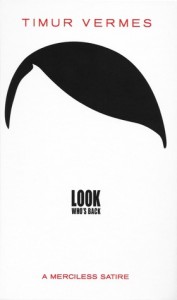
Look Who’s Back by Timur Vermes

Posted November 20, 2014 by Michael @ Knowledge Lost in Humour / 4 Comments

Look Who’s Back by Timur VermesTitle: Look Who’s Back (Goodreads)
Author: Timur Vermes
Translator: Jamie Bulloch
Published: MacLehose Press, 2012
Pages: 375
Genres: Humour
My Copy: Library Book

Buy: AmazonBook Depository (or visit your local Indie bookstore)

Adolf Hitler wakes up in the summer of 2011, lying on a patch of open ground in Berlin. However this isn’t the Germany he remembers; he calls over a nearby group of Hitler Youth but they appear to be unhelpful. He quickly discovers he is no longer the chancellor of the German Reich, in fact Angela Merkel held that role. The Kanzlei des Führers was no more and his home, The Reich Chancellery was no longer liveable. For the rest of Germany, Hitler was just a method actor who refused to break character.

Er ist wieder da (English title Look Who’s Back) is Timur Vermes first novel after working as a ghostwriter. The book is a biting satire of what might happen if Adolf Hitler was alive in the 21st Century. Of course, if he we was alive today he would be on television, spitting his ideology to the influential masses. While many thought of him as a method actor and a comedian, the novel centres on a return to power and politics with his lack of political correctness.

Interestingly enough Look Who’s Back plays on the ideas around satire; while most people within the novel believe Adolf Hitler is just a satirist, the whole notion is that there is a fine line between satire and venomous ideology. One thing I found particularly interesting within the novel is the way Timur Vermes plays with the idea that satire is meant to be funny and I want to stop and give these people a lesson on the differences between Horatian and Juvenalian satire. There are a lot of comedic values within Look Who’s Back (Horatian satire) however the satire within the novel was Juvenalian.

The way Hitler was portrayed within the book, kept reminding me of Bruno Ganz’s performance in Downfall for some weird reason.  While Vermes put a lot of effort and thought into how Hitler would react to a modern Germany, this book soon became a one trick pony. The different scenarios Hitler found himself in started off as humorous but soon the jokes got a little old. Despite this fact, I have to be impressed with the amount of thought that went into the ideas Hitler would have towards Germany today.

I do however suspect there is something lost on a reader who doesn’t live within Germany. While there is a lot of entertainment to be had with the novel the subject matter wouldn’t have the same effect. The fact remains that Adolf Hitler was very damaging to Germany and the subject matter would remain a controversial topic. While Timur Vermes depicted Hitler as a man (rather than a monster) in an effort to examine how National Socialism rose to power, Germany remains wary of the effects of this ideology. Hitler’s ideas towards Judaism and immigration have left a bad taste in the mouth of every German person and the results have led to an overly politically correct society. The damage is still visible, but despite the controversial nature of Look Who’s Back, the book sold over 1.4 million copies within Germany and has been translated into twenty eight languages (Jamie Bulloch being the English translator).

I found myself getting a little bored by the jokes within this novel and the moral message was easily recognisable half way through. While there is plenty of interesting ideas within Look Who’s Back, I believe this book might have been more enjoyable if it was cut down about half its size. Hitler comes across as an uncompromising, charismatic but deeply flawed human and while this is needed for this story, it is hard not to see him as anything but a monster.

germanlit

I read this book for German Literature Month


Gulliver’s Travels by Jonathan Swift

Posted November 18, 2014 by Michael @ Knowledge Lost in Classic / 0 Comments

Gulliver’s Travels by Jonathan SwiftTitle: Gulliver's Travels (Goodreads)
Author: Jonathan Swift
Published: Oxford World's Classics, 1726
Pages: 362
Genres: Classic
My Copy: Paperback

Buy: AmazonBook DepositoryKindle (or visit your local Indie bookstore)

Jonathan Swift’s classic satire novel Travels into Several Remote Nations of the World. In Four Parts. By Lemuel Gulliver, First a Surgeon, and then a Captain of Several Ships was released in 1726 but in 1735 the title was amended simply to Gulliver’s Travels. The novel was popular not only because it was a parody on the popular “travellers’ tales” genre but as a satire on human nature. It later gained increase popularity in its abridged form as a classic in children’s literature.

It seems a little odd to me that many people have experienced Gulliver’s Travels as a children’s book. Comparing what I know from the abridged children’s book to the version I just read, it feels like a completely different book. The abridged version I believe only focuses on books 1 and 2 and all satire, allegory or symbolism has been stripped from it, which means the bulk of makes Jonathan Swift a great writer has been completely removed and only the fantastical elements remain. Other classics received a similar treatment to turn into a kids book including, Robinson Crusoe, The Thousand and One Nights (known as The Arabian Nights) and to a less extent Alice’s Adventures in Wonderland and Peter Pan.

When reading a book like Gulliver’s Travels it is important to remember that Jonathan Swift deals heavily in irony. Take for example his essay ‘A Modest Proposal’ in which he suggests a solution to the population issue in Ireland. He suggested that we need to “regard people as commodities” and went on to say that “A young healthy child well nursed, is, at a year old, a most delicious nourishing and wholesome food, whether stewed, roasted, baked, or boiled; and I make no doubt that it will equally serve in a fricassee, or a ragout.” This straight-faced proposal is a form of Juvenalian satire where Swift mocks the heartless attitudes the government has towards the poor, as well as Irish policy in general.

Gulliver’s Travels’ satirical themes are very subtle but are typically directed towards moral, political, social and religious ideals. The main satirical themes I found within the novel focused on war, corruption in the laws and politics and the ignorance or arrogance of doctors. There is a lot of irony within the book, for example the term medical malpractice refers to ordinary medical practices and horrific carnage is meant to be extremely fun.

This is a book that comes with more layers than an onion; we could look at the travel novel as a genre, colonialism, and even the changes in Gulliver’s opinions and language over the course of the book. You could even read this as a rebuttal to Defoe’s optimistic account of human capability in Robinson Crusoe which was published seven years earlier. On the surface, you can look at Gulliver’s Travels as four different short stories but if you decide to explore it deeper you are heading down a rabbit hole you may never escape.

I have to admit I didn’t spend as much time as I should have and explored some of the ideas within this classic a little deeper. I was very aware that if I dug deeper I would be stuck reading this book for the rest of the year, maybe the next. I am fascinated by this book, I would love to dig deeper in the future but with the aid of a study guide or something similar. I will be reading this book again and I would like to encourage others to pick it up if they haven’t done it in the past. Swift really has a decent grasp on satire; so much so that we have the term Swiftian to refer to his satirical tone and pessimistic outlook in literature.


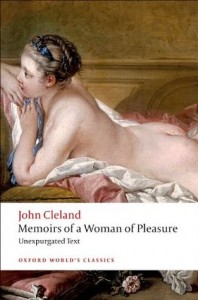
Fanny Hill, or Memoirs of a Woman of Pleasure by John Cleland

Posted November 14, 2014 by Michael @ Knowledge Lost in Classic, Erotica / 8 Comments

Fanny Hill, or Memoirs of a Woman of Pleasure by John ClelandTitle: Fanny Hill, or Memoirs of a Woman of Pleasure (Goodreads)
Author: John Cleland
Published: Oxford World's Classics, 1748
Pages: 240
Genres: Classic, Erotica
My Copy: Paperback

Buy: AmazonBook DepositoryKindle (or visit your local Indie bookstore)

In 1748 English novelist John Cleland went to debtors’ prison; while he was there he wrote a novel that went on to become the most prosecuted and banned book in history. Memoirs of a Woman of Pleasure is often referred to as Fanny Hill and is considered one of the first pornographic novels in the English language. Due to the release of this book, Cleland and his publisher Ralph Griffiths were both arrested and charged with “corrupting the King’s subjects”. The book went on to become so popular that pirated editions were sold underground. The book’s popularity eventually saw the book being published in 1821 in the United States, where its first known obscenity case convicted publisher Peter Holmes for printing a “lewd and obscene” novel.

Memoirs of a Woman of Pleasure tells the story of an orphaned fifteen year old with no skill and very little education named Fanny Hill. She leaves her village to find employment in London, where she is hired by Mrs. Brown. Fanny believed her employment was legitimate and that she would be working as a maid but she discovered that Mrs. Brown ran a brothel and intended to sell her maidenhead. The prostitute that shared her room opened Fanny’s innocent eyes to the sensuality of sex. She eventually falls in love and runs away with a man named Charles.

I do not want to go into too much detail about the plot of this book; in fact I have only covered the very first part of the story. I started off this review with mentioning that John Cleland wrote this book while in debtors’ prison and I think this is an interesting fact to remember. Cleland plays out all types of sexual fantasies while he is locked away; the novel pretty much covers everything you can think of sexually. The all-important one in this book was losing her maidenhead, which was sold to at least three different clients. However there is something deeper going on within the pages of Memoirs of a Woman of Pleasure.

This novel kept getting banned until 1973 in the United States; it was the introduction of the Miller test which finally lifted its banning. The Miller test is a three prong obscenity tested used in the United States Supreme Court to determine if something should be labelled as obscene. The work is considered obscene if all three conditions are satisfied and I am going to quote the law here so you better understand the Miller test.

(a) Whether “the average person, applying contemporary community standards” would find that the work, taken as a whole, appeals to the prurient interest
(b) Whether the work depicts or describes, in a patently offensive way, sexual conduct specifically defined by the applicable state law
(c) Whether the work, taken as a whole, lacks serious literary, artistic, political, or scientific value.

The ban was lifted because Memoirs of a Woman of Pleasure holds literary and artistic value and rightly so. Memoirs of a Woman of Pleasure is a stunning book to read, the proses are elegant but I also found it fascinating how many erotic fiction tropes comes from this one book. I have not read many erotic novels, but from what I know and read, there is a lot that this genre needs to thank John Cleland. All the cliché scenarios and sex scenes owe a lot to this novel but one I am glad I don’t see any more is the use of the word ‘machine’. The idea of men walking around with machines between their legs bugged me and I just didn’t like that terminology; unfortunately the word ‘weapon’ seems to have survived.

This was a fascinating exploration into the origins of erotic fiction and sex scenes in literature and ultimately I am glad to have read Memoirs of a Woman of Pleasure. It is not that often that I associate steaming sex scenes with literature of the 18th century, so it is good to know that people were deviant back then. Memoirs of a Woman of Pleasure isn’t just about sex; Fanny Hill works as a sex worker but she also finds love. She discovers that sex outside love isn’t as pleasurable and this is the message that I really took away from this novel. Despite all the fantasies, I think John Cleland wanted to look at how important love is when it comes to pleasure seeking.


Excavation: A Memoir by Wendy C. Ortiz

Posted November 12, 2014 by Michael @ Knowledge Lost in Non-Fiction / 0 Comments

Excavation: A Memoir by Wendy C. OrtizTitle: Excavation: A Memoir (Goodreads)
Author: Wendy C. Ortiz
Published: Future Tense Books, 2014
Pages: 242
Genres: Non-Fiction
My Copy: Paperback

Buy: AmazonBook DepositoryKindle (or visit your local Indie bookstore)

Wendy C. Ortiz was an only child to distant, alcoholic parents growing up in San Fernando Valley in the 1980’s and early 1990’s. She is an insecure and bookish girl with a passion for writing; this memoir is about her relationship with a teacher fifteen years her senior. A deep excavation into a relationship that nurtured Wendy’s writing but also left psychological scars. In a world where we take this victim/perpetrator relationship as a black and white issue, Excavation: A Memoir explores the grey area.

Wendy takes her journal entries from her teenage years, during this relationship and combines it with her memories. Excavation: A Memoir is a disturbing but fascinating look into a destructive teacher/student relationship. Excavation is a wonderful title for this memoir; the idea that this whole situation was buried deep in her own emotions and mind and now she must excavate to get it out. It gives you an idea of just how damaging the situation was for Wendy, even before starting the memoir.

The journal entries capture her teenage years perfectly, that whole feeling of being confused and unsure is something that just feels familiar. There was this constant swing between where she felt like she was in control but then a state confusion and uncertainty. Then there is sections called “Notes of Excavation” which is a reflection on the situation from where Wendy is now. Like an interesting footnote, it not only tells the story of her present day life but a reflection on the situation. There is a powerful and haunting chapter called “Why I didn’t tell” which goes through a list of reason for keeping the secret “I didn’t want to be average, I didn’t want it to end…”

Excavation: A Memoir is not just a memoir about the shocking moments of this relationship but rather exploring the grey area. This teacher essentially made Wendy a better writer and encouraged her in the arts. However he was also telling her not to write anything about their relationship down. This obviously didn’t happen and we are looking at this situation where teenage Wendy thinks she has this power but in reality the teacher is manipulating her.

Wendy C. Ortiz has a MA in Clinical Psychology and an MFA in Creative Writing, co-founder/curator of the Rhapsodomancy Reading Series as well as a contributor to places like The Olympian, Los Angeles Times and McSweeney’s. Excavation: A Memoir could be compared to works like Alissa Nutting’s Tampa or even The Kiss by Kathryn Harrison.

The memoir ends a little rough, it felt like she was just trying to rush something that needed more time. Maybe there is another memoir planned and she is just teasing the reader with what comes next. However the memoir was a trip into a dark hell but also a exploration into a messy relationship. I picked up this book to get a better understanding of abuse and while it isn’t a happy or easy book it is probably important to understand how this kind of situation can be. Thankfully the teacher is now a registered sex offender and Wendy C. Ortiz seems to be in a better place, but will these scars ever heal completely?