Source: Personal Copy

Heart of Darkness by Joseph Conrad

Posted July 6, 2012 by Michael @ Knowledge Lost in Classic / 0 Comments

Heart of Darkness by Joseph ConradTitle: Heart of Darkness (Goodreads)
Author: Joseph Conrad
Published: Penguin, 1899
Pages: 200
Genres: Classic
My Copy: Paperback

Buy: AmazonBook Depository (or visit your local Indie bookstore)

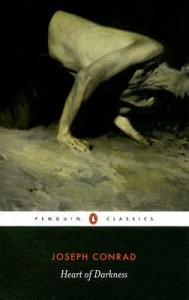
When you think of books required to consider yourself ‘well read’, one book that is often in that list is Joseph Conrad’s Heart of Darkness. I’ve been told that watching Apocalypse Now doesn’t count; however if you have read the book and seen the movie, fun can be found spotting the similarities. Heart of Darkness is a difficult book to read but if you stick with it, there is a certain elegance in the novel, as well as the fact that it’s heavily symbolic.

One of the more interesting aspects of this novel is the narrative style. It’s not narrated by the protagonist Marlow but an unnamed listener of his stories. Almost like the narrator is the reader, standing there listening to Marlow tell his tales. This is happening while the boat is anchored on the River Thames near London, though his tales are of him captaining a steamship in Africa.

The blend of feeling like a shipmate listening to the tales, and the fact that Marlow struggles to talk about the torments, makes this an excellent representation of the duality of human nature. While it was a fantastic book, the writing style did make it difficult to enjoy this book as much as I wanted.


Empire State by Adam Christopher

Posted July 4, 2012 by Michael @ Knowledge Lost in Pulp, Science Fiction / 0 Comments

Empire State by Adam ChristopherTitle: Empire State (Goodreads)
Author: Adam Christopher
Series: Empire State #1
Published: Angry Robot, 2012
Pages: 445
Genres: Pulp, Science Fiction
My Copy: Audiobook

Buy: AmazonBook DepositoryKindle (or visit your local Indie bookstore)

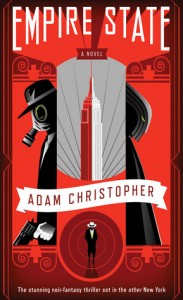
During the last great superhero fight, a blast of energy rips a hole in reality, the result is Empire State; a twisted parallel prohibition-era New York City. But now the rift is starting to close and both parallel worlds have to fight for the right to exist. Adam Christopher’s Empire State tells the story of Rad Bradley a private detective investigating the disappearance for Sam Saturn which leads him to uncover something a whole lot bigger. This book is everything you expect in a pulp style superhero novel; you have the super villains, airships, robots, organised crime and prohibition (to make it feel more like a pulp novel). This is all a brilliant back drop for the main plot; the case the gets Rad Bradley tangled in a complex web of robotic killers, inter-dimensional doppelgangers and science.

The whole tone of this book feels very much like a superhero novel but never loses sight of the noir style narrative. The whole story cast is wonderfully unique and mystery that will keep the readers on the edge of their seats while reading this book. There are some things that didn’t quite work within the story and the constant world shifting can get the reader lost. I think in the end there turns out to be at least three different worlds; Prohibition New York, Empire State and New York 1950’s. The world, the crime and the characters show potential for a lot of great stories to follow.

Adam Christopher and publisher Angry Robot Books have invited others to create works based in the world of Empire State. Writer, artist, musician, sculptor, puppeteer, interpretive dance major, or poet, are invited to create their own stories with what they are calling WorldBuilder as long as you stick to their Guidelines and Instructions. They are authorising fan-created content to be created under a Creative Commons Attribution-NonCommercial-ShareAlike 3.0 Unported License which means content can be posted on the internet or beyond as long as it’s in a non-commercial way; publication rights of the stories are still in the hands of the publisher. There are plans for an eBook or Print-on-Demand anthology of the best stories which is pretty exciting; I’ve never seen a novel do anything like this, making for some interesting stories to follow. I think this world is capable of millions of other great stories whether superhero, science fiction, alternate history, organised crime or even pulp stories.

I’m curious to see what the results of this creative common might lead to but as for this book, if you want a fun, exciting novel with twists and mystery, then you really should give Empire State ago. There’s a certain uniqueness within this book while remaining familiar with the writing style. I feel nostalgic towards a good pulp novel and this blends that with science fiction elements with such ease. This genre is often called neo-noir (a genre that blends pulp with updated themes, content, or style, often blended with Science Fiction) and there have been some great books that have come out in this style, but Empire State is definitely one of the better ones.



The Picture of Dorian Gray by Oscar Wilde

Posted June 28, 2012 by Michael @ Knowledge Lost in Book of the Month, Classic, Gothic / 0 Comments

The Picture of Dorian Gray by Oscar WildeTitle: The Picture of Dorian Gray (Goodreads)
Author: Oscar Wilde
Published: Barnes & Noble Classics, 1890
Pages: 248
Genres: Classic
My Copy: Personal Copy

Buy: AmazonBook Depository (or visit your local Indie bookstore)

I feel perplexed about The Picture of Dorian Gray by Oscar Wilde. On one hand, the story is well written about a young man being moulded and shaped. On the other hand, this book was incredibly flowery and doesn’t really start for 100 pages. Dorian doesn’t really know about life and meets an artist and an aristocrat that help him though his journey into manhood. The artist paints his portrait, subsequently making him keep his youth. The aristocrat had the biggest influence on Dorian Gray, though Lord Harry Wotton is very annoying. He talks and talks the whole way through this book, thinking he’s so witty.

Dorian Gray starts off in this novel as a blank slate, an easily influenced young man. Throughout the rest of the story he gets moulded and pushed into shape. After Basil paints his portrait Dorian starts to unravel, afraid to show the picture, he locks it way in a room and never lets anyone see it, protecting it at all costs. The whole thing symbolising the way we hide our real selves from the rest of the world, scared of what they may think.

The Picture of Dorian Gray would have been controversial in its day, with strong homosexual themes. Though the book itself is more about the life and morality, Oscar Wilde did a brilliant job of capturing this element of the book. For me the biggest downfall of this book was that Lord Wotton was too loud and dominates throughout the entire book.


The Grifters by Jim Thompson

Posted June 27, 2012 by Michael @ Knowledge Lost in Pulp / 0 Comments

The Grifters by Jim ThompsonTitle: The Grifters (Goodreads)
Author: Jim Thompson
Published: Knopf Doubleday, 1963
Pages: 189
Genres: Pulp
My Copy: Personal Copy

Buy: AmazonBook Depository (or visit your local Indie bookstore)

There is a reason they call Jim Thompson the Dimestore Dostoevsky; his works really spotlight the moral dilemma his protagonists and main characters face, so I was really looking forward to reading The Grifters.  I’ve seen the movie so I was interested in seeing the inner thoughts of the characters. 25-year-old short con operator Roy Dillion suffers an injury when a simple con goes horribly wrong; he finds himself in hospital recovering from an internal haemorrhage. This brush with death has led him to rethink his life, though his mother Lilly feels like Roy still owes her. She’s inattentive and manipulative while trying to care for Roy, but she is also trying to pull off a long con at the race tracks at the same time. Throw in another femme fatale, Moira, Roy’s girlfriend, who we also find out is also a grifter who favours the long con. The three explosive characters make for an interesting and twisted noir story, much to what we have come to expect from Jim Thompson.

I have to admit I do love Jim Thompson’s twisted plotting, he captures the pulp feel well while giving it is own flavour of surrealism. While The Grifters is not is most solid piece it does a good job at spotlighting what this author can do with crime and with is unreliable narrating. The characters are great and they each work well together while making life difficult for each other. His is one of the few pulp authors that break into the world of serious literary while never losing sight of what he does best.

If you haven’t read a Jim Thompson book maybe this is a good place to start, it’s not as dark or gritty, the characters are great, the plot isn’t as twisted as some of his other works and the suspense is a bit watered down. Let’s just call this book ‘Jim Thompson for beginners’; it gives you everything you expect in a Thompson book, just not to the same intensity, making the book approachable and easy to read.


The Deep Blue Good-By by John D. MacDonald

Posted June 24, 2012 by Michael @ Knowledge Lost in Pulp / 0 Comments

The Deep Blue Good-By by John D. MacDonaldTitle: The Deep Blue Good-By (Goodreads)
Author: John D. MacDonald
Series: Travis McGee #1
Published: Ballantine Books, 1964
Pages: 384
Genres: Pulp
My Copy: Personal Copy

Buy: AmazonBook Depository (or visit your local Indie bookstore)

I’ve never read a John D. MacDonald book before and I’ve read a lot of good things about his Travis McGee novels, so I thought I might start at the beginning for this series. This is the first in what is now a 21 book series and the first time we meet Travis McGee, a self-described “salvage consultant”, almost like a treasure hunter but instead he recovers the property of his clients for a fee; half.  He is hired and has to go up against the pathologically evil antagonist Junior Allen, who may seem friendly but has a very sinister agenda.

For a hard-boiled style “salvage consultant” McGee seems to be very ordinary; I felt like all the guys liked him (except the antagonist) and all the girls wanted him. There wasn’t much depth in the character at all except in one scene where he was ready to torture someone for information and I saw a glimpse of a sociopath in McGee. This just made me want to read a book with a sociopath hard-boiled detective, so if you have any recommendations let me know.

The story felt very predictable, it was more of a quick enjoyable story being told to me. I think, while this series might work well as filler reading to  help recover from something heavy, there are much better books out there to read instead of this series. The sex and violence that was in this book was pretty intense for a book written in 1964 so I really don’t want to just write off the entire series because of predictability; so if you share a different opinion or can recommend me one of the Travis McGee books that could change my mind, please let me know.


All That I Am by Anna Funder

Posted June 20, 2012 by Michael @ Knowledge Lost in Historical Fiction / 0 Comments

All That I Am by Anna FunderTitle: All That I Am (Goodreads)
Author: Anna Funder
Published: Harper Collins, 2011
Pages: 384
Genres: Historical Fiction
My Copy: Personal Copy

Buy: AmazonBook Depository (or visit your local Indie bookstore)

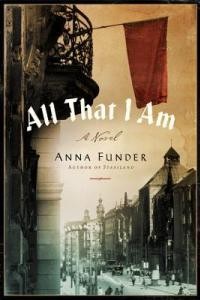
I wanted to read this book before the Mile’s Franklin award for 2012 is announced as I’m predicting this book will win. All That I Am by Anna Funder is told from the perspective of Ruth Becker and Ernst Toller in alternate chapters. Both Ruth and Toller are remembering life in 1930’s Germany as political activists. Both characters, along with Ruth’s husband Hans and Toller’s lover Dora, publically speak out against Hitler and everything he stands for, advocating independence and freedom of speech for Germany.

This book starts out very heavy; trying to cover all the relevant back story of Germany in the 1930’s while still trying to drive the story along. This is a delicate balance to manage but I think Anna Funder did a good job at managing this. I know people may disagree with me  but I think with the subject matter and the back story that needs to be covered, the author still manages to keep the reader turning the page, and for me, that never felt boring. I love the fact that this story is more about the politics and the effect Hitler’s rise to power will have on the German people rather than dealing with the holocaust.

The simple fact that this book tries to deal with the social impacts of the changing Germany has been the biggest contributing factor to my enjoyment of the book. I couldn’t care less about Toller who is writing his autobiography or Ruth, who after reading Toller’s writing, is remembering her side of the story. I know they risk a lot to speak out and I knew Hitler’s regime were actively trying to stop political opposition so I probably should care more for the characters, but the fictionalised German history was more interesting for me.

All That I Am would be a tough book to write and while at times it was heavy and at other time I might not have cared too much of the story; Anna Funder did do an excellent job at writing this novel. The book reminded me of the 2002 movie Max for some weird reason; mainly because it also was a fictionalised account of Hitler rising to power and how he dealt with the political opposition. For those who don’t know the movie Max starred John Cusack as a fictional Jewish art dealer and a young Austrian painter, Adolf Hitler (Noah Taylor). The interesting thing about the movie was it explores Hitler and the view’s that shaped Nazi ideology, while also taking a look at the artistic designs of the Third Reich.

Anna Funder must have done a lot of research in preparing to write this book. I know she has a non-fiction book called Stasiland: Stories from Behind the Berlin Wall but I think that was more about East Germany, but in the course of researching that book she might have gotten all the information needed for All That I Am. I’m glad to have read this novel; I think it offers an interesting insight into a world I was never a part of. It is an interesting piece of history and sociology. Anna Funder has won the Australian Independent Booksellers Indie Book Award for Literary Fiction and has been shortlisted for Miles Franklin Award for this book. I’d be interested to see if this book will stand the test of time.


Wolf Hall by Hilary Mantel

Posted June 18, 2012 by Michael @ Knowledge Lost in Historical Fiction / 0 Comments

Wolf Hall by Hilary MantelTitle: Wolf Hall (Goodreads)
Author: Hilary Mantel
Series: Wolf Hall #1
Published: Harper Collins, 2009
Pages: 651
Genres: Historical Fiction
My Copy: Personal Copy

Buy: AmazonBook Depository (or visit your local Indie bookstore)

Told through the eyes of Thomas Cromwell, Wolf Hall is a wonderful take on Tudor history. Hilary Mantel sets out to write a fictionalised biography of the rise to power of Cromwell, as well as the fall of Cardinal Thomas Wolsey, Henry VIII’s desire to divorce and the opposition of Thomas More. Mantel puts her take on the characterisation of these historical figures and went to painstaking lengths to make sure her version of the story lines up with the historical events as accurately as possible.

Just for the sake of understanding the history behind the book, I did a bit of research before reading this book. I believe this book is set between 1500 and 1535; King Henry VIII has no heir and his chief advisor Cardinal Wolsey is trying to secure his divorce which the Pope refuses to grant. Thomas Cromwell, the son of a blacksmith rises to power by becoming Cardinal Wolsey’s clerk and then later his successor. Wolf Hall takes a look at the history and the morality behind the English Reformation; the English church’s break with the Catholic Church in Rome.

With the success of The Tudors TV show and The Other Boleyn Girl by Philippa Gregory, I’m not surprised how popular this book was but I’m a little surprised that it ended up winning the Man Booker prize in 2009. However, this book is a beautiful read and I found it fascinating that Hilary Mantel gave Thomas Cromwell a real sense of humanity when most recordings seem to vilify him. I’m a little confused why this book was called Wolf Hall when Wulfhall was the manor that was the seat of the Seymour family and yet there wasn’t much in this novel to do with Jane Seymour.

Fans of historical fiction, especially of this period of history, this is the book for you. Don’t be too worried about the sheer size of this novel, you won’t be disappointed. For anyone that has no interest in the period then, I’m not sure if you would want to read this. Personally I don’t have much of an interest in the Tudor’s dynasty but I’m interested in books that tackle morality and that drove me through this book but I did end up developing an interest in the history. I’m keen to read the next book in this planned trilogy; Bring Up the Bodies which only covers 1535 to 1556 and centres around the downfall of Anne Boleyn.


Railsea by China Miéville

Posted June 16, 2012 by Michael @ Knowledge Lost in Young Adult / 0 Comments

Railsea by China MiévilleTitle: Railsea (Goodreads)
Author: China Miéville
Published: Random House, 2012
Pages: 448
Genres: Young Adult
My Copy: Personal Copy

Buy: AmazonBook Depository (or visit your local Indie bookstore)

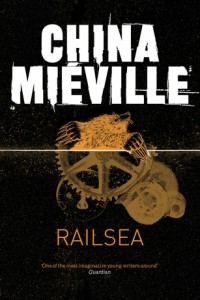
I’ve only really enjoyed one China Miéville novel (The City & The City) but I am a fan of what he does for literature and speculative fiction. His latest novel Railsea is his second attempt at a YA novel and while I’ve not read his other YA novel Un Lun Dun I must say I wasn’t really impressed with this one. I really loved the complexity of The City & the City so I was looking forward to see Miéville’s take on Moby Dick. Granted I should have read Moby Dick before this book but I found this book was too simplified and weird; writing without some intelligent plotting just ends up making the book weird.

Set in a dying dystrophic world that is now desert, Railsea is an adventure novel that tells the tale of three young orphans joining the train to hunt for Mocker-Jack; the giant Mole. The book mixes adventure elements that remind me of Treasure Island with Miéville’s own genre; which he calls ‘weird’ and is a mix of fantasy and steampunk. The main protagonist, Sham, was pretty average in this book but the train captain Abacat Naphi peaked my interest. I think she was the Ishmael in this book; even considering Mocker-Jack as her nemesis.

I thought this book might be more of a children’s book rather than a YA novel; io9 said it best when they said this book was for “kids who cut their teeth on Thomas the Tank Engine, then Lemony Snicket”. It just felt odd and too simplified but a twelve or thirteen year old would probably enjoy it as a gateway into the YA fantasy/steampunk genre. The main issue I had with this book was the overuse of the ampersand. There is way too many in the book; even a large amount of sentences starting with ‘&’. It just never looked or felt write when reading it and I found I got really annoyed with it.

This book is for young teenagers and China Miéville fans, anyone else interested in trying this author might want to look elsewhere. I’m a little disappointed with this book but would be interested to see how my other friends find it, if they read it. There are some interesting elements in this book but for me I felt more frustrated by it. I hope others love and enjoy this book more than I did. Miéville has a lot to offer the literary world but I personally think skip this one and go read The City & The City.


The Mountain by Drusilla Modjeska

Posted June 14, 2012 by Michael @ Knowledge Lost in Contemporary / 0 Comments

The Mountain by Drusilla ModjeskaTitle: The Mountain (Goodreads)
Author: Drusilla Modjeska
Published: Random House, 2012
Pages: 448
Genres: Contemporary
My Copy: Personal Copy

Before reading this book, I must admit that I’d never heard of Drusilla Modjeska so I thought I would look her up and find out a bit about this book before starting The Mountain. I would never have picked up this book if it wasn’t for the fact that I needed to read this book for my local bookclub. Yes, this was the same book club that made me read A Perfectly Good Man by Patrick Gale and The Hanging Garden by Patrick White so I was prepared not to enjoy, or even hate, this book. Modjeska is an award winning Australian author known for blurring the lines between Non-Fiction and Fiction. She has written three books in the past; Poppy (1990), The Orchard (1997) and Stravinsky’s Lunch (1999); all three books won the NSW Premier’s Literary Award for Non-Fiction.

The Mountain I believe was her first attempt at a purely fiction novel, but even this book has a lot of elements that might be considered non-fiction. I do like a book that uses real events and builds a story around them and I think Drusilla Modjeska did a decent job at doing just that. The first part of this book is a real coming of age story in Papua New Guinea during a time of colonialism. While there seemed to be a handful of characters this story covers (including Rika, Leonard, Jacob, Martha and Laedi) the books does a nice job of introducing each of the characters in this part of the book. The second part of the novel deals with a new generation who are dealing with the effects of everything that has happened. This generation is questioning their identity and the fallout of independence.

I really enjoyed learning more about Papua New Guinea’s history, featuring Whitlam government granting them independence and his dismissal. It was also nice to see the book revolving around other aspects of Papua New Guinea other than the Kokoda Track; which does feature but not in a huge way. Drusilla Modjeska took an interesting approach of making The Mountain the centre of this novel and almost took it to a point where she was making The Mountain a central character. This tactic helped drive the story a little for me; it was almost like the mountain has some secrets it didn’t want to tell.

I really wanted to enjoy this book more than I did but I felt the book ended up being too nice. While there are a lot of bad things happening during this book, the story itself felt too cutesy for me to enjoy properly. I think the characters were decent but I never felt like I knew them well enough to care about the struggles that they faced. I read this book right after reading another character driven book, The Red House by Mark Haddon, and I think Modjeska’s story was nice, but Haddon’s The Red House seemed to outshine The Mountain in terms of characters and exploring their personal struggles.


The Adventures of Sherlock Holmes by Arthur Conan Doyle

Posted May 30, 2012 by Michael @ Knowledge Lost in Book of the Month, Classic, Crime / 0 Comments

The Adventures of Sherlock Holmes by Arthur Conan DoyleTitle: The Adventures of Sherlock Holmes (Goodreads)
Author: Arthur Conan Doyle
Series: Sherlock Holmes #3
Published: Penguin, 1892
Pages: 307
Genres: Classic, Crime
My Copy: Audiobook

Buy: Amazon (or visit your local Indie bookstore)

It’s often really hard to review classic literature; simply because it’s already stood the test of time and that makes it difficult to be critical of the book. I’m not really a fan of reading a collection of short stories, especially over a few days; but I really did enjoy reading through The Adventures of Sherlock Holmes. I’m not sure why I haven’t read more of Sir Arthur Conan Doyle’s novels; this is my second with the first being A Study in Scarlet. I think I need to pick up my act and read more of his books; ideally all of the Sherlock Holmes novels.

Sherlock really is a great character, with some interesting quirks. I think at one point I thought he was taking cocaine to get over the monotony of not having a case to work on and then later in the book he was taking it because he was bored with a case. He really has an eye for detail and often it is really impressive the way he solves a case with the details that he discovers. Dr Watson; while you don’t get too much information about him, having him narrate the stories gives these books the extra boost it needs. The unreliable narrator is the perfect way to hide aspects of each case, without having the reader think the author is withholding on purpose.

There is not much I can say against this book apart from the fact it’s a collection of short stories. I feel like each story only gives you a quick glimpse into the brilliance of Sherlock and then the case is solved. I do like the way that this book does flow together without making the reader needing to reset the mind in preparation for the next story. This may be simply the fact that each story is in the same style and the characters are the same, but when it comes to reading a collection of short stories, this is often what I prefer. I probably should have read The Sign of Four in preparation for this month’s book club read but it will be the next Sherlock Holmes novel I get to.