Tag: Detective

Generation Loss by Elizabeth Hand

Posted December 7, 2020 by Michael @ Knowledge Lost in Crime / 0 Comments

Generation Loss by Elizabeth HandTitle: Generation Loss (Goodreads)
Author: Elizabeth Hand
Published: Small Beer Press, 2007
Pages: 265
Genres: Crime
My Copy: Audiobook

Buy: AmazonBook DepositoryKindleWordery (or visit your local Indie bookstore)

Most people know that I am very particular when it comes to crime novels. I tend to be drawn to the gritty, pulp novels of the 1930s. I honestly could not tell you what works for me and what would not. Taste is a weird measuring tool; it is constantly changing and there are aspects that even the reader is unaware of, for example, I recently read Generation Loss by Elizabeth Hand and there is so much I liked about this novel, yet there is something that did not work for me. I am reviewing the book in the hopes to fully understand my feelings here.

Cass Neary is the protagonist of what appears to be a series of currently five books. She had moderate success as a photographer in the 1970s, in which she was involved in the burgeoning punk movement and has a weird fascination with death photography. Thirty years, later she is a struggling freelance photographer that is running out of luck and work. An acquaintance of hers gives her a job to interview a famously reclusive photographer who lives on an island in Maine. Cass Neary has the style and attitude I tend to like in a protagonist of a crime novel but still there is a part of me that wants more. It could be the fact that we rarely get a female protagonist in literature and I really want to see the struggles that she faces along the way.

This is not to say that Cass Neary has an easy journey, she faces many obstacles with Generation Loss, but I feel I wanted more. The whole struggling artist and living in the world as a woman, there is so much angst and anger that could really come alive in this novel. I do not think Elizabeth Hand did a bad job, I think she delivered a great book, I am just thirsty for more. I will read the second book Available Dark, and I am curious to see where Cass Neary’s journey will take her. I am just realising that I want very different things from a female protagonist to a male. I know this is wrong, but I want a bitter cynical male, but I want female detectives to struggle with the everyday sexism as well. The world is unjust, and I think there is a lot of interesting layers that can be added.

I have really enjoyed the Michael Connelly books that feature Renee Ballard because there is an exploration into the sexism of the police force. It is not that I want sexism to exist, I just feel like this is an aspect that should not be ignored in these books. I think these female investigators have a legitimate reason to be bitter and cynical with the world, and it want to explore that journey. I want to read more crime novels that feature an angry, feisty woman, and let us be honest, I would rather it be written by a woman, men do not have to ability to really understand just how sexist the world really is.

I really wanted to talk about Generation Loss, but I did not know how to write a review for a crime novel without going into the plot. This turned into an exercise to unpack my own feelings towards the genre and my own reading tastes. I am very aware of my own biases here, I just think in an unjust world, it is important to explore those injustices. Also, I just like a bitter and cynical character, and I do not want them always to be men, because women have more to be angry about. If you have any recommendations, please let me know.


Knots and Crosses by Ian Rankin

Posted December 22, 2015 by Michael @ Knowledge Lost in Crime / 2 Comments

Knots and Crosses by Ian RankinTitle: Knots and Crosses (Goodreads)
Author: Ian Rankin
Series: Inspector Rebus #1
Published: Wheeler Publishing, 1987
Pages: 341
My Copy: Library Book

Buy: AmazonBook DepositoryKindle (or visit your local Indie bookstore)

I have been reading a lot non-fiction lately; my plan was to devote the entire November to non-fiction. However I got a little run down and found myself in need of some mindless fiction. I picked up Knots and Crosses, the first book in the Inspector Rebus by Ian Rankin. While writing my review of Dexter is Dead, I felt the need to find a new crime series to read through, but I have particular taste; I want something with an interesting protagonist and an overarching story arc. I have heard some good things about the Inspector Rebus series, so I thought I would check it out.

Knots and Crosses starts off telling a lot of the backstory of John Rebus, former member of Britain’s elite S.A.S. suffering from PTSD. Using his connections he got out of the army and joined the police force. However Edinburgh is being terrorised by a serial killer who is taking teenage girls and someone is sending Rebus mysterious notes.

There is something very different about Knots and Crosses to the normal bestselling crime novels, it deals with developing the main character and the mystery seems to be back story. I enjoyed the way Ian Rankin did this but I am unsure about the series; I might have to attempt another book first. I found the mystery completely obvious but that did not bother me much, I was more interested in the characters more than the plot.

I am not sure if there is an overarching story arc in this series but there were a few threads left, so hopefully this means book two will continue on. Unfortunately the crime is not dark and gritty, like I normally enjoy but the character development made up for that. I am not sure how this will fit in throughout the series but I am curious enough to find out. If you know of a crime series that you think I might like, please let me know.


Mr. Mercedes by Stephen King

Posted August 21, 2014 by Michael @ Knowledge Lost in Crime, Thriller / 0 Comments

Mr. Mercedes by Stephen KingTitle: Mr. Mercedes (Goodreads)
Author: Stephen King
Published: Hodder, 2014
Pages: 496
Genres: Crime, Thriller
My Copy: Paperback

Buy: AmazonBook Depository (or visit your local Indie bookstore)

When I picked up Stephen King’s new novel Mr Mercedes, I felt anxious and nervous. This novel has been billed as King’s first hard-boiled detective novel and it reminded me of his past attempts at pulp fiction. Joyland was billed as a pulp novel and by all accounts it had the makings of a good dime-store novel but the end result felt like King stuck to what he does best and only paying homage to the genre. Mr Mercedes has all the hallmarks of a hard-boiled novel, a brooding and jaded detective, a femme fatale and mysterious villain but this read more like a cat and mouse suspense thriller. Don’t get me wrong, this novel is a homage to detective fiction; Philip Marlow gets a mention and a fedora even makes an appearance. Though the third person narrative and chapters focusing solely on the killer meant we are in a thriller and I had to adjust my expectations.

Bill Hodges is a retired cop with not much to do; when he was on the force he was highly decorated but now he is left alone with the thoughts of all his unsolved cases. One of those cases was the psycho-loner who ploughed down a crowd of people in a stolen Mercedes. One day Hodges receives a letter from this killer taunting him into a little game of cat and mouse. This is a high-stakes race against time; can Hodges catch the Mercedes Killer before he strikes again?

I found it interesting that Stephen King picked the fundamental character archetypes found in hard-boiled fiction, in particular to Bill Hodges, and made it his own. On the other hand the plot felt into the typical tropes found in suspense thrillers. So we have a book that is walking a fine line between homage and cliché. When it comes to hard-boiled detectives, there has been a great evolution in the genre and character archetype; it was felt a little dated to see an old white guy again. I felt it to be unnecessary, in fact I am struggling to think of any ethnicity within the book that didn’t come across as stereotypical. It was a shame because you can do so much with a hard-boiled detective and still keep him as a homage to 1940’s crime novels.

I get the impression that maybe Stephen King is the kind of writer that sticks to the tried and true methods of writing within a genre. As prolific author, I’m beginning to question if he ever takes a risk in his writing. I am not one to judge King’s work, I’ve only read a few of his books (I think five) but they all seem to follow the typical tropes found within their genres. Does he take risks?

It is starting to bug me this whole ‘old white guy’ category of novels all feature non-multicultural characters and if we do have some ethnicity, they all feel a little too stereotypical. It isn’t necessary in today’s novels; there is room to explore some diversity within a book. I won’t go into anything about feminism because I fear I would give spoilers with what I want to say but we need more strong/independent women in novels like this.

Having had a bit of a rant, I found that I’ve managed to talk about the novel and not give any spoilers. I did in fact enjoy the ride this took me on, it was predictable and typical of the genre but sometimes it is fun to go on that journey again. In fact (with the exception of On Writing) I think this is the first Stephen King novel that I have actually enjoyed. I find some parts of his other books entertaining but on a whole they do not work for me. Maybe I’ve just read the wrong King novels. Bill Hodges is returning in another two more novels and I will be picking them up and using the books as a little entertaining read when I need them.


The New York Trilogy by Paul Austen

Posted April 13, 2014 by Michael @ Knowledge Lost in Crime, Literary Fiction / 2 Comments

The New York Trilogy by Paul AustenTitle: The New York Trilogy (Goodreads)
Author: Paul Auster
Published: Penguin, 1987
Pages: 308
Genres: Crime, Literary Fiction
My Copy: Audiobook

Buy: AmazonBook DepositoryKindle (or visit your local Indie bookstore)

If you want to try a metafictional detective novel, then look no further than The New York Trilogy by Paul Austen. Originally published sequentially as City of Glass, Ghosts and The Locked Room, these three interconnecting stories have been since collected into a single volume. Heavily influenced by the post-modernist movement, this novel blends elements of neo-realism, soft-boiled fiction and of course, metafiction. Even the pulp style cover (illustrated by Art Spiegelman) has a metafictional style to it.

I really wish I had a better grasp on post-modernism; there is a lot of literary theory that must go into fully understanding a novel like The New York Trilogy. My level of understanding of post-modernism might hinder this review but I will do my best to add something valuable here. Starting with a look at any example of one of the narrators; such as the one known as Peter Stillman, or is he? Maybe his name is something entirely different; maybe it is Paul Auster. This gives you an idea of just how you have to read this book; continuously questioning everything and assuming things are not as they have been told. This does make the novel difficult to read, I had to take my time with it and reread almost everything.

The first story City of Glass follows a detective fiction writer that becomes a private investigator. This unnamed narrator explores layers of identity and reality; often to Paul Auster (the author), Paul Auster (the writer), Peter Stillman (the mark), the other Peter Stillman (the son) and finally Daniel Quinn (the protagonist). The story follows this narrator as he descends into madness as the reader follows close behind. This is story that explores the relationship between the author, characters and the reader in a twisted kind of way. Essentially asking us to consider who has the real power in this relationship?

Ghosts follows the story of a private eye called Blue who is hired to follow Black; he has been hired by White to write down everything Black does. Only problem is that Black doesn’t do too much apart from sit and write all day, which means Blue spends all day sitting and writing. This is a story that explores the issue of who has the real power, the author or their characters. Paul Auster is showing us his views towards writing (sitting and watching what the character does).

Finally in The Locked Room, the title suggests that the story is referencing the locked room mystery archetype. It tells the story of a writer that doesn’t have the creativity to produce any fiction. When a childhood friend disappears, he has been hired to write his works and determine if they should be published. While one this job he finds himself taking the place of his friend and becoming husband and father to his family. This final story looks at the relationship between character and reader and asks us to consider if we are under the control of the author or do we interpret what is happening for ourselves.

It is interesting that a novel like The New York Trilogy can leave you perplexed and confused but when you try to articulate what happened and slowly dissect the novel into its three parts it all makes sense. I’m often surprised with how much I get out of a post-modern novel, especially since I often freak out and feel like I have not understood it. Then it all makes sense and I often wonder how I did not pick up on this while reading or after reading the novel. I hope I’ve made enough sense out of The New York Trilogy, a bizarre novel that requires very close attention but I’ve conquered it and I feel proud.


Abandoning The Luminaries

Posted March 15, 2014 by Michael @ Knowledge Lost in Historical Fiction / 13 Comments

The LuminariesRecently The Readers (which is a fantastic podcast) did an episode on when you have to finish a book. This has got me thinking a lot as I was reading a book for book club that I wasn’t enjoying. I feel like I need to finish a book in order to participate in the discussion but this particular book was over 800 pages and after 200 pages I was ready to throw in the towel. The book was The Luminaries and I have now abandoned the book, but I thought it would be a good opportunity to talk about the book, and the need to finish or abandon a book.

By all accounts, I should have loved The Luminaries; it has murder, mystery and it is a detective story cleverly disguised as literary fiction. Eleanor Catton is a talented writer and there is no denying that, the proses in The Luminaries are spectacular but some will argue that the words don’t match the time period. For me the problem with this novel is the believability and the fact that it takes too long to say what it needs to say. For the very start it felt repetitive, Walter Moody was introduced as a person on the run, trying to find his own fortune. Moody had brought shame to his family, but doesn’t want to go into the details; this takes up about 40 pages of the book. I felt like this wasn’t building mystery or developing the character, it just went around and around in circles.

As for the believability I first need to talk about my life. I was raised in a small mining town called Charters Towers. In the 1870s, this town was attracting prospectors from all over the world, so much so that it was the second biggest city in Queensland at the time. During the gold rush Charters Towers produced over 200 tonnes of gold from 1871–1917. The history of Charters Towers felt nothing like Hokitika 1866 from the book. The miners in this novel are nothing like my experience of miners (or others involved in the goldrush), the book lacked the drinking to access, over use of swearing, constantly fighting and over playing Cold Chisel. The Gold rush should be a dark and violent time but The Luminaries was based around twelve people that do nothing but talk.

The Luminaries won the Man Booker Prize in 2013 and my experience doesn’t match that of the people that have finished the book. General consensus seems to be that this book gets really good at page 600. I have to wonder if it is worth pushing through 600 pages for 200 pages of greatness. Big books always scare me and I was reading War and Peace at the same time, so I had an amazing book running alongside a book that wasn’t working for me. I wanted to finish this book for book club but in the end, there are too many books to read and left this book with 600 pages to go.

I’ve never really been good at abandoning books and I really felt like I had to finish this book but in the end it wasn’t working and The Dark Path by David Schickler was calling me. Have you ever felt that you had to finish a book? Normally I feel that I have to finish a book club book. This is the first one I abandoned; I love to hate a book but 800 pages is a big investment. Also when it comes to abandoning books, do you have a set page count you give a book to impress you? Have you ever considered writing a review of a book you abandoned? I would love to hear your thoughts on when you have to finish a book or abandon it.


The Sign of Four by Arthur Conan Doyle

Posted January 16, 2014 by Michael @ Knowledge Lost in Classic, Crime / 0 Comments

The Sign of Four by Arthur Conan DoyleTitle: The Sign of Four (Goodreads)
Author: Arthur Conan Doyle
Series: Sherlock Holmes #2
Published: Penguin, 1890
Pages: 152
Genres: Classic, Crime
My Copy: Paperback

Buy: AmazonBook DepositoryKindle (or visit your local Indie bookstore)

Mary Marston’s father disappeared and suddenly she has started receiving several large pearls. Now a mystery letter tells her she is a wronged woman, so she seeks out Sherlock Holmes to ask for help. This case leads Holmes down a path that involves the East India Company, India, the Indian Rebellion of 1857, a stolen treasure, and a secret pact among four convicts and two corrupt prison guards.

Scottish born Arthur Ignatius Conan Doyle was the third of ten siblings to Charles Altamont Doyle, an Irish artist who suffered from alcoholism, and Mary Foley, who was also Irish. In his youth he led a street gang called the Baker Street Irregulars. He then went on to be a medical student at Edinburgh University where he was mentored and influenced by Joseph Bell. Bell was a forensic surgeon and considered a pioneer in the field; he also was the inspiration for Sherlock Holmes.

The Sign of Four was written in 1890 but it was set in 1888 which is the same year as the Jack the Ripper murders. In fact by modern standards the distance between 221B Baker Street (the home of Sherlock Holmes) and the Whitechapel district is less than ten kilometres apart. The living conditions of the East End of London even before the Whitechapel Murders could be described as, in the words of Holmes in A Study of Scarlet “that great cesspool into which all the loungers and idlers of the Empire are irresistibly drained”. Naturally after the Ripper killings the public were in a panic; in comes the literary hero, here to fight crime, dispense justice and protect the streets of London, here is Sherlock Holmes.

It is important to note that historical context didn’t start or stop with the Ripper murders. In order to understand The Sign of Four better, the events of the Indian Rebellion of 1857 must also be taken into account. The four convicts in the title are connected to this to uprising. There is no single reason for the rebellion unless you consider colonialism as the cause. It was a mix of economic, political, social and much more that caused, in the terms of the British, ‘the mutiny’. Without going into too much detail about the rebellion, imperialism or even the use of the word ‘savages’, it is important to understand the basis and mindset of the time to analyse the text fully.

While The Sign of Four is a book that reflects the ideals of the late nineteenth century, some ideas, like justice are still relevant. The Indian Rebellion may no longer be considered mutiny or a crime; the way justice was dispensed in the end still remains a satisfactory resolution for the readers. It is still fair to say that the idea of being a hero to women and sexual justice is very real in the modern world. Conan Doyle highlighted the prejudice between both sexes but this stereotype remains very relevant in current times. The principle of moral rightness; equity is still an issue today.

There was a lot I got out of this novel, especially when it comes to justice, sexual equality and historical context. I was surprised with the start of this novel; the cocaine use from Sherlock was a little shocking. I knew there were references in this novel but I didn’t expect what I read. The whole idea of dulling his mind when he is not solving a mystery is an interesting one. Not really justifiable but the excuse got me thinking about his passion and how people manage when they are not doing what they enjoy.

I’m not sure if it was because I was studying this novel but this was the first Sherlock Holmes novel I’ve read where everything clicks and the symbolism and motifs hit me. I feel like I need to reread the other Holmes novels and see what I’ve missed. This book will have a special place in my heart now; the book that opened my eyes to Sir Arthur Conan Doyle’s brilliance. Am I weird for loving books that teach me? Most people read for enjoyment, but I feel more satisfied when I’ve discovered something about a book and the world.


And Then There Were None by Agatha Christie

Posted December 29, 2013 by Michael @ Knowledge Lost in Book of the Month, Classic, Crime / 2 Comments

And Then There Were None by Agatha ChristieTitle: And Then They Were None (Goodreads)
Author: Agatha Christie
Published: St. Martin's Griffin, 1939
Pages: 264
Genres: Classic, Crime
My Copy: Audiobook

Buy: AmazonBook DepositoryKindle (or visit your local Indie bookstore)

Ten people have been invited to have a holiday on Soldier Island; when they arrived they thought they had nothing in common. Soon they find out all of them have become complacent with the death (or deaths) of other human beings. One by one they all die, but who is the one that is there to seek revenge on the others?

And Then There Were None was originally titled Ten Little (I would rather not say) after the British nursery rhyme. The US edition used this title (which is also the last line of the rhyme) as well as changing the song to Ten Little Indians. Once again the novel was revived and now the song title has been changed to Ten Little Soldiers. Apart from the offensive name of the book originally, this novel was wildly successful and introduced a very common crime trope into the world. Ten people trapped in a house on an island trying to work out who is killing them off one by one. I’m sure you can think of many films, shows and books that have paid homage to this theme.

This classic crime novel looks at the idea of administrating justice; who has the right to judge others, and what happens when the law fails. I’m going to try to avoid spoilers and tell you who the killer is but most people would have read this and probably remember who the perpetrator was. The killer believes the others are complacent and in most facts while they deny being guilty publically are living tormented lives. Not everyone, but it was interesting to see that kind of turmoil and I was a little upset to see that wasn’t explored in greater detail. Having said that, I think the torment played out more in the symbolism and motifs. I’m thinking about the dreams and hallucinations (the guilty consciences of the victims are explored here) or the storm; a symbol of violence that cuts them off from the world.

The killer has set out to commit the perfect crime and it looks good on paper but I never really bought into it. While reading this novel I had a feeling that the cosy crime approach is playing against the story. If you think about the mess made from the violent murders, wouldn’t help the police work out what happened in the end? I’m sure they wouldn’t rely on the handwritten accounts, the evidence would be inconsistent. Making this far from a perfect crime (sorry this is hard to explain without spoilers).

This was my first Agatha Christie novel and while I enjoyed it there is one thing that frustrated me. I hate crime novels that hold back important pieces of evidence and expect the reader to work out what happened. I always feel like the author is trying to be smug but really it is just poorly executed writing. It wasn’t so bad in this novel but I get the feeling it is a common occurrence in all her novels and I can’t stand that. You have to make a great protagonist to make up for the withholding of information. It works better as a first person narrative; the unreliable narrator is more likely to forget to tell you important clues.

I will read some more Christie, I hope I’m mistaken about the withholding of clues. And Then There Were None had no real protagonist but maybe a Hercule Poirot, Miss Jane Marple or Tommy and Tuppence mystery hide this a little better. I suspect Murder on the Orient Express will be my next Agatha Christie read but who knows. I prefer my detectives a little more Hard-Boiled so it might be awhile between Christie novels.


Fadeout by Joseph Hansen

Posted August 18, 2013 by Michael @ Knowledge Lost in Pulp / 9 Comments

Fadeout by Joseph HansenTitle: Fadeout (Goodreads)
Author: Joseph Hansen
Series: Dave Brandstetter #1
Published: University of Wisconsin Press, 1970
Pages: 187
Genres: Pulp
My Copy: Personal Copy

Buy: AmazonBook DepositoryKindle (or visit your local Indie bookstore)

Dave Brandstetter is an insurance investigator who is hired to investigate a death claim of a local celebrity, whose car plunged off a bridge in a storm. In the absence of a body the insurance company needs to send their own investigator before handing over $150,000 (works out to be about $900,000 by today’s standards). As the investigation continues Brandstetter is convinced that Fox Olson is still alive and he must find him before the would-be killer does.

Dave Brandstetter embodies the tough, no-nonsense persona of most classic Hard-boiled detectives with one major difference; he’s openly gay. As most people know, I have a love for the hard-boiled detective and I’m always looking for new and interesting takes on this genre. I’ve found that in Joseph Hansen’s Fadeout. There are a few reasons why I plan to continue the series and I thought rather than talk about the book, it would be nice to mention what will make me continue with the other eleven novels.

First of all, I’ve never read a pulp novel like this before; a homosexual protagonist would have been controversial in 1970. This would have been near the beginning of the gay pride movement and Hansen must have gone through a lot of hardship with writing this character and being a homosexual as well. With all the stigma and prejudices towards homosexuality back then (and let’s face it, it’s still around today) it was refreshing to see a protagonist who is proud and comfortable with his sexuality (I get sick of seeing homosexuals in literature being portrayed as unstable or disturbed) .

From the very first page of Fadeout, we find out that Dave Brandstetter has just lost a long term partner to cancer, so now we have this fresh new angle as well. Joseph Hansen has been quoted in saying the following about this topic;

“There was room in the form to say important things about men and women and how they cope with life.”

So we have this protagonist that is both tough as nails and maybe cynical of life after this tragic loss but we also get to watch him deal with his grief. Throughout Fadeout you witness Dave Brandstetter struggle with loneliness, sexual desire and even alienation and you really get an idea of just how hard it must be for him. It’s something I don’t think I’ve seen in a hard-boiled novel before and it seems to work really well, I feel for Brandstetter and have a better understanding of just what makes this man tick and that connection makes me want to continue the series.

Lastly, something I didn’t see too much of in Fadeout but I feel like this would be an element that Joseph Hansen would work into the series; I can see it coming. Dave Brandstetter is an insurance investigator, in most hard-boiled novels you have the detective hired by someone close to the victim to solve the puzzle. In this series you have the investigator working against the people; working for the insurance company. Mix that with people’s prejudices and you have a protagonist that will have to struggle to solve any mystery because people will close up and refuse to talk to the man. I like the whole idea; sort of like an anti-hero, he wants to solve the crime or mystery but he has the best interest of the insurance company in mind and not the people. If Hansen uses this throughout the rest of the series, it could really open it up to some interesting and new situations.

Judging by the difficulty of getting a hold of this book, I’m inclined to think this series is cult classic but then you look at the blurbs on the book and think this is a series I should have known about and really is a classic in its own right. I’m sure it will be difficult to get a hold of the other eleven books but I think it will be worth the effort. I want to see if my predictions are correct and also see what Joseph Hansen does with the series. Highly recommend Fadeout; it has the makings of a classic hard-boiled novel but then you have added elements to make it stand out.


What it Was by George Pelecanos

Posted April 17, 2013 by Michael @ Knowledge Lost in Pulp / 0 Comments

What it Was by George PelecanosTitle: What it Was (Goodreads)
Author: George Pelecanos
Series: Derek Strange and Terry Quinn #5
Published: Back Bay Books, 2012
Pages: 243
Genres: Pulp
My Copy: Personal Copy

Buy: AmazonBook Depository (or visit your local Indie bookstore)

Derek Strange left the police department to set up shop as a private investigator while his old partner Frank “Hound Dog” Vaughn remained. When a young woman comes to Strange to help find a costume ring, it leads him right to Vaughn’s active homicide case. Now both of them are working together trying to find a ruthless killer known as Red Fury.

George Pelecanos is best known as a writer for The Wire; I will admit I’ve not watched the show in its entirety but I thought I will try one of his books. I picked up this book because it was accessible but soon found out it was book five in a series about Derek Strange & Frank Vaughn. Luckily enough this read like a standalone and still felt like I learnt enough about the two to enjoy this book.

This book reminds me of those 1970’s pulp movies, but I don’t think I’ve ever read a novel with that same feel. You have the typical cool, badass African American who goes around kicking ass and then you have his former partner who is as hard-boiled as they come but since he is a cop he does things by the book. This is almost like a buddy cop situation but because they are not working together it doesn’t turn into anything formulaic.

Pelecanos packs a lot of detail into this novel; the cars, the clothes and the action packed plot but most of all the music. I cannot help but wonder if George Pelecanos was obsessed with music at the time of writing this book, because it really came through. Not only does he mention songs, albums and artists but who was playing what instrument and a little review of the song according to the character. Never have I read such an obsession with music since American Psycho.

I’m not sure if Strange had an afro but I can’t imagine him any other way with his bellbottom pants; it really was an image driven novel. I think with all the work George Pelecanos did with TV helped him world build and paint a picture. There were some clunky parts of the book but nothing really that would detract from the enjoyment of Pelecanos hard-boiled style.

I want to read more books in this series, as well as try out some of his other standalone novels. While this was book five, it was enough to convince me to explore more of this author’s catalogue, but I can’t help but wonder if reading this series out of order was one of my major problems with the book. I hear many people talking about The Night Gardener, so maybe that will be my next step into George Pelecanos style.


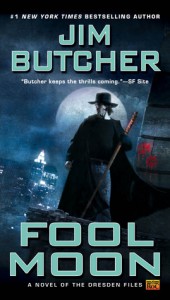
Fool Moon by Jim Butcher

Posted April 5, 2013 by Michael @ Knowledge Lost in Fantasy / 0 Comments

Fool Moon by Jim ButcherTitle: Fool Moon (Goodreads)
Author: Jim Butcher
Series: The Dresden Files #2
Published: Roc, 2001
Pages: 421
Genres: Fantasy
My Copy: Personal Copy

Buy: AmazonBook Depository (or visit your local Indie bookstore)

Harry Dresden is Chicago’s only professional wizard, so when another unusual murder happens it’s not surprised that Dresden will be dragged into the middle of it. Lt. Murphy calls on Dresden when a henchman is found murdered near a group of wolfish paw prints. A brutally mutilated corpse. Strange-looking paw prints. A full moon. Take three guesses and the first two don’t count…

Shortly following the events from Storm Front, Dresden is back to save Chicago from yet another evil force. You get the idea of how this series is structured but while this is purely escapist fiction there is something about these novels that makes me want to keep reading. While I’ve always said I’m not a fantasy fan, I do like the urban fantasy/noir style novels and Harry Dresden is probably the best protagonist I’ve found in these books.

With a new monster, it does not mean that this book will be exactly the same as the previous but the plot style does seem very much so, but it is developing characters that really stuck with me. There is this hidden desire within Dresden to use dark magic, almost like an inner sociopath just waiting to be unleashed. This is what attracts me to these series the most; I’m just waiting to see what other dark secrets we can discover about Harry Dresden while he battles the inner turmoil between good and evil.

The growing relationships between journalist Susan and Murphy are coming along nicely as well, I’m expecting one or both of these relationships to combust and I like the fact that Jim Butcher has let this slowly develop without playing his cards too soon. As for the plot; this is pretty average. Comparing Fool Moon with Storm Front, I can say this is the weaker of the two and I hope that Jim Butcher does offer something a little more in the series or I don’t think I will make it through all of them.

In between reading Storm Front and Fool Moon I watched the 2007 TV adaptation of the series which don’t seem to have any connection to the novels apart from the characters, but now I can’t help but think of Harry Dresden as looking like Paul Blackthorne. Its weird to have an English man, play a Chicago wizard in a Canadian TV show, but I think he portrayed Dresden so well that he is who I picture when reading Fool Moon.

I hope book three, Grave Peril is an improvement and offers something for me to keep reading. I don’t mind a bit of escapist fiction after reading something overly deep or dense. I have Grave Peril on my shelf so I will give it a go but if it is too much like Fool Moon, I think this is where I will leave the series. I don’t want to invest in another twelve books if it offers nothing more than just a new book, new villain situation.