Tag: fantasy

Top Ten Tuesday: Most Intimidating Books

Posted July 2, 2013 by Michael @ Knowledge Lost in Top Ten Tuesday / 0 Comments

I don’t normally participate in Top Ten Tuesday, which is a book blogger meme that is hosted by The Broke and the Bookish. But due to not having a post planned today and the fact I couldn’t resist the topic today, I thought ‘why not’. I suspect most people are going to go for the big classics that people expect you to read, so I thought I might add some other books too. So in no particular order;

10. Twilight by Stephenie Meyer
Have you seen Liberal Arts? There is a scene where Jesse (Josh Radnor’s character) decided to read an unnamed popular vampire novel (Twilight) just so he can properly see what is wrong with it. I feel like I might have to do the same.

9. The Lord of the Rings by J.R.R. Tolkien
I don’t really enjoy reading Fantasy, so I’m not looking forward to these high fantasy novels.

8. Birdsong by Sebastian Faulks
I watched the miniseries and was so bored, but that could be because Eddie Redmayne has no facial expressions.

7. Jasper Jones by Craig Silvey
I’m expecting that my experience to this book will be similar to that of The Book Thief. Everyone loves it and I’ll think it was overrated.

6. Anything by D.H. Lawrence
After my hatred for Lady Chatterley’s Love I’m too afraid to try this author again.

5. Finnegans Wake by James Joyce
Have you tried to read this one?

4. Catching Fire by Suzanne Collins
I was satisfied with the ending of The Hunger Games, I don’t feel the need to continue except there is a movie coming out.

3. Atlas Shrugged by Ayn Rand
Heavy stuff, but someone’s got to read it.

2. The Pillars of the Earth by Ken Follett
My wife loves this book and I don’t want to end up hating books she loves (see Outlander)

1. In Search of Lost Time (Remembrance of Things Past) by Marcel Proust
Long and unfinished, I’m not sure what to expect from this one.


ArmchairBEA 2013: Blogger Development & Genre Fiction

Posted May 29, 2013 by Michael @ Knowledge Lost in ArmchairBEA / 26 Comments

armchairBEADay two here at Armchair BEA and we are talking blogging and genre fiction. This could be interesting; I can’t wait to see what people say about both topics. When it comes to blogging I take this serious; it’s not that I want to become a professional and earn money (sure that would be nice but I want to treat this as a hobby, I’d love to get paid for doing what I love but I’m happy to have fun) I just like things organised and looking good. I’m not entirely happy with the way my blog looks but I think I lack the coding and graphic design skills to fix it so I leave it the way it is. Now when it comes to blogging platforms, I’m an elitist and think a self published wordpress blog is the only way to go; it is the only way to be flexible and professional. I’ve also recently discovered this amazing plugin thanks to The Oaken Bookcase which has been a book blogging lifesaver (after the hours spent going though older posts to fill in the information) so if you are on wordpress.org check it out.

Last year I wrote a Top Tips for Book Blogging post as part of Armchair BEA but think time I think I would just like to share my goals for this blog which should lead into the talking about genre fiction. This blog originally started as a way to document my reading journey, I’ve always thought my target audience is me and any other readers are just added bonuses. Now I want to be a literary explorer, I don’t want to get tied into only reading one genre, so before I started this blog I started a Goodreads book club also called Literary Exploration  in which we try to read different books in different themes and genres. Now this is all voted on so sometimes I think the book club can get a little stuck on reading cannon books but it is a lot of fun and still takes me out of my comfort zone. This led to the Literary Exploration Reading Challenge where we challenged people to read a book from different genres. This has had such a positive result that I think it will become a yearly challenge (with some fine tuning) and I hope it will continue to push people out of their comfort zones.

Now I like to read literary books but I do enjoy some good hard crime (hard-boiled and noir) but as a literary explorer I have to force myself to read all genres. I really struggle with Fantasy (not so much urban fantasy), Romance, Erotica, Chick Lit, Paranormal and Young Adult fiction but I really try. I think it is important to be willing to try other genres because there are always great books to experience and if we are not willing to try we end up missing books that could become our next loved book. A recent example of this for me was The People of Forever Are Not Afraid by Shani Boianjiu, I expected Young/New Adult but I got so much more for the book.

ArmchairBEA is a virtual convention for book blogger who can’t attend Book Expo America and the Book Blogger Convention. Banner by Nina of Nina Reads and button by Sarah of Puss Reboots


Guards! Guards! by Terry Pratchett

Posted May 16, 2013 by Michael @ Knowledge Lost in Fantasy / 0 Comments

Guards! Guards! by Terry PratchettTitle: Guards! Guards! (Goodreads)
Author: Terry Pratchett
Series: Discworld #8
Published: Orion, 1998
Pages: 317
Genres: Fantasy
My Copy: Borrowed from a Friend

Buy: AmazonBook Depository (or visit your local Indie bookstore)

The Unique and Supreme Lodge of the Elucidated Brethren of the Ebon Night is a secret organisation that plans to overthrow the Patrician and install a king of their choosing; a puppet under the control of the Supreme Grand Master. Using a stolen magic book to summon a dragon on the people of Ankh-Morpork, the plan is to slay the dragon, rid the city of its tyranny and have their hero take the throne.

Guards! Guards! attempts to parody Hard-Boiled and Noir novels with elements of police procedurals but there is one thing that really doesn’t match this style. Guards! Guards! is writing in third person with an omniscient and reliable narrator, this really seems weird since the style of novel it is trying to parody is often first person and unreliable. I’m not sure if it is the fact that all Terry Pratchett novels are written in the same style but it really didn’t help me connect with the novel, let alone notice most of the parodies.

This is a simple quest plot, The Unique and Supreme Lodge of the Elucidated Brethren of the Ebon Night obviously want to take over the throne but there are a few other plotlines that are on a quest for power. Wonse (The secretary to the Patrician) had power; he could make commands and have them carried out and he quite enjoyed that. Now he has lost this power, he wants it back. The Patrician wishes to hold onto his power as the ruining king, ultimately his calm demeanour is what aids him through the tyranny.

One thing I thought was difficult about this book was the language; while this novel uses modern language there is a lot of in world slang that took a while to get used to. There was an incident where a character got intoxicated and the words started being misspelt for emphasises. This can be effective but you don’t find out this is due to his intoxication till you read through some of his gibberish. Sometimes the language can be effective like when Death speaks, he only uses capital letters and when the dragons are speaking they use italics. Overall it just took so much to get used to. If you are a reader of the Discworld series, this might not seem too difficult but for an outsider like me it really affected my enjoyment of this novel.

This novel wasn’t broken into chapters; it’s just three hundred plus pages of continuous story. I’m not really sure the reason behind this, but the only way the novel switches between the plot and subplot are paragraph breaks. I’m not saying it is necessarily a bad thing but when you want to put the book down, I think it makes it hard to find a decent stopping place.

I’ve been very vocal about my struggle to connect with fantasy novels; I discovered I do enjoy the urban fantasy/noir blends (The Dresden Files, Bobby Dollar series) so I thought maybe this would be similar. Sure this book was funny and some of the parodies worked really well but it missed any crime element to really work for me. To make a good fantasy/noir blended novel, I think it needs to be a lot darker, with some cynical elements; it doesn’t necessarily need a crime but a quest that will cause an inner struggle within the protagonist will help.

If someone has a suggestion for a decent fantasy novel with some noir elements to it, please let me know. Guards! Guards! is a very funny fantasy novel; this is the second Discworld novel I’ve read and while I did enjoy them, I felt like the both lacked something. I guess I much prefer darker stories; this is just light entertainment and sometimes you need that, but it’s not a series I plan to read in its entirety.


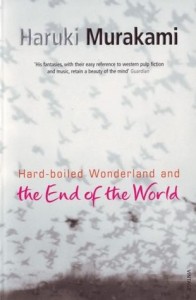
Hard-Boiled Wonderland and the End of the World by Haruki Murakami

Posted April 29, 2013 by Michael @ Knowledge Lost in Book of the Month, Literary Fiction, Magical Realism / 0 Comments

Hard-Boiled Wonderland and the End of the World by Haruki MurakamiTitle: Hard-Boiled Wonderland and the End of the World (Goodreads)
Author: Haruki Murakami
Translator: Alfred Birnbaum
Published: Vintage, 1985
Pages: 400
Genres: Literary Fiction, Magical Realism
My Copy: Personal Copy

Buy: AmazonBook Depository (or visit your local Indie bookstore)

In the future, Tokyo remains the technology powerhouse it is today. With the major advances in technology, data security has become more valuable; problem is all codes can be broken if you know how. The Calcutec is a human data processor/encryption system who has been trained to use his bio-algorithms implant and subconscious for encryption. A new comer to a strange, isolated walled town known as “The End of the World” is assigned a job as a dream reader. As he finds acceptance within the town, his mind begins to fade; or has it only been suppressed?

Hard-Boiled Wonderland and the End of the World tells the story of a split between two parallel narratives from different worlds. The consciousness and the unconscious mind; “Hard-Boiled Wonderland” refers to The Calcutec’s life as an encryption machine while “The End of the World” is his subconscious world. The two stories are told in alternating chapters as the reader slowly discovers the mysteries connecting these two worlds together. Hard-Boiled Wonderland is a homage to Raymond Chandler and hard-boiled fiction, as well as to science fiction and cyberpunk and “The End of the World” has similarities to Franz Kafka’s The Castle.

The major theme within this book is the nature of consciousness; both narratives are constructed around this general idea. While the odd numbered chapters refer to the conscious mind and the even-numbered chapters the subconscious, it is interesting to note they link together with similar themes; for example the song Danny Boy appeared in consecutive chapters. Even characters are shared between consciousnesses; the object of the narrator’s desire, the librarian is a perfect example of this.

Beyond that, the concept of subconscious being able to be controlled or shaped plays out in the entire book. This brings me to another major theme within this novel; the morality of science. The scientific experiments been done on the narrators mind in the attempt to separate the conscious and the subconscious in an attempt create more secure encryptions is an interesting topic. It reminds me a little of Frankenstein when it looks at the dangers of science and its moral implications. The Professor’s experiment killed about twenty people and while he feels remorse for the tragedy he also feels like it was the right choice in the name of progress.

While there are many more themes that would be interesting to explore I wanted to look at character. In both narratives there are no names for any of the characters, each is referred to by their occupation or a general description; from the Narrator, known as The Calcutec, the Librarian, the Old Man, the Professor, the Big Guy and the Chubby Girl. I never really payed too much attention to this while reading the book but referring to a girl as “the Chubby Girl” did bother me; it wasn’t till the very end that I was bothered by the lot. I couldn’t understand why this book was so frustratingly vague and incomplete with character and setting descriptions, I don’t know what the reason behind it would be, except for maybe removing any obstructions that might hinder the understanding of the novel.

Even the narrative is offering a very limited view of what is actually happening but slowly most of the mysteries do become clearer but the entire focus was on the subtext of this book. This wasn’t meant to be about great characters or scenes; this was all about exploring the themes as a way to get Haruki Murakami’s thoughts on the subject across. In a sense, this is what Murakami excels at; if it wasn’t for these well thought out ideas his books would just be odd and weird. This is my second Murakami novel and the first one I’ve actually enjoyed.

I’ve finally discovered what makes Haruki Murakami an author to take notice of; I didn’t find the same thing with 1Q84, I thought it was long winded and repetitive but Hard-Boiled Wonderland and the End of the World really worked for me. I have some issues with the novel, obviously the vagueness was one of the major ones, but overall this was a really interesting journey for me.


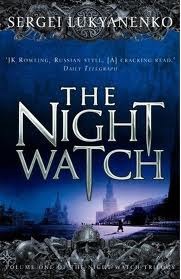
The Night Watch by Sergei Lukyanenko

Posted April 13, 2013 by Michael @ Knowledge Lost in Fantasy / 0 Comments

The Night Watch by Sergei LukyanenkoTitle: The Night Watch (Goodreads)
Author: Sergei Lukyanenko
Translator: Andrew Bromfield
Series: Watch #1
Published: Arrow, 1998
Pages: 576
Genres: Fantasy
My Copy: Library Book

Buy: AmazonBook Depository (or visit your local Indie bookstore)

Walking the streets of Moscow with the rest of the population are the Others, possessors of supernatural powers capable of entering the Twilight, a shadowy parallel that few know exists. Each Other owes allegiance to the Light or Dark side, The Night Watch follows Anton, a young Other of the Light, who must patrol the streets protecting ordinary people from the vampires and magicians of the Dark.

I’ve been trying more and more fantasy (in my quest to be a literary explorer) and with the success of some recent urban fantasy and The Lions of Al-Rassan, I thought I might try some Russian fantasy. This novel revolves around a confrontation between two opposing supernatural groups; the Night Watch, an organisation that polices the actions of the Dark Others, and the Day Watch, who police the Light Others. Now to help wrap your head around the novel, I first must explain just what are the Others; these are humans that while they live into the real world they can step into the Twilight (the supernatural world). Why do the Watch need to help police these two sides? The balance between Light and Dark must be kept at all times.

I thought my love of Russian literature would help me through this novel but in the end there was no saving this one. While the premise was excellent and the whole battle between good and evil in a police procedural type urban fantasy novel can really work (see The Dirty Streets of Heaven) but not in this book. Straight off the bat the whole book took a very long time to build momentum, I think I was a quarter of the way through the book when I started to enjoy it then Bam! a completely new story. Turns out these are three completely independent stories and each one of them was a very slow burn that ended too quickly. My major problem with the entire book that I had to spend so much time building the story then finally getting sucked into the plot only to have it end too soon.

There were so many interesting elements worth exploring, I would have liked to see more of the Post-Soviet Russia that this book (like most modern Russian literature) hints at but regrettably never really explored. Russia has this amazingly rich history that has sparked so many great novels and authors and I truly think Sergei Lukyanenko could be one of them with some work. Like Dostoyevsky, Lukyanenko tries to inject the novel with philosophical ideas on morality and this could have really worked in his favour had he stuck with one story right through to the end.

Personally I think Sergei Lukyanenko did not do himself any favours by dividing this book into three short tales; none of them really stood out and I really think the first of the three had the most potential if he explored it in greater detail and developed a more complex plot. The tension between Anton and Kostya Saushkin could have made for some really interesting philosophical discussion on morality, evil and the effects it has on the world around you. Plus the sexual tension between the two didn’t hurt either but that is when this short story ended abruptly. I felt disappointed at the miss opportunity.

The Night Watch really didn’t work for me; there was so much it could have done but I feel it shot itself in the foot when anything complex started to surface. On the front of the cover was a blurb that said “J.K. Rowling Russian style” which feels like a marketing ploy that I doubt it did itself any favours; it does not make me want to read the Harry Potter series. The second book in the pentalogy of Watches is called Day Watch which intrigues me but because it is broken into little stories as well, I think I will give it a miss. The Night Watch has left me with the need to explore some more of Sergei Lukyanenko’s novels but this is his most recent series, which makes me worry that he has not perfected his craft.


The Lions of Al-Rassan by Guy Gavriel Kay

Posted April 10, 2013 by Michael @ Knowledge Lost in Fantasy / 2 Comments

The Lions of Al-Rassan by Guy Gavriel KayTitle: The Lions of Al-Rassan (Goodreads)
Author: Guy Gavriel Kay
Published: Harper Voyager, 1995
Pages: 548
Genres: Fantasy
My Copy: Personal Copy

Buy: AmazonBook Depository (or visit your local Indie bookstore)

The peninsula of Al-Rassan has been split into three kingdoms; formerly under Jaddite control and known as Esperana. The split between the three Jaddite factions in the north and some Asharite kingdoms in the south makes for a volatile relationship of political and religious indifferences. The book centres on three protagonists from different races; Jehane bet Ishak, a Kindath physician in Fezana; Rodrigo Belmonte, a Jaddite captain of a company of cavalry and Ammar ibn Khairan, an Asharite poet, mercenary,
and advisor to King Almalik of Cartada.

The major theme I found in this book was one of religious indifference; the three main kingdoms in this book are actually based on the three major religions, the Kindath, based on the Jews; the Asharites, based on the Muslims; and the Jaddites, based on the Christians. The problem I had with this novel, it becomes incredibly confusing and hard to keep up; you practically have to keep a graph to remember which person is from where and what religion they are based on. I think one of the hardest things with High Fantasy is that all the weird names, races and everything else makes it too confusing.

This is a really complex story and even without the religious metaphors, you still have to have wrap your head around the medical practices of Jehane bet Ishak and all the other physicians in Al-Rassan. As well as military strategies mentioned by Rodrigo Belmonte, Ammar ibn Khairan and King Almalik of Cartada, plus many more overly thought out issues that Guy Gavriel Kay decides to inject into this novel. Luckily this world is the basis of some of his books so while he loves his metaphors, all the world building should translate into his other books.

The world is based around Moorish Spain which helps put the architecture and people’s behaviours into perspective. Even some of the characters are based loosely on Moorish historical figures such as El Cid and Ibn Ammar. Historical fantasy is apparently the genre type for The Lions of Al-Rassan but I cannot say that I have ever heard of this genre type but with a little bit of research I have since found out it is a pretty common sub-genre. Blending elements of the historical into a high fantasy setting and sometimes adding a mystical thread, this genre mixes elements of alternative history but sets it in a completely different world (with common elements); One Thousand and One Nights being the most known novel within the genre.

While this really is not my type of novel, I sometimes felt like the plot was not moving fast enough and other times felt completely lost, The Lions of Al-Rassan somehow managed to keep me. I give full credit to Guy Gavriel Kay’s writing style; the language and the similes helped paint a beautiful scene and overall story. Then the conflict between Jews and Muslims and Christian metaphor was really what interested me the most and kept me going. While fantasy has never been a strong suit for me, it really felt like a template just to explore the author’s thoughts on something so complex and misunderstood as religion. You can see the similarities between the factions and exploring this volatile world from a military strategy perspective really spotlights the political roadblocks that stand in the way for harmony.

This really ended up being something much more than I expected. Proving high literature can be found in any genre. If I had the time and knowledge, I think this would be a great book to pick apart and explore, though that would require deep looks into the theology of the three religions, history of Moorish Spain as well as military strategies. I am sure there must be an academic out there that took the time to look at this book but for me, I just enjoyed my brief visit to the world of Al-Rassan.


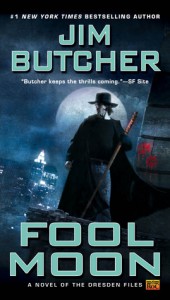
Fool Moon by Jim Butcher

Posted April 5, 2013 by Michael @ Knowledge Lost in Fantasy / 0 Comments

Fool Moon by Jim ButcherTitle: Fool Moon (Goodreads)
Author: Jim Butcher
Series: The Dresden Files #2
Published: Roc, 2001
Pages: 421
Genres: Fantasy
My Copy: Personal Copy

Buy: AmazonBook Depository (or visit your local Indie bookstore)

Harry Dresden is Chicago’s only professional wizard, so when another unusual murder happens it’s not surprised that Dresden will be dragged into the middle of it. Lt. Murphy calls on Dresden when a henchman is found murdered near a group of wolfish paw prints. A brutally mutilated corpse. Strange-looking paw prints. A full moon. Take three guesses and the first two don’t count…

Shortly following the events from Storm Front, Dresden is back to save Chicago from yet another evil force. You get the idea of how this series is structured but while this is purely escapist fiction there is something about these novels that makes me want to keep reading. While I’ve always said I’m not a fantasy fan, I do like the urban fantasy/noir style novels and Harry Dresden is probably the best protagonist I’ve found in these books.

With a new monster, it does not mean that this book will be exactly the same as the previous but the plot style does seem very much so, but it is developing characters that really stuck with me. There is this hidden desire within Dresden to use dark magic, almost like an inner sociopath just waiting to be unleashed. This is what attracts me to these series the most; I’m just waiting to see what other dark secrets we can discover about Harry Dresden while he battles the inner turmoil between good and evil.

The growing relationships between journalist Susan and Murphy are coming along nicely as well, I’m expecting one or both of these relationships to combust and I like the fact that Jim Butcher has let this slowly develop without playing his cards too soon. As for the plot; this is pretty average. Comparing Fool Moon with Storm Front, I can say this is the weaker of the two and I hope that Jim Butcher does offer something a little more in the series or I don’t think I will make it through all of them.

In between reading Storm Front and Fool Moon I watched the 2007 TV adaptation of the series which don’t seem to have any connection to the novels apart from the characters, but now I can’t help but think of Harry Dresden as looking like Paul Blackthorne. Its weird to have an English man, play a Chicago wizard in a Canadian TV show, but I think he portrayed Dresden so well that he is who I picture when reading Fool Moon.

I hope book three, Grave Peril is an improvement and offers something for me to keep reading. I don’t mind a bit of escapist fiction after reading something overly deep or dense. I have Grave Peril on my shelf so I will give it a go but if it is too much like Fool Moon, I think this is where I will leave the series. I don’t want to invest in another twelve books if it offers nothing more than just a new book, new villain situation.


Miss Peregrine’s Home for Peculiar Children by Ransom Riggs

Posted February 26, 2013 by Michael @ Knowledge Lost in Young Adult / 0 Comments

Miss Peregrine’s Home for Peculiar Children by Ransom RiggsTitle: Miss Peregrine's Home for Peculiar Children (Goodreads)
Author: Ransom Riggs
Series: Miss Peregrine #1
Published: Quirk, 2011
Pages: 352
Genres: Young Adult
My Copy: Personal Copy

Buy: AmazonBook Depository (or visit your local Indie bookstore)

Sixteen year old Jacob Portman goes to Wales on a search to find out the truth about his Grandfather’s past and unbelievable demise. There he meets Emma, a “strikingly pretty” girl who not only knows Jacob’s grandfather but can control fire. She takes Jacob to meet Miss Peregrine, who, accompanied by some very Peculiar Children, is stuck in a time loop set back in 1940, throwing Jacob into a mysterious situation full of strange killings and peculiarity.

What really stood out to me in this book was the real dark and almost gothic feel to the plot, this mixed with vintage photographs, setting and great characterisation makes for a refreshingly new style of YA novel.  Ransom Riggs seems to take the paranormal YA novel to a whole new level, putting other writers to shame with his unique blend of paranormal and character development. It was just a wonderful eccentric read and the vintage photographs were a nice touch; you feel like you know these characters and then you can look at the photos of them.

I think this is a cliché but for a debut novel, Ransom Riggs has shown great skill and love for his craft, developing a beautiful and slightly weird world. Riggs has stated there will be a sequel and I, for one, am looking forward to returning to this world and seeing where Jacob’s adventures will take him. This book has that dark and gloomy feel about it, almost like a horror movie, but yet the story never feels like it will become too dark. To give you an idea of the type of novel this is, 20th Century Fox are planning to adapt it into a film and want Jane Goldman (Stardust, Kick-Ass,  X-Men: First Class) to write the screen play and have Tim Burton (Edward Scissorhands, The Nightmare Before Christmas, Sweeney Todd) direct.

For people that like a little darkness in their YA novels this is a book you should check out. I’ve never been a fan of paranormal novels but this is just a perfect example of the genre being done well. The mystery, the characters, setting and plotting all come together to make this a great YA novel. I’m excited for the sequel and the film adaption.


Mr Penumbra’s 24-Hour Bookstore by Robin Sloan

Posted January 16, 2013 by Michael @ Knowledge Lost in Crime, Fantasy / 0 Comments

Mr Penumbra’s 24-Hour Bookstore by Robin SloanTitle: Mr Penumbra's 24-Hour Bookstore (Goodreads)
Author: Robin Sloan
Published: Text, 2012
Pages: 288
Genres: Crime, Fantasy
My Copy: Personal Copy

Buy: AmazonBook Depository (or visit your local Indie bookstore)

Clay Jannon is a 26 year old who finds himself looking for a new job thanks to the economic meltdown. He finds it at Mr Penumbra’s 24-Hour Bookstore, working the late shift. But Clay soon finds out that there is more to this bookstore than the question of how it is possible it remains in business. Mr Penumbra’s 24-Hour Bookstore will take you on a literary adventure of complex codes and a global conspiracy.

This will be a hard book to review without giving away any spoilers but I will try my best. Mr Penumbra’s 24-Hour Bookstore starts off as an exciting mystery when Clay begins his new job and is faced with a lot of unanswered questions. But I soon found myself being bored with what was happening and almost quit. It did change its gears when Clay has found out what is going on and the adventure begins. Though I think it was a little too late to fully revive this novel for me.

I do like the way Robin Sloan blended mystery and literature together but honestly he really lacks the skills to turn this into something as good as The Shadow of the Wind. I will say that the novel does display a glimpse at a possibly great career. I found myself thinking the adventure elements of this book were too generic and predictable but that doesn’t mean I didn’t enjoy reading it.

There is a love story in the novel but it wasn’t a romance between Clay and Kat. Sure that was there, but that was just a predictable boy meets girl and nothing ever goes wrong with their relationship. That isn’t worth mentioning, the love story I’m talking about is the love that author Robin Sloan has with Google; the whole book reads like a love letter to Google. The characters didn’t have to try and solve anything; they just need Google to solve all the mysteries of this book.

I haven’t mentioned the characters in the book because they felt very one dimensional; there was nothing complex about them and everything felt too neat. Sloan might have a career in thriller adventure novels but I think he really needs to learn how to make the characters flawed and realistic. I’m sure if another book of Sloan’s catches my attention I will read it but Mr Penumbra’s 24-Hour Bookstore failed to excite me the way it should have. I like books about books but maybe my expectations were a little too high.


Introducing The 2013 Literary Exploration Reading Challenge

Posted December 15, 2012 by Michael @ Knowledge Lost in Literature / 52 Comments

logoAs the year starts to come to a close, we readers start to think about what we would like to read next year and for some of us, we look for the reading challenge that excites us the most. As most people know, Literary Exploration tries to explore all different genres in the hope to become a well-rounded reader and even discover something new. So in 2013 we would like to challenge you to explore further.

Instead of increasing the book club to two books a month we decided we wanted people to read what they wanted to read; but we also want people to explore. So we are challenging everyone to dedicate either 12, 24 or 36 books that you would normally read to different genres. We have compiled a list which hopefully will give you a chance to explore literature a little deeper.

It’s real simple; below you will see an easy (12 books), hard (24 books) or insane (36 books) challenge. Each genre links to the Goodreads genre page if you need some suggestions on what to read. We want you to have some fun and explore; hopefully you might find a new genre that peaks your interest. To sign up either join the Literary Exploration book club on Goodreads and talk about your progress with others involved or for the bloggers out there, if you want to add it as part of your blogging experience simply let us know with a link (to your Literary Exploration Challenge page) in the comments below so our readers can see how you are going.

This is the first year doing this and if all goes well we might expand and make it a yearly challenge. If we do decide to do this on a yearly basis and you feel that there are some genres are either too heavily focused on or not mentioned at all, please let me know. The idea of this challenge is to have a well-balanced list of genres and not focusing on one genre more than any others.

Good luck all who decide to join in. I personally am going to go for the 36 book, insane challenge and I’m really looking forward to it. While there are some genres I’m not looking forward to reading, it’s all part of being a literary explorer. What could be wrong with that?

Read More