Tag: hard-boiled

Miami Blues by Charlies Williford

Posted August 27, 2013 by Michael @ Knowledge Lost in Pulp / 0 Comments

Miami Blues by Charlies WillifordTitle: Miami Blues (Goodreads)
Author: Charlies Williford
Series: Hoke Moseley #1
Published: Penguin, 1984
Pages: 284
Genres: Pulp
My Copy: Paperback

Buy: AmazonBook DepositoryKindle (or visit your local Indie bookstore)

After landing in Miami, Freddy Frenger Jr. (or Junior as he prefers to be called) steals three wallets and begins to plan his new life. While leaving the airport he snatches a suitcase and leaves a corpse of a Hare Krishna behind. Detective Hoke Moseley is on the case; chasing Junior and his new hooker girlfriend through luxury hotels and the suburban streets of Miami.

If this sounds really familiar then you’ve probably seen the 1990 movie of the same name starring Alec Baldwin and Jennifer Jason Leigh. While there are some major differences to the two, the majority of the book is exactly the same. I’m a little disappointed when I found out this was the first in the Hoke Moseley series, because I always thought of the detective as a supporting role. In the movie Junior steals Moseley’s badge and starts pretending to be a cop to con people; this was the best part of the movie. Sadly in the book there isn’t much of that going on.

Charlies Williford is an author of fiction, poetry, an autobiography, and literary criticism but he is best known for his hard-boiled writing. I think it is weird that he was a poet and literary critic as well as pulp writer, but then again I really shouldn’t be. It’s just an interesting fact about the author.  When you think 1980’s hard-boiled novels, Miami Blues is probably going to be one of the top nominations on that list. Charlies Williford was such a prolific writer, with over forty novels published, it is kind of sad that he is best known for the Hoke Moseley series that he wrote very late in his life. I wonder what some of his other books were like, there seems to be a whole lot of hard-boiled novels in the 1950’s and 1960’s that look interesting.

This book is an example of the noir sub-genre Florida glare which is basically a crime novel set in Florida where the heat and the culture play a role in the story as well. Noir is typically associated to LA and there have been some writers out there that wanted to depict Florida as the perfect location for crime stories as well. Some examples of this include the Travis McGee (by John D. MacDonald), Jack Ryan (by Elmore Leonard), and Dexter Morgan (by Jeff Lindsay) series and I’m sure many more. It is an interesting concept though do we really need another genre? I like how the heat of Florida plays a part in the book and the environment is almost like a supporting character.

This was a quick read and one of the rare cases where I think I prefer the movie over the book. I wonder if there are any more noir novels where a character pretends to be a cop in order to con people; I’m sure there are plenty out there, I like the concept and would like to read more of them. I think I’ll have to try another Charlies Williford, maybe something earlier. Does anyone want to recommend me a good Charlies Williford novel?


Fadeout by Joseph Hansen

Posted August 18, 2013 by Michael @ Knowledge Lost in Pulp / 9 Comments

Fadeout by Joseph HansenTitle: Fadeout (Goodreads)
Author: Joseph Hansen
Series: Dave Brandstetter #1
Published: University of Wisconsin Press, 1970
Pages: 187
Genres: Pulp
My Copy: Personal Copy

Buy: AmazonBook DepositoryKindle (or visit your local Indie bookstore)

Dave Brandstetter is an insurance investigator who is hired to investigate a death claim of a local celebrity, whose car plunged off a bridge in a storm. In the absence of a body the insurance company needs to send their own investigator before handing over $150,000 (works out to be about $900,000 by today’s standards). As the investigation continues Brandstetter is convinced that Fox Olson is still alive and he must find him before the would-be killer does.

Dave Brandstetter embodies the tough, no-nonsense persona of most classic Hard-boiled detectives with one major difference; he’s openly gay. As most people know, I have a love for the hard-boiled detective and I’m always looking for new and interesting takes on this genre. I’ve found that in Joseph Hansen’s Fadeout. There are a few reasons why I plan to continue the series and I thought rather than talk about the book, it would be nice to mention what will make me continue with the other eleven novels.

First of all, I’ve never read a pulp novel like this before; a homosexual protagonist would have been controversial in 1970. This would have been near the beginning of the gay pride movement and Hansen must have gone through a lot of hardship with writing this character and being a homosexual as well. With all the stigma and prejudices towards homosexuality back then (and let’s face it, it’s still around today) it was refreshing to see a protagonist who is proud and comfortable with his sexuality (I get sick of seeing homosexuals in literature being portrayed as unstable or disturbed) .

From the very first page of Fadeout, we find out that Dave Brandstetter has just lost a long term partner to cancer, so now we have this fresh new angle as well. Joseph Hansen has been quoted in saying the following about this topic;

“There was room in the form to say important things about men and women and how they cope with life.”

So we have this protagonist that is both tough as nails and maybe cynical of life after this tragic loss but we also get to watch him deal with his grief. Throughout Fadeout you witness Dave Brandstetter struggle with loneliness, sexual desire and even alienation and you really get an idea of just how hard it must be for him. It’s something I don’t think I’ve seen in a hard-boiled novel before and it seems to work really well, I feel for Brandstetter and have a better understanding of just what makes this man tick and that connection makes me want to continue the series.

Lastly, something I didn’t see too much of in Fadeout but I feel like this would be an element that Joseph Hansen would work into the series; I can see it coming. Dave Brandstetter is an insurance investigator, in most hard-boiled novels you have the detective hired by someone close to the victim to solve the puzzle. In this series you have the investigator working against the people; working for the insurance company. Mix that with people’s prejudices and you have a protagonist that will have to struggle to solve any mystery because people will close up and refuse to talk to the man. I like the whole idea; sort of like an anti-hero, he wants to solve the crime or mystery but he has the best interest of the insurance company in mind and not the people. If Hansen uses this throughout the rest of the series, it could really open it up to some interesting and new situations.

Judging by the difficulty of getting a hold of this book, I’m inclined to think this series is cult classic but then you look at the blurbs on the book and think this is a series I should have known about and really is a classic in its own right. I’m sure it will be difficult to get a hold of the other eleven books but I think it will be worth the effort. I want to see if my predictions are correct and also see what Joseph Hansen does with the series. Highly recommend Fadeout; it has the makings of a classic hard-boiled novel but then you have added elements to make it stand out.


Five Decent Film Noir Adaptations

Posted July 20, 2013 by Michael @ Knowledge Lost in Adaptations, Top 5 / 0 Comments

top-5This might be the last in a series of film adaptation posts for a while. Recently I listed ten of the worst adaptations and then five decent adaption; now for Film Noir. I’m a big fan of Hard-Boiled and Noir fiction so it’s time to look at some of the better Film Noir adaptations from these classic novels.

5. They Shoot Horses, Don’t They? by Horace McCoy

4. The Grifters by Jim Thompson

3. L.A. Confidential by James Ellroy

2. Double Indemnity by James M. Cain

1. The Big Sleep by Raymond Chandler

 I’m not going to go into too much explanation about these movies; some of them are faithful to the novel and some very different but they are all decent books and film noir classics. I could have also added The Post Man Always Rings Twice, The Black Dahlia, The Long Goodbye and even The Maltese Falcon but I didn’t want to have too many of the same author on the list. Now if you are a fan of Film noir and pulp novels, let me know what I’ve missed.


ArmchairBEA 2013: Blogger Development & Genre Fiction

Posted May 29, 2013 by Michael @ Knowledge Lost in ArmchairBEA / 26 Comments

armchairBEADay two here at Armchair BEA and we are talking blogging and genre fiction. This could be interesting; I can’t wait to see what people say about both topics. When it comes to blogging I take this serious; it’s not that I want to become a professional and earn money (sure that would be nice but I want to treat this as a hobby, I’d love to get paid for doing what I love but I’m happy to have fun) I just like things organised and looking good. I’m not entirely happy with the way my blog looks but I think I lack the coding and graphic design skills to fix it so I leave it the way it is. Now when it comes to blogging platforms, I’m an elitist and think a self published wordpress blog is the only way to go; it is the only way to be flexible and professional. I’ve also recently discovered this amazing plugin thanks to The Oaken Bookcase which has been a book blogging lifesaver (after the hours spent going though older posts to fill in the information) so if you are on wordpress.org check it out.

Last year I wrote a Top Tips for Book Blogging post as part of Armchair BEA but think time I think I would just like to share my goals for this blog which should lead into the talking about genre fiction. This blog originally started as a way to document my reading journey, I’ve always thought my target audience is me and any other readers are just added bonuses. Now I want to be a literary explorer, I don’t want to get tied into only reading one genre, so before I started this blog I started a Goodreads book club also called Literary Exploration  in which we try to read different books in different themes and genres. Now this is all voted on so sometimes I think the book club can get a little stuck on reading cannon books but it is a lot of fun and still takes me out of my comfort zone. This led to the Literary Exploration Reading Challenge where we challenged people to read a book from different genres. This has had such a positive result that I think it will become a yearly challenge (with some fine tuning) and I hope it will continue to push people out of their comfort zones.

Now I like to read literary books but I do enjoy some good hard crime (hard-boiled and noir) but as a literary explorer I have to force myself to read all genres. I really struggle with Fantasy (not so much urban fantasy), Romance, Erotica, Chick Lit, Paranormal and Young Adult fiction but I really try. I think it is important to be willing to try other genres because there are always great books to experience and if we are not willing to try we end up missing books that could become our next loved book. A recent example of this for me was The People of Forever Are Not Afraid by Shani Boianjiu, I expected Young/New Adult but I got so much more for the book.

ArmchairBEA is a virtual convention for book blogger who can’t attend Book Expo America and the Book Blogger Convention. Banner by Nina of Nina Reads and button by Sarah of Puss Reboots


Guards! Guards! by Terry Pratchett

Posted May 16, 2013 by Michael @ Knowledge Lost in Fantasy / 0 Comments

Guards! Guards! by Terry PratchettTitle: Guards! Guards! (Goodreads)
Author: Terry Pratchett
Series: Discworld #8
Published: Orion, 1998
Pages: 317
Genres: Fantasy
My Copy: Borrowed from a Friend

Buy: AmazonBook Depository (or visit your local Indie bookstore)

The Unique and Supreme Lodge of the Elucidated Brethren of the Ebon Night is a secret organisation that plans to overthrow the Patrician and install a king of their choosing; a puppet under the control of the Supreme Grand Master. Using a stolen magic book to summon a dragon on the people of Ankh-Morpork, the plan is to slay the dragon, rid the city of its tyranny and have their hero take the throne.

Guards! Guards! attempts to parody Hard-Boiled and Noir novels with elements of police procedurals but there is one thing that really doesn’t match this style. Guards! Guards! is writing in third person with an omniscient and reliable narrator, this really seems weird since the style of novel it is trying to parody is often first person and unreliable. I’m not sure if it is the fact that all Terry Pratchett novels are written in the same style but it really didn’t help me connect with the novel, let alone notice most of the parodies.

This is a simple quest plot, The Unique and Supreme Lodge of the Elucidated Brethren of the Ebon Night obviously want to take over the throne but there are a few other plotlines that are on a quest for power. Wonse (The secretary to the Patrician) had power; he could make commands and have them carried out and he quite enjoyed that. Now he has lost this power, he wants it back. The Patrician wishes to hold onto his power as the ruining king, ultimately his calm demeanour is what aids him through the tyranny.

One thing I thought was difficult about this book was the language; while this novel uses modern language there is a lot of in world slang that took a while to get used to. There was an incident where a character got intoxicated and the words started being misspelt for emphasises. This can be effective but you don’t find out this is due to his intoxication till you read through some of his gibberish. Sometimes the language can be effective like when Death speaks, he only uses capital letters and when the dragons are speaking they use italics. Overall it just took so much to get used to. If you are a reader of the Discworld series, this might not seem too difficult but for an outsider like me it really affected my enjoyment of this novel.

This novel wasn’t broken into chapters; it’s just three hundred plus pages of continuous story. I’m not really sure the reason behind this, but the only way the novel switches between the plot and subplot are paragraph breaks. I’m not saying it is necessarily a bad thing but when you want to put the book down, I think it makes it hard to find a decent stopping place.

I’ve been very vocal about my struggle to connect with fantasy novels; I discovered I do enjoy the urban fantasy/noir blends (The Dresden Files, Bobby Dollar series) so I thought maybe this would be similar. Sure this book was funny and some of the parodies worked really well but it missed any crime element to really work for me. To make a good fantasy/noir blended novel, I think it needs to be a lot darker, with some cynical elements; it doesn’t necessarily need a crime but a quest that will cause an inner struggle within the protagonist will help.

If someone has a suggestion for a decent fantasy novel with some noir elements to it, please let me know. Guards! Guards! is a very funny fantasy novel; this is the second Discworld novel I’ve read and while I did enjoy them, I felt like the both lacked something. I guess I much prefer darker stories; this is just light entertainment and sometimes you need that, but it’s not a series I plan to read in its entirety.


The Last Good Kiss by James Crumley

Posted May 12, 2013 by Michael @ Knowledge Lost in Pulp / 0 Comments

The Last Good Kiss by James CrumleyTitle: The Last Good Kiss (Goodreads)
Author: James Crumley
Series: C.W. Sughrue #1
Published: Vintage, 1978
Pages: 244
Genres: Pulp
My Copy: Personal Copy

Buy: AmazonBook Depository (or visit your local Indie bookstore)

James Crumley’s private investigator CW Sughrue finds himself searching for a runaway young woman, missing for ten years. But this is not how it started out; he was hired by a woman to find her ex-husband, Abraham Trahearne before he drinks himself to death. A confrontation in the bar that results in Trahearne being injured in hospital puts Sughrue in a position to look for this missing woman.

This hard-boiled novel is told in a way I don’t think has been done enough in a pulp crime novel. A parallel narrative exploring the problematic relationship between Sughrue and the wandering alcoholic novelist, and the three femme fatales in Trahearne’s life, just to make things more complex. Apart from that, you have the usual elements that make up a hard-boiled novel; alcohol, money, love, sex, power and violence.

Somehow James Crumley has a refreshing voice for this genre; I’m not sure if it is just that I’ve not read enough hard-boiled novels set in the seventies or there is something else there. I would put Crumley somewhere between Raymond Chandler and Jim Thompson; he doesn’t have the plotting skills and wit that Chandler has but he isn’t as violent and philosophical as Thompson. The narrative, while in a first person point of view, manages to switch between making the reader feel like they are in the same room trying to piece this mystery together, and then all of a sudden you are inside CW Sughrue head reading all his thoughts, emotions and memories. This isn’t easy to do but Crumley does this so seamlessly that you don’t really notice it happening. This narrative, mixed with the cynicism and low regard to society is what I think makes this book so refreshing.

This novel deals a lot with sex; Sughrue’s personal integrity and professional ethics are corrupted by the sexual desire towards Catherine; a desire she uses to manipulate him. Trahearne hasn’t been able to be creative because of his sexual desire with Melinda and his attraction towards his mother. Then there is Betty Sue, who just has a sexual desire towards everyone in the book. It’s important to know at the core of this books portrayal of sexual desire is the cynical belief that such corruption is unavoidable and even inevitable.

The Last Good Kiss also deals with the idea of identity and trying to escape your past, but ultimately realising you can’t run. Betty Sue hides her true self between layers of masks and other identities; she is running from her sexually exploitative time in San Francisco but it all comes back in the end. Trahearne can’t escape his infidelities, alcoholism and his ex-wife’s fury. All of them fail to realise that the past defines the present. Their mistakes in the past do not have to define their future but helps them grow; this book just ends up being a twisted celebration of life’s obstacles shaping our personality.

Admittedly I found myself being bored in parts of this book and wanting to skim read, but I persevered and found some interesting elements that stopped this from being a generic crime novel. CW Sughrue, is an alcoholic ex-army officer turned private investigator and that dark past is what makes me want to keep reading the series, just to discover what he is running from.  The Last Good Kiss has been described as the most influential crime novel of the last 50 years, influencing people like Michael Connelly, George Pelecanos, Dennis Lehane and even Neal Stephenson; that alone is an impressive reason to check this book out. While I think I prefer Jim Thompson for style and message, James Crumley is an author I plan to explore more of.


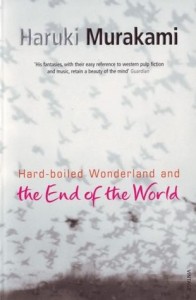
Hard-Boiled Wonderland and the End of the World by Haruki Murakami

Posted April 29, 2013 by Michael @ Knowledge Lost in Book of the Month, Literary Fiction, Magical Realism / 0 Comments

Hard-Boiled Wonderland and the End of the World by Haruki MurakamiTitle: Hard-Boiled Wonderland and the End of the World (Goodreads)
Author: Haruki Murakami
Translator: Alfred Birnbaum
Published: Vintage, 1985
Pages: 400
Genres: Literary Fiction, Magical Realism
My Copy: Personal Copy

Buy: AmazonBook Depository (or visit your local Indie bookstore)

In the future, Tokyo remains the technology powerhouse it is today. With the major advances in technology, data security has become more valuable; problem is all codes can be broken if you know how. The Calcutec is a human data processor/encryption system who has been trained to use his bio-algorithms implant and subconscious for encryption. A new comer to a strange, isolated walled town known as “The End of the World” is assigned a job as a dream reader. As he finds acceptance within the town, his mind begins to fade; or has it only been suppressed?

Hard-Boiled Wonderland and the End of the World tells the story of a split between two parallel narratives from different worlds. The consciousness and the unconscious mind; “Hard-Boiled Wonderland” refers to The Calcutec’s life as an encryption machine while “The End of the World” is his subconscious world. The two stories are told in alternating chapters as the reader slowly discovers the mysteries connecting these two worlds together. Hard-Boiled Wonderland is a homage to Raymond Chandler and hard-boiled fiction, as well as to science fiction and cyberpunk and “The End of the World” has similarities to Franz Kafka’s The Castle.

The major theme within this book is the nature of consciousness; both narratives are constructed around this general idea. While the odd numbered chapters refer to the conscious mind and the even-numbered chapters the subconscious, it is interesting to note they link together with similar themes; for example the song Danny Boy appeared in consecutive chapters. Even characters are shared between consciousnesses; the object of the narrator’s desire, the librarian is a perfect example of this.

Beyond that, the concept of subconscious being able to be controlled or shaped plays out in the entire book. This brings me to another major theme within this novel; the morality of science. The scientific experiments been done on the narrators mind in the attempt to separate the conscious and the subconscious in an attempt create more secure encryptions is an interesting topic. It reminds me a little of Frankenstein when it looks at the dangers of science and its moral implications. The Professor’s experiment killed about twenty people and while he feels remorse for the tragedy he also feels like it was the right choice in the name of progress.

While there are many more themes that would be interesting to explore I wanted to look at character. In both narratives there are no names for any of the characters, each is referred to by their occupation or a general description; from the Narrator, known as The Calcutec, the Librarian, the Old Man, the Professor, the Big Guy and the Chubby Girl. I never really payed too much attention to this while reading the book but referring to a girl as “the Chubby Girl” did bother me; it wasn’t till the very end that I was bothered by the lot. I couldn’t understand why this book was so frustratingly vague and incomplete with character and setting descriptions, I don’t know what the reason behind it would be, except for maybe removing any obstructions that might hinder the understanding of the novel.

Even the narrative is offering a very limited view of what is actually happening but slowly most of the mysteries do become clearer but the entire focus was on the subtext of this book. This wasn’t meant to be about great characters or scenes; this was all about exploring the themes as a way to get Haruki Murakami’s thoughts on the subject across. In a sense, this is what Murakami excels at; if it wasn’t for these well thought out ideas his books would just be odd and weird. This is my second Murakami novel and the first one I’ve actually enjoyed.

I’ve finally discovered what makes Haruki Murakami an author to take notice of; I didn’t find the same thing with 1Q84, I thought it was long winded and repetitive but Hard-Boiled Wonderland and the End of the World really worked for me. I have some issues with the novel, obviously the vagueness was one of the major ones, but overall this was a really interesting journey for me.


What it Was by George Pelecanos

Posted April 17, 2013 by Michael @ Knowledge Lost in Pulp / 0 Comments

What it Was by George PelecanosTitle: What it Was (Goodreads)
Author: George Pelecanos
Series: Derek Strange and Terry Quinn #5
Published: Back Bay Books, 2012
Pages: 243
Genres: Pulp
My Copy: Personal Copy

Buy: AmazonBook Depository (or visit your local Indie bookstore)

Derek Strange left the police department to set up shop as a private investigator while his old partner Frank “Hound Dog” Vaughn remained. When a young woman comes to Strange to help find a costume ring, it leads him right to Vaughn’s active homicide case. Now both of them are working together trying to find a ruthless killer known as Red Fury.

George Pelecanos is best known as a writer for The Wire; I will admit I’ve not watched the show in its entirety but I thought I will try one of his books. I picked up this book because it was accessible but soon found out it was book five in a series about Derek Strange & Frank Vaughn. Luckily enough this read like a standalone and still felt like I learnt enough about the two to enjoy this book.

This book reminds me of those 1970’s pulp movies, but I don’t think I’ve ever read a novel with that same feel. You have the typical cool, badass African American who goes around kicking ass and then you have his former partner who is as hard-boiled as they come but since he is a cop he does things by the book. This is almost like a buddy cop situation but because they are not working together it doesn’t turn into anything formulaic.

Pelecanos packs a lot of detail into this novel; the cars, the clothes and the action packed plot but most of all the music. I cannot help but wonder if George Pelecanos was obsessed with music at the time of writing this book, because it really came through. Not only does he mention songs, albums and artists but who was playing what instrument and a little review of the song according to the character. Never have I read such an obsession with music since American Psycho.

I’m not sure if Strange had an afro but I can’t imagine him any other way with his bellbottom pants; it really was an image driven novel. I think with all the work George Pelecanos did with TV helped him world build and paint a picture. There were some clunky parts of the book but nothing really that would detract from the enjoyment of Pelecanos hard-boiled style.

I want to read more books in this series, as well as try out some of his other standalone novels. While this was book five, it was enough to convince me to explore more of this author’s catalogue, but I can’t help but wonder if reading this series out of order was one of my major problems with the book. I hear many people talking about The Night Gardener, so maybe that will be my next step into George Pelecanos style.


March Violets by Philip Kerr

Posted March 24, 2013 by Michael @ Knowledge Lost in Pulp / 0 Comments

March Violets by Philip KerrTitle: March Violets (Goodreads)
Author: Philip Kerr
Series: Bernard Gunther #1
Published: Penguin, 1989
Pages: 256
Genres: Pulp
My Copy: Personal Copy

Buy: AmazonBook Depository (or visit your local Indie bookstore)

Bernie Gunther investigates the murder of the daughter of one of German’s wealthiest industrialists while the 1936 Summer Olympics play out in Berlin. Gunther is an ex-policeman that thought he had seen everything, but becoming a freelance Private Investigator has found him being sucked into the horrible excesses of Nazi subculture.

This is classic hard-boiled/noir fiction; it has the hard-hitting detective, a fast-paced plot and the everyday violence you come to expect. But this time that everyday violence comes in the forms of anti-Semitisms and the Nazi regime. The Nazi German backdrop is a great location for noir novel and makes for a whole cast of strong and interesting characters.

While the plot does need some polish, as it’s not a very strong crime plot, the interference from the Kripo and Gestapo did a great job of masking the flaws. March Violets reminds me a lot of Fatherland by Robert Harris with the concept but for me March Violets concept was much better just not as well executed.

The over used metaphors and attempts at humour really took away from the richly developed backdrop and while at times it did drag on a little, I really found myself enjoying this book. I’m not sure how well Philip Kerr researched this novel but the way he portrayed Nazi Germany felt right in my mind; the strong police state trying to play nice for the Olympic games and then the inability or unwillingness of ordinary Germans to try stop the crimes or injustices, while spending most of their time worrying about the coming war.

March Violets is the first in the Berlin Noir series and based on this book, I’m looking forward to reading the next two books. Not sure if I will continue the series after that but I will start with them. Bernie Gunther is a great protagonist with his hard hitting ways that seem like they will land him in a KZ (Konzentrationslager or Concentration camp). I’m glad I picked this book up, while there are some weak points, like I said before, they seem to be easily missed with everything else happening in this book. Well worth reading for pulp fans, it’s a fresh take on this genre.


In the Midst of Death by Lawrence Block

Posted March 14, 2013 by Michael @ Knowledge Lost in Pulp / 0 Comments

In the Midst of Death by Lawrence BlockTitle: In the Midst of Death (Goodreads)
Author: Lawrence Block
Series: Matt Scudder #3
Published: Orion, 1976
Pages: 182
Genres: Pulp
My Copy: Personal Copy

Buy: AmazonBook Depository (or visit your local Indie bookstore)

Private investigator Matt Scudder is back. This time he is on the case for NYPD cop Jerry Broadfield. While Broadfield was never going to be known as a pillar of society he was (mostly) an honest cop. But he seems to have rattled a few cages, mainly from the crook cops on the force. Now he is being set up.

Because The Sins of the Fathers was so short and I enjoyed it so much I went right into In the Midst of Death. Something I never do and that is normally because I never like to get entrenched in an author or a genre, so I always mix it up. But also because I find there are small elements that can become repetitive if you go from one book in a series to the next. While this is book three (which I originally thought was book two) Lawrence Block covers the same important information about Matthew Scudder; which is good for people reading out of order but jumping straight into this one after the first book, it felt more like a copy/paste job.

Unlicensed Private investigator is truly shaping into a great character  and even though I’ve read two books in the series so quickly and one after the other, I still want to read more, which is a real testament to Lawrence Block’s writing skills. I love Scudder’s cynical attitude and his reluctance to work; he is truly a great hard-boiled protagonist in the making.

Corruption is a tricky game and while you are meant to hate Jerry Broadfield it is interesting the way Scudder goes about this case. While this was not as strong as The Sins of the Fathers, it still worked really well. I want more insights into the psyche of Scudder because I really think there is something dark waiting to come out. After my second Block novel, I’m starting to see just why he is respected as a modern pulp author and he is quickly becoming a favourite.