Tag: hard-boiled

Guest Post: Brief Overview of Pulp Fiction – Part 1 (1930’s and 1940’s)

Posted November 25, 2012 by Guest Post in Guest Posts, Literature, Pulp / 11 Comments

In 1887 Arthur Conan Doyle created Sherlock Holmes and the success of his great detective spawned an entire genre of detective fiction that imitates to some degree or another to this date. The light-hearted and relatively straightforward approach towards solving crime reached its pinnacle in what has become known as The Golden Age of crime fiction, the 1920s and 1930s. The large majority of the authors writing in this popular style of fiction were British and this was reflected in the settings and general sense of manners contained within.

The inter-war years were a difficult time both socially and politically and this change in society saw crime fiction edge towards what was a more realistic, and more depressing tone with content that would almost certainly shock the characters found within an Agatha Christie novel. The pioneers for this movement towards realism were, perhaps unsurprisingly, Americans and this style became known as hard-boiled.

Taking its name from the style of preparing eggs that leaves the hard shell intact and the yolk fully solidified, the protagonists of hard-boiled fiction are tough skinned, street wise, sharp tongued and ready to solve a mystery with violence if necessary (and it almost always is.)

These are cops, private detectives, ordinary citizens coming up against prohibition gangsters, organised crime, crooked cops, and looking to stand up for what is morally correct. One lone man against an entire system; grown cynical and expecting the worst of people but hoping for the best, he’s the kind of guy who’s seen every horror and will surely see worse before he solves this case.
Hard-boiled is a naturalistic style of writing combined with a cynical, world-weary attitude. This evolved in to Noir fiction, a genre that is if anything even darker; it’s protagonists are usually morally suspect at best and at worst are degenerates, psychopaths and cold blooded murderers.

The most succinct and accurate definition of the difference between the two styles is this:

Noir is the world. Hard-boiled is the character. You can have Noir without the Hard-boiled, but not the other way around.

Carroll John Daly is credited with creating the first hard-boiled story for Black Mask magazine in the 1920s and his first hard-boiled novel Snarl of the Beast (1927) marks the first of, what I shall deem, the essentials of the genre. At the time Daly was the most popular author of the genre he essentially started but he has since been unfairly labelled a hack (the writers opinion only) for simply not being of the same quality as the famous authors he inspired.

Hot on the heels of Daly was Dashiell Hammett, the former Pinkerton operative turned author, who between 1929 and 1934 published the only novels he ever wrote. At least two of which are widely considered masterpieces of the genre. Red Harvest (1929) featuring the unnamed detective known as The Continental Op and perhaps his most famous work The Maltese Falcon (1930); it’s PI Sam Spade is credited as being the archetype that all other hard-boiled detectives are based on, with his personal detachment from the case and unflinching devotion to ensuring justice his strongest characteristics.

The man who would follow in his footsteps, Raymond Chandler, said of him:

“Hammett gave murder back to the kind of people that commit it for reasons, not just to provide a corpse…He put these people down on paper as they are, and he made them talk and think in the language they customarily used for these purposes.”

A more obscure name with an essential of the genre crops up next, Raoul Whitfield; his debut novel Green Ice (1930) was described by Dashiell Hammett as “280 pages of naked action pounded into tough compactness by staccato, hammerlike writing” but he never seemed to live up to his early success and retired from writing fiction only a few years later.

There are three names that everybody mentions when discussing this period of early hard-boiled American fiction. Hammett is the first, his Maltese Falcon regularly winning polls for best hard-boiled novel also, but to his name you will also find added the words Chandler and Cain.

Raymond Chandler decided to try his hand at writing after losing his job during the Depression and in the process seemed to capture America the way that America wants to be remembered. His hero is Philip Marlowe, his beat is L.A., a brave warrior in the Sam Spade mould but with a softer underbelly. In his classic debut The Big Sleep (1939) we find a PI who likes to drink, is handy in a fight and cynically wisecracks his way through most situations but this is also a man who plays chess, reads poetry and has philosophical questions playing on his mind. The generally acknowledge highpoint in Chandler’s (and Marlowe’s) career would come later with The Long Goodbye (1953) and demonstrates the literary nature of the genre, author and character.

James M. Cain on the other hand was largely active in the noir category; in his major works his characters were not detectives but men corrupted by sex and money. Double Indemnity (1943) is the story of an insurance agent who plots against his employers to get a woman and some money. The Postman Always Rings Twice (1934) features a mixture of sexuality and violence in a love triangle situation.

With the big names out of the way I will share two more important figures in the formative years of this genre that are a lot harder to find and therefore more obscure.

Cornell Woolrich, who also wrote with some success under the pseudonym William Irish, is virtually out of print today but his importance on the development of the genre remains. His work more often that not evoked despair and cynicism in the everyday life scenarios and as was the case with the bleaker examples of the genre was more popular in France than America. If you can find them, I recommend The Bride Wore Black (1940) and The Black Angel (1943) as good starting points.

Dorothy B. Hughes is another essential early noir author that few people have heard of. Her In A Lonely Place (1947) has recently been republished as a Penguin Modern Classic and quite rightly so, is a fine example of her tightly plotted and tense approach towards noir and features a truly heinous protagonist in Dix Steele. Amongst her other work The Blackbirder (1943) is a story of fear, paranoia and dread.

In Part Two I’ll be taking a look at the second generation of authors who worked during the boom in paperback fiction of the 1950s.

This is a guest post by blahblahblahtobyYou can find him discussing books on Goodreads, discussing movies on Letterboxd, tweeting nonsense as blahblahblahtoby and on his blog blahblahblahgay, feel free to say hi.

There are literally dozens of great authors and great novels that could have been suggested as essential reading for this guide. The writer of the article went through agonising decisions over who to leave out and is more than aware that your favourite author probably hasn’t been mentioned but feel free to start a discussion in the comments.

This post is part of a four post series exploring the history of Hard-Boiled and Noir Fiction, for recommendations check out each post;

The 1930’s – 1940’s

The 1950’s

The 1960’s – 1980’s 

The 1990’s – Onwards


He Died With His Eyes Open by Derek Raymond

Posted November 24, 2012 by Michael @ Knowledge Lost in Pulp / 4 Comments

He Died With His Eyes Open by Derek RaymondTitle: He Died with His Eyes Open (Goodreads)
Author: Derek Raymond
Series: Factory Series #1
Published: Serpent's Tail, 1984
Pages: 224
Genres: Pulp
My Copy: Personal Copy

Buy: AmazonBook DepositoryKindle (or visit your local Indie bookstore)

Armed with a box of tapes as evidence, the detective Sergeant sets out to solve the brutal murder of a middle-aged alcoholic who was found dumped on the city outskirts. Murder is a dime a dozen in London and Scotland Yard has more serious cases to deal with. This rogue detective is haunted by the voices on these cassette diaries which leaves him with no choice by to find out why He Died With His Eyes Open.

Book One of the Factory series follows the unnamed Detective Sergeant in his quest to solve the crime of someone the rest of the city does not care about. Part police procedural, part noir, Derek Raymond has a refreshingly new take on the pulp genre. Not only the fact that it combines procedural crime to the plot or the fact that it’s set in London, but what stood out to me is that Raymond mixed the dark hard hitting hard boiled protagonist and gave him compassion. You don’t actually see the compassion by his actions; this detective feels as hard boiled as they come, yet he seems to care about solving the crime of someone that doesn’t really matter. This is what made He Died With His Eyes Open so great.

I feel like Derek Raymond should be compared to noir legend Jim Thompson, mixing the dark and gritty with a real psychological aspect. While at times Raymond’s writing is a bit sloppy and the plot isn’t as tight as the greats, there is something quite spectacular about this novel. It feels like a normal pulp novel, but there is also something refreshingly different about this novel.

The unnamed protagonist is such a strong character, full of mystery and tough as nails. He Died With His Eyes Open is an absolute must read for pulp fans, and I must admit I’m so glad to read a crime novel like this that is not set in America. The English slang and terminology throughout this book was a joy to read. I like to see new spins in the pulp genre when they are done remarkably well, and this novel does just that. Everything you want in a deliciously dark pulp novel plus so many extras; He Died With His Eyes Open is worth getting your hands on.


Return of the Thin Man by Dashiell Hammett

Posted November 4, 2012 by Michael @ Knowledge Lost in Pulp / 0 Comments

Return of the Thin Man by Dashiell HammettTitle: Return of the Thin Man (Goodreads)
Author: Dashiell Hammett
Series: The Thin Man #2
Published: Mysterious Press, 2012
Pages: 320
Genres: Pulp
My Copy: ARC from Netgalley

Buy: AmazonBook Depository (or visit your local Indie bookstore)

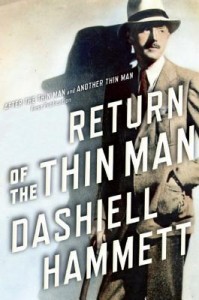
Dashiell Hammett is often referred to as one of the ‘Big Three’ when it comes to pulp fiction along with Raymond Chandler and James M. Cain. He is known for his hard-boiled novels turned film noir classics including The Maltese Falcon and The Thin Man. Return of the Thin man is a collection of two previously unreleased novellas featuring Nick & Nora Charles from The Thin Man.

While “After the Thin Man” and “Another Thin Man” have been promoted as two never before published novellas, these are basically glorified screen plays by the pulp legend. The cynical ex-detective is back along with his very cleaver wife for some more drinking, flirting and crimes. But you really need to have read or seen The Thin Man before reading this because they are sequels that relay heavily on the character development that has already taken place.

The main problem is there are no stories here; nothing to demonstrate the power of Hammett’s pulp styles. These are just scripts for cashing in on the success of The Thin Man film adaptation. I think they would have worked a lot better if they were made into movies in the 1930’s. It reminds me of the recent movie release of Taken 2; all the plot and character development was in its predecessor, it is just cashing in on the success by trying to continue the story.

As a pulp fan I was looking forward to reading this and I really wanted to love it, but I was very disappointed. This is a gimmick release, not recommended for people new to Dashiell Hammett and Nick & Nora Charles. But if you loved The Thin Man there is a slight pleasure in seeing what Hammett had planned for these characters. The Thin Man was never a favourite of mine, I do really like Nora but for someone interested in trying the author I would recommend The Maltese Falcon or my personal favourite, Red Harvest.


Mercy by Jussi Adler-Olsen

Posted October 14, 2012 by Michael @ Knowledge Lost in Crime / 4 Comments

Mercy by Jussi Adler-OlsenTitle: Mercy (Goodreads)
Author: Jussi Adler-Olsen
Translator: Lisa Hartford
Series: Department Q #1
Published: Penguin, 2011
Pages: 512
Genres: Crime
My Copy: Personal Copy

Buy: AmazonBook Depository (or visit your local Indie bookstore)

I often get worried when I pick up this Scandinavian crime novel but I recently read The Dinner and I thought I might try another Dutch author; turns out this was a Danish novel. Mercy is the first book in the series by Jussi Adler-Olsen which has been marketed for people that enjoy the show The Killing as well as Scandinavian Crime. I love this show so I wanted to give this book ago; well actually I picked up Disgrace and realised it was book two in the series so I thought I better read them in order. Mercy is the story of detective Mørck who has been put in charge of new department dedicated to trying to solve cold cases; one final attempt before they give up on the case completely. His first case is a missing person’s case; Merete Lynggaard vanished five years ago and everyone assumes she’s dead but will Mørck be able to solve this case?

It’s interesting to note that this book is also called The Keeper of Lost Causes in most countries, which is a subtle attempt at humour, to reflect what type of book you are getting into here. I’m not sure why Australia are marketing this book as Mercy but it works better for their marketing campaign to just draw on the success of the TV show The Killing. You have the usual elements that you’d find in a Scandinavian crime in this book; cold climate and dark disturbing themes but I think Adler-Olsen’s attempt at adding some light heartedness in to the mix really worked in his favour. It’s almost like a cross between a Scandinavian crime and a buddy cop movie; because Mørck’s assistant Assad really stole the show.

Department Q is a mixture of a hard-boiled style detective in Mørck and the light hearted, carefree assistant that oversteps his role and does whatever he thinks would be the most fun; Assad. Not only do the two characters have personality differences but the cultural differences as well lead to some entertaining reading. While Mørck is an interesting character without Assad this book would just be another boring, generic Scandinavian crime novel (no offense to those who like these novels, they are just not for me).

The crime and police procedural elements of this book are pretty standard, you have the typical hard-boiled character and the dark and twisted crime they are solving but it really was refreshing to read a book that takes the same style and puts a new spin on it. It has really worked well for Jussi Adler-Olsen and I truly can’t wait to read the next in the series. If it wasn’t for these characters this book would be a two star read; luckily I was really entertained with this one.


The Yiddish Policemen’s Union by Michael Chabon

Posted September 4, 2012 by Michael @ Knowledge Lost in Crime, Science Fiction / 0 Comments

The Yiddish Policemen’s Union by Michael ChabonTitle: The Yiddish Policemen's Union (Goodreads)
Author: Michael Chabon
Published: Harper Collins, 2007
Pages: 414
Genres: Crime, Science Fiction
My Copy: Personal Copy

Buy: AmazonBook Depository (or visit your local Indie bookstore)

Many people seem to enjoy Michael Chabon’s books so I was pleased when I finally had a reason to read The Yiddish Policemen’s Union. In the dark Alaskan winter in the city of Sitka, Detective Meyer Landsman’s ex-wife has just become his boss and has handing him a huge stack of old cold cases that she wants him to solve. While Landsman life may feel like it’s already hit rock bottom, he’s only just discovering the mess that he’s in; a mess that will lead to a conspiracy.

This alternative version of Sitka, Alaska in this book is a Yiddish-speaking metropolis. That was the whole basis of this book; Michael Chabon’s idea came from a book he found called ‘Say It in Yiddish’ which had sayings that he would never have a chance to use because Yiddish isn’t the primary language of any country. While toying with the idea of a hypothetical Yiddish-speaking country this book was born. The idea was Israel lost the 1948 war; the Jews established a Jewish state in Alaska.

The Yiddish Policemen’s Union is an interesting blend of Michael Chabon’s heritage with a love of old mystery novels. Chabon has called it a homage to Raymond Chandler, Dashiell Hammett, Ross Macdonald and Isaac Babel. But while the noir stylings of this book are good this book also has a satirical nature about it, with a comic look at the Yiddish language and Jewish culture. Michael Chabon originally published an essay called Guidebook to a Land of Ghosts; which he discussed some thoughts he had of the travel book Say It in Yiddish, this essay was responded with a spiteful reaction from a Jewish community. This vitriolic response only spurred Chabon on and eventually he developed the idea of this book.

While there was some parts of the book that felt like it dragged on, over all the balance between the comical and the noir seemed to work. There are some great line coming from thing book; a highlight for me was “He feels like he suffers from tinnitus of the soul.” I was really surprised with just how well the dark and gritty mystery mixed with Chabon’s satirical style. I liked the whole concept of a Jewish noir novel; it was a refreshing take on a genre that I love. Well worth checking out this alternate history novel as it is one of the best I’ve read. I hear that the Coen Brothers are looking at adapting this book into a movie; if anyone could do this book justice as a movie, it would definitely be them. I’d be interested to see if this movie ever gets made and how it translates onto the screen.


Reading Cycles

Posted June 3, 2012 by Michael @ Knowledge Lost in Literature / 0 Comments

Have you ever noticed that you read in cycles? I have; I’ve found that I tend to get entrenched with an author at times but most of the time it with genres. While I like to say I read anything and everything, I know this is not true.  I do find it interesting to look over my reading history and see just how it progresses.

I’ve said it before and most people already know that I only started reading in the middle of 2009 and while it was a slow start I gradually got better and better at reading that now I’m aiming for 100 books a year. While I would like to talk about reading challenges sometime in the future, for now I want to look at my reading cycle. I call it a cycle because I know that eventually I will go back to these genres and immerse myself with them again and again.

While I often just read on a whim, when I do an overall look at my reading habits the cycle looks like this;

  • Classics – My reading started with Frankenstein and I read a lot of classics as a way to catch up on the book I’ve missed out on. At the same time I was also trying to catch up on the Dexter series by Jeff Lindsey.
  • 1001 Books to Read Before You Die – when I discovered this list of books, I set out to read books from this list as a good way to try out genres and styles with the knowledge that the books must be good because they made the 1001 list.
  • Sci-Fi – I’m not sure why I moved onto Sci-Fi, but there were so many books that looked interesting in this genre that it felt like the natural progression.
  • Mystery – I have a love for the macabre and crime that it wasn’t much of a surprise that I begin reading a lot of books in this genre.
  • Hard-Boiled/Noir – I finally found the style and genre in the mystery/crime genre that I like the most. Hard-Boiled and Noir will always have a special place in my heart. I love the era and the style of these novels.
  • YA – I started trying out YA because of this blog post about What is Wrong with Dark YA Novels and during the time I found my favourite YA author John Green, which meant I needed to read all of his novels (still have one to read) plus other novels that are supposedly similar to his writing style.
  • Literary Fiction – I often wonder if this was a result of my book blog or just because I wanted to read something with a little more literary merit after reading so much YA. But now it feels like I’m reading so many literary novels.

I don’t know where my reading will go from here but feel free to make a prediction. I’m happy to let my reading take me where ever it wants to go. I’m happy with where it has taken me so far. I would love to know if other people have reading cycles and what they are.


The Redbreast by Jo Nesbø

Posted May 6, 2012 by Michael @ Knowledge Lost in Crime / 0 Comments

The Redbreast by Jo NesbøTitle: The Redbreast (Goodreads)
Author: Jo Nesbø
Translator: Don Bartlett
Series: Harry Hole #3
Published: Harvill Secker, 2000
Pages: 368
Genres: Crime
My Copy: Personal Copy

Buy: Amazon (or visit your local Indie bookstore)

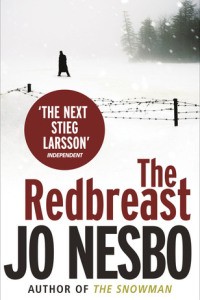
When they advertise Jo Nesbø as ‘The Next Steig Larsson’, I’m inclined to pass on this author. But since a lot of people seem to be raving about this author, I thought I better check him out, especially when they class his Harry Hole series as hard-boiled. I’ve found the only reason they are calling him the next Larsson is simply because he is another Scandinavian crime writer; which means some overly graphic murders, Nazis and an expected twist. The Redbreast is the third book in the Harry Hole novel but the first available in English. Hole is investigating neo-Nazi activity which leads him to further explore Norway’s activities on the Eastern Front during WWII.

Throughout the book it switches between telling the story of Harry Hole in 1999 and the man he is hunting Daniel Gudeson during the World War II. I like how Nesbø switched between the two times and characters to flush out the back story that was leading up to a much bigger current day threat. But that is where I stopped liking this book; I just felt this book was generic and too predictable for my liking. I want to be shocked, excited and enjoy myself when reading crime novels; one out of three just doesn’t cut it.

Now to address the genre issue; Harry Hole could be classed as a hard-boiled detective, as he drinks, smokes and seems to be a very bitter man. However, this novel seems to missing some of the elements that makes hard-boiled novels what they are; for starters where was the dark and gritty realism that I’ve come to love in pulp novels. Also the book was missing a femme fetale as well as the strong dialogue with hints of wittiness and/or irony. This felt more like the generic bestseller crime formula and if we are going to call Jo Nesbø ‘hard-boiled’,  we would have to let Michael Connelly in as well; and we don’t want that.

While this was in fact a fun book to read, I went into this book expecting something more pulp like and ended up getting generic. I’m sure there are plenty of people that will love this book, just don’t expect pulp; you’ll be sadly disappointed. If you are interested in knowing more about pulp fiction,  check out my blog entries on pulp for recommendations.


Pulp Fiction

Posted October 26, 2011 by Michael @ Knowledge Lost in Literature, Pulp / 4 Comments

Thanks to the “1001 Books to Read Before you Die” list I’ve been able to explore all types of genres in an effort to find a favourite. I believe I’ve found this genre, and that is Pulp; not crime or mystery in general, but the dark and gritty style of Hard-Boiled and Noir novels. Pulp fiction originated as a type of inexpensive fiction magazine published from 1896 through the 1950s commonly releasing adventure, detective/mystery, fantasy, gangster and science fiction stories. One of the more famous pulp magazines was known as Black Mask which produced a lot of crime stories which became the basis of the Hard-Boiled and Noir genres.

Now there isn’t much difference between the two genres, both written in a laconic, dispassionate, often ironic style of realism. Hard-Boiled is the detective genre, distinguished by the unsentimental portrayal of violence and sex, made famous by Dashiell Hammett and Raymond Chandler. While Noir focuses on a plot where the protagonist is the victim, suspect, or perpetrator; this style was commonly used by seminal author James M Cain. While the two genres are not black and white, often authors like Jim Thompson would blur the lines by writing about a detective or police officer being the perpetrator of the crimes.

In the film industry these types of movies are all classed as noir movies, which has been a huge success in France and in recent years has been modernised (both in films and literature) creating a new genre known as Neo-Noir. This genre is not necessarily a crime melodrama set in modern times but often set in the future (blending Noir with Science Fiction and Cyberpunk).

From my experience, the pulp genre seems to become popular in waves; first in the 1930 and 40’s with the original greats like Dashiell Hammett, Raymond Chandler and James M Cain. Later in the 1950 and 60’s it was revived again with authors like Jim Thompson, Ross MacDonald, David Goodis and Charles Williams. Then again in the 1980 and 90’s with authors like Elmore Leonard, Robert B. Parker, Walter Mosley and James Ellroy. It is possible that this genre is on the verge of making another come back; with The Girl With The Dragon Tattoo been compared to this genre and the popularity of the new video game LA Noire which has sparked a book of short stories based in that world. I can only hope, but with so many dime store books to catch up with, I think I will be alright without the genre making a comeback.

I really took to these genres, simply for the gritty realism, strong dialogue and wittiness and/or irony. While I have a lot to get through, I thought I would end this post with a top 5, for anyone interested in trying this genre out. If you have any recommendations, please let me know.

5. Pop. 1280 by Jim Thompson

The experimental style of Jim Thomspon made him one of darkest authors in this genre. The protagonist in this book is disturbing and still remains very realistic.


4. Red Harvest by Dashiell Hammett

While many people would choose The Maltese Falcon, this book has more violence, gangsters and corruption.


3. The Black Dahlia by James Ellroy

Using a true crime as the basis of this book, The Black Dahlia is both modern (written in 1987) and keeping to the same style and feel to many of the great pulp authors.


2. The Postman Always Rings Twice by James M. Cain

This book was full of sexuality and violence that was startling in the time and was ended up being banned in Boston. It’s a shining example of what a good noir novel should be like.


1. The Long Goodbye by Raymond Chandler

While some people would recommend The Big Sleep or Farewell, My Lovely; The Long Goodbye gets the nod from me for its social criticism and autobiographical elements.