Tag: Modern Classic

A Sport and A Pastime by James Salter

Posted April 19, 2013 by Michael @ Knowledge Lost in Erotica / 0 Comments

A Sport and A Pastime by James SalterTitle: A Sport and a Pastime (Goodreads)
Author: James Salter
Published: Farrar, Straus and Giroux, 1967
Pages: 200
Genres: Erotica
My Copy: Library Book

Buy: AmazonBook Depository (or visit your local Indie bookstore)

1950’s France, an American middle-class college drop-out Philip Dean begins a love with a young French girl. But this sad, tender story of their erotic affair has been captured by a witness, a self-consciously unreliable narrator. This narrator freely admits that some of the observations are his own fantasy of the couple making A Sport and A Pastime an intensely carnal account of this affair and in part a feverish dream.

James Salter’s writing in this book is really interesting; he creates this wonderful imagery with the scenery, the colours, the smells and when it comes to the erotic side of this story this continues in a way that never felt crude or overdone. Sure the descriptions might feel really tame for our generation but there is a real lyrical way about the whole book that really worked for me. I will admit that I’ve not heard of James Salter before but I’m very impressed with his style that I would be curious to read more.

The relationship with Philip Dean and the French girl, Anne-Marie, is just wonderfully portrayed; there is no sense of love between the two, only raw passion. Anne-Marie has a healthy sexual appetite and she wasn’t afraid to tell him what she wanted which I find a little rare, especially considering the year this was written. While she feels like she is dominating at time, there are other times she feel really submissive and I think Salter did a wonderful job in getting that balance right.

The unreliable narrator was tricky to get used to; a friend of Philip’s from Yale, he was on holidays enjoying regional France but he seemed rather obsessed with this affair.  You never quite know what is real and what is made up in his head, sometimes he will tell you but most of the time you are left wondering. It would be weird having a narrator standing beside the bed while you have sex so you have to assume that most of the sex is either his own fantasy or word of mouth.

I do like the way James Salter used this narrator to create this almost dreamlike story and I expect there is a lot more in the novel worth exploring. With a reread or two, I’m sure you will discover some interesting elements. I think Salter was trying to explore the emotions behind sex but sometimes that feels a little ambiguous; the tenderness, thrill, passion all come out rather clear but at times I thought there was an element of boredom and selfishness that was also coming out, just not as well.

A Sport and A Pastime is a wonderfully lyrical novel worth sinking your teeth into, the short sentences really give it a poetic feel throughout the whole book. I wasn’t sure what I was expecting but I am glad I gave it a try. I have to wonder why James Salter never had commercial success, was it because he was a misogynist? His style reminds me a bit Steinbeck and Hemingway and yet he isn’t as popular as the two. I’m not sure if I would read much more in the erotic genre but I will have to check out some Henry Miller or Anaïs Nin in the future.
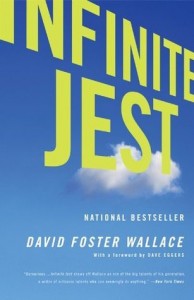

Infinite Jest by David Foster Wallace

Posted April 12, 2013 by Michael @ Knowledge Lost in Literary Fiction / 0 Comments

Infinite Jest by David Foster WallaceTitle: Infinite Jest (Goodreads)
Author: David Foster Wallace
Published: Back Bay Books, 1996
Pages: 1079
Genres: Literary Fiction
My Copy: Personal Copy

Buy: AmazonBook Depository (or visit your local Indie bookstore)

In the not so distant future, the residents of a Boston halfway house for recovering addicts and the students of the Enfield Tennis Academy both search for the master copy of a bizarre movie that is so entertaining the viewers die in a state of catatonic bliss. That movie is called Infinite Jest and it is said that anyone who watches it will lose all desire to do anything but watch it. This semi-parodic novel questions what entertainment is and why it dominates our lives.

I’m not going to lie, this book is both lengthy and difficult to read but in the end it is worth the effort. You will need three bookmarks for this book, one for where you are up to, another for the endnotes and the third for the timeline that sits around page 80. You do need to read the endnotes, this book relies heavily on them; they include definitions, side thoughts, in depth details and even a filmology. You will also need to know the timeline because David Foster Wallace likes to jump around a bit, so it helps to keep up. This is where it gets tricky; in the book’s future each year has a corporate sponsorship, so you have Year of the Whopper, Year of the Tucks Medicated Pad, Year of the Trial-Size Dove Bar and so on. It helps to know in what order the years are in so you can piece it all together. While all this might help you keep track of what’s going on there is still the fact that this book is piled with subplot after subplot and you will have to keep track of more characters than A Game of Thrones novel. You will need to keep notes and it might even be a good idea to get a study guide because this book will take you on a very interesting ride.

As I said before, this book is not easy; I took my time with it and slowly chipped away at this book for two months but I still think I’ve missed a lot. While there are some tangents that happen in the endnotes, this book jumps around so much that sometimes you get lost and have to go back. There shouldn’t be any shame in doing this as Wallace’s writing voice is a postmodern mixture of high- and low-brow linguistic traits which is very difficult to become familiar with. He also uses juxtaposes, colloquialisms and polysyllabic and highly esoteric words so you will need to spend some time researching.

Now that I’ve talked about the difficulties of reading the book, I should probably talk about my thoughts on it. Infinite Jest starts off rather dense, you really need to push through the first few hundred pages before things start to make any real sense. So why is this book considered a masterpiece, magnum opus or anything else it has been referred to? It’s not to read; rather it is a book that will challenge us, to rattle us out of complacency. For me I think David Foster Wallace has the ability to take something like substance addiction, recovery programs, depression, abuse, death, relationships, popular entertainment and even tennis and look at it in a very careful way. The way Wallace explores each topic may make you feel uncomfortable and it is confronting but you do gain a deeper understanding.  Yet the book doesn’t remain dry and depressing; Wallace has a very unique way of using humour to basically satirise the issues without making fun of them.

This book is a parody and comment on American culture, yet this is also a semi-autobiographical novel of the issues facing the author. Creating this funny but bitter sweet novel that I found difficult not to associate with the life of David Foster Wallace; his depression that lead to his suicide.  There is a lot going on in this novel and to go through all the major themes within this novel would probably turn this review into something too long to read so if you want to talk about themes I’ll leave that for the comments. So just a brief overview; the main character Hal Incandenza is an intelligent tennis prodigy dealing with the intense pressure put on him to succeed in a junior Tennis Academy, dealing with a drug addiction and the ongoing strain (both physical and emotional) to reach his full potential. While that is an understated summary, all the subplots makes it hard to cover, this is just the basis of the book.

Addiction and depression would be the two major themes in the most brutally confronting depiction of the struggles I’ve ever read. No other book has given me the insight like this one. I feel like the depiction of depression is often wrong in books and movies; depression is a complex thing, it’s not a state, it’s an overall feeling that can’t be shaked. One of the characters in the book; Kate tried to commit suicide because “[she] just didn’t want to feel this way anymore” and “[she’d] rather feel nothing than this”. This tragically honest view on depression really opened my eyes on the state of mind and the struggles that people dealing with depression go through, and for this only, Infinite Jest was worth reading.

The futuristic America created in Infinite Jest feels very much like western society now, just with the increased corporate involvement but that is the way the world is heading. I am reminded of dystopian classics with his satire of society and the social/cultural commentary. It really covers a lot of interesting topics and, while it is difficult, well worth reading.

This is one of those books I plan to re-read once I have a degree in Literature behind me; while I got a lot out of this novel, I am hit with the feeling that I’ve only scratched the surface. This is rather impressive novel overall, never have I seen a novel with over 60% of Goodreads users rating the book five stars and for good reason, the book covers a lot of topics and does it really well. Blending serious topics with an awkward sense of humour is balanced perfectly, and I highly recommend reading Infinite Jest; even if it is only to increase your pretentious levels.


Lolita by Vladimir Nabokov

Posted March 30, 2013 by Michael @ Knowledge Lost in Book of the Month, Classic / 9 Comments

Lolita by Vladimir NabokovTitle: Lolita (Goodreads)
Author: Vladimir Nabokov
Published: Penguin, 1955
Pages: 390
Genres: Classic
My Copy: Hardcover

Buy: AmazonBook Depository (or visit your local Indie bookstore)

Lolita is the highly controversial novel of Humbert Humbert, a middle-aged literature professor and his obsession with twelve year-old Dolores Haze. Of whom he becomes a step father as well as being sexually involved. Considered one of the most controversial novels of the twentieth century, Lolita is known not just for the disturbing nature but for the unreliable narration and sophisticated writing style.

Vladimir Nabokov’s masterpiece, Lolita, is one of those books that are worth reading even if it makes you very uncomfortable. The protagonist is the villain who tries so hard to gain the readers sympathy through his sincerity and melancholy. But as the story progress you can even see that he has lost of sympathy for himself and starts referring to himself as maniac who deprived Dolores of her childhood. The novel provides a remarkable perspective into the mind of a man you just want to hate and I will admit it can be a little exciting to watch him go through hell. Nabokov writes a hated character in the hope to knock him around and give him some humility and the reader is left wondering if he will learn from his mistakes.

This has often been described as an erotic novel, even the Great Soviet Encyclopedia called Lolita “an experiment in combining an erotic novel with an instructive novel of manners”. Personally I think of this book as a satirical tragedy with elements of eroticism and remorse. The narrator spends a fair chunk of the book begging the reader to understand that he is not proud of his actions and he is often stricken with guilt at the awareness of robbing Lolita of her childhood. But there is a case to be made at the fact that this is just an exploitation of a weak adult by a corrupt child but this can be problematic and not something I wish to go into great deal about.

The novel as a whole is a very one sided argument, we know how Humbert feels about the entire situation; we hear this to a very sickening degree. He has remorse but his obsession keeps him from ever changing, but one has to wonder what was really going through the mind of Dolores. I have to wonder how she sees the situation or even what she was thinking or feeling throughout the novel. We, as readers, can only surmise since we are forced to absorb Humbert’s feelings.

It is interesting to point out just how two dimensional all the characters are; all except himself and Dolores (Lolita), which he goes into great detail.  It reminds me of life; people tend to describe each other in a two dimensional manner unless we are obsessed with or interested in the person. This technique of writing really added to the realistic feeling of this book.

Lolita was a really awkward and sickening novel to read, there aren’t many books out there that have made me sick to my stomach. Lolita pulls off that feeling that horror novels try to achieve yet often get wrong – that feeling of uneasiness for the reader. This is my second read of this novel, so I knew what to expect and I was able to look past the controversial elements and focus on what this book can offer to the literary world.

Apart from the elements of oppression and an authority figure trying to assert their dominance this book explores tragicomedy, unreliable narration, irony and because Vladimir Nabokov is a Russian it could be a metaphor for totalitarianism. There are many themes you can explore within the novel but the one that will stick in most people’s minds is the lasting damage created by child sexual abuse.

Interestingly enough Vladimir Nabokov is a surrealist often linked to Gogol, Dostoevsky, and Kafka which make you wonder about some of the elements of this book even more. With a love of intricate word play and synesthetic detail Lolita turns into a wry observation of western culture. The novel is full of cleaver word play, double entendres, multilingual puns and in the end when you boil done to why people love it, it is just  a beautifully written novel.

You may not enjoy reading this book but you might enjoy having read it. I have to admit that I enjoyed this book more the second time around; there is great beauty to be found in this book and while content makes this book difficult to get through it is well worth the effort. I remember one of my first blog posts on literature was called “What Would You Read in an Introduction to Fiction Course” where I listed the books I’d include if I was to create an introduction to Fiction course and Lolita was one of my choices. Having now reread this book, it just validates my choice even more, there is so much to explore in this book that it has been put back on my list of books to reread.


Factotum by Charles Bukowski

Posted March 2, 2013 by Michael @ Knowledge Lost in Literary Fiction / 0 Comments

Factotum by Charles BukowskiTitle: Factotum (Goodreads)
Author: Charles Bukowski
Published: Ecco, 1975
Pages: 205
Genres: Literary Fiction
My Copy: Library Book

Buy: AmazonBook DepositoryKindle (or visit your local Indie bookstore)

A perpetually unemployed alcoholic. Henry Chinaski drifts through the seedy city streets of lower-class LA in search of a job. Factotum takes place in 1944 and follows the life of Chinaski in his search for a job that will not separate him from his writing. He is consistently rejected by the only publishing house he respects but he is driven by the knowledge that he could do better than the authors they publish.

When they call Charles Bukowski’s Factotum a beer-soaked, deliciously degenerate novel they are not lying. Bukowski is known for the literary movement Dirty Realism; a movement that often focuses on transgressive fiction in a very raw and interesting way. The willingness to try and portray forbidden behaviours and shock readers is what makes Factotum such a great read.

Henry Chinaski is Charles Bukowski alter ego so you suspect this is a semi-autobiographical novel that tries to capture not only his uncompromising love for writing but the isolation and loneliness he must feel. The emotional honesty that pours out in this book is both heart-breakingly beautiful but also very refreshing. I’ve yet to find a novel that displays that kind of reality in the way Bukowski does.

I really want to read more books by Charles Bukowski, I’m trying to track down Ham on Rye but my library doesn’t have it and my semi book buying ban for the year really makes it difficult to obtain. I really look forward to reading it, as I was recommended both books by a reliable source. I’m sure Post Office, Hollywood or Pulp will be worth reading but since I was recommended Ham on Rye I really want that to be my next dip into Bukowski’s mind, but maybe it won’t turn out that way.

Factotum is gritty and raw; I enjoyed everything about it and it was a quick read that I really didn’t want to end. Henry Chinaski is a great character; his low-life urbanity and alcoholism makes him a great guide into the seedy underbelly. I would love to know what Charles Bukowski’s other novels are like; do any of my readers enjoy his works and could maybe recommend something similar?


On The Road by Jack Kerouac

Posted December 30, 2012 by Michael @ Knowledge Lost in Book of the Month, Classic / 0 Comments

On The Road by Jack KerouacTitle: On The Road (Goodreads)
Author: Jack Kerouac
Published: Penguin, 1957
Pages: 307
Genres: Classic
My Copy: Personal Copy

Buy: AmazonBook Depository (or visit your local Indie bookstore)

On the Road is a semi autobiographical novel about Jack Kerouac’s travels through America. Set in 1947 the novel documents the travels of Sal Paradise with his friend Dean on a quest of self-knowledge and life experiences. This novel is often considered as the definitive ideal of the Beat generation and living life postwar. The Beat movement is a cultural movement which rejected a normal life for a bohemian lifestyle; this movement inspired jazz, poetry and literature.  The non-conformity and spontaneous creativity as well as experimentation with drugs, alternative sexualities and interest in Eastern religions lead to the hippy movement in the 1960’s even though there are many differences.

On the Road is a novel of friendship, not just between Sal and Dean but the people that come and go from your life. Hitchhiking through America gives an opportunity to see this quickly; Sal meets new people all the time and just like that they are gone from his life; their impact on Sal may very but it really is a good way to show the effects people have without having to scratch a story over a few years. Then there is the friendship between Sal and Dean, it’s clear to me that Sal is idolising his friend and his need to be just like him is really not helping him to grow. Sal does grow through the book but it never feels like Dean has, this really changes the dynamic of their friendship as the book goes on.

This is also a book on the ideals of the beatniks; they are young and wanting to experience life, learn from their experiences. But underneath it all Sal feels unhappy. Either alone, in a relationship or just having casual hook-ups, Sal is never content. The only time I ever feel like Sal is enjoying himself is when he is having intellectual conversations, but he never really works out how to channel that passion to make his life mean something, I did think he would find contentment in writing but he never really does. The characters feel they should learn from life instead of books and this leads more to sex, substance abuse and even madness seem to be the end results of their experiences rather than knowledge.

While some might think this is a rather boring novel, I tend to think there is so much in the book worth exploring. I like the style and feel of this book, it reminds me of dirty realism and the quest for knowledge and satisfaction in life really hit home for me. My past experiences are nothing like those of Sal or Kerouac’s but there is something so real and raw about this book that I enjoyed. Overall it was interesting to read the book as a manifesto to the beat generation.


As I Lay Dying by William Faulkner

Posted September 28, 2012 by Michael @ Knowledge Lost in Book of the Month, Classic / 0 Comments

As I Lay Dying by William FaulknerTitle: As I Lay Dying (Goodreads)
Author: William Faulkner
Published: Vintage, 1930
Pages: 267
Genres: Classic
My Copy: eBook

Buy: AmazonBook DepositoryKindle (or visit your local Indie bookstore)

As I Lay Dying is a classic American novel that was written by William Faulkner. This book follows the journey of fifteen different characters as they set out to fulfil the wishes of the recently deceased Addie Bundren who is to be buried in Jefferson.  Faulkner shifts between the fifteen narrators throughout book, one of them is even the deceased, who is expressing her thoughts from the coffin. As the book continues you can see the characters develop with each narrator’s perceptions and opinions.

This book is best known for its stream of consciousness writing technique which can be one of the biggest struggles with this book. It’s a dense read and if you don’t pay enough attention and try to delve deep into this book you will struggle to enjoy it. I made the mistake of starting reading book out as like a novel and it took me a while to pull myself up and approach this novel in the right mindset. But eventually I did start enjoying this book for what it is; and that is as a piece of literature that helped pioneer the stream of consciousness narrative and the interior monologue.

Faulkner was never an easy author to read but I hear this is his most accessible novel so I’m worried about reading anything else of his. I did enjoy exploring his literary style and just seeing the techniques he used for this novel but this really isn’t everyone’s idea of a fun read. There are some interesting characters in As I Lay Dying and some very ironic and dark elements to the story. As for the plot and scenery I did find it lacking but that really wasn’t what Faulkner was trying to achieve.

William Faulkner has famously said that he wrote the novel in six weeks and that he did not change a word of it. This in itself is a pretty impressive statement but if you look at the techniques and the novel as an overall piece of high literature, this statement is more impressive that I originally thought; it makes me feel like a failure. As I Lay Dying is not going to be for everyone, it is a dense novel but for lovers of literature it is interesting to dive into something that has been analysed deeply. I’m not going to go into this side of the book because I doubt I could really do it justice.  The style of this book is interesting, the prose is worth a deeper look and overall this book is just fascinating.