Tag: Philosophy

Organising Your Personal Library

Posted February 14, 2017 by Michael @ Knowledge Lost in Literature / 4 Comments

Recently I have been thinking about building the perfect library; this was due to a collection of essays I was reading called The Library at Night by Alberto Manguel. In this book, Manguel explores the process of building his personal library from an old barn but he also looks at the history of libraries around the world. Each essay is titled ‘The Library as…’ space, power, shadow, and so on. These essays explore different topics, giving you a wealth of information. Take for example ‘The Library as Shadow’, which explores a darker side of library history, from book burning to censorship.

What I am particularly interested in was from the essay ‘The Library as Order’, which focuses on how we would arrange our personal library. It does not matter where or how you house your personal library; every person has their own opinions on that topic. I wanted to explore the concept of how we arrange the books. There are so many ways to arrange books, currently my books are everywhere and there is a certain appeal to this. I have bookshelves around the house and any new books end up wherever it fits. If I need to find a particular book, I can spend hours searching for it. This is not always ideal but there is something about this literary treasure hunt that I enjoy. I often discover books on my shelves that I have forgotten about or I want to dip back into. Looking at a shelf that offers no rhyme or reason can be mesmerising, and who does not enjoy just staring at a bookshelf? While this method works for me now, it is not practical if I have a library, I need to arrange my books differently. In The Library at Night, Alberto Manguel suggests some different ways to organise books;

  • alphabetically
  • by continent or country
  • by colour
  • by date of purchase
  • by date of publication
  • by format
  • by genre
  • by literary period
  • by language
  • according to our reading priorities
  • according to their binding
  • by series

Amidst all of these choices, I have to admit ‘according to our reading priorities’ does sound appealing but I feel like this would continually change. The obvious choice would be to organise alphabetically (by authors last name of course) but there are some draw backs with this. Not only will fiction and non-fiction sit side by side but the idea of Charles Dickens sitting next to Philip K Dick or Jane Austen beside Paul Auster seems odd. Although for those authors that dabble in both fiction and non-fiction, like Aleksandr Solzhenitsyn this system may be preferable.

Sorting by genre seems like a popular choice, and for all intents and purposes the most logical. As someone that reads on a whim, the ability to just head to somewhere like the detective fiction section and pick a gritty hard-boiled novel sounds wonderful. My only problem is the fact that it is often difficult to fit novels neatly into a single genre. Also, with an author like Jonathan Lethem you would have to separate his works, especially with his early books. I like the idea of sorting by genre but I found too many flaws in this system.

Picking an organisation strategy appeared to be much harder than it looked. Organising by colour is aesthetically pleasing but I never considered this as an option; it is just too random. I am playing around with a book-sorting app on my phone, which allowed me to create different shelves for organising. This allowed me to scan my books into the program and play with different ways to organise.
I eventually decided that there was no perfect way to organise a library, you can go into your public library and see evidence of this everywhere. I had to come up with a solution that worked for me. I do not have a library yet, but when I do, I am now sure I know how it will be organised. I have settled on sorting by continents for my fiction, this is because I have a keen interest in books in translation. I have discovered that splitting my fiction into continents will give me the opportunity to see where my strengths and weaknesses lie. If I organise my fiction by continent, I will notice which continents I need to focus on, like South America and Africa. I love reading around the world, I find it both an educational and rewarding experience.

If your reading journey and your library is a personal reflection, then the books that do not appear on your shelves say just as much about you as the books you do have on your shelf. When I became a reader, I quickly started building my book collection to a point where I have shelves and shelves of books everywhere. The problem I face now is the fact that I have only read about half of them. Publishers sent me books because of my blog but I also purchased books that sounded interesting. Now I have evolved as a reader and discovered where my literary tastes lie, there are books that remain on my shelf that are not a reflection of me as a reader. These books do not tell you anything about me because I have no desire to read them. While I know I should cull all books I have no interest in, it is hard to let go of a book that you have never read. What if it is fantastic and I just do not know that yet? There is the problem, but I do feel like I am getting to a point where I can be confident about a book I would not like. So maybe a purge is coming.

Now the problem with sorting the fiction by continents is that there are some countries I have a greater interest in – the literature of France and Russia for example. Do I split them into their own section? I am interested in all post-Soviet literature, so that brings up another question. How do I shelve these books? Russia seems too exclusive; calling them post-Soviet countries just does not sit right with me; Baltic and Slavic countries do not cover all the countries. This is one problem I need to solve, but for now I think this is the best choice for me.

Another issue I found with sorting by continent is that the United Kingdom and the Republic of Ireland fall under Europe but they do not feel the same. There is so much literature from the United Kingdom anyway, I feel like it would require its own shelves. I wonder about North America but honestly, does it matter if Canada and the United States sit together? For me it does not, although this may displease my Canadian friends. There are so many things to consider and this is only a small fraction of the problems I face with sorting my books.

When it comes to non-fiction, it was not difficult; this was always going to be sorted by subject. Philosophy, history, Russian history, books about books, art, and so on. However, that posed some interesting questions as well. Do you include philosophical novels like The Stranger by Albert Camus or Either/Or by Søren Kierkegaard in the philosophical section? My feeling is yes but where do you draw the line? There are novels that are philosophical in nature that I would not include under philosophy, like The Brothers Karamazov by Fyodor Dostoevsky.

I will continue to ponder just how I would organise my dream library, but I wanted to give you plenty to consider. Instead of reviewing The Library at Night by Alberto Manguel, which everyone should read, I preferred to explore what I got out of this essay collection. I have not even touched on any of the other topics in this book; I will leave that for you to discover. Also, I have not even talked about other aspects of setting up a library, like using the Dewey decimal system, or a card catalogue system. Thinking about setting up a dream library is an exciting activity for every bibliophile and we all have different ideas. I loved reading about someone’s journey and it gave me plenty to contemplate. For now, I will continue cataloguing my books using the app BookBuddy and working out how to organise everything. This experiment should also help me discover the gaps in my own library so I can pick better books to purchase.


The Good Place and Ethics

Posted January 13, 2017 by Michael @ Knowledge Lost in Film & Television, Philosophy / 2 Comments

I discussed the moral dilemma in the HBO television show Westworld, and I have since discovered a show that looks at ethics. The Good Place is the story of Eleanor Shellstrop (Kristen Bell) who dies and finds herself in the afterlife, designated into ‘the Good Place’. Only problem is that she is not a good person and does not belong. In fact it is another Eleanor Shellstrop that should be in ‘the Good Place’, but she does not want to end up in ‘the Bad Place’ so she sets out to learn how to be a better person, in essence, to earn her place.

‘The Good Place’ is basically heaven, but the show is written to be as neutral as possible when it comes to religion. To do this, the architect of this ‘Good Place’ neighbourhood Michael (Ted Danson) states that all religions only guessed 10% of what the afterlife is like. Joking some random guy from the 1970’s managed to guess 91% of what happens after you die in a inebriated rant. While this might be considered a mockery towards religion it does allow the show to explore ethics in a stripped back way. Without getting bogged down with the religious aspect, the show explores different schools of thought when it comes to ethics.Beneath the low-brow humour the show is almost like an introduction to moral philosophy, exploring ideas from people like Immanuel Kant, Karl Marx, Jeremy Bentham and of course the obvious Socrates, Plato and Aristotle. These ideas are explored thanks to Eleanor’s soulmate Chidi (William Jackson Harper) who was a professor of ethics when he was alive. One of the major ideas that is explored is that of utilitarianism, I expect as a critique to society’s pleasure seeking ways.

The idea of utilitarianism is the idea that an action is considered right if it promotes happiness. The show focuses on the paradoxical nature of utilitarianism, mainly the idea of punishing an innocent person for the greater good. Eleanor’s presence in ‘the Good Place’ has a negative effect on the neighbourhood, where actions that are not inherently good manifest in terrifying ways. There is also the conundrum of Eleanor staying in ‘the Good Place’ may promote her happiness but it is at the cost of the other Eleanor who is suffering in ‘the Bad Place’.

“He who would criticise all human acts, movements, relations, etc., by the principle of utility, must first deal with human nature in general, and then with human nature as modified in each historical epoch.” – Karl Marx (Das Kapital)

While this show does more than name drop philosophical ideas of ethics, but rather try to explain them, I still find the show too simplistic. It is as if The Good Place is attempting to introduce the idea of moral philosophy to the viewers but a show like Westworld wants you to work for it. I do enjoy the philosophy and the way it explores ethics but I much prefer having to work towards understanding; then again, I am just pretentious like that. We started watching this show because my wife and I are big fans of Kristen Bell and I will continue to watch because of the philosophy, even if it is overly simplified.


Violent Delights: My Thoughts on Westworld

Posted December 12, 2016 by Michael @ Knowledge Lost in Film & Television / 2 Comments

One of the age-old questions that gets asked in science fiction revolves around artificial intelligence (AI). In particular, the existential risk from artificial intelligence that might result in human extinction or some global catastrophe. One of the most noticeable examples of an AI rebellion in pop-culture can be found in The Terminator series with Skynet, when it becomes self-aware and ultimately decides that humans are irrelevant. A more recent example is the HBO show Westworld created by husband and wife combo Jonathan Nolan (Person of Interest) and Lisa Joy (Pushing Daisies). The show is based on a 1973 film of the same name (written and directed by Michael Crichton) set in the future where people can visit this western themed amusement park populated by synthetic android, referred to as hosts.
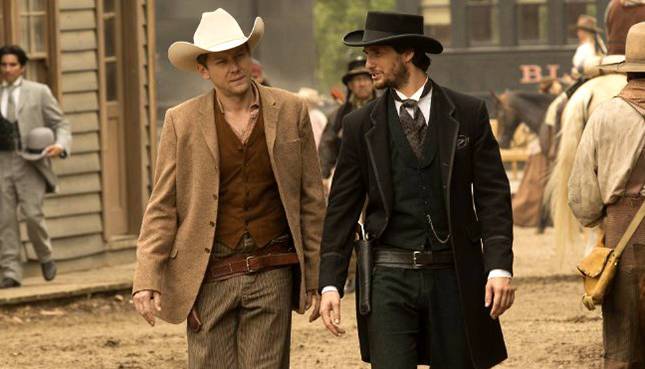
Westworld is one of the most exciting TV shows I have seen in a very long time, and while at its core it explores the idea of artificial intelligence becoming self-aware, I feel like there is something much more interesting going on. To understand this, you need to be aware of the criticism towards HBO shows (in particular Game of Thrones) which often revolve around the over exposure of nudity and violence, claiming that it is just low-brow entertainment. However, I am of the opinion that this show, Westworld can be seen more as a social criticism.

“These violent delights have violent ends.” Romeo and Juliet, Act II, Scene VI by William Shakespeare

The patrons come to this amusement park to fully immerse themselves into an adventure without fear of consequences. Whether they are seeking their thrills with sex or violence, the show is questioning if this is healthy behaviour. While there are no physical consequences, what are the moral implications of these violent delights? The hosts in Westworld are so realistic, they have memories, thoughts and feel pain – this brings so many questions to mind. For example; where is the line between harmless fun and dangerous behaviour?

At the beginning of season one, I found myself wondering if it takes a certain type of person to visit Westworld. Are the patrons visiting to act out their more depraved fantasies? However, I slowly began to view Westworld as a highly advanced video game (similar to virtual reality). If you compare this amusement park with popular games like Grand Theft Auto, it opens up a whole different thought process, one of game theory. A player of Grand Theft Auto might shoot up the street, visit a prostitute or something similar to test out the boundaries of the game. Not out of morbid curiosity but rather to see if the game is a really an open world. While some players may take delight in these actions rather than following the narrative, there is no real evidence that these actions have any links to criminal behaviour (although there is evidence of an increase of aggressive behaviour).

White Hats vs. Black Hats

Although when the ‘game’ is so realistic that you cannot tell the difference between host and human, the experience becomes more complicated. This show explores the idea of what happens when realism becomes too real, and while some patrons may test out the boundaries of this world, ultimately they get sucked into a narrative, what about the others? One of the taglines for Westworld is, “the dawn of artificial consciousness and the future of sin”. With this tagline in mind, we know the show wants to pay particular attention to what they call ‘the future of sin’, so it is asking the audience to think about the moral implications of these violent delights.

As you watch through season one of Westworld, you will discover that actions without consequences are just a myth. Starting with the discovery of lasting memories of the hosts and also the wounds. While these hosts are not humans, they show signs of emotions and pain. If they feel pain, do we not have a moral obligation to help them?

There are multiple scenes in the show depicting some close ups of a host’s eye, and if the eyes are the windows to the soul, what are they trying to say? I am inclined to think that this might actually be an exploration into how people treat each other. If you look at the history of the world, in particular colonialism, you will see that the first people are often treated as if they were different. Since this amusement park has a western theme, I would suspect we could make parallels between the treatment of hosts and the treatment of Native Americans.

The use of nudity in Westworld is very different to most TV shows. While nudity on television and movies is often used to sexualise a character, this show takes a very different approach. Often when you see nudity in this show, it is a host sitting in front of a scientist getting reprogrammed. The nudity has the effect of dehumanising the hosts – yet another example of the show trying to show you the difference between artificial intelligence and humans. Yet time and time again in the show it demonstrates that they these host are self-aware and conscious.

I have to say, I was completely immersed in the story being told in season one of Westworld and I really cannot wait for a new season. However, it was the philosophical questions that the show presented that really thrilled me. It was because I spent so much time thinking about what makes us human, the existential risk of artificial intelligence and game theory that I would consider Westworld one of the best TV shows of recent time. I feel like there is so much to say about this series, but I do not think I have the skill set to dive deeper. I wanted to get as many of my thoughts on Westworld down, and who knows I may even do more posts like this in the future.


Existence Precedes Essence: Understanding Existentialism

Posted December 5, 2016 by Michael @ Knowledge Lost in Philosophy / 4 Comments

When thinking about the term existentialism, a quote by Jean-Paul Sartre may come to mind; “existence precedes essence”. 1 This was a relatively new way of thinking within philosophy. The idea criticises the concept that everyone has an essence and our lives tend towards the actualisation of our essence, which dates back to Aristotle. Over the years, this idea of essence evolved into predestines, as philosophers leaned more towards religious ideas. For Sartre, this was an absurd way of thinking and this might have been connected to his atheist beliefs. However, this is not a universal idea in existentialism, many disagreed with Sartre, but it did start a new philosophical movement.

existentialists
Søren Kierkegaard, Friedrich Nietzsche and Jean-Paul Sartre

While Søren Kierkegaard, Friedrich Nietzsche and Fyodor Dostoevsky are all considered existentialists, the term was actually coined by Jean-Paul Sartre. It is widely believed that Kierkegaard may have been the first existentialist philosopher but he used the word ‘individualism’ to refer to his philosophical ideas. When looking as his writing, it is easy to see why it is closely associated to existentialism. In his book The Sickness unto Death, Kierkegaard wrote “The greatest hazard of all, losing one’s self, can occur very quietly in the world, as if it were nothing at all. No other loss can occur so quietly; any other loss – an arm, a leg, five dollars, a wife, etc. – is sure to be noticed.” 2

This leads us to ask, ‘What exactly is existentialism?’ which is not an easy question to answer. If you consider historical events that were happening at the start of existentialism (early twentieth century), you notice the world was a confused and complex place. When Sartre started his works, the world had already experienced one World War and was about to head into a second one. The political landscape was very unstable; Marxism, Communism and Fascism were all growing movements. Western ways of thinking were not providing the answers people craved about the meaning of life or at least a way to address the human condition.

Existentialism became a new philosophical way of thinking; a new way of facing a confused world that they could not accept. It was not a doctrine or a philosophical system rather existentialism was a movement. It was an inwards approach to thinking, when Jean-Paul Sartre said “existence precedes essence”, he was stating we exist first, and it is up to us to find what defines us then live our lives accordingly.  Which linked back to Søren Kierkegaard who said, “The most common form of despair is not being who you are.” 3 This was the foundation of existentialism; it did not matter if other philosophers believed existence came before essence, what mattered was living life authentically. To do so, there were three main sides to this form of thinking to consider: individualism, freedom and passion.

Individualism is the ethical idea that we are all responsible for our own actions. Rather than living by the morals set out by our society, religion and our elders, we must seek our own individual self-relevance and liberties. It was Friedrich Nietzsche who once said “The individual has always had to struggle to keep from being overwhelmed by the tribe. If you try it, you will be lonely often, and sometimes frightened. But no price is too high to pay for the privilege of owning yourself.” 4 Moral individualism should not be confused with selfishness or a desire for anarchy; rather it simply suggests that humanity must be defined by the individual. No two people are alike; thus, having set rules and ideas for everyone imposes restrictions on living authentically.

Freedom was a response to the current social/political situations; without freedom there was no possible way to allow people to be individuals and is considered the primary virtue to authenticity. This is more than the freedom to do whatever one desires. Existentialist often use the term facticity as a term to mean the limitation and a condition to freedom. For example, our birthplace, past choices and so on, may either limit or aid our quest to live our life authentically. If we are born blind, that may take away our freedom to read this text but does not mean we can never read.

Passion is self-evident, the need to find a purpose to life. A primary concern to “existence precedes essence” was simple to find a reason to live – your passion. For me, my passion would include literature, philosophy and writing articles like this. I am motivated in working towards a way to make my passions my career. That is not to say that there are no other reasons to live; such as loved ones or the simple pleasures in life.

meaning-of-lifeOnce you establish these four philosophies as the backbone of existentialism, you may have started on the journey down the rabbit hole into the existentialist way of thinking. Having definitive answers to life maybe be attractive but we realise life is not that simple. When adopting existentialism as your personal philosophy, be warned that many of the great existentialists did abandon their own philosophies. To quote Søren Kierkegaard once more; “Life can only be understood backwards; but it must be lived forwards.” 5 Existentialism has its appeals; it is often adopted by young adults as permission to be an individual and focus on themselves. However as the quote above stated, it is only in reflection that we understand our lives and where we went wrong and life is not that easy, you cannot simply rely on other people’s ways of thinking.

Essentially, existentialism suggests that we should all live our lives authentically and free. Our goal in life is to find our essence – our reason to live. Albert Camus has been quoted as saying “should I kill myself, or have a cup of coffee?” 6 which suggests that something as simple as a cup of coffee is enough to continue living. There are two major branches of existentialism that I have not mentioned, nihilism (the belief that life is meaningless) and absurdism (life has no purpose and the universe is chaotic) but I will not be going into details about the differences at the moment.

My goal of this was to give you a better understanding into existentialism but as you might have discovered, it can be complex. I hope you now have a basic understanding, allowing you to go down the rabbit hole of thinking about philosophy and what you believe. For more information about existentialism and the people behind this philosophical movement, I would recommend the book At the Existentialist Café by Sarah Bakewell. 7 This covers the history of existentialism as well as a little about people involved, like Jean-Paul Sartre, Simone de Beauvoir, Albert Camus, Martin Heidegger, Edmund Husserl, Karl Jaspers, Maurice Merleau-Ponty and so many others. I felt very inspired after reading At the Existentialist Café, that I have gone down a rabbit hole exploring philosophy and hope to write more about it in the near future.


Missing Person by Patrick Modiano

Posted November 29, 2016 by Michael @ Knowledge Lost in Literary Fiction / 0 Comments

Missing Person by Patrick ModianoTitle: Missing Person (Goodreads)
Author: Patrick Modiano
Translator: Daniel Weissbort
Published: Verba Mundi, 1978
Pages: 192
Genres: Literary Fiction
My Copy: Library Book

Buy: AmazonBook Depository (or visit your local Indie bookstore)

I have been wanting to read Patrick Modiano; not only has he won a handful of awards, he is the recipient of the 2014 Nobel Prize in Literature. The Nobel was “for the art of memory with which he has evoked the most ungraspable of human destinies” but the committee also called him the “Marcel Proust of our time”. Unfortunately, not many of his novels have been translated from the French into English, despite the fact that he is so prolific (I counted six English translations prior to winning the Nobel Prize in Literature and a further eight since winning).

Missing Person appeared to be the perfect starting point for me, as it covered two elements that I am drawn to in literature, noir and philosophy. The novel follows Guy Roland, who was been working for Constantin van Hutte in his detective agency for the past eight years. As Hutte has decided to retire, Roland embarks on one last case, to find out who he really is. Guy Roland (a name given to him by Hutte) lost his memories during the war and is essentially a blank slate.

What drew me into this story was the cinematic style; it feels like a French film noir. The French title of the novel is Rue des Boutiques Obscures, which translates to the Street of Dark Shops. This is not a hard-boiled story, as Roland is not hard-boiled in anyway; this is what I would probably call existentialist noir. A perfect blend of the mysterious setting; dark cafes and plenty of wine and cigarettes. With the enhanced feeling of being completely lost, as Roland tries to find out who he really is.

“The sand holds the traces of our footsteps but a few moments.”

Essentially this is a novel exploring the ideas of identity and memories. I like the way Modiano played with the idea of a blank slate. What defines this person? What makes up this man’s character, and will what defined him in the past return to him? An exploration into the way people remember you and how that shapes your character and personality. Roland tries on different personas; in his investigation he may not discover who he really is but he adopts this ideas of people to see if it feels right or sparks a memory. The way memory plays out in the novel is particularly interesting; in one scene he recalls a love affair with a woman, but fifteen years after the breakup she denies that it ever happened. So you are left wondering if it did happen, or is this a distortion of the truth or maybe even a suppression of her past.

This is the type of novel you do not read for the plot. Missing Person is meant to explore an idea, invoke an emotion and get you thinking about identity and memories. The pulp-ish style to this novel really worked for m., I love the idea of investigating yourself; playing with the idea of self-discovery and identity. I will be exploring more from Patrick Modiano; in particular I want to try his novel Honeymoon. I am glad I read Missing Person and I have not been able to stop thinking about the ideas explored in this novel.


Down the Non-Fiction Rabbit Hole

Posted November 2, 2016 by Michael @ Knowledge Lost in Literature, My Essays / 6 Comments

The quote by Socrates “The more I learn, the more I learn how little I know” has been on my mind for quite some time. There seems to be no truer statement to describe how I feel at the moment. One of the reasons I spend so much time reading is because I want to learn. Fiction can tell us so much about the world around us, and the experiences faced by different cultures. I am drawn to translated fiction because of what it can teach me about the world. It has taken me some time but I am slowly been drawn to non-fiction as well. Reading recently Secondhand Time by Svetlana Alexievich (translated by Bela Shayevich) and Wild Swans by Jung Chang I discovered just how much about the world I still need to learn.

While Russia is a particular interest of mine, Secondhand Time gave me some insights I did not realise I needed. This is a stunning collection interviews collected by Svetlana Alexievich of people just talking about their personal experience with the collapse of the USSR. I thought I had a decent grasp of the history of the Soviet Union but this book shattered it completely. It is not enough to understand the basic history, life is much more complex and there is so much more to learn. I need to know more about post-Soviet Russia and I plan to learn, starting with The Invention of Russia by Arkady Ostrovsky.

Wild Swans is a biography of three generations of women living in China. Jung Chang tells the story of her grandmother, her mother and then herself, the experiences they all faced in a rapidly changing country. Her grandmother, grew up in a world of foot binding and warlords, while her mother saw the rise of Chairman Mao and communism. This is a story that spans from the Manchu Empire to the Cultural Revolution. It was here I discovered a deeper understanding of communist China; I would never have known about the Great Leap Forward or the Cultural Revolution in such detail without the personal accounts found in this book. If I combine my love for Soviet history, I find myself wondering if I should learn more about communism in other countries. Do I dare to try and compare the differences?

nonfiction2016

There is so much to learn and I feel myself being drawn down the rabbit hole. I have identified three major interests that seem to be the current focus of mine when it comes to non-fiction. This is Russian history, philosophy and books about books. I know this is only the tip of the iceberg and I will be venturing down so many more paths in the future but for now I will start here.

With my love of Russian literature, I feel the need to have a deeper understanding of their history, especially surrounding the politics. Not only will this aid my understanding into the literature I am reading but it will also help me better appreciate the satirical nature that is often found in Russian literature. I am slowly working my way down this rabbit hole with books like Iron Curtain by Anne Applebaum, a look into the way the USSR treated Eastern Europe and Voices from Chernobyl by Svetlana Alexievich (translator: Antonina W. Bouis), an oral history into the nuclear disaster in 1986. Even a book like The Zhivago Affair by Peter Finn and Petra Couvée has been useful; not only does it explore the story of Doctor Zhivago but the impact it had on the world around it.

A new love for philosophy started with At the Existentialist Café by Sarah Bakewell and now I want to know so much more about Jean-Paul Sartre, Simone de Beauvoir, Albert Camus, and Søren Kierkegaard. But I do not plan to just stop at the existentialists, I have so much to learn. My knowledge of philosophy may have come from a novel called Sophie’s World by Jostein Gaarder (translator: Paulette Møller). There is a lot more I could learn from the philosophers, and I have started my journey, with Beyond Good and Evil by Friedrich Nietzsche (translated by R.J. Hollingdale) and The Story of Philosophy by Will Durant.

Finally, my love for literature has drawn me to reading about literature. Not just memoirs and biographies, although you may notice in my reviewing that I find context important. So a memoir or a biography gives me a deeper appreciation of the literature. A memoir like Little Failure gave me a greater understanding about its author Gary Shteyngart and a collection of letters and diary entries called Manuscripts Don’t Burn (translated and edited by J.A.E. Curtis) was a valuable insight into Mikhail Bulgakov. But then there are books about the reading journey that are entertaining to read, while still being a valuable part of my own reading life. I am talking about books like The Year of Reading Dangerously by Andy Miller, 84 Charing Cross Road by Helene Hanff and Howards End is on the Landing by Susan Hill. I can be very particular about books about books, the tone has to be right, their taste in literature and the way they talk about literature is equally important, and so for my money I would recommend Ex Libris by Anne Fadiman as the pinnacle in this genre of non-fiction. My reading journey is far from over, in fact it is only just beginning. Having only spent six years as a reader, I have so far to go. It is all part of my never ending quest to become well read. I will be focusing on reading more non-fiction, starting with these three interests and branching out.

Following the path of knowledge wherever it might take me. I look forward to talk about my journey as I continue and would also appreciate any recommendations.


The Meursault Investigation by Kamel Daoud

Posted September 12, 2016 by Michael @ Knowledge Lost in Literary Fiction / 2 Comments

The Meursault Investigation by Kamel DaoudTitle: The Meursault Investigation (Goodreads)
Author: Kamel Daoud
Translator: John Cullen
Published: Oneworld Publications, 2013
Pages: 143
Genres: Literary Fiction
My Copy: Paperback

Buy: AmazonBook DepositoryKindle (or visit your local Indie bookstore)

One of the key components to philosophy is the ability to argue your point, this is done in many different ways and Albert Camus’ novel The Stranger does exactly that. Kamel Daoud took the same approach for his counterargument, with his novel The Meursault Investigation. This novel seemed to have taken the world by storm, winning the Goncourt du Premier Roman, the Prix des Cinq Continents, the Prix François Mauriac and shortlisted for the Prix Goncourt. It follows Harum seventy years after his brother Musa (the Arab) was killed by Meursault. Harum is reflecting back on his life and the impact Meursault’s story has had on himself, his family and Algeria.

Kamel Daoud’s response to The Stranger is basically saying that life is not absurd, it has meaning. Taking a life has consequences and execution is not simply a life for a life. Meursault killing the Arab had a big impact, and never referring to him by name allowed Camus to focus his story but at the risk of missing the bigger picture. So seventy years later, well after Algeria has declared their independence from France, the story of Meursault is still a topic of discussion.

First of all, the death of Musa has an impact on the life of Harum and his family. The Meursault Investigation starts off exploring the life of Harum and his mother and how the death of Musa effected them. The novel spirals out, first looking at the effect it had on Harum, then his mother and family and then finally Algeria. This may come across as repetitive but I think it was important to understand the impact.

I watched a lecture by Daoud that talks about The Stranger and comparing it to Robinson Crusoe. This is an exploration into post-colonialism; Meursault meets someone who was different to him and kills him. Robinson Crusoe did the same thing to Friday, just not physically; he forced him to convert to his idea of civilisation. That meant changing the way his acted, dressed and most of all his religious beliefs. The fact that Meursault killed an Arab on the beach could be symbolic of the island. If you follow this train of thought, The Meursault Investigation turns into a very complex philosophical argument, not only against The Stranger but the opinions of Western society (especially France) towards the raise of Islam.

The Meursault Investigation is an angry novel with some very deep philosophical ideas embedded into the pages. Published originally in French (translated by John Cullen) this novel evoked similar reactions for me as Submission by Michel Houellebecq in the way it explores France’s reaction to Islam. I understand people’s criticism about repetitive in The Meursault Investigation but I feel like it was necessary as Daoud needs to keep circling back to the death of the Arab and exploring how it affected everyone. This is the butterfly effect and I enjoyed every moment of this novel.


Becoming a Philosopher

Posted August 11, 2015 by Michael @ Knowledge Lost in Philosophy / 2 Comments

Friedrich NietzscheWhile watching videos from the School of Life YouTube channel recently, in particular the video on Friedrich Nietzsche. I found myself feeling so envious towards people like Nietzsche and Alain de Botton (who was a founder of School of Life) because they are so smart, talented and make me feel like I have so much to learn. This is interesting, since Nietzsche believes envy is an important part of life; it is useful for understanding what we want to achieve and what we are working towards. In his 1887 book On the Genealogy of Morality (Zur Genealogie der Moral) Nietzsche theorises that the concepts of morality are controlled by the powerful (in his time, the clergy), therefore the concept of good and evil is subjective. While he never talks directly about envy, Nietzsche has often criticised the church for portraying envy as a sin and something we should feel guilty about. This is not the current teaching of the church regarding the seven deadly sins, these are just gateways we should be wary about because they can lead to sin. However this misconception can lead to an emphasis on envy which is leading people to feel insufficient with themselves, and that tends to leads to guilt rather than driving ambition.

Luckily in my case, my envy towards people like Friedrich Nietzsche is making me feel ambitious. I was thinking about life, and I asked Twitter how to become a philosopher and the first response I got back was “Be a dick to Plato”. This may not sound helpful but it really does cut to the core purpose of philosophy. If you look up philosopher in the dictionary you get something along the lines of “a person who offers views or theories on profound questions in ethics, metaphysics, logic, and other related fields.” Critically questioning ideas and theories, even the ones Plato wrote about, in essence would make you a philosopher.

My wife, in all her wisdom, said without thinking that everyone should be a philosopher. The ideas behind philosophy are to think about life and the world around us and to assess, accept, reject or expand on the ideas that have been presented to us. Granted, I have not worked out a way to make a career out of philosophy but the reason I started this blog was to story my thoughts and ideas in the one location. Literature has been a huge part of my life and has helped me to critically question the ideas I am faced with.

I have no formal background but I do believe academia does not have all the answers when it comes to philosophy. In the past education was the job of the clergy and the church. Universities were originally created during the decline of religion as a place for people to find meaning to life, ask questions, share ideas and be part of a community. However if you look at the state of today’s universities, you may not even find anything close to this idea. Rather, it feels like a place to tell people what they need to do in order to be qualified for the degree they are pursuing.  I have been in many classes where there is no questioning, no sharing of ideas and no community; you are given a print out and you get assessed on how well you align to the ideas found on the page. Can you imagine going to university in the hopes to become a teacher and then being taught how to teach a class with methods that are never recommended for a classroom setting?

While it is true that you’ll learn something by reading a piece of paper and writing about it (that is essentially what I do here), academia does not seem to be promoting a philosophical lifestyle. My autodidactic journey feels like it aligns with what I want to achieve more than academia does. I question what I read but when it comes to writing about it, I am doing so for myself. I am not being assessed on how well I align to the teacher’s ideas. Rather, I write to practise expressing my opinions and document my learning process.

Granted, if you want to make a living in philosophy, then working in academia would be useful but I often question the way academic papers are written. Reading some philosophical ideas that are written in an academic format can be very difficult, it makes me feel stupid and question my own intellect. I know I have a lot to learn but I think academic writing is more designed to sound smart so people will think the author knows what they are talking about. If I was to say “God is a woman” you might agree or reject my statement without any thought. However if I say “God is a woman and I have a hundred page academic paper to back that up”, your reaction might be a little different. You may think I am still wrong but it might take longer to reach that conclusion. If you disagreed with me but still chose to read the hundred pages, things could be different once again; you might question your own beliefs before accepting or rejecting mine. The purpose of a paper like this would be to express opinions and challenge ideas, however I prefer a more casual approach to writing.

I believe we can start a conversation about ideas without the need to alienate people with overly complex academic papers. If people are willing to share and exchange ideas there are people willing to listen and challenge. I call myself a philosopher because I like to question ideas and explore my thoughts via my writing. Also my twitter bio says I am a philosopher so it must be true. I hope to continue to learn and explore ideas, to question and challenge my way of thinking and if needed, I will be a dick to Plato.


The Stranger by Albert Camus

Posted May 2, 2015 by Michael @ Knowledge Lost in Classic / 6 Comments

The Stranger by Albert CamusTitle: The Stranger (Goodreads)
Author: Albert Camus
Translator: Matthew Ward
Published: Vintage, 1941
Pages: 123
Genres: Classic
My Copy: Paperback

Buy: AmazonBook DepositoryKindle (or visit your local Indie bookstore)

The Stranger (also known as The Outsider or L’Étranger) tells the story of Meursault, an unsympathetic French Algerian, who after attending his mother’s funeral, finds himself killing an Arab man. The novel follows a first-person narrative that explores the events before and after this murder. Albert Camus said is best when he said “I summarised The Stranger a long time ago, with a remark I admit was highly paradoxical: ‘In our society any man who does not weep at his mother’s funeral runs the risk of being sentenced to death.’ I only meant that the hero of my book is condemned because he does not play the game.”

On the surface The Stranger is the story of an emotionless protagonist; Meursault does not care about anything and could be considered a sociopath. However, this novel is often cited as an example of Camus’ philosophy on the absurd and existentialism. So in order to fully grasp the intent behind this classic novel, we must look into just what existentialism is and more practically absurdism.

The absurd is often referring to the conflicting philosophy that humans have a tendency to seek out value and meaning in life. However absurdism believes it is logically and humanly impossible to find any meaning of life. Philosophers may have very different doctrines but they generally believe that philosophical thinking begins with the human subject. Though existentialism comes from the disorientation or confusion that we are living in a meaningless (or absurd) world.

For Albert Camus, The Stranger is an exploration into the meaning of life and if life has no meaning what is the purpose of morality. Meursault’s detachment from the world is a result of his conclusion that life is meaningless; “The chaplain knew the game well too, I could tell right away: his gaze never faltered. And his voice didn’t falter, either, when he said, ‘Have you no hope at all? And do you really live with the thought that when you die, you die, and nothing remains?’ ‘Yes,’ I said.” Paradoxically, it was only after being sentenced to death, that Meursault was able to obtain some sense of happiness.

Without an understanding of Albert Camus’ philosophical ideas, I do not think that the reader will have any hope in truly understand or appreciating this novel. However I have heard that The Stranger has been an option for high school students (especially in America) to study. I wonder how many students fall into the trap of picking this novel thinking it was short only to discover how difficult it is to analyse. I do not have enough of an understanding of absurdism or existential philosophy to full appreciate The Stranger. However re-reading this novel has helped me understand this enough to enjoy the Camus’ philosophical ideas.


What Is Literature? by Jean-Paul Sartre

Posted December 16, 2014 by Michael @ Knowledge Lost in Non-Fiction / 2 Comments

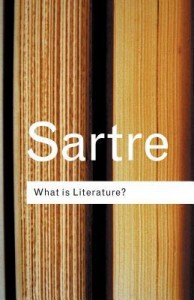
What Is Literature? by Jean-Paul SartreTitle: What Is Literature? (Goodreads)
Author: Jean-Paul Sartre
Translator: Bernard Frechtman
Published: Routledge, 1947
Pages: 280
Genres: Non-Fiction
My Copy: Library Book

Buy: AmazonBook Depository (or visit your local Indie bookstore)

What Is Literature? (Qu’est ce que la littérature?) by Jean-Paul Sartre has also been published as Literature and Existentialism. It is a collection of freestanding essays originally published in the French literary journals Les Temps Modernes, Situations I and Situations II. Jean-Paul Sartre is best known as the French philosopher who played a key part in the schools of existentialism and phenomenology. It is sometimes forgotten that he was also a literary critic and a Marxist who was often vocal about the abuses of human rights by the Soviet Union.

The reason I mention that Jean-Paul Sartre was a Marxist is because this plays a big part of What Is Literature? To understand his political standing is useful because it plays an important role in his literary criticism; Sartre was very vocal political, and though he embraced Marxism he never joined the communist party. While his literary criticism is always focused on Marxism, his schools of thought in philosophy are relevant, as well as his views on sociology and post-colonialism.

There are four essays found within What Is Literature? “What is Writing?”, “Why Write?”, “For Whom Does One Write?” and “Situation of the Writer in 1947”. “What is Writing?” is probably the most fascinating (for me, anyway) of the four essays, exploring the ideas of writing that distinguish it as an art form apart from poetry, painting and music. I found it interesting how Sartre has separated poetry and journalism out of his thoughts of writing to focus on literature as an art form. Whether you believe his idea of not, Jean-Paul Sartre will give you plenty of food for thought and I have to admit that a sufficient amount of it went over my head.

Jean-Paul Sartre has spent a great deal of time thinking about literature and writing as an art and philosophical idea, more than I could ever imagine. Because of this, it can be difficult and as a reader I had to admit that I wouldn’t understand everything. What Is Literature? did however leave me with plenty to think about and offer me a fresh perspective and that is all I wanted from this book. Let’s face it, this is a pretty pretentious book to read but I still think it is worth exploring the ideas within What Is Literature?