Tag: Post-Modernism

Infinite Jest by David Foster Wallace

Posted April 12, 2013 by Michael @ Knowledge Lost in Literary Fiction / 0 Comments

Infinite Jest by David Foster WallaceTitle: Infinite Jest (Goodreads)
Author: David Foster Wallace
Published: Back Bay Books, 1996
Pages: 1079
Genres: Literary Fiction
My Copy: Personal Copy

Buy: AmazonBook Depository (or visit your local Indie bookstore)

In the not so distant future, the residents of a Boston halfway house for recovering addicts and the students of the Enfield Tennis Academy both search for the master copy of a bizarre movie that is so entertaining the viewers die in a state of catatonic bliss. That movie is called Infinite Jest and it is said that anyone who watches it will lose all desire to do anything but watch it. This semi-parodic novel questions what entertainment is and why it dominates our lives.

I’m not going to lie, this book is both lengthy and difficult to read but in the end it is worth the effort. You will need three bookmarks for this book, one for where you are up to, another for the endnotes and the third for the timeline that sits around page 80. You do need to read the endnotes, this book relies heavily on them; they include definitions, side thoughts, in depth details and even a filmology. You will also need to know the timeline because David Foster Wallace likes to jump around a bit, so it helps to keep up. This is where it gets tricky; in the book’s future each year has a corporate sponsorship, so you have Year of the Whopper, Year of the Tucks Medicated Pad, Year of the Trial-Size Dove Bar and so on. It helps to know in what order the years are in so you can piece it all together. While all this might help you keep track of what’s going on there is still the fact that this book is piled with subplot after subplot and you will have to keep track of more characters than A Game of Thrones novel. You will need to keep notes and it might even be a good idea to get a study guide because this book will take you on a very interesting ride.

As I said before, this book is not easy; I took my time with it and slowly chipped away at this book for two months but I still think I’ve missed a lot. While there are some tangents that happen in the endnotes, this book jumps around so much that sometimes you get lost and have to go back. There shouldn’t be any shame in doing this as Wallace’s writing voice is a postmodern mixture of high- and low-brow linguistic traits which is very difficult to become familiar with. He also uses juxtaposes, colloquialisms and polysyllabic and highly esoteric words so you will need to spend some time researching.

Now that I’ve talked about the difficulties of reading the book, I should probably talk about my thoughts on it. Infinite Jest starts off rather dense, you really need to push through the first few hundred pages before things start to make any real sense. So why is this book considered a masterpiece, magnum opus or anything else it has been referred to? It’s not to read; rather it is a book that will challenge us, to rattle us out of complacency. For me I think David Foster Wallace has the ability to take something like substance addiction, recovery programs, depression, abuse, death, relationships, popular entertainment and even tennis and look at it in a very careful way. The way Wallace explores each topic may make you feel uncomfortable and it is confronting but you do gain a deeper understanding.  Yet the book doesn’t remain dry and depressing; Wallace has a very unique way of using humour to basically satirise the issues without making fun of them.

This book is a parody and comment on American culture, yet this is also a semi-autobiographical novel of the issues facing the author. Creating this funny but bitter sweet novel that I found difficult not to associate with the life of David Foster Wallace; his depression that lead to his suicide.  There is a lot going on in this novel and to go through all the major themes within this novel would probably turn this review into something too long to read so if you want to talk about themes I’ll leave that for the comments. So just a brief overview; the main character Hal Incandenza is an intelligent tennis prodigy dealing with the intense pressure put on him to succeed in a junior Tennis Academy, dealing with a drug addiction and the ongoing strain (both physical and emotional) to reach his full potential. While that is an understated summary, all the subplots makes it hard to cover, this is just the basis of the book.

Addiction and depression would be the two major themes in the most brutally confronting depiction of the struggles I’ve ever read. No other book has given me the insight like this one. I feel like the depiction of depression is often wrong in books and movies; depression is a complex thing, it’s not a state, it’s an overall feeling that can’t be shaked. One of the characters in the book; Kate tried to commit suicide because “[she] just didn’t want to feel this way anymore” and “[she’d] rather feel nothing than this”. This tragically honest view on depression really opened my eyes on the state of mind and the struggles that people dealing with depression go through, and for this only, Infinite Jest was worth reading.

The futuristic America created in Infinite Jest feels very much like western society now, just with the increased corporate involvement but that is the way the world is heading. I am reminded of dystopian classics with his satire of society and the social/cultural commentary. It really covers a lot of interesting topics and, while it is difficult, well worth reading.

This is one of those books I plan to re-read once I have a degree in Literature behind me; while I got a lot out of this novel, I am hit with the feeling that I’ve only scratched the surface. This is rather impressive novel overall, never have I seen a novel with over 60% of Goodreads users rating the book five stars and for good reason, the book covers a lot of topics and does it really well. Blending serious topics with an awkward sense of humour is balanced perfectly, and I highly recommend reading Infinite Jest; even if it is only to increase your pretentious levels.


Lolita by Vladimir Nabokov

Posted March 30, 2013 by Michael @ Knowledge Lost in Book of the Month, Classic / 9 Comments

Lolita by Vladimir NabokovTitle: Lolita (Goodreads)
Author: Vladimir Nabokov
Published: Penguin, 1955
Pages: 390
Genres: Classic
My Copy: Hardcover

Buy: AmazonBook Depository (or visit your local Indie bookstore)

Lolita is the highly controversial novel of Humbert Humbert, a middle-aged literature professor and his obsession with twelve year-old Dolores Haze. Of whom he becomes a step father as well as being sexually involved. Considered one of the most controversial novels of the twentieth century, Lolita is known not just for the disturbing nature but for the unreliable narration and sophisticated writing style.

Vladimir Nabokov’s masterpiece, Lolita, is one of those books that are worth reading even if it makes you very uncomfortable. The protagonist is the villain who tries so hard to gain the readers sympathy through his sincerity and melancholy. But as the story progress you can even see that he has lost of sympathy for himself and starts referring to himself as maniac who deprived Dolores of her childhood. The novel provides a remarkable perspective into the mind of a man you just want to hate and I will admit it can be a little exciting to watch him go through hell. Nabokov writes a hated character in the hope to knock him around and give him some humility and the reader is left wondering if he will learn from his mistakes.

This has often been described as an erotic novel, even the Great Soviet Encyclopedia called Lolita “an experiment in combining an erotic novel with an instructive novel of manners”. Personally I think of this book as a satirical tragedy with elements of eroticism and remorse. The narrator spends a fair chunk of the book begging the reader to understand that he is not proud of his actions and he is often stricken with guilt at the awareness of robbing Lolita of her childhood. But there is a case to be made at the fact that this is just an exploitation of a weak adult by a corrupt child but this can be problematic and not something I wish to go into great deal about.

The novel as a whole is a very one sided argument, we know how Humbert feels about the entire situation; we hear this to a very sickening degree. He has remorse but his obsession keeps him from ever changing, but one has to wonder what was really going through the mind of Dolores. I have to wonder how she sees the situation or even what she was thinking or feeling throughout the novel. We, as readers, can only surmise since we are forced to absorb Humbert’s feelings.

It is interesting to point out just how two dimensional all the characters are; all except himself and Dolores (Lolita), which he goes into great detail.  It reminds me of life; people tend to describe each other in a two dimensional manner unless we are obsessed with or interested in the person. This technique of writing really added to the realistic feeling of this book.

Lolita was a really awkward and sickening novel to read, there aren’t many books out there that have made me sick to my stomach. Lolita pulls off that feeling that horror novels try to achieve yet often get wrong – that feeling of uneasiness for the reader. This is my second read of this novel, so I knew what to expect and I was able to look past the controversial elements and focus on what this book can offer to the literary world.

Apart from the elements of oppression and an authority figure trying to assert their dominance this book explores tragicomedy, unreliable narration, irony and because Vladimir Nabokov is a Russian it could be a metaphor for totalitarianism. There are many themes you can explore within the novel but the one that will stick in most people’s minds is the lasting damage created by child sexual abuse.

Interestingly enough Vladimir Nabokov is a surrealist often linked to Gogol, Dostoevsky, and Kafka which make you wonder about some of the elements of this book even more. With a love of intricate word play and synesthetic detail Lolita turns into a wry observation of western culture. The novel is full of cleaver word play, double entendres, multilingual puns and in the end when you boil done to why people love it, it is just  a beautifully written novel.

You may not enjoy reading this book but you might enjoy having read it. I have to admit that I enjoyed this book more the second time around; there is great beauty to be found in this book and while content makes this book difficult to get through it is well worth the effort. I remember one of my first blog posts on literature was called “What Would You Read in an Introduction to Fiction Course” where I listed the books I’d include if I was to create an introduction to Fiction course and Lolita was one of my choices. Having now reread this book, it just validates my choice even more, there is so much to explore in this book that it has been put back on my list of books to reread.


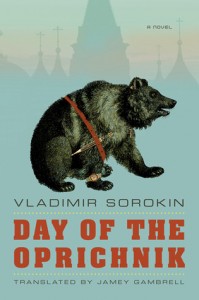
Day of the Oprichnik by Vladimir Sorokin

Posted March 8, 2013 by Michael @ Knowledge Lost in Dystopia / 0 Comments

Day of the Oprichnik by Vladimir SorokinTitle: Day of the Oprichnik (Goodreads)
, 2006
Pages: 191
Buy: AmazonBook Depository (or visit your local Indie bookstore)

Welcome to new Russia, where the Russian Empire has been restored back to the draconian codes of Ivan the Terrible. Corporal punishment is back and the monarchy is divided once again, but this is the future, the not so distant future for the Russian empire, or is it? Day of the Oprichnik follows a government henchman, an Oprichnik, through a day of grotesque event.

Day of the Oprichnik is a thought provoking Science Fiction novel of the worst possible Russia imagined. But while the book is dark, it also is hilarious and then it has this wonderfully satirical nature about it. Komiaga is the narrator of this gem, an anti-hero and one of the Tsar’s most devoted henchmen. While the humour and satire throughout this book is grotesque, this book is a perfect example of great contemporary Russian literature as well as a political critique.

I will admit I like these types of modern Russian Science Fiction novels, like Super Sad True Love Story, you have this wonderful dystopian backdrop as well as the high tech gadgets like the “mobilov” and then you use this to create delightfully thought provoking plot riddled with satirical elements. These witty and intelligently written books are what I live for.

Komiaga is one of the elites, enforcing the laws of the land, helping the Czar’s to rule with an iron fist for the sake of the motherland and the Russian Orthodox Church. This is my first Vladimir Sorokin novel and I would like to compare this novel to one of Philip K. Dick’s (The Man in the High Castle to be exact); there is this wonderfully crafted story and you have these philosophical and political ideas that stick with you well after you have finished the book.

The Telegraph named this book one of the best for 2011 and the New York Review called Sorokin “[the] only real prose writer, and resident genius” of late-Soviet fiction”, just to give you an idea of what to expect. Day of the Oprichnik is deliciously complex, full of garish science fiction and hallucinogenic fish. Komiaga’s day might not be a typical one but it’s full of executions, parties, meetings, oracles, and even the Czarina.

I loved every moment of Day of the Oprichnik, even the moments that made me think “WTF” and for all of the people that have read this book, I want to say one word that will mean something to you but not the others, the word that the person who recommended this book to me said when I finished. That word is “caterpillar”. For everyone else; read the book, enjoy the satire, black humour and Science Fiction elements of this book and also find out what I mean.


House of Leaves by Mark Z. Danielewski

Posted November 29, 2012 by Michael @ Knowledge Lost in Book of the Month, Horror / 0 Comments

House of Leaves by Mark Z. DanielewskiTitle: House of Leaves (Goodreads)
Author: Mark Z. Danielewski
Published: Random House, 2000
Pages: 706
Genres: Horror
My Copy: Personal Copy

Buy: AmazonBook Depository (or visit your local Indie bookstore)

Johnny Truant searches an apartment for his friend and finds an academic study of a documentary film called The Navidson Record. This film investigates the phenomenon of the Navidson’s house where the house is larger inside than the outside. Initially it’s less than an inch difference but it keeps growing. The only problem with all of this is there is no evidence of this documentary ever existing. The book House of Leaves is that academic study (with all the footnotes) mixed with Johnny’s interjections, transcripts from the documentary and anything else.

This debut novel of Mark Z. Danielewski tries to mix a horror novel with some romance and satire but it mainly focuses on just how unreliable a narrator can be. I’ll be honest with you; I struggled to work out if I should review this as a piece of literature or as art, so I’ve done both and you can find my art review. Danielewski has really come up with a unique idea here, it’s almost the literary equivalent of The Blair Witch Project; there is a lot happening on the pages but the reader never gets a full grasp on what is actually happening.

The first 150 pages of this book were quite enjoyable, there were some funny moments and it gave you a real feel for what was going on. But then everything turns completely weird and I found myself raging and sometimes going insane. This is by no means an easy book to read, more of an exploration in the postmodern idea of Post-structuralism. I don’t pretend to understand postmodern literature but it was interest to see what Mark Z. Danielewski does in this book

You’ll either love or hate this genre blending novel; for me, I hated the story. I think my wife got more enjoyment out of watching me rage than I did with reading it. House of Leaves is known as Ergodic literature, which requires the reader to navigate the text in a non-traditional way; this is the first time I’ve seen a book like this. Everyone will have a different interpretation of this novel, so I would love to hear what others thought. Also make sure you check my post about this book as an art form.