Tag: The Castle

Invitation to a Beheading by Vladimir Nabokov

Posted May 19, 2013 by Michael @ Knowledge Lost in Classic / 0 Comments

Invitation to a Beheading by Vladimir NabokovTitle: Invitation to a Beheading (Goodreads)
Author: Vladimir Nabokov
Published: Vintage, 1936
Pages: 240
Genres: Classic
My Copy: Personal Copy

Buy: AmazonBook Depository (or visit your local Indie bookstore)

In this bizarre and irrational world, Cincinnatus has been convicted and condemned to death by beheading for gnostical turpitude, an imaginary crime with no definition.  Cincinnatus spends his remaining days in prison where he is visited by the chimerical jailers, an executioner who masquerades as a prisoner, and his in-laws. When Cincinnatus is finally brought out to be executed, he simply wills his executioners out of existence: they disappear, along with the whole world they inhabit.

There is no denying that Invitation to a Beheading is a weird novel; often compared with Franz Kafka’s The Castle, it is important to know that Vladimir Nabokov had not read any German novels, let alone Kafka when writing this. The reason this is important is to avoid trying to compare the two novels; sure they have similarities but they are still also vastly different. Originally published as a serial, with the title Sovremennye Zapiski (Contemporary Notes), Nabokov has stated while Lolita holds his greatest affection, this novel holds his greatest esteem.

While people call this Kafkaesque, the impossible and dreamlike world reminds me more of Haruki Murakami’s style. From the very start the reader understands there is something not right about this world, this reminded me of Hard-Boiled Wonderland and the End of the World. I got the feeling that this wasn’t reality but a world constructed in Cincinnatus’ mind based on his fears, doubts, and insecurities. Cincinnatus’ enemy is the society he’s created and the people of that society act according to ridiculous rules that have been set. We never know what gnostical turpitude is and this will probably remind people of Kafka’s The Trial. Cincinnatus is rebelling against the construction of this reality and the rules the people of this society observe and perhaps this is what makes him a criminal.

Maybe gnostical turpitude is the crime of being different from all the other people in this reality. Maybe Cincinnatus is being oppress for his ideas and his nature. Maybe he is so different from everyone around him; he has an internal depth that the others lack. A lot like Lolita, Vladimir Nabokov has a way about his writing that just leaves you with so many questions that you need to think through, this whole reality and society leaves me perplexed. Though this is the point; life isn’t simple and being an outsider sometimes feels like you are Cincinnatus in a bizarre reality.

While this book primarily looks at society and oppression it also looks at human connection. Cincinnatus desires to connect with his wife Marthe, despite her unfaithfulness and lack of concern for him. The one thing he craves the most is to make a connection and she felt like the logical choice; also the fact that he loved her helped. He begs her to come alone and reveal her true self to him but there is always something that interferes with the communicating.

While this was a very odd book, Vladimir Nabokov is just a brilliant writer and that really makes up for the weirdness. Also the weird and bizarre act as motifs within the narrative and without the symbolism and meaning it would just be trippy book. Nabokov does a good job of weaving his messages and ideas while entertaining the reader in unexpected ways. Most people only ever read  Lolita by Vladimir Nabokov and I think that means they miss out on his brilliance, I hope to read more; currently on my To Be Read list is Mary, Pnin and Pale Fire. Are there any others I should add?
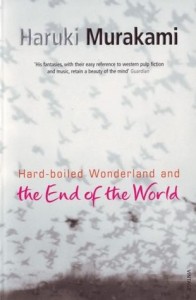

Hard-Boiled Wonderland and the End of the World by Haruki Murakami

Posted April 29, 2013 by Michael @ Knowledge Lost in Book of the Month, Literary Fiction, Magical Realism / 0 Comments

Hard-Boiled Wonderland and the End of the World by Haruki MurakamiTitle: Hard-Boiled Wonderland and the End of the World (Goodreads)
Author: Haruki Murakami
Translator: Alfred Birnbaum
Published: Vintage, 1985
Pages: 400
Genres: Literary Fiction, Magical Realism
My Copy: Personal Copy

Buy: AmazonBook Depository (or visit your local Indie bookstore)

In the future, Tokyo remains the technology powerhouse it is today. With the major advances in technology, data security has become more valuable; problem is all codes can be broken if you know how. The Calcutec is a human data processor/encryption system who has been trained to use his bio-algorithms implant and subconscious for encryption. A new comer to a strange, isolated walled town known as “The End of the World” is assigned a job as a dream reader. As he finds acceptance within the town, his mind begins to fade; or has it only been suppressed?

Hard-Boiled Wonderland and the End of the World tells the story of a split between two parallel narratives from different worlds. The consciousness and the unconscious mind; “Hard-Boiled Wonderland” refers to The Calcutec’s life as an encryption machine while “The End of the World” is his subconscious world. The two stories are told in alternating chapters as the reader slowly discovers the mysteries connecting these two worlds together. Hard-Boiled Wonderland is a homage to Raymond Chandler and hard-boiled fiction, as well as to science fiction and cyberpunk and “The End of the World” has similarities to Franz Kafka’s The Castle.

The major theme within this book is the nature of consciousness; both narratives are constructed around this general idea. While the odd numbered chapters refer to the conscious mind and the even-numbered chapters the subconscious, it is interesting to note they link together with similar themes; for example the song Danny Boy appeared in consecutive chapters. Even characters are shared between consciousnesses; the object of the narrator’s desire, the librarian is a perfect example of this.

Beyond that, the concept of subconscious being able to be controlled or shaped plays out in the entire book. This brings me to another major theme within this novel; the morality of science. The scientific experiments been done on the narrators mind in the attempt to separate the conscious and the subconscious in an attempt create more secure encryptions is an interesting topic. It reminds me a little of Frankenstein when it looks at the dangers of science and its moral implications. The Professor’s experiment killed about twenty people and while he feels remorse for the tragedy he also feels like it was the right choice in the name of progress.

While there are many more themes that would be interesting to explore I wanted to look at character. In both narratives there are no names for any of the characters, each is referred to by their occupation or a general description; from the Narrator, known as The Calcutec, the Librarian, the Old Man, the Professor, the Big Guy and the Chubby Girl. I never really payed too much attention to this while reading the book but referring to a girl as “the Chubby Girl” did bother me; it wasn’t till the very end that I was bothered by the lot. I couldn’t understand why this book was so frustratingly vague and incomplete with character and setting descriptions, I don’t know what the reason behind it would be, except for maybe removing any obstructions that might hinder the understanding of the novel.

Even the narrative is offering a very limited view of what is actually happening but slowly most of the mysteries do become clearer but the entire focus was on the subtext of this book. This wasn’t meant to be about great characters or scenes; this was all about exploring the themes as a way to get Haruki Murakami’s thoughts on the subject across. In a sense, this is what Murakami excels at; if it wasn’t for these well thought out ideas his books would just be odd and weird. This is my second Murakami novel and the first one I’ve actually enjoyed.

I’ve finally discovered what makes Haruki Murakami an author to take notice of; I didn’t find the same thing with 1Q84, I thought it was long winded and repetitive but Hard-Boiled Wonderland and the End of the World really worked for me. I have some issues with the novel, obviously the vagueness was one of the major ones, but overall this was a really interesting journey for me.