Tag: William S. Burroughs

The Adventures into Krissy Kneen and Incredible Erotic Literature

Posted July 25, 2016 by Michael @ Knowledge Lost in Literature / 4 Comments

The Adventures of Holly White and the Incredible Sex MachineSometimes you come across a novel that sounds so weird that you cannot help but consider reading it. For me, while browsing the shelves of Avid Reader, a delightful indie bookstore in Brisbane, I came across Krissy Kneen’s novel The Adventures of Holly White and the Incredible Sex Machine. The premise was simple, a young woman who wears a True Love Waits ring finds herself joining a sex book club. They dedicate themselves to exploring the so called classics of erotic literature. Upon reading this novel, I found this to be a delicious romp of genre blending and surreal sex. In the vain of Memoirs of a Woman of Pleasure but with a blue glow emanating from her vulva. This fact I discovered early in the novel with the line “She wondered what Jack would think on their wedding night when he lifted her skirt to find her glow-in-the-dark vulva providing subtle illumination of their final act of love”.

One of the joys of this weirdly surreal novel was the way Kneen managed to explore the journey of sexual awakening while also recommending some good erotica to the reader. I compare this book with Memoirs of a Woman of Pleasure (or shall I call it Fanny Hill) simply because it explore this journey into sexual pleasure in a similar way. While one book feels more about the empowering nature of desire and the other a perverted fantasy written by someone stuck in prison.

I will admit my experience into erotica is very limited, from a perverted start into the website literotica to a mild curiosity in this genre. One key difference I have found between modern erotica and the classics is intention. For popular authors like Tiffany Reisz, Sylvia Day and E.L. James, their books intend to explore a fantasy, hoping to titillate the reader in one way or another. While in the case of the classics, it was more about exploring something much deeper. Whether it be a sexual awaking (Memoirs of a Woman of Pleasure), the pleasures of the flesh (A Sport and a Pastime) to just using sex for symbolism.

I still have gaps in my reading for this genre, for example Anaïs Nin or Marquis de Sade. Though I am curious to explore it in greater detail. Thanks to Krissy Kneen and her novel, I now have a list to work from. I was pleased to see James Salter kicking off this wonderful novel and I was eager to write down a list books to read…only to find them listed in the back of the novel as well. In my never ending efforts to be well read, I now have some direction when it comes to Erotica.Erotic literature

While I adore the voyeuristic nature of A Sport and a Pastime, I was pleased to see some transgressive erotica gracing the pages of The Adventures of Holly White and the Incredible Sex Machine. One could argue whether these picks should be considered erotic in nature but they do explore sex in an interesting way. Take for example Lolita, there are some beautifully written erotica writing in the novel but this is countered by the disturbing nature of Humbert Humbert. Dolores’ own sexual awakening will be forever tainted by the predatorily nature of Humbert. This can also be explored in Me and Mr. Booker by Cory Taylor and Alissa Nutting’s novel Tampa which takes on the idea of the fantasy of sleeping with the teacher. However for further exploration into this I would recommend a memoir; Excavation by Wendy C. Ortiz.

Then you have something far more disturbing in nature with Story of the Eye by Georges Bataille, which takes sex to a far more depraved level. While this novel will indeed shock and sicken you, the symbolism to be found is what I found undeniably appealing. With the help of some essays combined with this novel called “The Pornographic Imagination” by Susan Sontag and “The Metaphor of the Eye” by Roland Barthes, Story of the Eye transforms into more than a surreal erotic. As I read it, I was disturbed by the mind of Bataille but now I feel sympathetic to his pain.

I was not surprised to see Henry Miller (Tropic of Cancer) or Joseph Kessel (Belle de Jour) was neglected from the pages, I was expecting Naked Lunch by William S. Burroughs to make an appearance. Sex in Burroughs represents power and could have added an interesting dynamic, though this could be just a projection of my love for surrealism. It is pleasing to read a novel that mirrors fragments from the classics. Kneen not only recommends books to Holly White and the reader, she was able to pay homage to the greats.

While my journey into erotica seems to be focused on the classics, I am all too aware that I have not considered literary erotica. I would like to think that a more literary erotic novel would closely resemble what I am interested in rather than just a fantasy aimed to arouse. I know I need to read Affection and Triptych by Krissy Kneen but I do need to try other authors. More research is needed for me and recommendations as well as I continue down this rabbit hole, who knows I may write more about erotica in the future.


Me and the Devil by Nick Tosches

Posted December 12, 2015 by Michael @ Knowledge Lost in Literary Fiction / 0 Comments

Me and the Devil by Nick ToschesTitle: Me and the Devil (Goodreads)
Author: Nick Tosches
Narrator: Rick Zieff
Published: Back Bay Books, 2012
Pages: 400
Genres: Literary Fiction
My Copy: Audiobook

Buy: AmazonBook Depository (or visit your local Indie bookstore)

Aging writer Nick is witnessing the decline of civilisation. One night he meets a provocative young woman in a bar that surprisingly offers to go home with him. This one night unleashed an unholy desire within him. Unable to control his primitive desires, Nick finds his thirst getting strong. His desire for blood quickly becomes the driving force in his life. However, has he just found the key to mortality or has he just unknowingly made a deal with the devil?

Reading Me and the Devil, I notice right away that Nick Tosches is playing with the vampire genre; the idea of old men drinking the blood of young women to gain extended morality. Turning it into a sexual perversion, blood play works really well as a device to explore the vampire mythology. The story basically follows a young nineteen year old in an unhealthy relationship with an older man. It is basically Twilight, exposing many of the problems with the relationship of Edward and Belle.

Although Nick Tosches does a much better job with the relationship, exploring a darker and more brutal nature of an unhealthy relationship. His writing is beautiful and is often compared to William S. Burroughs and Charles Bukowski. I love that gritty nature of the novel and surprising beauty in the language. When it comes to talking about food, Tosches is very detailed and I found myself getting hungry at the food imagery.

Besides the vampire angle, Me and the Devil is a story of a grumpy old man that is angry with the changing world. Interestingly enough that the main character is named Nick Tosches, making this anger autobiographical. If you look at Nick’s website, the ‘about the author’ section simply says “Nick Tosches lives in what used to be New York.” This is a representation of how the character viewed New York, always talking about the old days. When you had little deli’s and mum and pop stores. The quality of the food was so much better back in the old days.

I feel like there is a lot to say about this novel but it would require spoiling the plot and I really think this is a book that deserves to be experience blind. Since Nick is a writer in the novel there are heaps of literary references to obscure and cult classics, which I appreciated. I loved Nick Tosches writing style and need to read more of his books. He is mostly known for his dark and gritty music biographies Hellfire: The Jerry Lee Lewis Story and Dino: Living High in the Dirty Business of Dreams (Dean Martin) and I am interested in reading those books. Tosches also explores a lot of religious themes so I am excited to experience more of his novels.  This is the type of author that you will either love or hate, luckily for me, I have found a new favourite.


Naked Lunch by William S. Burroughs

Posted June 14, 2013 by Michael @ Knowledge Lost in Classic / 5 Comments

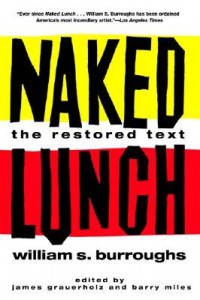
Naked Lunch by William S. BurroughsTitle: Naked Lunch (Goodreads)
Author: William S. Burroughs
Published: Grove Press, 1959
Pages: 289
Genres: Classic
My Copy: Personal Copy

Buy: AmazonBook Depository (or visit your local Indie bookstore)

In a complex and disturbing string of events, William Lee finds himself fleeing from the police. While on the run, this drug addict finds himself journeying across the United States and into Mexico. His travels lead him into the underground world of both drug and homosexual culture. The coun
ter story revolves around the use of mind control by the government and psychiatrists to manipulate and direct the public.

Considered one of the most important novels of the twentieth century, William S. Burroughs’ Naked Lunch is a bizarre cut up narrative protesting the death penalty. You got that the book was trying to do that from the synopsis right? Naked Lunch is a non-linear narrative that does make it really difficult to summarise the plot. Burroughs is famously known for his cut-up narrative; which is a literary technique that can be traced back to the Dadaists in the 1920s. For more information about Burroughs and cut-up check out my post called William S. Burroughs & Surrealist Writing Methods.

The book looks into two key groups; the drug and homosexual subcultures. The two unite early in the novel by the narrator but are never mutually exclusive. At the start of the book William Lee believes he will be punished more harshly for his involvement in homosexual activities than using and selling illegal drugs, which is really sad to think that people are being still victimised over their sexuality and drugs have just become socially acceptable.

Then the subplot largely focuses on the way in which psychotherapy combines with the government to institute mind control. Dr Benway experiments on ways to manipulate the minds of his patients in order to further his research. With no ethical consideration, he often changes his patient’s sexual identity and then tries to cure them. He also creates a mental controlling device for the towns as a way to use the population for his sadistic experiments and put them through psychological torture. Many of these experimental towns are based on the utopian idea and Burroughs like to explore the problems with the idea in a rather sinister way.

So how is this novel a protest to the death penalty? Well that would be in the same way Jonathan Swift’s Modest Proposal ideals with economics. William S. Burroughs uses Juvenalian satire to highlight the barbaric, disgusting and anachronism of capital punishment. While the sex in Naked Lunch can be considered as mutual satisfaction sometimes, it is also used as a metaphor (especially in the more violent sexual acts) for defeating an enemy, self serving idol worshipping and capital punishment. The results of these metaphors are often confusing, shocking, taboo and sickening. Sex is a powerful tool with this novel and while it does look at sex and relationships in a positive way (rarely), the majority is used to symbolise the dark and cynical themes within the book.

William Lee is obviously William S. Burroughs alter ego and the book can be read as a semi-autobiographical novel through a serious drug addiction but like Infinite Jest there is so much more going on. This book did remind me a lot of Infinite Jest; not just with how it dealt with drug addiction but the way it used very dark themes to look at other social issues. William S. Burroughs had a similar experience to the narrator, taking trips around the world in order to avoid being arrested. Even the addition and sexual experimentation is similar to the authors own experiences, as part of his attempts to separate himself from mainstream culture. William S. Burroughs is a fascinating man and I’m interested to learn/blog more about him.

I’m not sure what the difference between the original and restored text but I did read the restored edition. While this was a really weird and somewhat difficult book to get though there is so many interesting themes to explore that I feel very satisfied by completing this novel. It is disturbing and some of it will make you feel sick to your stomach and I can understand why people hate this book. This is a really intense novel that will drain you emotionally and mentally. The book is full of violent and graphic sex, so it will never be for everyone but I can see why it is an important novel, not just because of the obscenity trial but also for all the themes.

I’ve not read many Beat novels in my life, I think On the Road was the only other one but I do like the gritty and surreal approach both books take. I’m not sure if this is a major theme for all beat novels but if so, I will have to read more. I doubt I’ll ever return to Naked Lunch simply because of how disturbing some of the scenes are but I know I can be completely satisfied with having read this one and judging by this review, I can also take comfort in the fact I was able to pick it apart and understand some of the themes.


Monthly Review – May 2013

Posted May 31, 2013 by Michael @ Knowledge Lost in Monthly Reading / 0 Comments

As May comes to a close, like all months, I want to have a quick look at what happened. First of all I managed to get fully up to date with my reviews; a few months ago I was about 20 reviews behind, waiting to be posted. Now when I finish a book the review will go up within a few days (sometimes more) and this frees me up to do other bookish posts. This is so exciting because I really like to write my thoughts about the world of literature without being confined to reviews. Also as you can see we are smack in the middle of being green with envy of everyone attending the Book Expo of America (BEA). I’m participating in Armchair BEA again and this will hopefully mean new blogs and new people to talk to. I’m also currently overseas so I’ve scheduled all these posts, I still have access to internet but I wanted to be free to comment and read instead of writing blog posts.

As for this month, the book club theme was Supernatural and we got to read the classic Victorian Gothic novella Strange Case of Dr Jekyll and Mr Hyde. My review went up yesterday and there have been some interesting discussions about the book and its influences in modern pop culture over at Goodreads if you’ve missed it. Next month’s book is going to be a little obscure, something I’ve not heard of; I’m really looking forward to diving into The Dud Avocado by Elaine Dundy.

Last month I was in the middle of a reading slump so I was worried that May would be a terrible month for me but I’m pleased to say the slump didn’t last long. I was able to read heaps of great books including Invitation to a Beheading, Main Street and The People of Forever Are Not Afraid. Interesting enough the highlight of the month was none of those books, but a reread of The Great Gatsby; I just enjoyed returning to that novel and then picking it apart trying to understand it. I would love to know what your highlights of the month were or even what you read this month.

My Monthly Reading


William S. Burroughs & Surrealist Writing Methods

Posted November 19, 2010 by Michael @ Knowledge Lost in Literature, Writing / 2 Comments

Post-modern author, William S. Burroughs is best known for his experimental writing style.  He was a primary figure of the Beat Generation and a major influence in popular culture as well as literature.

In 1959, he released Naked Lunch which he described as “Automatic writing gone horribly wrong”. Previously, I have posted about Automatism, but it is a process of writing where the writer tries to avoid conscious thoughts.  Burroughs has said that Naked Lunch wasn’t a book he wanted to write, but he had no choice but write it: he couldn’t write anything else.  When it came to using André Breton’s method of automatism; where the subconscious focuses on one image or phase, Burroughs found his subconscious was taken over by a hostile entity. The results speaks for its self, Naked Lunch is not only full of obscene language but completely weird.

William S. Burroughs moved to Paris in the 1960’s where he met a painter named Brion Gysin. The two of them are often credited for rediscovering an old surrealist method known as Cut-up. This technique is when you take a finished piece of text, cut it up and rearrange it for a completely new novel. Burroughs experimented with this technique, which resulted in The Nova Trilogy; also known as The Cut-up Trilogy. The first book in the trilogy, The Soft Machine, was the result of the two on a journey (with the aid of some recreational drugs) to find hidden meanings in Naked Lunch. Using the cut-up technique, Burroughs wanted to find the answer to the question that had been plaguing him; the question of control; why did he have no control over the writing of Naked Lunch? The Soft Machine was first published with 182 pages; though in the second edition Burroughs removed 82 pages, replacing them with another 82 pages & with the other 100 pages, he rearranged and restructured using further cut-ups.

William S. Burroughs will always be known for his Beat influences, political trenchancies, cultural influences, his satirical writing and hopefully his experimental use of surrealist writing methods.


Olympia Press; Controversy & Erotic Fiction

Posted November 16, 2010 by Michael @ Knowledge Lost in Literature / 4 Comments

It’s hard to imagine a life without a freedom to talk openly about sex. Before the sexual revolution things were completely different and there were two publishers that pushed the boundaries. In 1929 an English man named Jack Kahane formed Obelisk Press, based out of Paris. His goal was to publish books other publishers would not touch for fear of prosecution. Though Obelisk Press went bankrupt, it paved the way for dbs (dirty books) later known as Erotic Fiction. Obelisk Press published books like Henry Miller’s Tropic of Cancer, DH Lawrance’s Lady Chatterley’s Lover & James Joyce’s Haveth Childers Everywhere (often considered a working progress of Finnegans Wake).

While Jack Kahane laid the ground work, it was his son Maurice Girodias, who pushed the envelope on censorship. In 1953 Maurice started Olympia Press, a rebranded Obelisk Press which came under fire straight away for Austryn Wainhouse’s English translations of Marquis de Sade’s Justine. In a move that put Olympia Press under a lot more fire, Maurice started offering good money for dbs, though most of these books were eventually banned they were able to make a small profit before being removed from the shelves. Obelisk Press were responsible for such books like Lolita by Vladimir Nabokov, The Naked Lunch by William S. Burroughs & The Ginger Man by J. P. Donleavy.

Though both publishers ended in bankruptcy, they did pave the way with controversy and erotic fiction in English literature. Apart from the controversy it start the ball rolling for other authors and took the risk in publishing book others wouldn’t. What would books be like nowadays if no one printed books like Lolita, The Naked Lunch or James Joyce’s works?