Author: Michael @ Knowledge Lost

Animal Farm by George Orwell

Posted May 29, 2010 by Michael @ Knowledge Lost in Classic / 0 Comments

Animal Farm by George OrwellTitle: Animal Farm (Goodreads)
Author: George Orwell
Published: Penguin, 1945
Pages: 112
Genres: Classic
My Copy: Personal Copy

Buy: Amazon (or visit your local Indie bookstore)

‘Animal Farm’ is truly an interesting story; we all know what the story represents but George Orwell portrayed communists Russia in World War II really well. The book was short and I was able to read it in one day, almost in one sitting. I think we could spend a long time discussing which animal represents which Russian and working out which battle was The Battle of the Cowshed or The Battle of the Windmill. I did especially enjoy the flag (The Horn and Hoof Flag reminiscent of the hammer and sickle), Squealer (propaganda pig) and Moses the Raven (the Russian Orthodox Church). It is definitely one of those books you need to read at least once in your lifetime. I think I enjoyed it more than ‘Nineteen Eighty Four’.


Spirituality and The Arts

Posted May 21, 2010 by Michael @ Knowledge Lost in Culture / 0 Comments

I just read an article from Time-Online called ‘The Spiritual History of English’, which talks about a book by Andrew Thornton-Norris of the same name. The book bases its arguments on the T.S Eliot’s premise that “culture of a people as an incarnation of its religion”. According to Thornton-Norris, literature is the result of liberalism in politics. He also claimed that previously “tradition prevented art or the individual – and relativism in belief” and as for modern art “Now almost every word that is written is a manifesto, a statement, a theology or anti-theology, rather than an unselfconscious work of art, a contribution to the tradition or communal enterprise, as it was in the Latin Classical tradition.”

I know spirituality has played a huge part in the Arts (eg. Caravaggio or any painter back then, John Milton’s Paradise Lost and Dante’s Divine Comedy) in the past but does it play much of a part now?


Foucault’s Pendulum by Umberto Eco

Posted May 10, 2010 by Michael @ Knowledge Lost in Historical Fiction, Speculative Fiction / 0 Comments

Foucault’s Pendulum by Umberto EcoTitle: Foucault's Pendulum (Goodreads)
Author: Umberto Eco
Translator: William Weaver
Published: Vintage, 1989
Pages: 623
Genres: Historical Fiction, Speculative Fiction
My Copy: Personal Copy

Buy: Amazon (or visit your local Indie bookstore)

Foucault’s Pendulum may not be for everyone and I will try not to give away any of the story. Personally, I really enjoyed the way it was written.  I went into the book knowing it was about Secret Societies and conspiracy theories, but as I kept reading the book, I started to think it was real. I had to snap myself out of this thought process. The story follows a group of publishers who started deconstructing and analysing what they knew about the Templers, eventually they were drawing connections to other secret societies like the Rosicrucians, the Freemasons & the Jesuits. I don’t know how much of the information was real, but this book was written in such a way that you may get sucked in. It defiantly isn’t a book for everyone, it is very content heavy, but well worth the read if you have any interest in the topic.

If you want to know more about this book, check out my previous post about Foucault’s Pendulum.


What I Learnt From Script Frenzy

Posted May 6, 2010 by Michael @ Knowledge Lost in Writing / 0 Comments

Now that my first attempt at Script Frenzy is over, I want to share what I learnt from the experience. For those who don’t know what script frenzy is; during the month of April people join the challenge of writing a 100 page screen play over the span of the month. Similar to NaNoWriMo, it was an enjoyable experience and I want to share a few things that I learnt from it .

  • Screenplays require so much more planning. Unlike a story you need to know in advance what you want to happen, what the characters are going to do and where it will be set. I liked NaNoWriMo for the simple fact that I didn’t have to plan; I could write and see where it will take me and what will happen.
  • Screenplays and I don’t mix. I’ve discovered that I like my protagonist to have more of an inner monologue which just doesn’t work too well in a script.
  • There are plenty of great and free screenwriting tools out there; for planning and writing scripts (eg. Celtex and Scripped)
  • I’m not nearly as discipled in my writing as I would like to be

Script Frenzy was an enjoyable experience but possibly not one I would do again. Screenwriting is very detailed and require more planning. For me; I think my writing style and brain don’t work too well in this style.


The Buddy System

Posted May 4, 2010 by Michael @ Knowledge Lost in Writing / 0 Comments

Have you got yourself a writing or blogging buddy? What are the benefits of a buddy? This is something I’ve personally been thinking a lot about lately and I’ve thought of 5 major reasons to get yourself a buddy;

  1. Motivation/Accountability – I’m often procrastinating and sometimes I need that little push to actually get off my ass and back writing. I’m lucky to have people that often ask about my blog and if I’ve updated, not so much when it comes to writing, simply because my blog is my primary focus.
  2. Proofreading – I’m really bad at proof reading so it’s nice to have someone who will find any spelling or grammar mistakes that you may have missed
  3. Constructive Criticism – while your buddy is checking for spelling mistakes it’s also handy for them to point out sections that didn’t flow right or even didn’t full explain what was going on.
  4. Collaboration – especially in blogging it’s nice to be able to have someone write a guest post and offer a new perspective for your readers. Also it’s nice to be able to play around with a story with your buddy and see where it takes you.
  5. Strategy – you often need someone to bounce ideas and vent to; often a buddy would be the perfect person to go to when you’ve hit a wall and need help getting around it.

What to look for in a writing buddy?

Obviously you want to find a writing buddy that you can trust and rely on, I’m lucky I’ve got my wife who is always one of my biggest critics and knows what I’m trying to write (most of the time). Thought she doesn’t write much, I think she covers all the relevant requirements in a writing buddy.

Even if you don’t have a writing buddy, your blog community is another amazing source. They may not cover every aspect of a writing buddy but they do become a reliable source for feedback and growth. I personally feel like I gain very valuable insight form my readers.

All in all there, it’s important as a writer to know how to take criticism and how to apply it. As a writer or a blogger, it’s important to grow and evolve into the best you can be; and a writing buddy is the perfect companion on your writing journey.

What are your opinions on Writing Buddies?


Evolution of the English Language

Posted April 22, 2010 by Michael @ Knowledge Lost in Linguistics / 16 Comments

Recently I wrote an entry about pop culture destroying literature and in one comment it was mentioned the beautiful language the classics were written in. This got me thinking; why did the English language have to evolve?

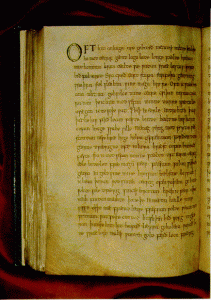
I did some research on the topic, beginning with the Anglo-Saxons. The Anglo-Saxons’ language was already a blend of dialects from West Germanic tribes. Add some dialects from the Norse, Frisian and the Dutch and you start to see the English language form. Now skipping all the history lessons of basically everyone invading England and leaving their make on the English language, you begin to form what is now known as Old English.

This is where it begins to get tricky and hard to follow, so stick with me while I try to explain the old English to modern English transition. From what I can tell Old English pronounced P, b, t, d, m, n, l, and r as we do today but rarely use letters like k, q, v, x, and z, then you have non-modern letters like thorn (þ) and eth (ð).

The period between 1150 and 1475, there were three major dialects of Middle English; Northern (Northumberland), Midlands (Mercia) and Southern (Wessex). From what I can work out, Modern English was like a major merger between the three dialects.

This began the basics of what we call the Modern English language. One of the biggest reasons behind the evolution of language is pronunciation. Words were pronounced vastly different in a lot of cases to their modern pronunciation. Over the years it continued to evolve with influences from Latin, Greek, French, etc. Later on during conflicts with the French, the English dropped the letter u in words ending –our. Though the English picked this practice back up later, the Americans never did (this is why Americans can’t spell).

The 19th Century is where I would have liked the evolution of the English language to stop, but unfortunately it continues. Now the English language has come to a point of dropping letters for ‘IM English’. I hope this won’t be the next evolution in English, but it looks like it is moving that way.

I would love to know what others think of the Evolution of the English Language, as well as what I may have missed.

For more information about the history of the English language in America, a friend recommended a book called Made in America by Bill Bryson. Bill Bryson’s book explores the history of the English language in the United States and the evolution of American culture.


IO9’s 20 Science Fiction Novels That Will Change Your Life

Posted April 15, 2010 by Michael @ Knowledge Lost in Listology / 0 Comments

I just stumbled across a list of 20 Science Fiction Novels that Will Change Your Life on the io9 blog. While I haven’t read all the books there are some great choices there and I thought I should share it with my readers as well. Whether you agree or not, this is an interesting list;

  1. Frankenstein (1818), by Mary Shelley
  2. The Time Machine (1895), by H.G. Wells
  3. At the Mountains of Madness (1931), by H.P. Lovecraft
  4. I, Robot (1955), by Isaac Asimov
  5. The Dispossessed (1974), by Ursula LeGuin
  6. Kindred (1979), by Octavia Butler
  7. Wizard (1979), by John Varley
  8. Consider Phlebas (1987), by Iain M. Banks
  9. He, She, and It (1991), by Marge Piercy
  10. Sarah Canary (1991), by Karen Joy Fowler
  11. A Fire Upon the Deep (1992), by Vernor Vinge
  12. The Bohr Maker (1995), by Linda Nagata
  13. The Sparrow (1996), by Mary Doria Russell
  14. Cryptonomicon (2000), by Neal Stephenson
  15. The Mount (2002), by Carol Emschwiller
  16. Perdido Street Station (2002), by China Mieville
  17. Down and Out in the Magic Kingdom (2003), by Cory Doctorow
  18. Pattern Recognition (2003), by William Gibson
  19. Newton’s Wake (2004), by Ken MacLeod
  20. Glasshouse (2006), by Charles Stross

For those of you not familiar with io9, it’s a blog part of the gawker network that focuses on the subjects of science fiction, futurism and advancements in the fields of science and technology.


Five Books That Changed My Life

Posted April 12, 2010 by Michael @ Knowledge Lost in Literature / 0 Comments

As most of you may know, I never use to be much of a reader; it was only last year that I decided to discipline myself to read more. So I thought I might as well share with you five books that really had strong effects on me and my views on life.

  • Markheim – This short story by Robert Louis Stevenson is definitely my favourite of his works I’ve read so far. The concept is amazing, but I won’t give you any spoilers.
  • Slaughterhouse-Five – And so it goes…nothing could have prepared me for a book like this. It’s unique in its style and left me pondering it for months after reading it.
  • Wuthering Heights – I know one reader that would be happy to see this on my list. The reason it does grace this list is the simple fact, that it defied all expectations. I went into this book thinking I knew what the story was about, but it shattered every expectation and left me with a dark and beautiful tale.
  • Frankenstein – It is apparent that this book has changed my life. I’ve mentioned it before in reference to pop culture and even a Smashing Pumpkins song. This book is simply a brilliant book on very real social issues.
  • Hey! Nietzsche! Leave them kids alone! – This book is the reason this blog exists. Craig Schuftan opened my eyes to a world I didn’t know by providing some interesting connections between the Romantic Period and today’s music scene.

Write What You Know?

Posted April 8, 2010 by Michael @ Knowledge Lost in Writing / 0 Comments

People say to write what you know, but what if your life is boring? Or what if the only think in your life that is interesting enough to write is an emotional and heart wrenching topic? This is something I’ve was thinking about all night last night. I know writing is a painful and emotional process for me, but as a writer am I willing to open old wounds and real live past mistakes and heart aches just to write a story?

The question is; should you write what you know if what you know is to painful to write about?


Did Pop Culture Destroy Literature?

Posted April 8, 2010 by Michael @ Knowledge Lost in Culture, Literature / 0 Comments

Isn’t it interesting that in pop culture, we think we know icons like Dracula, Frankenstein, Dr Jekyll and Mr Hyde. We know their basic story but until we read the books that made these characters famous, and then we realise that we have missed so much of the concepts and story.

Frankenstein is referenced  in countless  movies but ia most commonly associated with the monster, not the doctor. It’s just a tale of a monster terrorising the villages and  until you read the book you don’t understand it at all. I remember reading Frankenstein for the first time and discovering this isn’t a book about a monster.  This is a book about society and how we judge and treat people.

When it comes to Dracula, we all know the story of the Vampire, Count Dracula from Transylvania, but we don’t have a clue on just how interestingly the book was written. I went into the book thinking I was going to be reading a novel, but I discovered a series of letters, diary entries and ship logs that told this story in such an unsuspecting way.

Now unfortunately pop culture has ruined the plot of The Strange Case of Dr Jekyll and Mr Hyde but it has left out a lot of the interesting concepts. The book explores the idea of separating the Good from the Evil in the doctor, who was trying to explore the evil inside of himself and still live with his conscience clear. Or maybe it’s a story about living life with split personalities.   There are so many interpretations, but all in all its a book about the duality of human nature.  Pop Culture just tells a story of a doctor discovering this potion by accident.

The interesting thing is that no one really knows where Mr Hyde goes all those nights and what he does. This has lead to many of conversations through the ages trying to work out what Mr Hyde was up to; Some say it’s a metaphor for Homosexuality but I believe it’s open for personal interpretation. So the reader can make his own discovery on their evil side.