Posted January 27, 2010 by Michael @ Knowledge Lost in Culture / 0 Comments

Canadian philosopher/scholar Marshall McLuhan’s work is sometimes referred to as the cornerstone of media and communication theories. But what exactly does the phrase “The Medium is The Message” mean?
Well you could read his book “Understanding Media: The Extensions of Man” to understand it fully or I will attempt a brief sum up. McLuhan believed that the media and not the content that had the affects the society. Let me try to break this down by trying to explain this by using three different times of History.
Ear Oriented: In the early days stories and knowledge was passed down verbally, from elders to the younger. This was the social norm; to get all the knowledge told to them verbally. This means that the media around back; their medium for getting the message out there would be verbally.
Eye Oriented: With the invention of the printing press came a change in the way people would get there news. Socially, people changed the way they receive their news. Have you heard the saying ‘I won’t believe it until I see it in black and White’? That is a shining example of the shift in society.
Now Days: Now with the invention of Television and The Internet people will get their news both audibly and visually. The AV society is moving towards a different and completely new way to obtain the knowledge. I have no fancy name for it like McLuhan did with Ear and Eye Oriented but I believe that people are choosing to gain the information themselves.
Soon it will be “You are the Message”
With the resources on the internet, people are choosing not to believe things from one source but looking though different sources to gain a better understanding.
Does this mean we will have a society with individual opinions?
Will people become only have a tiny bit of information on a broad range of subjects? And will this be the end of the so-called experts?
Posted January 27, 2010 by Michael @ Knowledge Lost in Culture / 0 Comments
Benjamin Franklin was a brilliant scientist but one thing people don’t know about him, is his desire to be morally perfect. This is often known in philosophy as Perfectionism. It is important to know that the perfectionism does not believe that one can attain a perfect life or state of living. Rather, a perfectionist practices steadfast perseverance in obtaining the best possible life or state of living.
Benjamin Franklin set himself 13 virtues to live by in his attempt;
- “TEMPERANCE. Eat not to dullness; drink not to elevation.”
- “SILENCE. Speak not but what may benefit others or yourself; avoid trifling conversation.”
- “ORDER. Let all your things have their places; let each part of your business have its time.”
- “RESOLUTION. Resolve to perform what you ought; perform without fail what you resolve.”
- “FRUGALITY. Make no expense but to do good to others or yourself; i.e., waste nothing.”
- “INDUSTRY. Lose no time; be always employ’d in something useful; cut off all unnecessary actions.”
- “SINCERITY. Use no hurtful deceit; think innocently and justly, and, if you speak, speak accordingly.”
- “JUSTICE. Wrong none by doing injuries, or omitting the benefits that are your duty.”
- “MODERATION. Avoid extremes; forbear resenting injuries so much as you think they deserve.”
- “CLEANLINESS. Tolerate no uncleanliness in body, cloaths, or habitation.”
- “TRANQUILLITY. Be not disturbed at trifles, or at accidents common or unavoidable.”
- “CHASTITY. Rarely use venery but for health or offspring, never to dullness, weakness, or the injury of your own or another’s peace or reputation.”
- “HUMILITY. Imitate Jesus and Socrates.”
Posted January 25, 2010 by Michael @ Knowledge Lost in Literature / 0 Comments
 The more I read the more I discover, but also the more I find that I need to read. I keep finding more and more books that I really want to read. Like the ‘1001 Books you must read before you die’ I want to read all of them. I never use to be a read and I wish I trained myself to read when I was younger. I feel like I’ve missed so much by not reading. But now, with a passion for writing has also come a passion for reading and I want to explore this passion more and more.
For some reason I seem to ignore most of the modern books and I rather go for the classics. Not that it’s a bad thing; It is a great thing, though I feel like I’m reading a language that doesn’t get used anymore. The old 1800’s books have such beauty and elegance in the way they are written, it’s a shame that the English language has changed.
So If you look up the top of my blog I’ve now added my Reading Goals for people to look at and recommend more books to read.
Posted January 25, 2010 by Michael @ Knowledge Lost in Philosophy / 4 Comments
 I’ve been thinking a lot about Philosophy lately. As most people know philosophy is the study of general and fundamental problems concerning matters such as existence, knowledge, values, reason, mind, and language. It is an interesting concept and something I truly want to understand in greater detail.
So like most of my research, I started at Wikipedia, but that’s where I stopped. I’m not going to learn about Philosophy researching it. From what I can gather it is a lifelong pursuit. The word ‘philosophy’ comes from the Greek word ‘philosophia’ which basically means “love of wisdom”.
So there you have it, Philosophy wrapped up in three simple words; Love of Wisdom. I know that love and that desire to understand the world is almost an unreachable target and many spend their lives in the pursuit, so for now I’m just going to look at those people first. Learn from them before even considering learning the ways of the world.
Posted January 24, 2010 by Michael @ Knowledge Lost in Writing / 0 Comments
 I’ve been reading a few articles about how to cure writers block, but I thought it was about time I weighed in on the subject. I’m in no means an expert or have any answers what so ever, but I have found something that has been writing for me lately.
For me I’ve got a passion for music, so what I did was start a music blog, I’ve written a music review every day as well as adding interesting music news. This has gotten me into the habit of writing something every day.
As this habit has grown I’ve started to build an addiction. I feel like I need to write more and more every day. I’ve decided to write a cultural lesson now and I’ve also been writing ideas and concepts to work into stories.
Also there is something else that helps me and is a good idea for every aspiring writer. I believe it was Stephen King that gave this piece of advice to people wanting to be writers. He said “If you don’t have the time to read, you don’t have the time or the tools to write.” So read, read, read! Read everything and anything, just to get styles concepts and ideas planted in your mind.
When asked, “How do you write?” He also said “one word at a time.”
Posted January 24, 2010 by Michael @ Knowledge Lost in Art, Culture / 0 Comments

I mentioned avant-garde in the previous entry so I thought it was only fitting to look at the originals. The Pre-Raphaelites Brotherhood has been considered the first avant-garde movement in art. They throw away the rule book of art to create something different and exciting. They believed that the Classical poses and elegant compositions of Raphael in particular had been a corrupting influence on the academic teaching of art, hence the name Pre-Raphaelites.
The brotherhood rejected the rule and formula of art that were been taught by Sir Joshua Reynolds and the Royal Academy of Art. They considered the work ‘sloppy’ and formulaic, they believed that Sir Sloshua (Sir Joshua) was stopping them explore other styles, they wanted to return to the abundant detail, intense colours, and complex compositions of Quattrocento Italian and Flemish art.
The brotherhood stop up against the norm and followed their own doctrine:
- To have genuine ideas to express;
- To study Nature attentively, so as to know how to express them;
- To sympathise with what is direct and serious and heartfelt in previous art, to the exclusion of what is conventional and self-parodying and learned by rote;
- And, most indispensable of all, to produce thoroughly good pictures and statues.
Influenced by Romanticism, they thought that freedom and responsibility were inseparable so they followed the principles of realism. The Brotherhood was met with lots of controversy in there struggle against the Royal Academy of art, but ultimately they influenced and changed art history as well. When the brotherhood disbanded the artists who had worked in the style still followed these techniques (initially anyway) but they no longer signed their works with “PRB”
Posted January 24, 2010 by Michael @ Knowledge Lost in Literature / 2 Comments
Because this book is known as one of the most difficult works of fiction in the English language, I thought I would explore the book a little more. No, I have not and probably never will read Finnegans Wake by James Joyce (Ok, I lie, I would probably try to read it, if my passion for modern culture continues) but I like to learn more of these types of books.
The thing I found interesting about what I’ve learnt is this book is that the entire thing is written in an idiosyncratic language, consisting of multilingual puns and portmanteau words. This to me would mean that there would never be a correct interpretation of this book; it’s just a twisted world full of no answers.
The book is a non linear story which attempts to recreate the experience of sleep and dreams. Which is interesting because back in the early 1900 Freud wrote a book called “The Occurrence in Dreams of Material from Fairy Tales”. In this he made mention of dreams been a coded message waiting to be cracked. So it seems Finnegans Wake was just James Joyce deciding to follow this idea and blend it with his obvious love of puns to create a completely unorthodox book.
For a book that took seventeen years to write, it’s hard to think what the point of it is. Is this just a social experiment that Joyce was doing? Maybe he was just setting out to defy all conventions of plot and character construction. What ever the reason was it remains on of the most interesting ideas I’ve seen so far.
Just a great example of avant-garde in modern literature that doesn’t get read. I think the only people that do read it are the people fascinated with this kind of topic and the people that read it to sound intellectual.
I would love to talk to someone who’s actually read this book.
EDIT: I read somewhere that the idea of all the puns is so essentially the book never ends.
Support Knowledge Lost and my reading habits, If you wish to get a copy of Finnegans Wake do so here.
Posted January 23, 2010 by Michael @ Knowledge Lost in Literature / 0 Comments
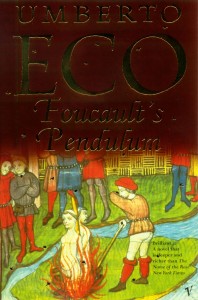 I found this book recently called “Foucault’s Pendulum” (still haven’t read it) but I’m in love with the concept. Reminds me of the John Cage Quote “Finnegans Wake is one of the books I’ve which always loved, but never read” (sorry for the tangent, just adding that quote to remind me to write about both John Cage and Finnegans Wake).
Written by Italian novelist and philosopher Umberto Eco the novel is basically about three friends that decide they can make a better conspiracy theory then what’s out there and they set out to create the conspiracy known as ‘The Plan’. As the story progresses these three begin to forget it’s a game and become more and more obsessed with the ideas and theories and start making connections to other theories out there; like lost artefacts and the Templers. Even a very real secret society begins to believe one of the three possesses the key to the lost treasure of the Knights Templar. Eventually ‘The Plan’ involves connections between a whole range of different societies like;
- The Knights Templar
- The Rosicrucians
- The Gnostics
- The Freemasons
- The Bavarian Illuminati
- The Elders of Zion
- The Assassins of Alamut
- The Cabalists
- The Bogomils
- The Cathars
- The Jesuits
The concept is brilliant and makes me ponder a few ideas, like ‘Will people believe anything that is printed?’ and ‘Do you start believing your own lies if you say them enough?’
I have a huge pile of books to read but I’m excited about reading this book. It has been described as “the thinking person’s Da Vinci Code” with makes me even more excited, I know the Da Vinci Code was a good read but it wasn’t thought provoking.
Posted January 22, 2010 by Michael @ Knowledge Lost in Poetry / 0 Comments

Lord Byron is probably best known as a poet for the romantic period. widely read and influential, considered one of the greatest English poets of all time.
So I wanted to look more into the personal side of his life. Which is sometimes described as; ‘upper-class living, numerous love affairs, debts, and separations.’ I’m not an expert but this is what I’ve managed to piece together and thought it was very interesting, I could be wrong, so feel free to correct me.
As a teenage he feel for a distant cousin Mary Chaworth, which his mother thought, “He has no indisposition that I know of but love, desperate love, the worst of all maladies in my opinion. In short, the boy is distractedly in love with Miss Chaworth.”
Byron expressed a sense of melancholy;
“Ah! Sure some stronger impulse vibrates here,
Which whispers friendship will be doubly dear
To one, who thus for kindred hearts must roam,
And seek abroad, the love denied at home.”
Later in life he had an affair with Lady Caroline Lamb which involved a lot of obsession from either side. Once the affair ended Lady Caroline became emotionally disturbed and lost a lot of weight, Byron described this as if he was been “haunted by a skeleton”. Lady Caroline Lamb described Byron as “mad, bad, and dangerous to know”
Through the rest of his life he still seemed to continue with marriages and affairs, and numerous amount of debt, due to his reckless disregard for money. Later in life he became involved in The Carbonari, which were a secret revolutionary societies whose goals were patriotic and liberal. They played an important role in the Risorgimento and the early years of Italian nationalism. He then went on to fight in the Greek War of Independence, against the Ottoman Empire, which is where he developed sepsis causing him to develop a violent fever and died.
Interestingly enough Byron often described his affairs as ‘violent and passionate’.
Posted January 22, 2010 by Michael @ Knowledge Lost in Culture / 0 Comments
Billy Corgan from The Smashing Pumpkins wrote the song Disarm about a fantasy of cutting his parents limbs off. Because he hated them, he hated the fact they brought him into this world which is full of hate and all he wants, is to be loved.
“It’s about chopping off somebody’s arms.. The reason I wrote Disarm was because, I didn’t have the guts to kill my parents, so I thought I’d get back at them through song. And rather then have an angry, angry, angry violent song I’d thought I’d write something beautiful and make them realize what tender feelings I have in my heart, and make them feel really bad for treating me like shit. Disarm’s hard to talk about because people will say to me ‘I listen to that song and I can’t figure out what it’s about.’ It’s like about things that are beyond words. I think you can conjure up images and put together phrases, but it’s a feeling beyond words and for me it has a lot to do with like a sense of loss. Being an adult and looking back and romanticizing a childhood that never happened or went by so quickly in a naive state that you miss it.” — Billy Corgan on Disarm
Does this sound familiar?
Well it defiantly does to me, my all time favourite book is “Frankenstein; or, The Modern Prometheus” by Mary Shelley which is an amazing story written in two view points. Dr. Victor Frankenstein created a monster and being scared of his creation abandoned it. Monster Frankenstein was a lost soul, with nothing the desire to be loved, yet his creator abandoned him and society feared and wanted to destroy him.
At the very end of the book when asked to justify his actions Monster Frankenstein said something like; “I do this because I feel too much, I was brought into this world with the desire to love and denied it at every turn”
Both Billy Corgan and Monster Frankenstein both wanted to be love but life and society seemed to give them violent thoughts. Billy Corgan expressed his dark thoughts via writing a song but Monster Frankenstein didn’t know how to handle these thoughts.
Support Knowledge Lost and my reading habits, If you wish to get a copy of Frankensteinor the Smashing Pumpkins album which featured Disarm; Siamese Dream do so here.


