Author: Michael @ Knowledge Lost

The Girl on the Train by Paula Hawkins

Posted December 24, 2014 by Michael @ Knowledge Lost in Thriller / 2 Comments

The Girl on the Train by Paula HawkinsTitle: The Girl on the Train (Goodreads)
Author: Paula Hawkins
Published: Transworld Publishers, 2015
Pages: 320
Genres: Thriller
My Copy: ARC from Publisher

Buy: AmazonBook DepositoryKindle (or visit your local Indie bookstore)

Every day Rachel takes the train into London and at a particular stop she likes to look out to the street and observe the row of back gardens. One house in particular is of particular interest to Rachel; she likes to imagine the lives of the couple living there, in which she has named ‘Jess and Jason’. They seem so happy, compared to her on life, she views them as a perfect couple. Until one day the minute stop allowed her to see something shocking, which leads Rachel to become a part of their lives. Rachel becomes more than The Girl on the Train.

I have to admit that I was a little hesitant going into this book; I thought it was going to try and replicate what Gone Girl did. While in the same vain with the multiple perspectives between Rachel and ‘Jess’, whose real name is Megan, The Girl on the Train stands on its own. While this book is already being compared to Gone Girl, I would just like to say that The Girl on the Train shares more similarities to The Silent Wife than anything else.

This novel plays a lot with the ideas of relationships and perspective; what may seem like a perfect couple on the surface can be a deceiving. Without going too much into the plot, I want to look at the way ‘Jess and Jason’ are perceived by Rachel. Obviously Rachel is an unreliable narrator, she only sees the couple’s house for a minute or two a day and not always the couple. To pass the time on her commute, she makes up this whole idea of what is happening in their lives.

The Girl on the Train does go a little deeper with exploring ideas of relationship, with a focus on abuse. Emotional abuse becomes a key component in the book and Paula Hawkins dives into the previous marriage of Rachel and even adding a couple of chapters from her ex-husband’s new wife. This thriller mainly happens on a psychological level and the reader gets an insight into the effects of emotional abuse.

There is a lot to be said about The Girl on the Train and I think this would make an excellent pick for a book club. Unfortunately reviewing a book like this makes it difficult, I am too worried about giving out spoilers and this restricts me from diving deeper into the themes within the novel. This debut by Paula Hawkins is not without its flaws; I think there was a missed opportunity to dive deeper into the major themes, however I did enjoy my time with this novel.


Blue is the Warmest Color by Julie Maroh

Posted December 20, 2014 by Michael @ Knowledge Lost in Graphic Novel / 2 Comments

Blue is the Warmest Color by Julie MarohTitle: Blue is the Warmest Color (Goodreads)
Author: Julie Maroh
Translator: Ivanka Hahnenberger
Artist: Julie Maroh
Published: Arsenal Pulp Press, 2010
Pages: 160
Genres: Graphic Novel
My Copy: Borrowed from a Friend

Buy: AmazonBook DepositoryKindle (or visit your local Indie bookstore)

Blue is the Warmest Color (Le bleu est une couleur chaude) took French graphic novelist Julie Maroh five years to complete. She started it when she was 19 and thanks to the support of the community she was able to finish this coming of age story. It has since been adapted into a movie directed by Abdelatif Kechiche and went on to be awarded the Palme d’Or at the 2013 Cannes Film Festival.

Blue is the Warmest Color takes place in 2008 following the death of Emma’s partner Clémentine. At the request of Clémentine, Emma has been granted access to her dairies. The diaries start in 1995 when Clémentine was a fifteen old girl, confused about her sexuality. It is within the diaries we discover her struggle with her sexuality as well as the relationships she had with Emma.

This graphic novel takes all the nuance of a relationship and plays it out within the pages and it does it in a way that is never cliché. This depiction plays on the highs and lows of the relationship between Clémentine and Emma, which allows it to explore the struggles as well as all the tender moments they share. However before the relationship starts and even as it blossoms there is also the coming of age story where Clémentine is trying to find herself as well as understand her own sexuality.

I am not a lesbian so I could not speak to this struggle with sexuality, however it felt so raw and emotional. I could not help but think the struggle or the emotions experienced were all real and possibly autobiographical. Julie Maroh has a real way with capturing the emotions of this relationships and she allows the readers to experience them along with the characters. This makes for an intimate experience and I was able to empathise with both characters even when they were making silly mistakes.

Julie Maroh is also the artist for this graphic novel and the art is the highlight of this story. The line work Maroh has drawn on to each page captures both expression and details beautifully. Then with the added colours, the pictures in each frame just pop. I love the way Maroh draw this comic and the sparing use of colour, each frame felt breathtaking and I think I spent more time admiring the art work than actually reading the story. Blue is the Warmest Color was originally written in French so I have to compliment Ivanka Hahnenberger for the translation. It is a real skill of a translator to be able to present the text in a beautiful that allows the reader to forget that they are reading a work in translation, but Hahnenberger pulled it off.

I am not sure how autobiographical this graphic novel is, but it is hard to imagine anyone writing these emotions without first experiencing them for themselves. It is interesting to experience a life that is different to your own and I want to read a lot more graphic novels like this one. This is at times beautiful and at other times heartbreaking. Blue is the Warmest Color had plenty of tender moments and by the end I think I had a little dirt or something in my eye because they were leaking.


Authority by Jeff VanderMeer

Posted December 19, 2014 by Michael @ Knowledge Lost in Horror, Science Fiction / 4 Comments

Authority by Jeff VanderMeerTitle: Authority (Goodreads)
Author: Jeff VanderMeer
Series: Southern Reach Trilogy #2
Published: Fourth Estate, 2014
Pages: 341
Genres: Horror, Science Fiction
My Copy: Library Book

Buy: AmazonBook DepositoryKindle (or visit your local Indie bookstore)

For thirty years, the clandestine government agency simply known as the Southern Reach have been sending expeditions into an isolated area known as Area X. Twelve expeditions have been sent to this unspoilt stretch of the US coastline but they are no closer to unlocking the mysteries of Area X. John Rodriguez, or as he is better known, Control is the newly appointed head of Southern Reach and he is determined to sort out this agency from all its disarray.

While Annihilation focused on Area X and served as an exhibition into nature, Authority is more about the bureaucratic nightmare of a secretive government organisation. The story follows Control, who serves as more of an outsider trying to make sense of everything that is going on within the Southern Reach. While this novel focuses on the organisation rather than Area X, readers can still expect to experience the same building of tension and terror found in Annihilation.

Even though it is a different cast of characters, I am very mindful of giving spoilers to the series so I will be a little vague and won’t be able to say everything I would like to say. Having said that, I tend to view Authority as a novel that parallels Annihilation in many ways. This makes me believe that the effects of Area X is not just a physical anomaly but also psychological. Yet again the reader is left with more questions than answers; What is going on here?

While I don’t think Authority was nearly as exciting as Annihilation. I am still very curious how this series will end with the last book Acceptance. I do have the last book from the library and I will probably read it sometime in January; I just need to know the answers. These books are a fun departure from the types of books I normally read but I do hate how vague I have to be in the reviews. Go out and read them; that is pretty much all I can really say.


A Man in Love by Karl Ove Knausgård

Posted December 18, 2014 by Michael @ Knowledge Lost in Contemporary / 4 Comments

A Man in Love by Karl Ove KnausgårdTitle: A Man in Love (Goodreads)
Author: Karl Ove Knausgård
Translator: Don Bartlett
Series: Min Kamp #2
Published: Harvill Secker, 2009
Pages: 528
Genres: Contemporary
My Copy: Library Book

Buy: AmazonBook Depository (or visit your local Indie bookstore)

Karl Ove Knausgård’s six volume autobiographical novel, My Struggle (Min Kamp) has been dubbed a literary sensation more often than I can count. Despite what the critics think, I often look to the book blogging community to help measure the success and popularity of a book and sadly this series hasn’t really become the sensation it should be. It has been compared to Proust but I think that is mainly because of the large autobiographical nature, My Struggle tells the story of Karl Ove Knausgård’s life in a non-linear way; A Death in the Family (My Struggle #1) focuses on the theme of death, while A Man in Love (book 2) looks at love.

When Karl Ove Knausgård leaves Oslo and starts his life afresh in Stockholm, it is because of a messy breakup with his wife. His move to Stockholm is aided by Geir, in which he develops a deep friendship with. He also meets a beautiful Swedish poet, Linda Boström, who captivated him and becomes the object of his affection. A Man in Love is the story of Karl Ove and Linda’s blossoming romance, eventual marriage and children.

As stated in my review of A Death in the Family, this series of books have been met with massive controversy and his friends and family have been none too pleased. His ex-wife has stated in an interview that he has made a “Faustian bargain”, sacrificing relationships for this series of books. Karl Ove Knausgård is brutally honest and doesn’t paint the best light on himself or others, despite the fact this is considered an autobiographical novel.

Compared to A Death in the Family, A Man in Love is a linear story that focuses on the relationship between Karl Ove and Linda. Knausgård writes with such affection and love towards Linda and there is such a tender and sweet tone to the book. However because he wants to remain viciously truthful there are moments where she isn’t portrayed as the sweet woman he feel in love with. Knausgård airs all their domestic disputes and Linda sometimes comes across as aggressive, angry and stubborn. In contrast, the reader will also notice that Karl Ove Knausgård is flippant, arrogant and narcissistic.

I loved the dark themes and what Knausgård had to say on bewilderment and grief, so I kind of felt like this was a little light and flowery for me. Don’t get me wrong, there are some dark moments here and Linda Boström Knausgård’s outbursts make their relationship rough but there was just something that bugged me about this novel. Karl Ove kept threating to leave Linda every time she had an outburst and that bothered me but I realised that was his style of arguing and at least he was honest about his flaws as well. After a little bit of research I found out that Linda suffers from bipolar disorder, which I don’t remember being revealed in the book but helps put things into perspective.

A Man in Love is a novel about love and Karl Ove’s relationship with Linda, which is an important part of his life but doesn’t always make for a compelling read. I did enjoy this novel and I am looking forward to picking up book three in the Min Kamp series, Boyhood Island. It sounds like the majority of the story has been covered in A Death in the Family but I will find out soon. The fourth book in the series is set to be released in March next year, but then I will be stuck waiting for the last two books. Karl Ove Knausgård’s My Struggle is well worth checking out and I am disappointed that not many other people are reading it, but maybe they are just waiting till the entire series is released.


Middlemarch by George Eliot

Posted December 17, 2014 by Michael @ Knowledge Lost in Classic / 4 Comments

Middlemarch by George EliotTitle: Middlemarch: A Study of Provincial Life (Goodreads)
Author: George Eliot
Published: Penguin, 1872
Pages: 880
Genres: Classic
My Copy: Hardcover

Buy: AmazonBook DepositoryKindle (or visit your local Indie bookstore)

Middlemarch: A Study of Provincial Life was George Eliot’s seventh novel and was originally published in a serial from 1871-72. Set in a fictional town, this novel follows a wide range of characters in interlocking narratives that really do allow the reader to study the provincial life of Middlemarch. As this is broken into eight “books” it would be difficult to summarise the plot and even write a review that could do this book justice. Instead I am going to write down some thoughts and observations I found while reading Middlemarch.

First of all, I think it is beneficial to know a little about George Eliot; an understanding of her life helps put a lot of this novel into perspective. Most people know George Eliot is a pen name for Mary Ann Evans, she used the pseudonym to keep her private life from public scrutiny, as she was in a relationship with a married man, George Henry Lewes with whom she was living with. She picked a male nom de plume to escape the stereotypes placed on woman writers, this allowed her to offer a social critic without being judged on her gender. Raised as an Anglican, Mary Ann struggled with religious doubts and eventually became an atheist. As a young woman (before her relationship with George Henry Lewes), her father threatened to throw her out of the house due to her non-belief, but they seemed to come to a compromise. Mary Ann continued to attend church with her father until he passed away to keep him happy, even if she didn’t believe in a God anymore.

This is a very tiny glimpse at Mary Ann Evans but I wanted to share that information about her as it ties into common themes found throughout Middlemarch. The themes I am talking about here are gossip, marriage, femininity and religion. Living in Victorian England may not be too different to now (people like to gossip), Mary Ann would have been the subject of plenty of gossip and in a small town like Middlemarch it feels like the primary source of information. Throughout this novel, information is continuously being conveyed from an indirect party. George Eliot satirises the idea of gossip by continuously having other characters speak on someone else’s behalf to avoid direct communication. While others will avoid conversations believing that any relevant information will eventually make its way to them. These ideas of gossip feel like Eliot is poking fun at how gossip is used, however as a social commentary it is spot on.

I love what George Eliot has to say on the ideas of courtship and marriage and this is one of the most important parts of the novel. In Middlemarch marriage is never an end result, the happily ever after ending literary trope. While some people do end up being happy, there are plenty of unhappy marriages within the novel. Mary Ann’s lover George Henry Lewes was trapped in an unhappy marriage which he couldn’t get out of and this seems to be the basis of relationships within Middlemarch. There is this exploration of the idea of courtship, and it begs the reader to question these ideas. There are a lot of thoughts on how well we can really know someone before marriage; playing with ideas on being an outsider, deception and even intimacy. Each marriage within Middlemarch is different and it allows the reader to explore these unions as part of a social construct.

While there was a huge focus on marriage within Middlemarch there still were a few unwed woman within the novel. There are well educated women with the book that sometimes appear to be happier than the woman trapped in marriage. Eliot wanted to depict woman as strong individuals who have something to offer the world other than just being wives and mothers. The women in the book are often great and complex personalities but then Eliot plays with the ideas of suppressing themselves for men and the role they play in society. There is some social conditioning within the book but ultimately I kept seeing this idea of women having the ability to make social change.

Finally I want to talk about religion and spirituality; this is an interesting theme that steams from Mary Ann’s own life. I suspect sitting in a church listening to someone talk about a God she didn’t believe in made her think a lot about spirituality and organised religion. I haven’t used any examples but in this case I want to compare Dorothea with Mr Bulstrode. Dorothea has this internal and private spiritual life, the depiction of this is somewhat vague in the novel. This is because as an outsider she doesn’t come across as a spiritual person but internally it is an intimate part of her life. While Mr Bulstrode is portrayed as someone who is more public about his religious beliefs. While not always hypocritical he has a warped opinion; he believes his previous transgressions are part of the providential plan but will openly condemn others for their past misdeeds. Throughout Middlemarch, religion and spirituality is explored in different way and it is interesting to compare it with the ideas of morality within the novel.

There are so many different themes I can talk about, including money, education, vocations, social classes and even self-delusion but that would drag this on too much. I read Middlemarch with the aid of a reading guide called Eliot’s Middlemarch by Josie Billington and I did this because there is so much to offer within this novel I wanted to get as much as I could from the book. This is a smart and intelligent social commentary and I got the sense that there was no wasted moments within the book despite the fact it was 880 pages long. I dipped in and out of this novel for six months and I am glad I choose to read it in this way; it allowed me to ponder what I read before moving on. It is the type of book you need to spend a lot of time with and written in a way that allows you to dip in and out.

I haven’t even talked about the writing or style of Middlemarch and that is probably the most important part. There is a slight detachment within the style, this is probably because the novel is a form of social criticism; a study of provincial life. Having said that, I found Middlemarch very funny; the satirical irony and wit played a big part for me, but you could also say this is a morbid book. The style of the book is psychological, erudite and extremely elegant; I often felt myself being swept away with the writing but still fascinated by the insightfulness.

It is hard to explain how much I loved this book; this a realistic depiction of Victorian life and George Eliot displays a real mastery on human nature. However, even though it sounds like it is nothing but a psychological look at society, Eliot is able to make you feel like you are a part of the story. I am sure you can read this book as just a beautiful Victorian classic but I picked up this book for the social criticism. If you do want to get more out of this book then I recommend Josie Billington’s reading guide Eliot’s Middlemarch. This is the type of book I will need to frequently return to throughout my life and see what I get out of it with a re-read.


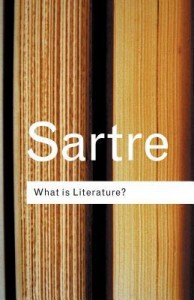
What Is Literature? by Jean-Paul Sartre

Posted December 16, 2014 by Michael @ Knowledge Lost in Non-Fiction / 2 Comments

What Is Literature? by Jean-Paul SartreTitle: What Is Literature? (Goodreads)
Author: Jean-Paul Sartre
Translator: Bernard Frechtman
Published: Routledge, 1947
Pages: 280
Genres: Non-Fiction
My Copy: Library Book

Buy: AmazonBook Depository (or visit your local Indie bookstore)

What Is Literature? (Qu’est ce que la littérature?) by Jean-Paul Sartre has also been published as Literature and Existentialism. It is a collection of freestanding essays originally published in the French literary journals Les Temps Modernes, Situations I and Situations II. Jean-Paul Sartre is best known as the French philosopher who played a key part in the schools of existentialism and phenomenology. It is sometimes forgotten that he was also a literary critic and a Marxist who was often vocal about the abuses of human rights by the Soviet Union.

The reason I mention that Jean-Paul Sartre was a Marxist is because this plays a big part of What Is Literature? To understand his political standing is useful because it plays an important role in his literary criticism; Sartre was very vocal political, and though he embraced Marxism he never joined the communist party. While his literary criticism is always focused on Marxism, his schools of thought in philosophy are relevant, as well as his views on sociology and post-colonialism.

There are four essays found within What Is Literature? “What is Writing?”, “Why Write?”, “For Whom Does One Write?” and “Situation of the Writer in 1947”. “What is Writing?” is probably the most fascinating (for me, anyway) of the four essays, exploring the ideas of writing that distinguish it as an art form apart from poetry, painting and music. I found it interesting how Sartre has separated poetry and journalism out of his thoughts of writing to focus on literature as an art form. Whether you believe his idea of not, Jean-Paul Sartre will give you plenty of food for thought and I have to admit that a sufficient amount of it went over my head.

Jean-Paul Sartre has spent a great deal of time thinking about literature and writing as an art and philosophical idea, more than I could ever imagine. Because of this, it can be difficult and as a reader I had to admit that I wouldn’t understand everything. What Is Literature? did however leave me with plenty to think about and offer me a fresh perspective and that is all I wanted from this book. Let’s face it, this is a pretty pretentious book to read but I still think it is worth exploring the ideas within What Is Literature?


The Crocodile Club by Kaz Cooke

Posted December 14, 2014 by Michael @ Knowledge Lost in Chick Lit / 4 Comments

The Crocodile Club by Kaz CookeTitle: The Crocodile Club (Goodreads)
Author: Kaz Cooke
Published: Allen & Unwin, 1993
Pages: 240
Genres: Chick Lit
My Copy: Paperback

Buy: AmazonBook Depository (or visit your local Indie bookstore)

The Crocodile Club tells the story of Selina Plankton, an assistant to the magician The Great Salami, who finds herself out of a job. At the same time she receives an eviction notice. Her life becomes a little strange when she meets a Serbo-Scottish psychiatrist who offers her $10,000 for a first date. However a desperate phone call sends her to Darwin to help a life long friend where Selina is embroiled in a mystery that involves political corruption, mayhem and attempted murder.

Kaz Cooke is an Australian author, cartoonist and radio broadcaster. She is an experienced journalist, with over 30 years’ experience and now the author of advice books like Women’s Stuff, Girl Stuff: your full-on guide to the teen years and Up the Duff: the real guide to pregnancy. I would like to point out when viewing her website there is only one mention of her novel The Crocodile Club and I had to use the find option in my browser to actually find it.

This is a really strange book; on the surface it is this story of a modern Australian woman struggling through life, trying to make the most of her job and find romance. There is that question of etiquette when it comes to being offered $10,000 for a date that plays a role within the novel. There are the normal chick-lit tropes, a quirky protagonist who is hopeless with love, a destructive ex-boyfriend and the light hearted humour.

However Kaz Cooke’s journalistic style comes out every so often with the story and creates these really weird moments. The first time it was about thirty pages into the story and I was learning about the socio-economical make up of Darwin. Later there were moments heavily focused on small-town politics, political corruption and the relationship between government and mining companies. It doesn’t stop there; I was sent on a tangent about foreign relationships and trade between Australia and Asia and even going on about the United States of America. It is almost like Cooke wanted to give the reader all this information to show them what she was trying to do with the story. Though it was meant to be a quirky romance/adventure story and I am sure most readers would have been able to manage without all this information. This was such a strange experience to jump from chick-lit to journalistic research and back again constantly.

I picked up this novel because it was my wife’s favourite book when she was a teenager and putting aside all those heavy moments I can see why. The romantic elements of The Crocodile Club fall into the spectrum of what a teenager would class as romantic, it is the type of novel a young person would try to write. As an adult, I thought it was clichéd, the characters’ actions were juvenile and dialogue was clunky but besides all of that, there were some funny moments. Finally, I could never understand Selina’s obsession with hairpins. That was until she turned into the MacGyver of hairpins.


Merciless Gods by Christos Tsiolkas

Posted December 13, 2014 by Michael @ Knowledge Lost in Short Stories / 8 Comments

Merciless Gods by Christos TsiolkasTitle: Merciless Gods (Goodreads)
Author: Christos Tsiolkas
Published: Allen & Unwin, 2014
Pages: 304
Genres: Short Stories
My Copy: Paperback

Buy: Book Depository (or visit your local Indie bookstore)

As most people know, I am a big fan of transgressive fiction and in Australia there is one author that doesn’t shy away from a touch or taboo subject. This author is Christos Tsiolkas and he is best known for his two recent novels The Slap and Barracuda. Merciless Gods is his first collection of short stories and deals mainly with sexuality, family and identity.

Author of six novels, Christos Tsiolkas was born in 1965 to Greek immigrant parents. Reading through his novels you quickly get the sense of what it must have been like growing up in suburbia as a Greek immigrant and a homosexual. He likes to explore these themes constantly and you get an idea of just how backwards people’s thinking can be. Then with his breakout novel The Slap, he challenged everyone’s thoughts, tapping into the universal dilemma around discipline and child-rearing.

Merciless Gods seems to be more of a “return to his roots” collection of short stories, which shares similarities with first novel Loaded at any of his other. There is this whole theme about social and personal struggle that play out within these stories. I am impressed with the way Tsiolkas challenges people’s views; particularly when it comes to sexuality and immigrants. There was a particular story that he wrote in Greek and then translated into English that was very powerful.

Christos Tsiolkas has officially become an ‘auto-buy’ author for me now and I will have to read the rest of his backlist sometime soon. Merciless Gods is hard-hitting and not for the faint of heart, he is pushing the boundaries but he does this really well. I am not sure when these stories were originally written, I think that will be interesting to know. However if you have never read this great Australian author, this is probably not the best place to start. Maybe begin with The Slap or Barracuda before working your way up to Loaded and Merciless Gods.


Roadside Picnic by Arkady & Boris Strugatsky

Posted December 12, 2014 by Michael @ Knowledge Lost in Science Fiction / 2 Comments

Roadside Picnic by Arkady & Boris StrugatskyTitle: Roadside Picnic (Goodreads)
Author: Arkady Strugatsky, Boris Strugatsky
Translator: Olena Bormashenko
Published: Chicago Review Press, 1972
Pages: 209
Genres: Science Fiction
My Copy: Paperback

Buy: AmazonBook DepositoryKindle (or visit your local Indie bookstore)

Aliens have made contact, or have they? Thirteen years after the visitation, an international science cooperative has locked up each landing site, dubbed Zones in an effort to study the unexplained phenomena. Red Schuhart is a stalker, someone that sneaks into the zones and tries to collect artefacts. Despite the legal ramifications, artefacts on the black market sell really well. When Red puts together another team to collect a “full empty” everything goes wrong.

The attempts to gain publication of Roadside Picnic is a story in itself; like most Russian literature this novel was originally serialised in a literary magazine. Attempts to publish in book form took over eight years, mainly due to denial by the Department for Agitation and Propaganda. The heavily censored book that originally was published was a significant departure to what the authors originally wrote. I am unclear as to whether the new translation I read corrected this censorship, to quote the back of the book “this authoritative new translation corrects many errors and omissions”. I know some of the corrections made included to the original translation starting thirty years after the visitation rather than thirteen but unsure what else was changed. However, despite the censorship and notwithstanding the fact this novel was out-of-print in America for thirty years; Roadside Picnic is wildly regarded as one of the greatest science fiction novels of all time.

The title Roadside Picnic refers to the visitation and the fact that they never made contact with humanity. The novel plays with the idea that intelligent life wouldn’t want to make contact with the human race. One look at humanity, full of all the violence towards each other, aliens would conclude that humans are not intelligent life forms but rather savages. One character within the novel, Dr. Valentine Pilman compared the aliens visit to that of an extra-terrestrial picnic.

“Xenology is an unnatural mixture of science fiction and formal logic. At its core is a flawed assumption—that an alien race would be psychologically human.”

It is fascinating to look at humanity in a first contact novel and it reminded me of how much I’ve enjoyed the psychological/philosophical science fiction novels that seemed to be produced in the 1960s and 70s. However Roadside Picnic went deeper; like most Russian novels of this time, there was a strong reflection on society at the time. Like I said before, I am not sure if this edition still holds the Soviet censorship but I was impressed by the subtle look at society. It wasn’t just a poke at the Soviet Union but rather a look at humanity under an unidentifiable superpower. This could be an American superpower and it looks at ideas of what might happen if the government prohibits the people from gaining access to the biggest scientific discovery of their time. You have a struggle between quarantined verses legitimate scientific research, playing with the moral idea of government regulated technology.

Moving away from the themes, Roadside Picnic is a thrilling and beautifully written novel. Red Schuhart almost comes across as a hard-boiled narrator but less cynical; he remains a wide-eyed curious protagonist throughout the narrative. A surreal, tense story that threw out the rules found in a ‘first contact’ novel and ended up redefining the genre. It went on to challenge some of the ideas in the study of xenology and perhaps even ufology.

Arkady and Boris Strugatsky have been the authors of over twenty science fiction novels, their unique style of blending Soviet rationalism with speculative fiction can be found throughout their books. Roadside Picnic remains their masterpiece and inspired the Russian cult classic movie Stalker (1979) directed by Andrei Tarkovsky. Arkady and Boris Strugatsky wrote the screenplay for Stalker and then the novelisation; no idea why you need a novelisation of a movie that was based on a book. Roadside Picnic is an amazing novel, and reminds me why I love Russian science fiction. The blend of social commentary and science fiction is what I continue to look for when searching for books in this genre.