Category: Random

Anna Karenina by Leo Tolstoy

Posted May 28, 2015 by Michael @ Knowledge Lost in Classic, Russian Lit Project / 0 Comments

Anna Karenina by Leo TolstoyTitle: Anna Karenina (Goodreads)
Author: Leo Tolstoy
Translator: Aylmer Maude, Louise Maude
Published: Oxford World's Classics, 1873
Pages: 831
Genres: Classic
My Copy: Personal Copy

Buy: AmazonBook DepositoryKindle (or visit your local Indie bookstore)

Anna Karenina is the tragic story of the socialite’s marriage to Karenin and her affair with the wealthy Count Vronsky. The novel begins in the midst of their families break up due to her brother’s constant womanising; a situation that preferences her own situation throughout the novel. Running in parallel to this story of Konstantin Levin, a humble country landowner that wishes to marry Kitty, who is Anna’s sister in-law. Anna Karenina is a pinnacle piece of realist literature, exploring a wide range of family issues.

At over 800 pages, Anna Karenina can be a daunting novel to pick up; the large cast of characters does not make it any easier. I look at this classic novel as an exploration into melodrama that just about every family experiences. Born in 1828, Lev (Leo) Nikolaevich Tolstoy was born into a large and wealthy Russian landowning family, and has often been suggested that Anna Karenina is based on a similar social upbringing. While there are vast differences, issues with wealth, religion, farming and morality are issues that seem to parallel between reality and fiction. The story arch of Levin is considered to be autobiographical; Tolstoy’s first name is Lev (although in English he is known as Leo) and the Russian surname Levin actually means Lev.

Leo Tolstoy has been known for adding real life events into his fiction as a way with dealing with current political and social issues. Within Anna Karenina, events like the liberal reforms initiated by Emperor Alexander II of Russia and the judicial reform are used as the backdrop for the novel. This allows him to explore current issues, like the developing of Russian into the industrial age and the role of agriculture in these changing times. Also Tolstoy questions the role of the woman in this changing society and (the ever popular in Russian lit) class struggles.

The story of Anna Karenina is probably the most interesting for me and I enjoyed reading the struggle between love and the public opinion. She was trapped in a marriage and wanted to divorce but Karenin, who was a politician cared more about his public image. Then there is the fact that Anna’s brothers womanising destroyed the family and now she is faced with a similar situation that could cause the same damage. Adultery becomes a big theme within the book and seems to be a common theme within Russian literature to this day. However with Nathaniel Hawthorne’s The Scarlet Letter (1850) and Gustave Flaubert’s Madame Bovary (1857), these three novels seemed to start a fascination in exploring the themes of passion and adultery in the mid to late nineteenth century.

There is a lot to explore within this book, and re-reading Anna Karenina was such an enjoyable experience. I know big books often scare me but there is something about going back to a much-loved novel that I find enjoyable. Leo Tolstoy intentionally made this novel long, he wanted to replicate life’s journey and the struggles people face along the way. I think he was able to capture that struggle and Anna Karenina will remain a favourite on my shelves and in Russian literature. There are so many more themes that could be explored within the novel but I will leave that for others to discover on their own.

Death and the Penguin by Andrey Kurkov

Posted May 26, 2015 by Michael @ Knowledge Lost in Contemporary, Humour, Russian Lit Project / 2 Comments

Death and the Penguin by Andrey KurkovTitle: Death and the Penguin (Goodreads)
Series: The Penguin Novels #1
, 1996
Pages: 228
Buy: AmazonBook DepositoryKindle (or visit your local Indie bookstore)

Viktor Alekseyevich Zolotaryov is an unemployed aspiring writer struggling to live in a post-soviet society. He has aspirations to write novels but a job writing obituaries conveniently fell into his lap. Viktor’s job is to prepare obituaries for notable Ukrainian figures. However he quickly found out he was being assigned to write obituaries of the enemies of an unknown organisation, using the newspaper as a front. He is now trapped in a situation and there appears to be no escape.

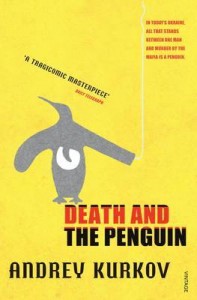
The title of this book refers to Viktor’s job and his pet king penguin, Misha. The Kiev zoo had run out of money and could no long afford to support or feed the animals. Their solution was to give the pets to any citizen able to feed them in the hope they will care for the animals. Andrey Kurkov uses Misha to mirror Viktor Zolotaryov. An existential look into life imitating art and the balance between life and death.

Death and the Penguin is a dark comedy and political satire that portrays a bleak post-Soviet Ukraine to the reader. Kurkov takes a pragmatic approach with exploring morality. The idea of writing a mournful article in case a politician or socialite dies suddenly in exchange for money offers a morbid look at mortality but that is not enough for Andrey Kurkov and he wants to talk about politics and corruption. “People have got used to the corruption. People here are flexible and they accept the new rules and don’t dwell on moral questions. They just watch what everyone else is doing and try to find their own ways of deceiving others to make money for themselves to survive”

The Kiev Kurkov portrays is one driven by greed and corruption. A place where bribes have to be handed out before an ambulance will come and take a dying man to hospital. However, once at the hospital the staff can offer no medicines to ease the pain, let alone a cure. A place where money rules and the gangster underworld are offering a practical solution into solving corruption. Turning this society into a place where organised crime and political corruption seem to be ruling in tandem.

What really stuck with me was the parallels between Viktor and Misha’s life. Starting from struggling to feeling trapped, Misha’s life mimicked Viktor’s own life. Also Misha helped provide a contrast with Victor’s plot; exploring ideas of life and death simultaneously. While people are dying due to the hit list, Viktor struggles to keep Misha alive in an environment that is not suitable for a king penguin. These parallels and contrast make up the back-bone of the book and what really cemented my love for this novel.

Death and the Penguin is a wonderful satire that combines elements of the surreal and existential. I really enjoyed the dark comedy and the themes Andrey Kurkov explored within this novel. There is a sequel to the book called Penguin Lost which I plan to read but I have no idea how this story could continue. As part of my Russian lit project, I plan to explore a lot more post-Soviet literature and if this is anything to go by, I know I will discover some great novels.


A Young Doctor’s Notebook by Mikhail Bulgakov

Posted May 14, 2015 by Michael @ Knowledge Lost in Russian Lit Project, Short Stories / 0 Comments

A Young Doctor’s Notebook by Mikhail BulgakovTitle: A Young Doctor's Notebook (Goodreads)
Author: Mikhail Bulgakov
Translator: Hugh Aplin
Published: Alma Classics, 1926
Pages: 155
Genres: Short Stories
My Copy: Paperback

Buy: AmazonBook Depository (or visit your local Indie bookstore)

A Young Doctor’s Notebook (also known as A Country Doctor’s Notebook) is a semi-autobiographical collection of short stories published early in Mikhail Bulgakov writing life in Russian medical journals. Bulgakov was educated at the Medical Faculty of the Kiev University, though his interest lied in theatre. When World War I broke out, he volunteered with the Red Cross. He was sent directly to the front lines to work as a medical doctor and was badly injured on two separate occasions.

In 1916 Mikhail Bulgakov graduated and was quickly appointed as a provincial physician to the Smolensk province. He found himself performing procedures he had only seen once or twice while at medical school. The seven stories in this collection explore the ignorance or stubbornness of people towards medical treatment, an issue that is still very relevant today. While A Young Doctor’s Notebook was set in the small village doctor in revolutionary Russia, the stories were all written in the 1920s.

Like most editions of A Young Doctor’s Notebook, my copy of the book came with one extra story called ‘Morphine’. This was also published in a medical journal and is much different to the other stories. ‘Morphine’ is yet another semi-autobiographical story that explores Mikhail Bulgakov’s own struggles with a morphine addiction. His injuries in the war lead to chronic stomach pains and the easy access to pain relief quickly lead to a morphine addiction. Bulgakov did end up leaving the medical profession to pursue a career in writing stage plays and was able abandon the use of morphine.

A Young Doctor’s Notebook is a wonderful collection of stories that illustrate Mikhail Bulgakov’s humour and writing style. If you have seen the TV adaptation, you may notice some similarities to the story, blending the seven short stories and his other story ‘morphine’ together to deliver a fabulous dark comedy. I binge watched the show over a weekend and I was not ready for it to end, so I picked up this collection and this quickly started an obsession with the life of Bulgakov.

While Mikhail Bulgakov is mainly known for his book The Master and Margarita (a book I recently re-read), A Young Doctor’s Notebook may be a more accessible book. It allows you to get a taste of Bulgakov’s style and humour with the seven short stories. I read an edition that was translated by Hugh Aplin and he is quickly becoming a favourite of mine and I will be hunting down everything he has translated (he translated mainly Bulgakov and Dostoevsky). Learning more about Mikhail Bulgakov’s life does give me extra enjoyment and context when reading his books. I am slowly reading a collection of his letters and diaries in a book called Manuscripts Don’t Burn, so you may see a lot more about Bulgakov on this blog.


Monthly Review – April 2015

Posted April 30, 2015 by Michael @ Knowledge Lost in Monthly Reading / 2 Comments

kafka on the shoreApril has been a wonderful month for me; I celebrated my third blogiversary this month (not very publically). However the big news is the announcement of my Russian lit project, I am actually very excited to dive into this world and see what I discover. I have been feeling unmotivated with my blogging lately and I have fallen behind in my reviewing (currently ten reviews I need to write). I am struggling to find the motivation and the inspiration to blog but this Russian lit project has got me so excited. Even if I do not know how if it will work in terms of blogging or BookTube, my excitement is all directed towards what I will read and learn.

As far as reading goes, I was in a weird place where while I read an average amount of books, I still feel like I did not read much. I started the month off finishing The Whispering City by Sara Moliner, a Spanish crime novel translated by Mara Faye Lethem, that I had high hopes for but never really lived up to me expectation. However, I did follow that book up with another historical fiction novel, The Zone of Interest by Martin Amis which was my first attempt for this author and not sure if it was the best place to start. It had a very interesting premise but exploring Jewish heritage and culture during World War II has been done to death.

The next novel I read, I can actually review as part of my Russian lit project and that is the Ukrainian novel Death and the Penguin by Andrey Kurkov (translated by George Bird). This novel explores a struggling writer named Viktor who was given a king penguin to look after when the Kiev Zoo ran out of money and could not afford to feed the animals. Viktor gets a job writing obituaries and the book has the wonderful contrast between life and death. This is a dark comedy and I love the way Kurkov handled the balance between the satire and the message. Next was What You See in the Dark by Manuel Muñoz, which tries to imitate the style of Alfred Hitchcock but I do not think worked. Hitchcock has a very visual style, playing with shadows and atmosphere and while this novel is able to replicate this to some extent, it does not work that well on paper. I followed that book with Haruki Murakami’s book Kafka on the Shore (translated by Philip Gabriel) which I love and have already posted a review for.

I attempted my first Ali Smith novel with There But For The, which is a witty and satirical book that I am still trying to get my head around. I love the style Smith writes in and I know I am going to read a whole lot more of her books. I then read Helen MacDonald’s memoir on grief H is for Hawk. I made the mistake of trying to annotate this; I had never tried to write in the margins of any book and while I loved the experience it was not the right choice. I found myself questioning MacDonald’s emotions and quickly decided I will try annotating again but with a work of fiction. I then moved onto Boyhood Island by Karl Ove Knausgård (translated by Don Bartlett) which is the third book in the autobiographical novel series My Struggle. Finally, the last book was a novel that reminded me that I was not that intelligent and that is 10:04 by Ben Lerner. This was an extremely sophisticated and intelligent novel, I am still struggling to wrap my head around it completely and I am beginning to fear I never will comprehend it fully.

In retrospect I had a pretty great reading month, even if I felt like I did not read enough. Going into May, I have Anna Karenina, The Firebird, Get Shorty and Manuscripts Don’t Burn all on the go. So I know I am going to have a good month, I also have some vacation time and I cannot wait. How was April for you, did you read anything amazing? Let me know in the comments below.

Read More


Kafka on the Shore by Haruki Murakami

Posted April 29, 2015 by Michael @ Knowledge Lost in Book of the Month, Magical Realism / 0 Comments

Kafka on the Shore by Haruki MurakamiTitle: Kafka on the Shore (Goodreads)
Author: Haruki Murakami
Translator: Philip Gabriel
Published: Vintage, 2002
Pages: 480
Genres: Magical Realism
My Copy: Library Book

Buy: AmazonBook DepositoryKindle (or visit your local Indie bookstore)

Kafka on the Shore tells the story of a fifteen year old book named Kafka who runs away from home to find his mother and sister. Although the alternate chapters tell the story of Nakata; a strange old man who has the ability to talk to cats. Like many of Haruki Murakami’s books, Kafka on the Shore blends pop culture with magical realism in order to explore the psyche of the characters involved.

It is often hard to try and give an overview of a Murakami book because they tend to come out weird and I do not want to give the impression that his novels are not worth attempting. For Kafka on the Shore, the magical realism allows the reader to explore the psychological mind of fifteen year old Kafka Tamune. Not only is Kakfa a young man discovering his sexuality, Sigmund Freud would probably suggest that he also has an Oedipus complex and has developed an unhealthy obsession with his mother and sister.

According to Freud, an Oedipus complex stems from the unconscious mind and normally caused by the repression of a mother (or father) figure. Freudian psychoanalysis theory suggests that this is a key psychological experience needed for normal sexual development. However if it is unsuccessful at resolving it may lead to neurosis, paedophilia, or homosexuality. Without going into the problematic thinking of Sigmund Freud, this does make for an interesting analysis of Kafka’s journey throughout the book, especially with his interactions between Sakura and Miss Saeki.

If we continue looking at this novel through the lens of psychoanalysis theory, we might even get some interesting insights into Nakata. I always thought the loss of mental faculties was due to the psychological trauma, he experienced as a young boy. He was one of sixteen schoolchildren picking mushrooms in a field trip towards the end of World War II, when they were all rendered unconscious from a mysterious light in the sky. However it has also been suggested that maybe Kafka and Nakata are two different parts of the same person.

Every time I read a Haruki Murakami, I am reminded of his brilliance (with the exception of 1Q84), and I want to explore more of his works. I am also reminded that I need to learn a whole lot more about psychoanalytical theories, and how much it would help with books like Kafka on the Shore. For me this was a bildungsroman book about sexual development and memories. However, I found myself more interested in the chapters centred on Kafka over those about Nakata but maybe that was because I understood them a little better.

Yet again Haruki Murakami has impressed me with Kafka on the Shore and I am eager to pick up more of his books. I know magical realism can be scary for some people but I love the way Murakami uses it to explore the mind. My only real criticism of this book is that it was a little bloated and could have been trimmed down a little and still achieve the same. This might be due to an aversion to big books that I really need to overcome and not a true reflection on Murakami. I highly recommend giving this author a go if you have never tried him but Kafka on the Shore is not a good starting point; may I suggest trying Norwegian Wood first.


Monthly Review – March 2015

Posted March 31, 2015 by Michael @ Knowledge Lost in Monthly Reading / 2 Comments

Fear and Loathing in Las VegasI started March with a lot of work stress and as a result I thought I would not get much reading done. All I wanted was to play video games or watch TV. The month never improved workwise but I still had a productive reading month; I was actually surprised with how much I read. As for my adventures on BookTube, things are still going well, I am enjoying the experience and I feel like I am slowly improving. Hopefully this will translate into my writing as well. I have also been looking at other way to improve my writing, I may join Hitrecord and try their writing challenges or just try my hand at short stories. However, I might just do some research and wait till work gets a little less stressful.

It did take me over ten days to finish my first novel this month. Sadly that novel was not enjoyable and I wish I had not spent so much time with the book. That novel was The Severed Streets by Paul Cornell, I really enjoyed the first book in the series, London Falling and was expecting so much more. Thankfully the next book was better; it was Fear and Loathing in Las Vegas by Hunter S. Thompson, however I cannot work out if I had read it before or not. I guess because the movie is so memorable I thought I had read the book; I would have a record of reading Fear and Loathing if I had.

The longlist for the IFFP (The Independent Foreign Fiction Prize) was announced this month and reminded me that I want to read more books in translation. As most people know, my current reading challenge is more books in translations and some rereads (at least one of each, every month). This month I read the 2011 IFFP winner, Red April by Santiago Roncagliolo (translated by Edith Grossman). I did the reading diversity tag on BookTube this month and realised I needed to read a lot more books from South America; Red April is by an author from Peru. While it did follow many of the tropes found in crime fiction, it still found this to be a fascinating read; I loved exploring Peruvian culture. My reread for the month was The Stranger by Algerian author Albert Camus (translated by Matthew Ward), which was a lot better than I remember it being, I must have a better grip on the themes this time round.

I also picked up some short story collections to read this month, firstly The UnAmericans by Molly Antopol and then The Yellow Wallpaper and Other Stories by Charlotte Perkins Gilman. The UnAmericans was a contemporary collection that dealt mainly with immigrants living in America. While this was a great collection, The Yellow Wallpaper and Other Stories blow it out of the water. I was sucked in by Charlotte Perkins Gilman’s style blending gothic with feminist ideas, I highly recommend reading this collection. I am not sure what Charlotte Perkins Gilman’s other books are like but I am curious to find out.

The highlight this month was Mr. Kiss and Tell by Rob Thomas and Jennifer Graham, which is the second book in the Veronica Mars series. I am a huge Veronica Mars fan and while this book was not as good as the first one, it was nice to return to Neptune. Followed by Something Coming Through by Paul McAuley which was very average and A Young Doctor’s Notebook by Mikhail Bulgakov (translated by Hugh Alpin) after binge watching the TV adaptation. So that was seven books read in March, which was as many as February but still a very decent reading month. I currently have four books on the go at the moment and I hope April will be a much better month both in reading and work.

Read More


Fear and Loathing in Las Vegas by Hunter S. Thompson

Posted March 30, 2015 by Michael @ Knowledge Lost in Book of the Month, Classic / 2 Comments

Fear and Loathing in Las Vegas by Hunter S. ThompsonTitle: Fear and Loathing in Las Vegas (Goodreads)
Author: Hunter S. Thompson
Artist: Ralph Steadman
Published: Harper Perennial, 1971
Pages: 230
Genres: Classic
My Copy: Paperback

Buy: AmazonBook Depository (or visit your local Indie bookstore)

Journalist, Raoul Duke heads to Las Vegas with his attorney Dr Gonzo in order to cover the Mint 400 motorcycle race. After experimenting with some recreational drugs, LSD, ether, cocaine, cannabis and alcohol, their assignment was quickly abandoned. What follows is a series of hallucinogenic trips that end in disaster from trashed hotel rooms, car wrecks and much more. Fear and Loathing in Las Vegas: A Savage Journey to the Heart of the American Dream is a roman à clef, with autobiographical elements in which Hunter S. Thompson writes a retrospective of the 1960s countercultural movement.

Hunter S. Thompson was a journalist, but he was best known for his novel Fear and Loathing in Las Vegas. While working in Journalism he coined the term Gonzo journalism which is a writing style he adopted for his first person narratives. The style is a combination of fact and fiction that allows Thompson a more personal approach to his articles. Combining elements of sarcasm, humour, exaggeration and profanity it allowed a first person look into social criticism. Fear and Loathing in Las Vegas was a result of Gonzo journalism and was originally published as a two part series in Rolling Stone magazine in 1971.

When thinking about the life of Hunter S. Thompson, I find it hard to imagine him as someone who  critiques the 1960s counterculture. I think of him saying things like “I hate to advocate drugs, alcohol, violence, or insanity to anyone, but they’ve always worked for me.” Thompson has often stated that this novel was an exploration into the death of the American Dream but his views on counterculture are so fascinating. Drawing inspiration from his two favourite novels The Great Gatsby and On The Road, Thompson combines ideas of travelogue and the American Dream and goes on to show the reason why drug use was not the answer to social problems.

Fear and Loathing in Las Vegas is a pretty confronting novel; the descriptions of drug-induced hazes and lurid hallucinogenic trips are very vivid and confronting. I am pretty sure I have read this book in the past but I had not marked it as read on Goodreads, LibraryThing or even the spreadsheet I keep. However going into the novel everything felt so familiar and I cannot tell if it was due to the movie adaptation or if I have actually read the book before.

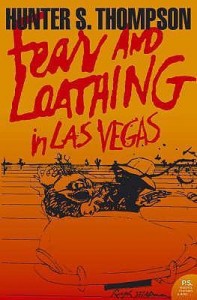
The experience of reading Fear and Loathing in Las Vegas is enhanced by the illustrations done by Ralph Steadman. My edition of the book stated in the introduction that Hunter S. Thompson requested the art to be done by Steadman because he believed this illustrator really understood the concept of Gonzo journalism. The novel is an interesting book and well worth exploring, and I was interested to see the satirical side and surprised at the way Thompson criticised his own lifestyle in this autobiographical novel.


Monthly Review – February 2015

Posted February 28, 2015 by Michael @ Knowledge Lost in Monthly Reading / 4 Comments

The Paying GuestsWhere has the month gone? I cannot believe that February is over already; time just moves too fast. I feel like this month has been a very busy month with work and life but I cannot really work out what occupied so much of my time. Having said that, in my reading life, I was very happy with February. While I have been making this the year of reading more books in translations and some re-reading, my wife has challenged herself to read a book by an author from every country in the world. This is fantastic challenge that might take her years to complete but it also reminds me that there are some gaps in my reading. On BookTube, there is a lot going around about reading more diversely, and while I have noticed some trending problems, it has let me evaluate my reading. I have never read a book by a non-binary author. I do not know of any non-binary authors, so do not know where to begin and finally I need to read more books from South America. I may do the reading diversely tag on my BookTube channel just so I have a document of this.

I have not done too much towards my challenge in February, my goal is to do at least one re-read and one book in translation a month and I did achieve that. I had one re-read and two books in translation; I feel like most of my rereads will be books in translation but I am okay with that, I finished The Master and Margarita by Mikhail Bulgakov (translated by Hugh Aplin) which I started in January and I enjoyed this book so much more the second time around, there is so much going on and it is hard to articulate everything I want to say about it but I will try to do that sometime soon. I even read Norwegian Wood by Haruki Murakami (translated by Jay Rubin) and this is the first time I have read this book but I can see why people often pick this as their favourite from this author. I am currently reading two books in translation at the moment, The Whispering City by Sara Moliner (translated by Mara Faye Lethem) which is a book from Spain and Red April by Santiago Roncagliolo (translated by Edith Grossman) which is from Peru, but I still have not worked out what I am re-reading in March.

I started off very slow in February and I got to a point where Goodreads were telling me I had fallen behind on my reading goal already. However one of the advantages of reading multiple books at a time is that sometimes all the books being read finish at the same time and I was able to get back on track. I have mentioned three books already but I also read another six books. The first book I read this month was Broken Homes by Ben Aaronovitch which is the fourth book in the Peter Grant series and I am trying to resist the urge to move onto the next book; I want to read it but then I will have to wait months for book six.

My local indie bookshop hosts a book club and it has returned and this month we discussed Deeper Water by Jessie Cole, which I had to race through to get it read before the meet up. This is an interesting novel that explores the culture clash between the city and rural Australia and while I had issues with it I still enjoyed reading this one. I also picked up Save Me the Waltz by Zelda Fitzgerald to compare with Tender Is The Night, which I read last month. I need to do some research into this book because I feel like F. Scott Fitzgerald may have white washed it a little to make himself appear like a nicer person. Finally after that I picked up my first Rose Tremain, which was a collection of short stories called The American Lover and shows off Tremain’s writing skills and character development, so much so I need to check out a novel by this author. Also I dived into Wolf in White Van which explored isolation and depression in a really interesting way and I read Go Tell It on the Mountain by James Baldwin. This book was amazing. It was my first Baldwin novel and I have so much I want to say about this book but I am unsure how to express these feelings. Finally I read The Buried Giant by Kazuo Ishiguro, which seems to be getting mixed reviews but I really enjoyed; still sorting out my thoughts but I cannot wait to talk about this one with others.

I feel like I say this every month but I have no plans for March (reading wise) apart from what I am currently reading, which is The Whispering City, Red April and The World According to Garp by John Irving. I do have some books reserved at the library, The UnAmericans by Molly Antopol, Get Shorty by Elmore Leonard, Something Coming Through by Paul McAuley and The Severed Streets by Paul Cornell, so these books may make an appearance in my reading month. I would love to know what you have read in February and if you have any reading plans for March.

Read More


The Paying Guests by Sarah Waters

Posted February 27, 2015 by Michael @ Knowledge Lost in Book of the Month, Historical Fiction / 8 Comments

The Paying Guests by Sarah WatersTitle: The Paying Guests (Goodreads)
Author: Sarah Waters
Published: Hachette, 2014
Pages: 576
Genres: Historical Fiction
My Copy: ARC from Publisher

Buy: AmazonBook DepositoryKindle (or visit your local Indie bookstore)

The Paying Guests is something a little different for Sarah Waters; set in 1922 London, it is a period of history I don’t expect from this author. The novel tells the story an impoverished widow and her spinster daughter who are struggling to keep their large Camberwell villa after the loss of her husband and sons due to the war. They take in a modern young couple, Lilian and Leonard Barber to help make ends meet. True to Sarah Waters form, The Paying Guest is full of tension and mystery, but there was something missing.

Granted I have only read Tipping the Velvet (I really should read Fingersmith) but what I know and expect from Waters is something set in the 1800’s. Needless to say this was an enjoyable novel, exploring the differences in classes and the effects of World War I on the people in London. This period of time is an interesting one; the results of the war and the modernisation of London make for an interesting backdrop.

What I think Sarah Waters does best is create incredibly complex characters and The Paying Guests in no exception. Told from the point of view of Frances Wray, all the characters within the novel slowly take form, as secrets and new facts are revealed about them. This is an effective way to build a character and allows them to grow with small reveals that are both expected and unexpected.

The main focus of this novel is the blossoming romance between Frances and Lilian, this is expected from Waters and where she really excels. The idea of forbidden love is a heavy theme, not just because a lesbian relationship would be taboo but also the fact that Lilian was stuck in a marriage she wasn’t happy with. This allows the reader to explore the concepts of love and relationships in interesting ways; should we be encouraging the relationship between Frances and Lilian when one is married?

As I said earlier, I still think there was something missing in this novel. There is a gothic element that runs through The Paying Guests which starts off well, with all the secrets that slowly began to be revealed. However this stopped working for me when the plot became too predictable. I’m not opposed to a predictable plot; the focus on the character development was effective enough. The problem was the whole gothic aspect became clunky and the basic plot didn’t allow this theme to really go anywhere and just left me wanting more.

Comparing this novel with Tipping the Velvet is probably a little unfair; this is a completely different type of book. Having read one great Sarah Waters book, I expected a little more. I like the way Sarah Waters writes characters and captures a time period; I would have liked to see her do more with a gothic theme. Somehow The Paying Guests was on track to being another great novel by Waters but for me, it fell a little short. Maybe someone new to Sarah Waters would enjoy this one more, as it gives a little tamer introduction to what this author does best. Having said that, I’m still excited to read everything written by Waters; she is a great author.