The Dystopian World of Super Sad True Love Story

Posted April 29, 2011 by Michael @ Knowledge Lost in Literature / 0 Comments

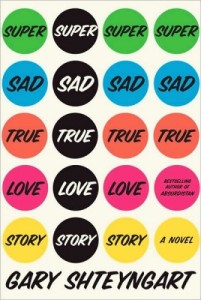
I love the dystopian genre; the feeling of hopelessness that needs to be overcome makes a great backdrop for a novel. But unlike most books in the dystopian genre, Super Sad True Love Story really stuck with me, more than any other. I’ve been pondering this for a while and I have come to the conclusion that the reason is the fact that this dystopian world feels so close to our future that it feels like this is what our future will be like.

For those who have not read Super Sad True Love Story, I highly recommend it. The novel is set in a very near future—oh, let’s say next Tuesday—where the world is dominated by the Media. The story is centred on a thirty nine year Russian immigrant, Lenny, and what could likely be the world’s last diary. As well as the object of his affection; Eunice, who has her side of the story to by a collection of e-mail correspondences on her “GlobalTeens” account.

While this may be a story of a modern relationship; there is so much more in the novel worth exploring. This dystopian back drop mixing in some very interesting concepts;

Media and Retail

The world is controlled by the media, telling everyone how to think, feel and act. No one reads anymore, they are all feed their information from all the shows streaming to them. Like the media today, this is teamed up with the Retail industry. Media and Retail are the high powered jobs of this world; everyone is a slave to fashion.

The Apparatus

The iPhone is gone, replaced with the Apparatus, a device that is required to be worn at all times. This device is the connection to the world, streaming all the news, storing all your personal information; credit rating, personal history and preferences. But this device is so much more powerful than that, it monitors the heart and blood pressure and calculates your attraction to a mate based on history, preferences and the way your body reacts to them. Giving everyone a rating in the following categories; Finances, Personality, Attractiveness and Fuckabililty.

Lack of Privacy

In a world of commercialisation – even porn is mainstream – the Apparatus mixed with reading posts around the world allows all information to be collect and public record. These reading posts will display your credit rating as you walk past. But as this is a world of controlled by Retail and the media telling people to spend, the credit rating is a catch 22; spending money will increase your social rating but decrease your credit rating therefore decreasing your social rating.

There is so much in this book that is worth discussing; it’s a light and humorous read but under the surface it is a witty and intelligently written book. I probably could go on further writing about the dystopian world, including Privatisation of the military and immigration check points, etc. but I have tried to keep this spoiler free. All in all, this world is so close to the direction the world is moving, you can almost feel this coming.

Support Knowledge Lost and my reading habits, If you wish to get a copy of Super Sad True Love Story: A Novel do so here.


Burning Realisation: I Can't Write

Posted April 7, 2011 by Michael @ Knowledge Lost in Writing / 0 Comments

Over the past few weeks I’ve had to come to terms with the fact that I really not very good at writing. I think I’m getting better at blogging, but for someone that aspires to be a writer, I’m not good at it. I’ve had to take a step back and evaluate what I’ve been doing wrong.

If you don’t have the time to read, you don’t have the time or the tools to write.

Stephen King, On Writing, p. 147

I’ve been reading a lot and I’ve been getting lots of great ideas on what I want to do with my writing, from style, plots, metaphors. But when I go to write a novel, I really do lack the skills to get very far. I’ve decided I have to change my approach. I have to learn the art of writing. I can’t give up; I still have a burning desire to write.

The only reason for being a professional writer is that you just can’t help it.

Leo Rosten

So I’ve reached a decision to give up trying to write a novel for now. I need to practise my craft, and build up to attempting to do something like a full novel. I read an interview with Carlos Ruiz Zafón (who wrote the brilliant book The Shadow in the Wind) that he always had this book sitting in the back of his mind but he needed to gain the skills to attempt writing it. So Carlos Ruiz Zafón began his career writing books for young adults. While I don’t think I have the skills to write a full length novel, I think the idea of starting small and building up is a smart move.

A writer is somebody for whom writing is more difficult than it is for other people.

Thomas Mann

So I’ve decided to set myself a new writing goal; to focus not on completing a full length novel, but to focus on honing my craft. To do this, I’ve decided to focus on writing short stories (not limiting myself to a word count); I’m hoping this will help develop the skills to write more complete and interesting stories. Currently I’m aiming at a short story a quarter, but I will see how I go.


What is a Cult Book

Posted April 1, 2011 by Michael @ Knowledge Lost in Listology / 0 Comments

Recently I watched a show about Cult books, yet I still don’t really understand the concept of Cult followings. So I thought I would do some research and this blog post on the topic.

A broad strokes definition would be: “A cult following is a term used to refer to a group of fans who are highly dedicated to a specific area of pop culture.” But it is much deeper than this and it’s a fine line between Cult and Mainstream. Normally a cult follower is passionate and devoted to their subject, but not always for positive reasons. Film Director Ed Wood has a cult following, not because they enjoy his movies, but because they consider them so bad that they become funny and curiously fascinating. Generally, Cult followings normally involve books, movies, etc that originally are not very successful but grow in popularity at a later date (eg. Firefly).

It seems that everyone has a different definition of what would make a cult book, while some may include best sellers like The Lord of the Rings, others would consider these as mainstream. But one thing that seems to be consistent is the fact that a cult book is a book that we share a special bond with, it grips our imagination and you never want to let go of it. I would love to know how you would define a cult book and what your top five cult books would be.

My Top Five

1. Frankenstein
2. Slaughterhouse-Five
3. Catch-22
4. Brave New World
5. Foucault’s Pendulum

The Romantic Celebrity

Posted March 25, 2011 by Michael @ Knowledge Lost in Poetry / 0 Comments

Lord Byron pioneered a new form of living to give meaning to his own existence. His poem Childe Harold’s Pilgrimage was an instant best seller, and the crowds loved it, and him. The poem gave Byron a lot of followers, all wanting to be Romantics; dissatisfied with the world, yearning for something else.

His house, his home, his heritage, his lands,
The laughing dames in whom he did delight,
Whose large blue eyes, fair locks, and snowy hands,
Might shake the saintship of an anchorite,
And long had fed his youthful appetite;
His goblets brimmed with every costly wine,
And all that mote to luxury invite,
Without a sigh he left to cross the brine,
And traverse Paynim shores, and pass earth’s central line.
–          Childe Harold’s Pilgrimage 1812

With all his followers, came the proposals, many of which Byron took up (making him one of the first celebrities to have groupies), resulting in a scandal when his marriage fell apart; which Byron fed on, even drawing inspiration from it. But as the scandals grew, public accusations of incest and sodomy, Lord Byron fled from England, never to return. But for the public, Lord Byron had redefined the idea of a poet, making his life a living poem of passion and scandal.

Lord Byron’s life in the public may have made him the first rock star, but did his life of passion have a greater effect on his poetry than John Keats life of brooding or Percy Bysshe Shelley’s life rebelling for liberty? Did Byron find the sublime? He may have redefined the way we view a poet, but his life’s quest for passion and freedom was the real poem.


The Romantic Bad-Boy

Posted March 18, 2011 by Michael @ Knowledge Lost in Poetry / 0 Comments

In Oxford in 1811, an anonymous pamphlet was distributed to every clergy man and the heads of all the colleges. It was called The Necessity of Atheism and in it one of the key points was without proof of God’s existence, how can we believe he exists. The Pamphlet was written by Percy Bysshe Shelley and though he was committing blasphemy and attacking the very existence of civilisation, Shelley was standing up against the authoritarianism of the Church. The result of his pamphlet; expulsion.

With this liberty from the Church, Shelley began a life in pursuit of a new way of living. Shelley was married to Harriet Westbrook but his heart belonged to his lover Mary Wollstonecraft Godwin. Shelley wrote to his wife claiming his ‘heart belonged to another’ and ended up running away with Mary, making him one of the pioneers in the ‘Free Love’ movement.

Whilst thou alone, then not regarded,
The … thou alone should be,
To spend years thus, and be rewarded,
As thou, sweet love, requited me
When none were near — Oh! I did wake
From torture for that moment’s sake.
–          To Mary Wollstonecraft Godwin

If poetry was the new religion, then the poet would be a god. This idea led Shelley into a dark place, seeing visions of phantoms all around him. He began to question the worth of his own existence, becoming haunted by his own ideas. With death, his poetry will live on in the sublime way that Keats poems did. When Percy Bysshe Shelley died, he was found on the beach with a copy of John Keats poems in his pocket. He was burned on the beach by Byron and other friends, who claimed his heart was not consumed; a final act against the church.


BBC Magazine's — Frankenstein: 10 Possible Meanings

Posted March 15, 2011 by Michael @ Knowledge Lost in Literature / 0 Comments

I stumbled across this story (thanks to twitter) by BBC Magazine and though it was absolutle brilliant and had to share it with everyone I know. All credit should go to Tom Geoghegan who wrote this article.

Frankenstein: 10 possible meanings

The idea emerged from a summer that didn’t happen.

Due to the largest volcanic eruption for more than 1,600 years, in Indonesia in late 1815, the northern hemisphere was plunged into a freakishly cool and sunless summer the following year.

On the shores of Lake Geneva, the miserable weather kept five British tourists cooped up inside a villa for days, where they passed the time in a horror story-writing competition. The 19-year-old Mary Godwin, in Switzerland with poet Percy Shelley, envisioned “the hideous phantasm of a man” and turned her contribution into a novel published anonymously in 1818.

It told the story of a Swiss scientist, Victor Frankenstein, who is so horrified by the ugly creature he brings to life from assembled body parts that he abandons him, with terrible consequences.

Within a few years, the novel was being adapted for the stage, and in the 20th Century there were many memorable film versions that took the work in different directions. This week, a production by Slumdog Millionaire director Danny Boyle at London’s National Theatre is being screened live to 400 venues in 22 countries.

Nearly 200 years after that sunless summer, the novel is considered a landmark work and every decade brings a new interpretation. Here is a selection – some include plot details.

1. Science can go too far

The term “Frankenstein foods” – applied to genetically modified products – suggests the name of the novel has become a byword for bad science. But this metaphor is unfair, says Angela Wright, a lecturer in Romantic literature at the University of Sheffield.

“There’s evidence that she was very conversant with the scientists of her day. But she believed in the sanctity of human life and knew the work of Lawrence and Abernethy, who were working in Edinburgh in the 1810s in dissection theatres, on the re-animation of corpses. [Her husband] Percy Shelley was also very interested in that.”

She thought these people had crossed a line, says Wright, but she had a lot of admiration for scientific thought in general.

2. Actions have consequences

Boris Karloff in the 1931 film Frankenstein

It’s not just the responsibility of creating life that Shelley wants to emphasise, says Wright, and this is clear in the letters of Robert Walton that frame the Frankenstein story – the wider narrative that is often overlooked.

Walton is the seafarer who rescues Frankenstein from an ice float deep in the Arctic, as the scientist pursues the monster. Encouraged by Frankenstein, the captain ignores the pleas of his crew to to turn back, actions that Shelley appears to condemn.

“Walton doesn’t take responsibility for the safety of his men and that is criticised within the novel. He comes round but regretfully, simply because the atmospheric conditions are against him, not out of concern for his men.

“He seems to be a very shadowy double of Victor Frankenstein in many ways, because he pants for tales of romance and adventure in the same way.”

3. Don’t play God

“As suggested by the novel’s subtitle, The Modern Prometheus, Victor Frankenstein is an example of the Romantic over-reacher, who transgresses boundaries between the human and the divine,” says Marie Mulvey-Roberts, author of Dangerous Bodies: Corporeality and the Gothic.

According to Greek myth, Prometheus stole fire from the gods and gave it to man, and suffered eternal punishment. The sense that Frankenstein has pursued forbidden knowledge is further underlined by the references to Milton’s Paradise Lost, a work the creature reads and recites. His rejection by his creator can be seen as a second Fall of Man.

4. A warning about freed slaves

Mary Shelley

Shelley was writing the novel a mere 10 years after the abolition of the slave trade in the British Empire, and she did so in Bath, not far from the port of Bristol, where many of the slaving ships departed the country. There are references to it in the novel, says Mulvey-Roberts.

“Frankenstein says he is enslaved to his work, and the creature escapes like a refugee slave, pursued by his master. But then there’s a power shift, so you get a hegemonic master-slave dialectic where the slave is a master and the master is a slave to his work and to his obsession.

“Mary Shelley was certainly no supporter of slavery but she did not protest when [Foreign Secretary George] Canning used the analogy of the Frankenstein as a spectre warning of the danger of slaves being emancipated too quickly. In the novel when the creature assumes mastery, he causes mayhem leading to the loss of life.”

5. Shelley’s maternal guilt

Many critics think the novel is shaped by the tragic events in Shelley’s own life. Her mother died days after she was born and Shelley herself lost her first child, born prematurely.

The first feminist interpretation of Frankenstein was by Ellen Moers, who read Shelley’s novel as a sublimated afterbirth, says Diane Hoeveler, from Marquette University in Wisconsin, US.

“The author expels her own guilt both for having caused her mother’s death and for having failed to produce a healthy son for Percy, as his legal wife Harriet had done three months earlier.

“For Moers, the novel’s strength was to present the ‘abnormal, or monstrous, manifestations of the child-parent tie’ and in so doing, ‘to transform the standard Romantic matter of incest, infanticide, and patricide into a phantasmagoria of the nursery’.”

6. Post-natal depression

The feminist movement has championed the elevation of Mary Shelley to canonical rank, says Prof John Sutherland, former Booker Prize judge and an expert on Victorian fiction. And there are moments when the creation appears to be presented as a birth and Victor Frankenstein as a stricken mother.

“It was on a dreary night of November, that I beheld the accomplishment of my toils… It was already one in the morning; the rain pattered dismally against the panes, and my candle was nearly burnt out, when, by the glimmer of the half-extinguished light, I saw the dull yellow eye of the creature open; it breathed hard, and a convulsive motion agitated its limbs. How can I describe my emotions at this catastrophe, or how delineate the wretch whom with such infinite pains and care I had endeavoured to form?” (Frankenstein by Mary Shelley, Chapter five)

Is this, asks Sutherland, inventor’s remorse or post-natal depression?

7. Monsters are not born monsters

The creature’s initial innocence suggests you are not born a monster, says Vic Sage, a professor at the University of East Anglia who has written extensively on the Gothic tradition.

“When he looks into the pool and sees himself, you want to shout out at him ‘You’re not a monster, you’re OK.'”

Many of the Hammer films didn’t even give the monster a voice, he says, only capable of grunting the odd word.

“Even with [director] James Whale, it doesn’t ever feel like history could ever be on Boris Karloff’s side. They are thought to be great films but they missed the point of the book.

“Mary Shelley gave him a voice. It’s great that he talks like an 18th Century philosopher because then you have this disparity between his appearance and his speech, which tests the viewer.”

8. Difference should be celebrated, not shunned

Today’s society has a greater understanding of the notion of difference, says Dr Sage, so the scene where Frankenstein rejects his creation, so repulsed is he by his disfigurement, has a wider resonance.

“Everyone reading it now knows that she’s dramatising difference in the most absolute way possible. Differences in race and class. That’s why it’s very important to think that the creature is a creature and not a monster, and that he has a voice.”

9. Vive la revolution

Frankenstein’s creature has been interpreted as symbolic of the revolutionary thought which had swept through Europe in the 1790s, but had largely petered out by the time Shelley wrote the novel.

Critics said the creature’s failure to prosper and the havoc unleashed was evidence that Shelley was anti-revolution, unlike her radical parents and husband, and supportive of the old order.

But by applying modern values to the narrative, it is clear that the failings lie with man, the creator, and not the creature, says Dr Sage.

“That’s the notorious riddle: Who is the ‘new Prometheus’ of the title – Victor or his creature? You can read into it that it’s a failure of the revolution that he represents, but only if you don’t have the psychological and social attitudes of today.”

10. Christian allegory

The book is really a dialogue between reactionary and progressive points of view, says Sage, and this applies to the question of the presence of Milton and the Christian story – the treatment of the Fall – which it puts under the glass.

“The creature has read Milton but, as he says, he feels more like the fallen angel than Adam in that story, because he has to play the part of the outcast. Mary Shelley dramatises the conflict between the Romantic view of Satan as a Promethean hero, out to take God’s place, which was the projection of a set of male poets – Blake, Shelley, Byron and Goethe, for example – and the havoc that such idealistic projects wreak domestically, in people’s actual lives.”

The Romantic Brooder

Posted March 11, 2011 by Michael @ Knowledge Lost in Poetry / 0 Comments

It is interesting that the three most influential Romantics had three entirely different personalities. So how did these personalities help shape and hold up the romantic ideas. Over the next three weeks, I will attempt to discover how this was done.

John Keats was always surrounded by death; even as a young boy, when he lost his mother and brother. This caused Keats to contemplate life and the legacy left, after death. But Keats wasn’t always a poet, he was a trained surgeon. Though he had a real talent in the medical profession, the horrid sights affected him deeply. In the end he “feared that he should never be a poet, & if he was not he would destroy himself”. With the new discovery of empathy, Keats sought to heal the soul with his words; choosing his passion, Art, over the prestige of Science.

Lord Byron despised Keats’ quiet contemplation, calling his style mental masturbation. But Keats life of solitude was his attempt to reach towards meaning. With the experiences of death came depression, but also a more intense love for life.

“How astonishingly does the chance of leaving the world impress a sense of its natural beauties upon me! Like poor Falstaff, though I do not “babble,” I think of green fields; I muse with the greatest affection on every flower I have known from my infancy—their shapes and colours are as new to me as if I had just created them with a superhuman fancy.” 1820

Images of life and death haunted Keats; in 1820 Keats displayed increasingly serious symptoms of tuberculosis. Death terrified Keats; the thought of his poems drifting into obscurity scared him. The thought of immortality plagued him, he wished for his words to live forever.

This Grave
contains all that was Mortal
of a
Young English Poet
Who
on his Death Bed, in the Bitterness of his Heart
at the Malicious Power of his Enemies
Desired
these Words to be
engraven on his Tomb Stone:
Here lies One
Whose Name was writ in Water.
24 February 1821

Keats’ memory didn’t dissolve has he had predicted. After his death, his words were read more intensively by his fellow Romantics, as well as people today. Even Shelley thought that Keats’ suffering conveyed the sense of the sublime often sought by the Romantics.


The Romantic Bond With Nature

Posted March 4, 2011 by Michael @ Knowledge Lost in Poetry / 0 Comments

Wanderer above the Sea of Fog by Caspar David Friedrich 1818

During the birth of the industrial age, the art world draw great inspiration from the changing world, so why were the Romantics focused on Nature? So what made the Romantics so interested in Nature? Their quest for liberty seemed to draw a lot from their natural surroundings. What did Blake, Wordsworth, Lord Byron & Mary Shelley draw from the natural world?

Blake

As a boy William Blake dreamed of a different type of world; claiming he had a vision of angels while staring at the sunlight shining through the trees.

To see a world in a grain of sand,
And a heaven in a wild flower,
Hold infinity in the palm of your hand,
And eternity in an hour.
Auguries of Innocence (1803)

Blake never forgot his vision and like most Romantics, often drew inspirations from his childhood imagination. While the industrial age was taking a toll on child innocents with the use of child labour, Blake wrote a collection of poems called Songs of Innocence in which he dreamed of a world of innocent children again, included poems like The Chimney Sweeper, in while he hopes to save four and five child chimney sweepers.  But his desire for innocents was shattered when he lost his brother, this lead to a new collection of poems called Songs of Experience, which included a darker version of The Chimney Sweeper. William Blake considered the industrial age the works of the devil, having left the city to live on the outskirts to be closer to nature.

And did the Countenance Divine,
Shine forth upon our clouded hills?
And was Jerusalem builded here,
Among these dark Satanic Mills?
And did those feet in ancient time (1808)

Wordsworth

Wordsworth grew up in the Lake District and was heavenly influenced by this. William Wordsworth had a love/hate relationship with nature. While he loved his childhood growing up in the Lake District, he also lost both parents due to the acts of Nature and had been educated by the natural forces all around him. One night he was stuck in a situation similar to what caused his father’s death, but instead of fear, Wordsworth discovered an awe of the power of nature, it could render him small and insignificant but it also could connect him to the world.

Was blowing on my body, felt within
A correspondent breeze, that gently moved
With quickening virtue, but is now become
A tempest, a redundant energy,
Vexing its own creation. Thanks to both
The Prelude, Book One (1799)

Byron

1816 was known as the year without a summer, as a result of a volcanic winter event. Lord Byron thought this to be the beginning of the apocalypse. While he didn’t spend much time in nature, this fear and respect for nature brought a group of intellectuals together. The fear of darkness and nature brought together a group of new Romantics.

I had a dream, which was not all a dream.
The bright sun was extinguished, and the stars
Did wander darkling in the eternal space,
Rayless, and pathless, and the icy earth
Swung blind and blackening in the moonless air;
Morn came and went -and came, and brought no day,
And men forgot their passions in the dread
Of this their desolation
Darkness (1816)

Shelley

During the year without summer, Mary Shelley was hidden indoors with Lord Byron, her lover and future husband Percy Bysshe Shelley. During these nights they would write poetry and gothic stories and during this time was the birth of one of the greatest horror novels of all time. Frankenstein was a cautionary tale that expresses the dangers of messing with nature and a great source of the romantic ideal. Frankenstein’s message was clear, respect and revere nature.

The Romantics were the first to express a desire for the sublime in nature. Their longing for nature was not just the discovery of beauty but the terror that nature can bring. The key to the sublime was the ability to lose themselves, with no restraints or confinement. Weather they feared or loved nature, or just feared the modern world; nature played a big part of the Romantic Period.


A Quest for Liberty

Posted February 24, 2011 by Michael @ Knowledge Lost in Culture / 2 Comments

The Mariner; one of the wood-engraved illustrations by Gustave Doré.

On 11th July 1789 the French citizens stormed the Bastille. Their dreams were for a revolution, a dream of liberty. One of the biggest influences of the French Revolution was Jean-Jacques Rousseau. Rousseau and his fellow philosopher Denis Diderot dreamed of a world where everyone was unique and free. But both these philosophers shared two very different views on the world. Diderot believed knowledge was power and is as a co-founder and contributor to the Encyclopédie and is quite possible the father of the Age of Enlightenment (an era that focused heavily on Western philosophy, intellectual, scientific and cultural life). But Rousseau was focused more on the emotions and humanity; his thinking paved the way for the Romantic Period.

While both philosophers dreamed of liberty and went onto do great things after the French Revolution, liberty was not fully achieved. While the lower and middle classes were now considered people, they never really have the opportunity to have a voice and freedom of expression. It wasn’t until the book Lyrical Ballads did this chance begin to take effect. The collection of poems breathed life into the Romantic Period and the vision of individuality. Lyrical Ballads was written by William Wordsworth and Samuel Taylor Coleridge and changed the course of English literature and poetry. The book was an intimate look at the rustic lives, written in simple words for everyone to read and enjoy. The poems had a more lasting affect than any political document and were a pure expression of Romantic ideas. The poems placed an emphasis on the vitality of the living voice and used the poor to express their realities. The poems took aim at the harsh realities of life at the time; like The Last of the Flock, which tells the story of a farmer who had to sell all his animals in order to feed his family. One of best known poems from this collection, The Rime of the Ancient Mariner focused on one of the major themes linked with the Romantic Period; the importance of nature.

The Romantic Period and the Age of Enlightenment (both era’s I’ve held great interest in) have helped build society – for better or worse – into what it is today. While both eras were fighting for liberty, it is interesting to note that without the French Revolution we may have never been free to express ourselves.


Why Study Literature?

Posted February 18, 2011 by Michael @ Knowledge Lost in Literature / 0 Comments

Recently I posted a blog post about what I would teach if I was to do a class on English Literature 101.  The topic sparked a lot of debate and I was very happy with the post. But I was asked this week, why I read so much and why I would want to teach English literature. The short answer is the fact I love reading and it’s an exciting topic; but I’ve been pondering the question and trying to get a deeper more extensive answer.

As most people know, I never was much of a reader until recently, when I started my journey into educating myself; I discovered a real joy in reading. It’s easy to just look at reading as just an activity to do for enjoyment but I believe there is so much more to reading and there is a lot to gain from studying literature.

To benefit from others beliefs, bias, insight & knowledge

The world of literature has a wealth of knowledge we can learn from and if we take the time to study and analyse what we read, we have access to some interesting points of views. This information can give us access to many different aspects, from first-hand accounts of history, their personal understanding of the world and even a different take on the philosophy and culture we live by and in. While it’s important to remember that what we read is in the view point of someone else, this bias view can help us redefine or strengthen ourselves.

Self Improvement

I can think of so many ways reading can help you improve; from simple things like improve vocabulary, exercising our brains, learning from others mistakes and helping to define a writing style. While I think these are great; there is one more reason why reading can help you improve and I want to focus on this one. Reading encourages us to question “accepted” knowledge; in school we are taught that we have to accept what we are taught as fact, and those basic hypotheses are the building blocks of knowledge. However the human progress doesn’t work this way. When we get older we begin to question things more and more. The main problem is we often just form assumptions based on what we know and don’t take the time to analyse the information. When we read (especially nonfiction) we are forced to look at information from other points of view and while we don’t always agree with it, inevitably we are forced to look at ourselves. While people “say what they mean and mean what they say” ultimately we need to learn to open our minds to the ambiguities of world.

Exploration

While most people say they read as a form of escape, it is important to remember that we are able to learn while we are escaping our world. We can be learning empathy just by reading a tragic story; we can be learning about other cultures and their views and even into the mindset of a different type of person. There is so much about the world we can discover.

Maybe we don’t take the time to analyse what and why we are reading but maybe subconsciously we are learning something new. I’d like to think every book I’ve read is teaching me something different and while I don’t take the time to analyse every book, I do try to understand and judge the books content for myself.