Belgian artist, René Magritte is one of my favourite surrealist painters. His paintings attempt to evoke emotion while never revealing the meaning of the weird art. ‘The Lovers’ (both pieces) are the most fascinating of his works – for me anyway. When I look at the two pieces the first thing that pops out is the fact that both people are yearning for love but are so oblivious to what is right in front of them.
This mentality is so common in today’s society. People are so self absorbed thatthese paintings always ring true. The Lovers have been interpreted many times and appears in many different mediums. Two modern rock albums come to mind straight away. The Mars Volta’s ‘Frances the Mute’ and Funeral for a Friend’s ‘Casually Dressed & Deep in Conversation’. The cover of Funeral for a Friend’s album is the more interesting of the two. If you look closely at the artwork you can see that the lovers are sitting on the rocks overlooking a storm’ representing the turmoils of life and how sometimes this gets in the way of love.
Of course with all art, people will interpret it differently; this is my interpretation and a little food for thought.
Recently I read Made In America by Bill Bryson, so I thought it would be appropriate to read Mother Tongue as well. Though there was a fair chunk of similar information in both books, Mother Tongue is just more relevant. While Made in America focused on the history of English in America; Mother Tongue focuses mainly on the history of English in general. Trying to cover questions like, “Why is there a ‘u’ in four and not in forty?” or “Why do we tell a lie and tell the truth?”
Bill Bryson does a great job of teaching and keeps the book interesting and sometimes humorous. Though the format and the style of the books are similar, I would recommend Mother Tongue over Made in America simply because the information is more relevant and covers all aspects of the English language.
Recommended for all English geeks, this book will give you a deeper understanding of the language as well as grammatical structures like amphibology. My wife might also be happy to hear that the book covers the topic of onomatopoeia.
I’ve been thinking a lot about flow and construction of sentences and whole paragraphs. Authors spend a fair amount of time on playing around with the words and sentence structure to find that all important flow and feel. It all comes down to how it sounds and reads on paper.
On paper, little things can really make a difference. Simple things like the term ‘had had’ which is acceptable English but on paper, doesn’t always look or sound right. Most of the time, the sentence works without the need for repeating the word.
I’ve been reading a fascinating book about what publishers look for in manuscripts. They look for any excuse to reject a manuscript and simple things, like two accompanying words starting with the same letter could be found sloppy. So it really is important to get the best manuscript possible. Rewriting is the most important and time consuming part of writing and wordsmiths probably spend most of that time making a sentence sound the best it can possibly be. I think writers can learn a lot from poets in this aspect.
It becomes very important to learn the proper use of semi-colons, colons, dashes and parentheses when you are playing around with sentence structure. Misusing one of them will disrupt the flow, and you may not notice it doesn’t sound right, when you read through later. Other things you need to look for are echoes, alliteration and resonance.
When we are at school, most English teachers taught us the importance of adjectives and adverbs. They taught us to try and be as descriptive as possible. Now as writers, we need to break this habit; but why? Here is what I’ve discovered.
Both the adjective and adverb are considered modifiers (adjectives modify nouns and adverbs, verbs). Typically they sound like good words to use but I have found, and most others may have also found, that they seem to drag out the sentence. I’m not saying to try and get rid of all adjectives and adverbs, just try to limit to only one modifier per noun or verb and if possible remove them all together. The reason I’ve found for this is that it just makes the writing tighter and flow more eloquently.
I know it’s hard to break the habit, but I do believe it will help your writing in the long run. Some things to remember and try;
In your writing try removing all adverbs and adjectives and see if the story still remains;
If needing an adjective or adverb, keep the most important one;
Experiment with your sentences. You will find interesting ways to tell the story and make the writing flow;
There is a common used saying when coming to writing “show, don’t tell”. The readers are usually smart enough to know what is happening (either by imagination or what has been said), eg; if it is a storm they will know it will also be dark, cold and wet. So at some point you will need to let the readers imagination do some of the work too.
Although I don’t live in America, it is obvious that they have had a big influence on the English language. Bill Bryson’s Made In America explores the history of America and the effects it had on the language. I found the most interesting parts to do with censorship in America, from titbit becoming tidbit, cockroach becoming roach and to the extreme case of political correction which wanted to stop the use of terms like blackeye and blacksmith (but interestingly enough, not blackout). I feel I’ve gained some valuable insight into why American English is different to the commonly used Queens’ English, while getting a history into commonly used terms. Bill Bryson writes in such a way that it makes this book easy to read and at times humorous, which I feel is what you want in a Non Fiction book.
‘Animal Farm’ is truly an interesting story; we all know what the story represents but George Orwell portrayed communists Russia in World War II really well. The book was short and I was able to read it in one day, almost in one sitting. I think we could spend a long time discussing which animal represents which Russian and working out which battle was The Battle of the Cowshed or The Battle of the Windmill. I did especially enjoy the flag (The Horn and Hoof Flag reminiscent of the hammer and sickle), Squealer (propaganda pig) and Moses the Raven (the Russian Orthodox Church). It is definitely one of those books you need to read at least once in your lifetime. I think I enjoyed it more than ‘Nineteen Eighty Four’.
I just read an article from Time-Online called ‘The Spiritual History of English’, which talks about a book by Andrew Thornton-Norris of the same name. The book bases its arguments on the T.S Eliot’s premise that “culture of a people as an incarnation of its religion”. According to Thornton-Norris, literature is the result of liberalism in politics. He also claimed that previously “tradition prevented art or the individual – and relativism in belief” and as for modern art “Now almost every word that is written is a manifesto, a statement, a theology or anti-theology, rather than an unselfconscious work of art, a contribution to the tradition or communal enterprise, as it was in the Latin Classical tradition.”
I know spirituality has played a huge part in the Arts (eg. Caravaggio or any painter back then, John Milton’s Paradise Lost and Dante’s Divine Comedy) in the past but does it play much of a part now?
Foucault’s Pendulum may not be for everyone and I will try not to give away any of the story. Personally, I really enjoyed the way it was written. I went into the book knowing it was about Secret Societies and conspiracy theories, but as I kept reading the book, I started to think it was real. I had to snap myself out of this thought process. The story follows a group of publishers who started deconstructing and analysing what they knew about the Templers, eventually they were drawing connections to other secret societies like the Rosicrucians, the Freemasons & the Jesuits. I don’t know how much of the information was real, but this book was written in such a way that you may get sucked in. It defiantly isn’t a book for everyone, it is very content heavy, but well worth the read if you have any interest in the topic.
If you want to know more about this book, check out my previous post about Foucault’s Pendulum.
Now that my first attempt at Script Frenzy is over, I want to share what I learnt from the experience. For those who don’t know what script frenzy is; during the month of April people join the challenge of writing a 100 page screen play over the span of the month. Similar to NaNoWriMo, it was an enjoyable experience and I want to share a few things that I learnt from it .
Screenplays require so much more planning. Unlike a story you need to know in advance what you want to happen, what the characters are going to do and where it will be set. I liked NaNoWriMo for the simple fact that I didn’t have to plan; I could write and see where it will take me and what will happen.
Screenplays and I don’t mix. I’ve discovered that I like my protagonist to have more of an inner monologue which just doesn’t work too well in a script.
There are plenty of great and free screenwriting tools out there; for planning and writing scripts (eg. Celtex and Scripped)
I’m not nearly as discipled in my writing as I would like to be
Script Frenzy was an enjoyable experience but possibly not one I would do again. Screenwriting is very detailed and require more planning. For me; I think my writing style and brain don’t work too well in this style.
Have you got yourself a writing or blogging buddy? What are the benefits of a buddy? This is something I’ve personally been thinking a lot about lately and I’ve thought of 5 major reasons to get yourself a buddy;
Motivation/Accountability – I’m often procrastinating and sometimes I need that little push to actually get off my ass and back writing. I’m lucky to have people that often ask about my blog and if I’ve updated, not so much when it comes to writing, simply because my blog is my primary focus.
Proofreading – I’m really bad at proof reading so it’s nice to have someone who will find any spelling or grammar mistakes that you may have missed
Constructive Criticism – while your buddy is checking for spelling mistakes it’s also handy for them to point out sections that didn’t flow right or even didn’t full explain what was going on.
Collaboration – especially in blogging it’s nice to be able to have someone write a guest post and offer a new perspective for your readers. Also it’s nice to be able to play around with a story with your buddy and see where it takes you.
Strategy – you often need someone to bounce ideas and vent to; often a buddy would be the perfect person to go to when you’ve hit a wall and need help getting around it.
What to look for in a writing buddy?
Obviously you want to find a writing buddy that you can trust and rely on, I’m lucky I’ve got my wife who is always one of my biggest critics and knows what I’m trying to write (most of the time). Thought she doesn’t write much, I think she covers all the relevant requirements in a writing buddy.
Even if you don’t have a writing buddy, your blog community is another amazing source. They may not cover every aspect of a writing buddy but they do become a reliable source for feedback and growth. I personally feel like I gain very valuable insight form my readers.
All in all there, it’s important as a writer to know how to take criticism and how to apply it. As a writer or a blogger, it’s important to grow and evolve into the best you can be; and a writing buddy is the perfect companion on your writing journey.


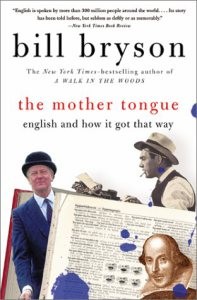 Title: Mother Tongue (
 Title: Made in America (
 Title: Animal Farm (
 I just read an article from Time-Online called ‘
 Title: Foucault's Pendulum (