Evolution of the English Language

Posted April 22, 2010 by Michael @ Knowledge Lost in Linguistics / 16 Comments

Recently I wrote an entry about pop culture destroying literature and in one comment it was mentioned the beautiful language the classics were written in. This got me thinking; why did the English language have to evolve?

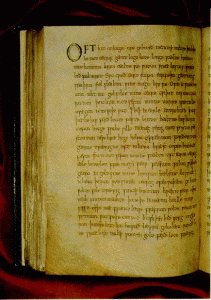
I did some research on the topic, beginning with the Anglo-Saxons. The Anglo-Saxons’ language was already a blend of dialects from West Germanic tribes. Add some dialects from the Norse, Frisian and the Dutch and you start to see the English language form. Now skipping all the history lessons of basically everyone invading England and leaving their make on the English language, you begin to form what is now known as Old English.

This is where it begins to get tricky and hard to follow, so stick with me while I try to explain the old English to modern English transition. From what I can tell Old English pronounced P, b, t, d, m, n, l, and r as we do today but rarely use letters like k, q, v, x, and z, then you have non-modern letters like thorn (þ) and eth (ð).

The period between 1150 and 1475, there were three major dialects of Middle English; Northern (Northumberland), Midlands (Mercia) and Southern (Wessex). From what I can work out, Modern English was like a major merger between the three dialects.

This began the basics of what we call the Modern English language. One of the biggest reasons behind the evolution of language is pronunciation. Words were pronounced vastly different in a lot of cases to their modern pronunciation. Over the years it continued to evolve with influences from Latin, Greek, French, etc. Later on during conflicts with the French, the English dropped the letter u in words ending –our. Though the English picked this practice back up later, the Americans never did (this is why Americans can’t spell).

The 19th Century is where I would have liked the evolution of the English language to stop, but unfortunately it continues. Now the English language has come to a point of dropping letters for ‘IM English’. I hope this won’t be the next evolution in English, but it looks like it is moving that way.

I would love to know what others think of the Evolution of the English Language, as well as what I may have missed.

For more information about the history of the English language in America, a friend recommended a book called Made in America by Bill Bryson. Bill Bryson’s book explores the history of the English language in the United States and the evolution of American culture.


IO9’s 20 Science Fiction Novels That Will Change Your Life

Posted April 15, 2010 by Michael @ Knowledge Lost in Listology / 0 Comments

I just stumbled across a list of 20 Science Fiction Novels that Will Change Your Life on the io9 blog. While I haven’t read all the books there are some great choices there and I thought I should share it with my readers as well. Whether you agree or not, this is an interesting list;

  1. Frankenstein (1818), by Mary Shelley
  2. The Time Machine (1895), by H.G. Wells
  3. At the Mountains of Madness (1931), by H.P. Lovecraft
  4. I, Robot (1955), by Isaac Asimov
  5. The Dispossessed (1974), by Ursula LeGuin
  6. Kindred (1979), by Octavia Butler
  7. Wizard (1979), by John Varley
  8. Consider Phlebas (1987), by Iain M. Banks
  9. He, She, and It (1991), by Marge Piercy
  10. Sarah Canary (1991), by Karen Joy Fowler
  11. A Fire Upon the Deep (1992), by Vernor Vinge
  12. The Bohr Maker (1995), by Linda Nagata
  13. The Sparrow (1996), by Mary Doria Russell
  14. Cryptonomicon (2000), by Neal Stephenson
  15. The Mount (2002), by Carol Emschwiller
  16. Perdido Street Station (2002), by China Mieville
  17. Down and Out in the Magic Kingdom (2003), by Cory Doctorow
  18. Pattern Recognition (2003), by William Gibson
  19. Newton’s Wake (2004), by Ken MacLeod
  20. Glasshouse (2006), by Charles Stross

For those of you not familiar with io9, it’s a blog part of the gawker network that focuses on the subjects of science fiction, futurism and advancements in the fields of science and technology.


Five Books That Changed My Life

Posted April 12, 2010 by Michael @ Knowledge Lost in Literature / 0 Comments

As most of you may know, I never use to be much of a reader; it was only last year that I decided to discipline myself to read more. So I thought I might as well share with you five books that really had strong effects on me and my views on life.

  • Markheim – This short story by Robert Louis Stevenson is definitely my favourite of his works I’ve read so far. The concept is amazing, but I won’t give you any spoilers.
  • Slaughterhouse-Five – And so it goes…nothing could have prepared me for a book like this. It’s unique in its style and left me pondering it for months after reading it.
  • Wuthering Heights – I know one reader that would be happy to see this on my list. The reason it does grace this list is the simple fact, that it defied all expectations. I went into this book thinking I knew what the story was about, but it shattered every expectation and left me with a dark and beautiful tale.
  • Frankenstein – It is apparent that this book has changed my life. I’ve mentioned it before in reference to pop culture and even a Smashing Pumpkins song. This book is simply a brilliant book on very real social issues.
  • Hey! Nietzsche! Leave them kids alone! – This book is the reason this blog exists. Craig Schuftan opened my eyes to a world I didn’t know by providing some interesting connections between the Romantic Period and today’s music scene.

Write What You Know?

Posted April 8, 2010 by Michael @ Knowledge Lost in Writing / 0 Comments

People say to write what you know, but what if your life is boring? Or what if the only think in your life that is interesting enough to write is an emotional and heart wrenching topic? This is something I’ve was thinking about all night last night. I know writing is a painful and emotional process for me, but as a writer am I willing to open old wounds and real live past mistakes and heart aches just to write a story?

The question is; should you write what you know if what you know is to painful to write about?


Did Pop Culture Destroy Literature?

Posted April 8, 2010 by Michael @ Knowledge Lost in Culture, Literature / 0 Comments

Isn’t it interesting that in pop culture, we think we know icons like Dracula, Frankenstein, Dr Jekyll and Mr Hyde. We know their basic story but until we read the books that made these characters famous, and then we realise that we have missed so much of the concepts and story.

Frankenstein is referenced  in countless  movies but ia most commonly associated with the monster, not the doctor. It’s just a tale of a monster terrorising the villages and  until you read the book you don’t understand it at all. I remember reading Frankenstein for the first time and discovering this isn’t a book about a monster.  This is a book about society and how we judge and treat people.

When it comes to Dracula, we all know the story of the Vampire, Count Dracula from Transylvania, but we don’t have a clue on just how interestingly the book was written. I went into the book thinking I was going to be reading a novel, but I discovered a series of letters, diary entries and ship logs that told this story in such an unsuspecting way.

Now unfortunately pop culture has ruined the plot of The Strange Case of Dr Jekyll and Mr Hyde but it has left out a lot of the interesting concepts. The book explores the idea of separating the Good from the Evil in the doctor, who was trying to explore the evil inside of himself and still live with his conscience clear. Or maybe it’s a story about living life with split personalities.   There are so many interpretations, but all in all its a book about the duality of human nature.  Pop Culture just tells a story of a doctor discovering this potion by accident.

The interesting thing is that no one really knows where Mr Hyde goes all those nights and what he does. This has lead to many of conversations through the ages trying to work out what Mr Hyde was up to; Some say it’s a metaphor for Homosexuality but I believe it’s open for personal interpretation. So the reader can make his own discovery on their evil side.


Thoughts from a Writing Historical Fiction Course

Posted March 21, 2010 by Michael @ Knowledge Lost in Writing / 0 Comments

I just got back from a course on writing Historical Fiction and I got more out of it that I ever expected. Just basic ideas and thoughts are swimming in my head; I thought I will write through what was talked about with some ideas of writing exercises.

Warming Up Before Writing

This is something I’ve never really done but I can see that doing some exercises to get you into the flow of writing would help. Also if you do exercises that will relate to your story then it will defiantly benefit you later. Although the craft of writing is in the rewrite all these exercises are really to help you write your first draft.

Warm Up Exercises

  • Write a descriptive paragraph of a characters favourite food from their childhood
  • Write a descriptive paragraph of a characters favourite song from their childhood

There are more things you can write about as well, for any experience, like owning a pet or driving a car. This is to help you understand the character a bit better and get the creative juices flowing. If you struggle try writing from your own perspective first.

Characters

Well written stories have well written characters. These Characters need to be complex creatures with fears, desires and struggles. Though you may not write about all these things, it’s important to know everything about the character so you know how they will talk, think and feel in certain situations.

Character Building Exercise

Find a picture of person that maybe a character in your book then work out the following

  • Characters Full Name
  • Age
  • Job
  • What they want most in the world
  • What do they fear most in the world

Editing

Self editing is often extremely hard and you often miss a lot of mistakes. So here is a list of ideas to help with editing and things to look for when you edit.

  • Try putting the story away for a few weeks or a month and not look at it, then come back to it
  • When something doesn’t sound right
    • Delete It
    • Make it on the page and come back to it later
    • Re-write it
    • Try reading out aloud
  • Print out your work
  • This way you can see if it too descriptive (too blocky)
  • Not descriptive enough (too much unused space)
  • Look for consistencies
  • If it feels like you are explaining not telling a story (you most likely are)
  • Be willing to delete lovely writing if it has no relevance to the story
  • Be wary of too many agentives or adverbs.
  • If a section isn’t working
  • Try writing from a different perspective
  • Step out of your work, but stay in character (eg. Write the characters journal or a series of letters to people or even put the character in another situation)
  • Don’t be nervous about trashing the whole story and starting again

Research

All books will require some research; it is the foundation of every story.
With any story not just Historical Fiction tries to be accurate with the story; there are plenty of resources out there for this.

  • Textbooks (Not just current ones but textbooks written in those days)
  • Oral History or Even of Diaries (will give you an idea of slang and informal language)
  • Official Records / Newspapers (will give you an idea of the formal language)
  • Academics (There is normally a Thesis on any subject)
  • Historical Societies (normally have good records and good antidotes about life in a particular time)
  • The Internet (Good reference point with a lot of information but not always a reliable source)
  • Field Work (Get a sense of the scenery, how things feel, smell, etc)

Remember it’s the little details that often matter the most in a story. Try to cover a range of sources and don’t be afraid to include little snippets of real text into your story (as long as you check copyrights and reference it). There is a fine line to overloading your story with facts, so don’t be intrusive with the facts.

Research Exercise

Split a page into two columns; the left side write down all the facts you will need to add (eg. What was the weather like, what did people where, etc) and on the other side write some imagery to go with these facts (eg. If the weather was cold and windy, write something like “the wind was like icy knives stabbing at my skin”)

Timelines & Maps

It’s important to make sure your work is consistent, so sometimes its a good idea to make a timeline of relevant world events and then match them up with your characters timeline to make sure they are consistent. You don’t want to make a reference to something that wasn’t around that era (eg. If you character took a train make sure there were trains in the area in that time)
Also make mud maps of the house, the area and surrounding. This way you will know distances, water crossings, old buildings, etc. You don’t want to fall into a trap of mentioning something and then forgetting about it later on. (eg. If someone took 2 days by horse to get somewhere you don’t want another person arriving in only a day.)
If you are writing about a real place, maybe look at Google maps or Google earth, find some maps from that era, just so you understand the surroundings and what’s happening.

Points to Remember

  • Don’t make your novel sound like a series of facts
  • Make the characters feel like real flawed people
  • Hook into the terminology and language used back then (maybe don’t write in old English because people won’t understand it, but use phrases or worlds that remind people it’s set in old English times)
  • Use era appropriate words (eg. Don’t call it a train if it was referred to as a Locomotive back then)
  • Be aware of slang or cursing (check to see what was used back then)
  • Don’t try to tell the reader life was harder or easier back then, just that it was different
  • Leave your own perceptions out of your work
  • Remember the day to day lives of your character
  • Research names commonly used in that era
  • Understand your character and the landscape
  • Just Write – you can rewrite and edit later; just try to get all the thoughts on paper before you lose them. Polishing your work can come at anytime.

Trying to Understand Existentialism

Posted March 14, 2010 by Michael @ Knowledge Lost in Culture, Philosophy / 0 Comments

The Myth of Sisyphus

“The struggle itself…is enough to fill a man’s heart. One must imagine Sisyphus happy.”

Albert Camus

Existentialism is an interesting philosophical concept; if God doesn’t exist then life has no point. So if life has no point, we can basically do what ever we want, make our own life worth living.

Existentialist thinkers focus on the question of concrete human existence and the conditions of this existence rather than hypothesizing a human essence, stressing that the human essence is determined through life choices. However, even though the concrete individual existence must have priority in existentialism, certain conditions are commonly held to be “endemic” to human existence.

It is in relation to the concept of the devastating awareness of meaninglessness that Albert Camus claimed that “there is only one truly serious philosophical problem, and that is suicide” in his The Myth of Sisyphus. Although “prescriptions” against the possibly deleterious consequences of these kinds of encounters vary, from Kierkegaard’s religious “stage” to Camus’ insistence on persevering in spite of absurdity, the concern with helping people avoid living their lives in ways that put them in the perpetual danger of having everything meaningful break down is common to most existentialist philosophers. The possibility of having everything meaningful break down poses a threat of quietism, which is inherently against the existentialist philosophy.

Existentialist thinking makes me wonder about things like;

  • Angst
  • Authenticity or even inauthenticity
  • Despair
  • Facticity
  • Freedom
  • Reason

Where do these fit into the world of Existentialism?


Killing An Arab

Posted March 7, 2010 by Michael @ Knowledge Lost in Philosophy / 0 Comments

The debut single from UK Goth greats; The Cure was Killing An Arab. Robert Smith calls the song a “short poetic attempt at condensing my impression of the key moments in L’Étranger (The Stranger) by Albert Camus”. The song tells the story of the scene on the beach where the protagonist Meursault shots the Arab attacker. The Stranger (also known as The Outsider) covers philosophical concepts like) absurdism, atheism, determinism, existentialism, nihilism, and stoicism.

One interesting concept in this book and the main reason I want to read it, is the fact that Meursault chooses not to lie. In the afterword Camus stats;

[Meursault] refuses to lie. Lying is not only saying what isn’t true. It is also, in fact especially, saying more than is true and in the case of the human heart, saying more than one feels. We all do it, every day, to make life simpler.

The best example of people lying would be the typical conversations

“How have you been?”

“Fine”

The response “Fine” is hardly ever true and is just avoiding the real issues you are going through. But in the same conversation; how many people ask “How have you been?” and not really cared one way or another, just using it as a conversation starter.


Blogging Vs. Writing

Posted March 7, 2010 by Michael @ Knowledge Lost in Writing / 0 Comments

I’ve been thinking a lot lately about my writing and my blog. The question I’ve been asking myself is;

Does my blogging affect my writing?

It’s true that I haven’t been writing much since I’ve started this blog. I think it really isn’t a bad thing, I believe that I’m beginning to discover more and more things that I need to know. I’ve discovered more about myself and writing while blogging than I thought imaginable. Previously I would write without any preparation; I never worked with character profiles, research, story boards, etc. But now I’ve started to work smarter.

Research is the main lesson learnt for me, so much so I’ve signed up for an interesting writing course; Writing Historical Fiction. Basically it’s all about recreating times, events and places in history accurately and evocatively. Outlining the resources available and methods for researching the details of every-day lives. This workshop will give you a broader knowledge of resources from which to access historical fact, and methodologies for translating that fact into compelling prose.

So I don’t feel guilty that I’m not writing, I feel like I’m learn basic and fundamental tools that will improve my style. I think I’ve learnt more about myself and my writing style in this blog than in just trying to write.

One big advantage is the great community on WordPress.com, I’ve started to find some great minds to bounce ideas off, as well as push me along the way. I know my writing will improve; my editing (hopefully) will improve too. But all in all I’m enjoying learning and sharing what I’ve learnt more than anything else.


The Catcher In The Rye by J.D. Salinger

Posted March 2, 2010 by Michael @ Knowledge Lost in Classic / 0 Comments

The Catcher In The Rye by J.D. SalingerTitle: The Catcher In The Rye (Goodreads)
Author: J.D. Salinger
Published: Penguin, 1951
Pages: 241
Genres: Classic
My Copy: Personal Copy

Buy: Amazon (or visit your local Indie bookstore)

On one hand The Catcher In The Rye was an impressive insight of teenage life. I identified with many of those feelings when I was in high school. I remember feeling alone, annoyed all the time and never feeling like doing anything. In this aspect J. D. Salinger was a master at capturing the feelings of my youth. But on the other hand, Holden Caulfield is the most annoying character I’ve ever read; I’ve wanted to punch him in the face so many times. He just infuriated me and I struggled to read this book because of that fact. On the upside there is a scene where Holden is having a conversation with an old school teacher, Mr. Antolini. The teacher told him that one day, he will discover what he is meant to do with his life, and on that day he will wish he paid attention in school. This is probably the most identifiable scene in the book; I know the feeling of wishing I paid attention and discovering a passion later in life.

Despite all the Controversy I really want to know why this book is always assigned to students in school. A book about teenage angst and dropping out of school; is that something you want students to learn about? High School Teacher who was involved in the controversy in America Shelley Keller-Gage stated; “[They] are being just like Holden . . . They are trying to be catchers in the rye.”