Format: Paperback

Apocalypse Baby by Virginie Despentes

Posted March 10, 2017 by Michael @ Knowledge Lost in Thriller / 0 Comments

Apocalypse Baby by Virginie DespentesTitle: Apocalypse Baby (Goodreads)
Author: Virginie Despentes
Translator: Siân Reynolds
Published: Serpent's Tail, 2010
Pages: 338
Genres: Thriller
My Copy: Library Book

Buy: AmazonBook Depository (or visit your local Indie bookstore)

Provocative French author Virginie Despentes is best known for her debut novel Baise-moi, which was published in 1993 to much controversy. The book was adapted into a film, which was also written and directed by Despentes. This debut novel is often considered the most controversial French novel of recent times, exploring a punk fantasy of two women on a vengeance rampage à la Thelma and Louise. The novel and film are modern examples of a crime thriller genre known as rape and revenge.

Virginie Despentes has had a salacious life, which ranges from working as a maid/sex worker in ‘massage parlours’ to being a pornographic film critic. As a novelist she has written seven novels of transgressive fiction, although only three have been translated into English. Her latest novel Apocalypse Baby (Apocalypse Bébé) was published in English by Feminist Press in 2015. The book is a faced-paced thriller about a missing adolescent girl. Two mismatched private investigators are paired together to find this lost girl.  The two follow the evidence from Paris to Barcelona and back on this epic road trip.

Lucie Toledo is not a great private investigator, her skills typically include watching over her clients, but when the troublesome fifteen-year-old Valentine disappears she is out of her league. Tasked to watch the girl by her grandmother, Lucie is held responsible. She enlists the help of the legendary detective, known as The Hyena to help with this missing person case. The Hyena is a sexist, misogynist; constantly wolf whistling at female pedestrians and grabbing their crotches. Two very different personalities stuck in a car propels the novel towards the inevitable conflict.

Apocalypse Baby is an unflinching thriller that never shies away from graphic descriptions. Though not without its flaws, the novel offers so much more than a psychological romp. Virginie Despentes uses this transgressive story as a platform for social criticism, exploring French politics and society. Between each chapter, there lies a glimpse at different members of Valentine’s family, exploring their own struggles and fears. Her father, step mother, and two sisters are all fleshed out in these sections; not taking away from the novel but rather giving an extra dimension and providing a deeper understanding on Valentine’s motivation.

What really stuck with me in Apocalypse Baby was the way it played with the idea of gender equality. Take for example the misogynist partner The Hyena, when you think about this character, did you envision a woman? I found myself constantly thinking “You are a woman, you should know better” but then I stop myself, a man should know better as well. I like the way Virginie Despentes used this idea as a tool to explore social issues. While this novel is nothing special, this one aspect really stuck with me and I appreciate just how masterfully Despentes made her point.


Back to Moscow by Guillermo Erades

Posted January 25, 2017 by Michael @ Knowledge Lost in Contemporary / 0 Comments

Back to Moscow by Guillermo EradesTitle: Back to Moscow (Goodreads)
Author: Guillermo Erades
Published: Scribner, 2016
Pages: 371
Genres: Contemporary
My Copy: Library Book

Buy: AmazonBook Depository (or visit your local Indie bookstore)

Martin has just arrived in Moscow, on the advice of an old girlfriend (she thought it would be easier to score a scholarship from a Russian university). He plans to finish his studies and write a thesis on the Russian heroine, exploring the difference between Russian literature and the western world. However, it is the early 2000s and Moscow is changing rapidly, and the appeal of nightclubs, woman and cheap alcohol is distracting him from his study. Guillermo Erades’ debut novel Back to Moscow is a booze soaked exploration of an aspiring writer in a new setting.

Do not get me wrong, I love those novels that are set in New York that follow to wannabe writers that are often difficult men. I cannot get enough of those types of stories but this is so much better, for starters this is about Russian literature. Back to Moscow thrilled me from start to finish because of the setting and the exploration into Russian classics that appeared at the start of every part.

I am normally am hesitant in picking up a book set in Russia by a western author, but I seem to have decent luck with Spanish authors. Granted I have only read Encyclopedia of a Life in Russia by Jose Manuel Prieto and now Back to Moscow but both have impressed me greatly. Maybe my hesitancy should be directed towards American authors rather than the entire western society. I find the lack of knowledge of Russia often reflects poorly on the author.

With Back to Moscow, the whole novel was structured around understanding Russia and its literature and this is a quest that I am personally on as well, so my gushing review is inevitable. I also enjoy reading about terrible people and Martin fits into that category but I never thought of him as an anti-hero. I had some empathy for him, partly because I have made so many of those stupid mistakes. I have put my desire for pleasure over the feelings of others and as result hurt myself and the people I love.

This does not mean I sympathise with Martin; I did get frustrated with every selfish action but I could relate (as much as I hate to admit it). Add that to the mix of an antisocial writer with a passion for Russian literature, and you have someone that closely resembles me (although the bad life choices are over for me, thankfully). I do wonder if Back to Moscow is at all autobiographical, because the way he writes makes me think this is the case.

I like the focus on exploring the differences between Russia and western society. This becomes the focus of the novel. It is this exploration that allows people to try and gain a better understanding of the differences. One of Martin’s friends even said. “You Westerners are always angry because you want to change everything in life. We Russians are always sad because we know that most things cannot be changed.” This quote really stuck with me in really understanding the differences. There is so much more to understand, but I am working on an essay on Russian literature (stay tuned).

“Russia is lost” she continued. “First we had God. Then we had Lenin. Now we have nothing.”

Without giving away much about the plot, I will say that this debut novel impressed me greatly. There is a definite affection for Russia and the classics coming from the author and I think that is the appeal. The novel ends with the perfect metaphor for the entire story and Russia literature itself.

“In Metro systems around the world, a screen about the platform shows the time left until the arrival of the next train. Five minutes. Four minutes. Three minute. Two minutes. One minute. Then the countdown stops and you feel the breeze and you hear the rattle of a new train approaching through the tunnel.

Not in Moscow.

In Moscow’s metro, the electronic counter about the platform shows the time that has passed since the departure of the last train. With unnecessary precision, the seconds keep adding up one by one, informing you not about the train to come, but the one you’ve missed, the train that would be carrying you, if only you arrived earlier. But that train is for ever gone. You don’t know when the next one will arrive.”

The back of the novel compares Guillermo Erades to Ben Lerner and Bret Easton Ellis, while I can see the comparison with Larner, I debate the other. I think the only thing Erades and Ellis have in common is their ability to write a difficult men. Back to Moscow is one of those books that I wanted to turn back to page one and re-read straight away. I cannot say this is a novel that will appeal to everyone, it appealed to me for the reasons I have mentioned. I do not think there is anything profound to get from this book, but the quotes I have added to this review are lines that stuck with me. I find it hard to review this critically because I got so much out of it personally. If you have a love of Russia and its literature then maybe you need to give this book a go as well.


One Day in the Life of Ivan Denisovich by Aleksandr Solzhenitsyn

Posted January 23, 2017 by Michael @ Knowledge Lost in Classic / 0 Comments

One Day in the Life of Ivan Denisovich by Aleksandr SolzhenitsynTitle: One Day in the Life of Ivan Denisovich (Goodreads)
Author: Aleksandr Solzhenitsyn
Translator: Ralph Parker
Published: Penguin, 1962
Pages: 142
Genres: Classic
My Copy: Paperback

Buy: AmazonBook DepositoryKindle (or visit your local Indie bookstore)

One of the most important works of fiction to come from the Soviet Union was Aleksandr Solzhenitsyn’s One Day in the Life of Ivan Denisovich. It was this novella that informed the world of the harsh realities of the gulag under Stalin’s reign. The reaction from the world even lead to Solzhenitsyn’s most important piece, The Gulag Archipelago, a seven volume exposition into the gulag; it was part oral history, part personal account and a political statement. The Gulag Archipelago has become an important piece of literature, and it is taught in Russian high schools, while One Day in the Life of Ivan Denisovich is sometimes assigned reading in classrooms around the rest of the world.

The novella follows Ivan Denisovich Shukhov for one day in 1951, exploring life as a prisoner in a Stalinist labour camp (known as the gulag). Aleksandr Solzhenitsyn was sent to the gulag in 1945 for criticising Joseph Stalin in a private letter. He would have been left there to die but when Nikita Khrushchev became the first secretary of the Communist party after Stalin’s death in 1953, Solzhenitsyn was released in 1956 due to his poor health. Most of his writing is autobiographical in nature, in particular One Day in the Life of Ivan Denisovich (about life in the labour camps) and Cancer Ward (which is about his battle with cancer that lead to his release from the gulag).

The significance of this novel is far reaching, not just on giving the reader an understanding on life in the labour camps but also as a political statement on Stalin. The book looks at the struggle to keep human dignity in such harsh treatment. From constantly being treated inhumanely to the removal of their identity by referring to everyone by a serial number (Shukhov being SHCHA-854). While the guards are constantly trying to discourage camaraderie, we still get a glimpse into the interactions between the prisoners. It is here that we get an idea on just how temperamental Stalin could be. Although getting into the tyrannical reign of Stalin requires more research, you get an idea of unjust punishment while reading One Day in the Life of Ivan Denisovich.

There is a lot to explore in One Day in the Life of Ivan Denisovich ranging from the constant struggle with privacy to the vivid descriptions of the cold weather. However, the one thing that stood out for me is the parcels that Tsezar was selling. Not just tobacco but a range of desirable items. For me he became a symbol of worldly pleasures in a place where everyone had nothing. This turns the novella into something so much deeper. You might notice that the name Tsezar is similar word to Tsar, in fact both are Russian words for Caesar. Keeping this in mind we now have a motif for the events that lead to the Russian revolution and it begins to explore the corruption of power under Stalin. Rather than working towards the socialist utopia that the Bolsheviks dreamt of, Stalin rewarded the people that had his favour while punishing everyone else. This idea stuck with me and I think it transformed Aleksandr Solzhenitsyn’s work into something far greater. Although this is what I have come to expect from this author.

This is only my second Solzhenitsyn book (the other being In the First Circle) but I am constantly surprised with the depth he goes to in order to explore his ideas. His books were often published as samizdat (Russian for self-published but referring to the illegally published and distributed literature of the Soviet era) but he still has a unique ability to hide a deeper idea in his novels to avoid serious repercussions from the government. One of my favourite parts of Soviet literature is the way the authors often use satire, motifs and symbolism to explore their true message. I always get a thrill from these books, as if I am understanding some hidden secret. I do think One Day in the Life of Ivan Denisovich is an essential read for anyone interested in Russian literature and I am a little ashamed I put if off for so long.


The Invention of Morel by Adolfo Bioy Casares

Posted January 9, 2017 by Michael @ Knowledge Lost in Classic / 2 Comments

The Invention of Morel by Adolfo Bioy CasaresTitle: The Invention of Morel (Goodreads)
Author: Adolfo Bioy Casares
Translator: Ruth L.C. Simms
Artist: Norah Borges
Published: NYRB Classics, 1940
Pages: 103
Genres: Classic
My Copy: Paperback

Buy: AmazonBook Depository (or visit your local Indie bookstore)

Never have I read anything like The Invention of Morel, it is beautiful and yet left me somewhat confused. I have spent more time thinking about this novella than actually reading it. While the plot is straight forward, it is the bizarre and fantastical elements that left me perplexed. The novella tells the story of a man on the run, who hides on a deserted island (the fictional island of Villings which is believed to be part of the Ellice Islands, now known as Tuvalu). When people start to arrive on the island, things become a little more complicated.

This is the book that launched Adolfo Bioy Casares’s career, despite being his seventh book. He remains a little obscure outside of Argentina, even though his friend Jorge Luis Borges is known to sing his praises. While this book is sometimes categorised as science fiction or fantasy, for me it reads like a psychological adventure story. Rather than focusing on a plot which is common in genre fiction, he prides himself in making the book plotless and almost formless. This is a unique style for a novel like this but helps explore the inner psyche of the narrator.

The way the novella is written leaves you constantly questioning the reliability of the narrator. This is done in many different ways, from the disease that is apparently effecting the island (symptoms seems to be similar to radiation poisoning) to the hallucinations the narrator experiences from food poisoning and just the bizarre nature of the novella as a whole. I found this to be an effective way to explore The Invention of Morel and the main protagonist. It was these psychological elements of the book that I ended up appreciating.

The Invention of Morel was written in a time where radiation has a hot topic. I do not know much about the history of radioactivity but I know Marie Curie died in 1934 from aplastic anaemia, which is believed to be brought on by exposure to radiation, then in the 1940s there was a race to perfect the nuclear bomb. This I believe had an effect on Bioy Casares’s novella and helped him explore the idea of dying which leads to the theme of waiting for his soul to pass on.

I have to add that the reason Louise Brooks was put on the cover of the edition I read was because Adolfo Bioy Casares wrote this novella as a reaction to the demise of her film career. Take that to mean what you will, I do not know anything about Brooks to be able to draw any connections between her life and the book. Also the illustrations were provided by Norah Borges, Jorge Luis Borges younger sister. I am so please to have read The Invention of Morel, it was such an enjoyable experience and this novella is something I will contemplate for years to come.


Voroshilovgrad by Serhiy Zhadan

Posted December 7, 2016 by Michael @ Knowledge Lost in Contemporary / 0 Comments

Voroshilovgrad by Serhiy ZhadanTitle: Voroshilovgrad (Goodreads)
Author: Serhiy Zhadan
Translator: Reilly Costigan-Humes, Isaac Wheeler
Published: Deep Vellum Publishing, 2010
Pages: 445
Genres: Contemporary
My Copy: Paperback

Buy: AmazonBook DepositoryKindle (or visit your local Indie bookstore)

The novel Voroshilovgrad by Serhiy Zhadan was dubbed “Trainspotting set against a grim post-Soviet backdrop” by Newsweek. Having read this tag and with a recommendations from Agnese from Beyond the Epilogue, I knew I had to read this one. It revolves around Herman, who finds himself managing his brother’s gas station, after he mysteriously disappeared. Though it is a story of a bleak industrial city as it is a story of Herman.

Voroshilovgrad is a fascinating exploration into a post-soviet Ukraine. Not only does it explore the effects of communism to an industrial city, but also the power vacuum left behind when the Soviet Union collapsed. The mystery of what happened to Yuri takes a backseat as the novel explores the lives of Herman and his employees Kocha and Injured as they go head to head with a gangster who wants to control the gas station.

This is an interesting novel that appears to blend elements of post-modernism with the writers of the Beat generation, with a splash of Hunter S. Thompson. Serhiy Zhadan himself is a novelist, a poet and a translator. He mainly translates poetry from German, English, Belarusian and Russian but has translated Charles Bukowski into Ukrainian. This knowledge helps understand his influences, and while I still maintain that Voroshilovgrad reminds me of the Beats, I can see some Bukowski coming through.

While Voroshilovgrad was an entertaining insight into a post-Soviet city, I do not think there is many more themes to pull from this novel. I think it explored this idea really well and while I would have loved something deeper, I cannot fault the novel at all. I typically read books in translation to understand a different time and place, and Voroshilovgrad was able to do this perfectly. I love the dark and gritty nature of this novel, and I plan to re-read Voroshilovgrad in the future.


Missing Person by Patrick Modiano

Posted November 29, 2016 by Michael @ Knowledge Lost in Literary Fiction / 0 Comments

Missing Person by Patrick ModianoTitle: Missing Person (Goodreads)
Author: Patrick Modiano
Translator: Daniel Weissbort
Published: Verba Mundi, 1978
Pages: 192
Genres: Literary Fiction
My Copy: Library Book

Buy: AmazonBook Depository (or visit your local Indie bookstore)

I have been wanting to read Patrick Modiano; not only has he won a handful of awards, he is the recipient of the 2014 Nobel Prize in Literature. The Nobel was “for the art of memory with which he has evoked the most ungraspable of human destinies” but the committee also called him the “Marcel Proust of our time”. Unfortunately, not many of his novels have been translated from the French into English, despite the fact that he is so prolific (I counted six English translations prior to winning the Nobel Prize in Literature and a further eight since winning).

Missing Person appeared to be the perfect starting point for me, as it covered two elements that I am drawn to in literature, noir and philosophy. The novel follows Guy Roland, who was been working for Constantin van Hutte in his detective agency for the past eight years. As Hutte has decided to retire, Roland embarks on one last case, to find out who he really is. Guy Roland (a name given to him by Hutte) lost his memories during the war and is essentially a blank slate.

What drew me into this story was the cinematic style; it feels like a French film noir. The French title of the novel is Rue des Boutiques Obscures, which translates to the Street of Dark Shops. This is not a hard-boiled story, as Roland is not hard-boiled in anyway; this is what I would probably call existentialist noir. A perfect blend of the mysterious setting; dark cafes and plenty of wine and cigarettes. With the enhanced feeling of being completely lost, as Roland tries to find out who he really is.

“The sand holds the traces of our footsteps but a few moments.”

Essentially this is a novel exploring the ideas of identity and memories. I like the way Modiano played with the idea of a blank slate. What defines this person? What makes up this man’s character, and will what defined him in the past return to him? An exploration into the way people remember you and how that shapes your character and personality. Roland tries on different personas; in his investigation he may not discover who he really is but he adopts this ideas of people to see if it feels right or sparks a memory. The way memory plays out in the novel is particularly interesting; in one scene he recalls a love affair with a woman, but fifteen years after the breakup she denies that it ever happened. So you are left wondering if it did happen, or is this a distortion of the truth or maybe even a suppression of her past.

This is the type of novel you do not read for the plot. Missing Person is meant to explore an idea, invoke an emotion and get you thinking about identity and memories. The pulp-ish style to this novel really worked for m., I love the idea of investigating yourself; playing with the idea of self-discovery and identity. I will be exploring more from Patrick Modiano; in particular I want to try his novel Honeymoon. I am glad I read Missing Person and I have not been able to stop thinking about the ideas explored in this novel.


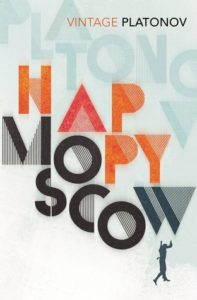
Happy Moscow by Andrei Platonov

Posted October 14, 2016 by Michael @ Knowledge Lost in Short Stories / 0 Comments

Happy Moscow by Andrei PlatonovTitle: Happy Moscow (Goodreads)
Author: Andrei Platonov
Translator: Robert Chandler
Published: Vintage, 1991
Pages: 263
Genres: Short Stories
My Copy: Library Book

Buy: AmazonBook Depository (or visit your local Indie bookstore)

“Life has become better, comrades, life has become merrier” – Joseph Stalin

Happy Moscow was an unfinished novel by Andrei Platonov, finally published in 1991 and yet it still became one of his greatest works. It is believed that Platonov started the novel in about 1932 but abandoned it a few years later. Happy Moscow tells the story of Moscow (or Moskva) Ivanovna Chestnova, an orphan trying to make her way through life. Named after the Soviet capital, Moscow becomes a metaphor for life under Stalin.

The story of a woman’s struggle through life is an obvious metaphor for Russia’s own journey starting with the revolution. Starting off with a clear and ascending life however as the years go by, life becomes more and more complex. Dreams turn into distant memories as responsibility and bumps along the way happen. While Andrei Platonov was a communist, his novels were often banned due to his criticism towards Stalin regarding collectivization and other policies. It is easy to see why Platonov would leave this novel unfinished out of fear of the consequences.

This anarchic satire is very odd to read, it is fragmented due to it being left unfinished and Platonov’s experimental or avant-garde style. There is a complex struggle that comes out in the writing, making this more of the writings of a man trying to understand his own views. This alienating struggle that unfolds on the page is what made Happy Moscow an interesting read because Platonov’s writing style was a struggle. Platonov is a philosopher, using his writing to explore his ideas, often drawing on Marxism or Leninism while criticising Stalinism. Stalin obviously did not see Platonov as having any worth in literature but his feelings were some what complex, calling him a “fool, idiot, scoundrel” and then “a prophet, a genius” in the same meeting. Platonov was eventually arrested and exiled to a labour camp as an anti-communist (anti-Stalinist would be a better suited term).

The book I read contained a few short stories and a screenplay with the unfinished novel Happy Moscow. These stories include ‘The Moscow Violin’, ‘On The First Socialist Tragedy’, ‘Father’ and ‘Love for the Motherland’. While all had their own themes they all seem to have similar threads that tie them back to Happy Moscow. Andrei Platonov was a difficult author to tackle, but I am glad I did it. There are a few more of his novels I would like to get to including The Foundation Pit but I think they will be in the distant future


Pale Fire by Vladimir Nabokov

Posted September 27, 2016 by Michael @ Knowledge Lost in Classic / 2 Comments

Pale Fire by Vladimir NabokovTitle: Pale Fire (Goodreads)
Author: Vladimir Nabokov
Published: Penguin, 1962
Pages: 246
Genres: Classic
My Copy: Paperback

Buy: AmazonBook Depository (or visit your local Indie bookstore)

Vladimir Nabokov’s Pale Fire is a novel centred around a 999 line poem of the same name by fictional poet John Shade. It is primarily focused on a literary commentary by Charles Kinbote, an academic with an obsession with the poet. Starting with the poem in four cantos, then leading into Kinbote’s analysis, Pale Fire is a wonderfully complex novel on obsession and literary criticism. While Nabokov’s 1962 post-modern masterpiece might sound dense on the surface,  I found the novel itself easy to read, but difficult to unpack.

Before sharing my thoughts on Pale Fire, I feel it is important to point out Vladimir Nabokov’s academic career in America. While in America, Nabokov worked as a lecturer mainly in Russian and European literature, most notably at Cornell University from 1948-1959. The reason why this is important is the fact that this experience would have contributed the satirical nature of Pale Fire. I often found the novel to be a tongue in cheek look at literary criticism. On reading this, I found myself laughing at the leaps Kinbote often took to explain the Shade poem. I could not help but think this was a reflection of some of the assignments Nabokov read as a lit professor.

Looking deeper into Pale Fire and there is a lot to gain from the novel. What I noticed first seems to be a popular trope for Nabokov, and that is the unreliable narrator. I cannot help but comparing Charles Kinbote to Humbert Humbert from Lolita. Not only is he unreliable but the obsession with the poet John Shade feels very similar. His obsession towards the poet and the art leads to an artistic passion, however this turns into a struggle with desire exceeding creative capability. It is here we get an interesting idea of critical commentary verses the desire to creating literature.

As things progress the novel shifts to an exploration into reality. I found myself questioning the sanity of Kinbote and maybe he is actually King Charles of Zembla. He could in fact be the exiled king or far more likely, he is suffering from dangerous delusions. From what I know after reading Lolita and Invitation to a Beheading (the only other novels I have read) Nabokov likes to play around with obsession, in particular the dangerous realities it may lead to. It is here where I wished I had read Speak Memory or a biography on Nabokov, because I get a feeling of autobiographical elements in Pale Fire. There are moments that seem to parallel his own life, in regards to fleeing the Soviet Union and even teaching literature. Zembla resembles the Soviet Union but portrayed in a nostalgic way. Like Kinbote looks at the country through rose-coloured glasses, not remembering the harsh reality.

Apart from the wonderful writing style to be found in Vladimir Nabokov’s novel, you can expect to see plenty of allegories and references. One thing I love about Russian literature (and I call Nabokov a Russian simply because he was born there) is the way they often reference other novels; it is the same joy I get from reading books about books. Pale Fire is jammed packed with references from The Brothers Karamazov, A Hero of Our Time, James Joyce, Keats, Proust and even mentions Lolita. A better review could go into a lot of detail exploring the references and what they mean to the novel but I will not go into those detail.

Pale Fire is a book that will take a lifetime to read, there is so much here to explore and that is what appeals to me. The more I read from Nabokov the more I want to read, and re-read. I do feel like I need to learn more about this author before diving back into his novels. Speak Memory will be my next read from Nabokov but I am half tempted to crack open a collection of essays I have called Lectures on Russian Literature. I am excited to return to Pale Fire in the future and talk even more about the novel.


The Meursault Investigation by Kamel Daoud

Posted September 12, 2016 by Michael @ Knowledge Lost in Literary Fiction / 2 Comments

The Meursault Investigation by Kamel DaoudTitle: The Meursault Investigation (Goodreads)
Author: Kamel Daoud
Translator: John Cullen
Published: Oneworld Publications, 2013
Pages: 143
Genres: Literary Fiction
My Copy: Paperback

Buy: AmazonBook DepositoryKindle (or visit your local Indie bookstore)

One of the key components to philosophy is the ability to argue your point, this is done in many different ways and Albert Camus’ novel The Stranger does exactly that. Kamel Daoud took the same approach for his counterargument, with his novel The Meursault Investigation. This novel seemed to have taken the world by storm, winning the Goncourt du Premier Roman, the Prix des Cinq Continents, the Prix François Mauriac and shortlisted for the Prix Goncourt. It follows Harum seventy years after his brother Musa (the Arab) was killed by Meursault. Harum is reflecting back on his life and the impact Meursault’s story has had on himself, his family and Algeria.

Kamel Daoud’s response to The Stranger is basically saying that life is not absurd, it has meaning. Taking a life has consequences and execution is not simply a life for a life. Meursault killing the Arab had a big impact, and never referring to him by name allowed Camus to focus his story but at the risk of missing the bigger picture. So seventy years later, well after Algeria has declared their independence from France, the story of Meursault is still a topic of discussion.

First of all, the death of Musa has an impact on the life of Harum and his family. The Meursault Investigation starts off exploring the life of Harum and his mother and how the death of Musa effected them. The novel spirals out, first looking at the effect it had on Harum, then his mother and family and then finally Algeria. This may come across as repetitive but I think it was important to understand the impact.

I watched a lecture by Daoud that talks about The Stranger and comparing it to Robinson Crusoe. This is an exploration into post-colonialism; Meursault meets someone who was different to him and kills him. Robinson Crusoe did the same thing to Friday, just not physically; he forced him to convert to his idea of civilisation. That meant changing the way his acted, dressed and most of all his religious beliefs. The fact that Meursault killed an Arab on the beach could be symbolic of the island. If you follow this train of thought, The Meursault Investigation turns into a very complex philosophical argument, not only against The Stranger but the opinions of Western society (especially France) towards the raise of Islam.

The Meursault Investigation is an angry novel with some very deep philosophical ideas embedded into the pages. Published originally in French (translated by John Cullen) this novel evoked similar reactions for me as Submission by Michel Houellebecq in the way it explores France’s reaction to Islam. I understand people’s criticism about repetitive in The Meursault Investigation but I feel like it was necessary as Daoud needs to keep circling back to the death of the Arab and exploring how it affected everyone. This is the butterfly effect and I enjoyed every moment of this novel.


The Dead Lake by Hamid Ismailov

Posted September 8, 2016 by Michael @ Knowledge Lost in Literary Fiction / 0 Comments

The Dead Lake by Hamid IsmailovTitle: The Dead Lake (Goodreads)
Author: Hamid Ismailov
Translator: Andrew Bromfield
Published: Peirene Press, 2014
Pages: 128
Genres: Literary Fiction
My Copy: Paperback

Buy: AmazonBook DepositoryKindle (or visit your local Indie bookstore)

While I actively avoid a novel that is described as a modern fairy-tale, it is a good term to use while talking about The Dead Lake. The novella tells the story of Yerzhan growing up in the remote parts of Kazakhstan, in an area that the Soviets used for atomic weapons testing. As a young boy he tried to impress the neighbour’s daughter by diving into a forbidden lake. The lake was radioactive and diving into the water changed Yerzhan forever.

Diving into the dead lake means that Yerzhan will now never grow into a man, he is doomed to watch his love grow into a beautiful woman while he will forever be a prepubescent boy. The plot is very fairy-tale like and the reader has a front row seat into a struggle in masculinity. While never growing old may seem like a dream for some people, never reaching puberty would not be desirable. While re-reading Interview with the Vampire, I wanted this exact issue explored with Claudia. The idea that while Yerzhan may never physically age, time and experience means he grows and matures. His inner self is not reflected physically and he is doomed to be always treated like a child.

While the plot tells a fairy-tale like story, underneath all this there is something different happening. The Dead Lake is an exploration into the environmental impact of the cold war. Not just exploring the effects the Soviets had on Karakhstan but rather the impact both American and the USSR had on the world to demonstrate their power. I believe this novella was based on Lake Chagan, which the Soviets conducted nuclear tests on in 1965 and is still radioactive today. Around about 100 times more than the permitted level of radionuclides in drinking water.

This grim book deals with some hard hitting topics but credit to Hamid Ismailov for producing a beautiful novella. The writing in The Dead Lake is so lyrical and poetic it just flows off the page. I found myself captivated by the writing and completely sucked into the story. While it is no secret that I am a fan of Soviet and post-Soviet literature, there is something special about this novella. I love the idea of a bildungsroman where the protagonist is physically unable to truly come of age, I would like to read more novels like this.