Reading Challenge: 1001 Books You Must Read Before You Die

Gulliver’s Travels by Jonathan Swift

Posted November 18, 2014 by Michael @ Knowledge Lost in Classic / 0 Comments

Gulliver’s Travels by Jonathan SwiftTitle: Gulliver's Travels (Goodreads)
Author: Jonathan Swift
Published: Oxford World's Classics, 1726
Pages: 362
Genres: Classic
My Copy: Paperback

Buy: AmazonBook DepositoryKindle (or visit your local Indie bookstore)

Jonathan Swift’s classic satire novel Travels into Several Remote Nations of the World. In Four Parts. By Lemuel Gulliver, First a Surgeon, and then a Captain of Several Ships was released in 1726 but in 1735 the title was amended simply to Gulliver’s Travels. The novel was popular not only because it was a parody on the popular “travellers’ tales” genre but as a satire on human nature. It later gained increase popularity in its abridged form as a classic in children’s literature.

It seems a little odd to me that many people have experienced Gulliver’s Travels as a children’s book. Comparing what I know from the abridged children’s book to the version I just read, it feels like a completely different book. The abridged version I believe only focuses on books 1 and 2 and all satire, allegory or symbolism has been stripped from it, which means the bulk of makes Jonathan Swift a great writer has been completely removed and only the fantastical elements remain. Other classics received a similar treatment to turn into a kids book including, Robinson Crusoe, The Thousand and One Nights (known as The Arabian Nights) and to a less extent Alice’s Adventures in Wonderland and Peter Pan.

When reading a book like Gulliver’s Travels it is important to remember that Jonathan Swift deals heavily in irony. Take for example his essay ‘A Modest Proposal’ in which he suggests a solution to the population issue in Ireland. He suggested that we need to “regard people as commodities” and went on to say that “A young healthy child well nursed, is, at a year old, a most delicious nourishing and wholesome food, whether stewed, roasted, baked, or boiled; and I make no doubt that it will equally serve in a fricassee, or a ragout.” This straight-faced proposal is a form of Juvenalian satire where Swift mocks the heartless attitudes the government has towards the poor, as well as Irish policy in general.

Gulliver’s Travels’ satirical themes are very subtle but are typically directed towards moral, political, social and religious ideals. The main satirical themes I found within the novel focused on war, corruption in the laws and politics and the ignorance or arrogance of doctors. There is a lot of irony within the book, for example the term medical malpractice refers to ordinary medical practices and horrific carnage is meant to be extremely fun.

This is a book that comes with more layers than an onion; we could look at the travel novel as a genre, colonialism, and even the changes in Gulliver’s opinions and language over the course of the book. You could even read this as a rebuttal to Defoe’s optimistic account of human capability in Robinson Crusoe which was published seven years earlier. On the surface, you can look at Gulliver’s Travels as four different short stories but if you decide to explore it deeper you are heading down a rabbit hole you may never escape.

I have to admit I didn’t spend as much time as I should have and explored some of the ideas within this classic a little deeper. I was very aware that if I dug deeper I would be stuck reading this book for the rest of the year, maybe the next. I am fascinated by this book, I would love to dig deeper in the future but with the aid of a study guide or something similar. I will be reading this book again and I would like to encourage others to pick it up if they haven’t done it in the past. Swift really has a decent grasp on satire; so much so that we have the term Swiftian to refer to his satirical tone and pessimistic outlook in literature.
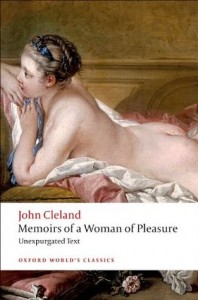

Fanny Hill, or Memoirs of a Woman of Pleasure by John Cleland

Posted November 14, 2014 by Michael @ Knowledge Lost in Classic, Erotica / 8 Comments

Fanny Hill, or Memoirs of a Woman of Pleasure by John ClelandTitle: Fanny Hill, or Memoirs of a Woman of Pleasure (Goodreads)
Author: John Cleland
Published: Oxford World's Classics, 1748
Pages: 240
Genres: Classic, Erotica
My Copy: Paperback

Buy: AmazonBook DepositoryKindle (or visit your local Indie bookstore)

In 1748 English novelist John Cleland went to debtors’ prison; while he was there he wrote a novel that went on to become the most prosecuted and banned book in history. Memoirs of a Woman of Pleasure is often referred to as Fanny Hill and is considered one of the first pornographic novels in the English language. Due to the release of this book, Cleland and his publisher Ralph Griffiths were both arrested and charged with “corrupting the King’s subjects”. The book went on to become so popular that pirated editions were sold underground. The book’s popularity eventually saw the book being published in 1821 in the United States, where its first known obscenity case convicted publisher Peter Holmes for printing a “lewd and obscene” novel.

Memoirs of a Woman of Pleasure tells the story of an orphaned fifteen year old with no skill and very little education named Fanny Hill. She leaves her village to find employment in London, where she is hired by Mrs. Brown. Fanny believed her employment was legitimate and that she would be working as a maid but she discovered that Mrs. Brown ran a brothel and intended to sell her maidenhead. The prostitute that shared her room opened Fanny’s innocent eyes to the sensuality of sex. She eventually falls in love and runs away with a man named Charles.

I do not want to go into too much detail about the plot of this book; in fact I have only covered the very first part of the story. I started off this review with mentioning that John Cleland wrote this book while in debtors’ prison and I think this is an interesting fact to remember. Cleland plays out all types of sexual fantasies while he is locked away; the novel pretty much covers everything you can think of sexually. The all-important one in this book was losing her maidenhead, which was sold to at least three different clients. However there is something deeper going on within the pages of Memoirs of a Woman of Pleasure.

This novel kept getting banned until 1973 in the United States; it was the introduction of the Miller test which finally lifted its banning. The Miller test is a three prong obscenity tested used in the United States Supreme Court to determine if something should be labelled as obscene. The work is considered obscene if all three conditions are satisfied and I am going to quote the law here so you better understand the Miller test.

(a) Whether “the average person, applying contemporary community standards” would find that the work, taken as a whole, appeals to the prurient interest
(b) Whether the work depicts or describes, in a patently offensive way, sexual conduct specifically defined by the applicable state law
(c) Whether the work, taken as a whole, lacks serious literary, artistic, political, or scientific value.

The ban was lifted because Memoirs of a Woman of Pleasure holds literary and artistic value and rightly so. Memoirs of a Woman of Pleasure is a stunning book to read, the proses are elegant but I also found it fascinating how many erotic fiction tropes comes from this one book. I have not read many erotic novels, but from what I know and read, there is a lot that this genre needs to thank John Cleland. All the cliché scenarios and sex scenes owe a lot to this novel but one I am glad I don’t see any more is the use of the word ‘machine’. The idea of men walking around with machines between their legs bugged me and I just didn’t like that terminology; unfortunately the word ‘weapon’ seems to have survived.

This was a fascinating exploration into the origins of erotic fiction and sex scenes in literature and ultimately I am glad to have read Memoirs of a Woman of Pleasure. It is not that often that I associate steaming sex scenes with literature of the 18th century, so it is good to know that people were deviant back then. Memoirs of a Woman of Pleasure isn’t just about sex; Fanny Hill works as a sex worker but she also finds love. She discovers that sex outside love isn’t as pleasurable and this is the message that I really took away from this novel. Despite all the fantasies, I think John Cleland wanted to look at how important love is when it comes to pleasure seeking.


In Cold Blood by Truman Capote

Posted August 30, 2014 by Michael @ Knowledge Lost in Book of the Month, Non-Fiction / 0 Comments

In Cold Blood by Truman CapoteTitle: In Cold Blood (Goodreads)
Author: Truman Capote
Published: Penguin, 1965
Pages: 336
Genres: Non-Fiction
My Copy: Library Book

Buy: AmazonBook DepositoryKindle (or visit your local Indie bookstore)

In 1959 a farmer from Holcomb, Kansas was killed along with his wife and two of his four children by a couple of two-bit thieves. This brutal crime spawned a desperate search for the killers who left bloody footprints at the murder scene. From petty crime to mass murder, In Cold Blood tells the story from murder to the gallows where they were executed by hanging.

In the Truman Capote literary masterpiece, it is easy to consider In Cold Blood a crime novel; it has shades of pulp and southern gothic throughout the book. However this journalistic investigation has often been cited as the first and best example of the non-fiction genre known as true crime. While there have been true crime books before In Cold Blood, this book did redefine the genre. Capote likes to call his book a non-fiction novel which he defined in an interview with The New Your Times as “a narrative form that employed all techniques of fictional art, but was nevertheless immaculately factual”.

However this is not just a book about the brutal murder of the Clutter family; we also get a Capote’s depiction of rural America. Outside the details of the crime, the author paints a descriptive backdrop of Kansas, the way he sees it. Religion, masculinity, femininity, the nuclear family and small town communities all play a big part in developing the scene. When he talks about the crime, the reader gets to explore the psychological motivations of murder and awaiting execution.

There is the issue of mental illness that needs to be explored when talking about In Cold Blood. It is almost like Truman Capote wants to challenge the reader to consider if Perry and Dick suffered from an untreated mental illness. There are shade of delusional, depression, schizophrenia and a sociopathic personality that comes through when talking about these two people but as this is 1959 I expect no psychological consult or treatment were given to these men; the court rejected the request.

I expected a true crime book but I feel like In Cold Blood was trying to do something similar to One Flew Over the Cuckoo’s Nest by Ken Kesey and The Bell Jar by Sylvia Plath. I was very impressed with this book and I feel like Capote may have ruined true crime and even narrative non-fiction for the rest of the authors in these genres. Capote’s investigational skills and mastery over the written word is what makes this book a masterpiece.


The Monk by Matthew Lewis

Posted July 30, 2014 by Michael @ Knowledge Lost in Classic, Gothic / 0 Comments

The Monk by Matthew LewisTitle: The Monk (Goodreads)
Author: Matthew Lewis
Published: Oxford World's Classics, 1795
Pages: 456
Genres: Classic, Gothic
My Copy: Paperback

Buy: AmazonBook DepositoryKindle (or visit your local Indie bookstore)

When The Monk was first published in 1796 it was surrounded by heated hatred and scandal. One critic claimed that The Monk was full of “Lust, murder, incest, and every atrocity that can disgrace human nature”; a line that now seems to commonly appear in the synopsis. While this novel is a transgressive gothic novel and possibly one of the first books to feature a priest in such a villainous way there is so much more going on within the pages. To begin, we must look at the context, and it is not surprising that this novel had so much anger towards it when it was released. The reader has to understand that this novel was released in a period of time where everything was changing. The church still played a huge role in English society but across the channel the French Revolution was raging on, so in the middle of a changing society came a novel that tried to explore the political and religious authoritarianism of the church.

The Monk is set in a sinister monastery in Madrid, were Ambrosio struggled between maintaining his monastic vows and falling to temptation. We follow this monk as desire turns to obsession, to rape and then murder in order to conceal the guilt. Ambrosio is a celebrated and devout monk of 30 years but we read his downfall due to desire and pride. This novel is a social commentary of everything wrong with the church as the author sees it. The Monk follows the story of Ambriosio’s disillusion, from a well-respected Monk, serving God to a psychologically scared man.

Matthew Lewis wrote this novel at 19 years old and I think it is important to mention that I don’t view The Monk as an indictment of God or the Church but more critique of the corrupting power that comes with the priesthood. When I read this I got the impression that Lewis wanted to explore the hidden struggles that come with the vows of a monk as well as the effects of power. When we think about all the evil the church has done, it is not God or religion that is to blame but rather the people. Guilt and power can corrupt and essentially we are looking at a man going to great lengths to disguise his transgressions.

This is not an easy read and I found myself struggling at times to get through this book but there is so much going on I found it hard to believe that when this was first published it was dubbed this gothic classic to be crude and lacking of depth. In the heavily censored edition of this novel published in 1798 saw all words like lust and desire removed from the text. Even words like enjoyment were removed and any mention of sex; I can’t imagine how the essence of The Monk would have remained with this heavily edited edition. While there was plenty of hatred toward the novel, the critics seemed to have mixed feelings towards it. Samuel Taylor Coleridge both praised and judged harshly in his article found in The Critical Review, saying “[the] underplot… is skilfully and closely connected with the main story, and is subservient to its development” and “The Monk is a romance, which if a parent saw in the hands of a son or daughter, he might reasonably turn pale.”

However The Monk looks at more than just the monastery, it even looks at what seems like an anti-feminist movement going on within the Church. The convent seems like a harsh place to live, the women brutally treated and never allowed to succeed. Woman are seen as the downfall of the monks and other woman but there is so much lust, desire and sexual misconduct that happens inside the walls of convents and monasteries. Matilda posed as a man in order to get close to Ambrosio, at first it wasn’t to seduce but to bask in his brilliance. She is portrayed as a she-devil but is it really her fault that Ambrosio gave into his earthly desires. As one critic stated “It is Ambrosio’s sexual ignorance and hence ‘innocence’ that makes him vulnerable to Matilda’s seduction” (Blakemore, 1998). This made me ponder and question the whole approach to life in a monastery, especially in an era where priests are more likely to be sexually ignorant.

I’ve mentioned a few times that The Monk was met with hatred and I think this is still true today; people tend to see the book as anti-religious, anti-Catholic and immoral but this is a problem with taking text to literally. The Monk is a satire and socially critiques the church in what feels like a comedic kind of approach. It happens that this is also a transgressive gothic novel so we have a very brutal and dark approach to the themes Matthew Lewis wants to explore. Near the start of the book I read the line “She was wise enough to hold her tongue. As this is the only instance known of a Woman’s ever having done so, it was judged worthy to be recorded here” and thought it was a little harsh; I soon began to see a real tongue in cheek approach emerging from this dark novel.

I started off thinking this was a gothic novel and it was going to be dark and serious but I soon found myself adjusting my approach. Once I got past my initial misconceptions I started to settle into this book and ended up really enjoying The Monk. It took a while to get into a groove and found the first part of the book to be particularly difficult to get through. Then the plot started to settle in and I was able to explore the themes and enjoy the journey I was taken on. I’m so glad I finally got around to reading this gothic classic, it is weird but wonderful. I hope everyone else enjoys it as much as I did.


The Sorrows of Young Werther by Johann Wolfgang von Goethe

Posted April 24, 2014 by Michael @ Knowledge Lost in Classic / 1 Comment

The Sorrows of Young Werther by Johann Wolfgang von GoetheTitle: The Sorrows of Young Werther (Goodreads)
Author: Johann Wolfgang von Goethe
Translator: David Constantine
Published: Oxford World's Classics, 1771
Pages: 160
Genres: Classic
My Copy: Paperback

Buy: AmazonBook DepositoryKindle (or visit your local Indie bookstore)

The Sorrows of Young Werther is an epistolary novel that has influenced the Romantic Movement. Often known as the original ‘emo’, a term that I hate, this novel is a semi-autobiographical novel that brought huge success to Johann Wolfgang von Goethe. The novel is a collection of letters written by Werther to his friend Wilhelm. These letters are an intimate account of his attraction towards the beautiful Lotte; a young woman he meets in the village of Wahlheim. Despite knowing that she is already engaged to a man 11 years her senior, Werther falls for her and attempts to develop a friendship between the two in an effort to get closer to Lotte.

You can probably guess how this story goes; Werther, an artist of highly sensitive and passionate nature heading down a road that can only lead to heartbreak. I’m not one to enjoy a novel that revolves around a love triangle but when it is done properly it can be an effective plot device; I’m thinking of books like those mentioned in this post. There is no denying the cultural impact The Sorrows of Young Werther has had on the world; unfortunately the ‘Werther effect’ is the most common reference to the novel nowadays.

I’ll be honest, I wanted to read this novel because Frankenstein’s monster finds this book in a leather portmanteau along with Plutarch’s Lives of the Noble Greeks and Romans, and John Milton’s Paradise Lost which gives you an interesting insight into FrankensteinLives of the Noble Greeks and Romans is a series of biographies of famous men to illustrate their common moral virtues or failings, while Paradise Lost is an epic poem on creationism and the fall of man. The Sorrows of Young Werther embodies the Romantic ideals; Werther being a sensitive intellect with an obsession of nature and values emotion over reasoning. All three novels represent different themes that Shelley wants the reader to explore when reading Frankenstein.

While this may sound like a morbid and depressing novel, Goethe shows the beauty behind the tragedy. One thing I loved about this book is the wording, and permit me to post a few quotes from the book to just show you the beauty in the novel.

 “Sometimes I don’t understand how another can love her, is allowed to love her, since I love her so completely myself, so intensely, so fully, grasp nothing, know nothing, have nothing but her!” 

The major theme obviously is love; a look in how it can defy all logic. Werther can’t stop his heart from falling for Lotte, even if he knew it would lead to pain. The idea that the heart has more control over someone’s actions than their head is often evident in life and The Sorrows of Young Werther captures it perfectly. For me, that is what makes this novel spectacular and significant.

“I am proud of my heart alone, it is the sole source of everything, all our strength, happiness & misery. All the knowledge I possess everyone else can acquire, but my heart is all my own” 

However, you can look at this novel as something other than love; the idea that Goethe is portraying the decline in Werther’s mental health is also a vital angle that needs to be considered. The reason I hate the term ‘emo’ I won’t go into at this time but Werther’s overly emotional journey could also be symptoms of a bi-polar depression, though not a known diagnosis of the time. We have to consider the idea that his joy and sorrow is not just unrequited love but a deeper issue. The love triangle would have added fuel to his depression and we cannot ignore that this could be the root cause of Werther’s sorrow.

For such a small novel, The Sorrows of Young Werther packs a huge punch. This is the type of book I can see myself reading again and again, not just because of the Romantic ideas but what it has to say about love and mental illness. I can’t help but think that The Sorrows of Young Werther is just a better version of The Catcher in the Ryein the sense that is a journey of a self-absorbed protagonist, but maybe too difficult for high-school student. The Sorrows of Young Werther is an important book, not only did it influence the greatest literary movement we’ve seen but it still relevant today, almost 250 years later.


The New York Trilogy by Paul Austen

Posted April 13, 2014 by Michael @ Knowledge Lost in Crime, Literary Fiction / 2 Comments

The New York Trilogy by Paul AustenTitle: The New York Trilogy (Goodreads)
Author: Paul Auster
Published: Penguin, 1987
Pages: 308
Genres: Crime, Literary Fiction
My Copy: Audiobook

Buy: AmazonBook DepositoryKindle (or visit your local Indie bookstore)

If you want to try a metafictional detective novel, then look no further than The New York Trilogy by Paul Austen. Originally published sequentially as City of Glass, Ghosts and The Locked Room, these three interconnecting stories have been since collected into a single volume. Heavily influenced by the post-modernist movement, this novel blends elements of neo-realism, soft-boiled fiction and of course, metafiction. Even the pulp style cover (illustrated by Art Spiegelman) has a metafictional style to it.

I really wish I had a better grasp on post-modernism; there is a lot of literary theory that must go into fully understanding a novel like The New York Trilogy. My level of understanding of post-modernism might hinder this review but I will do my best to add something valuable here. Starting with a look at any example of one of the narrators; such as the one known as Peter Stillman, or is he? Maybe his name is something entirely different; maybe it is Paul Auster. This gives you an idea of just how you have to read this book; continuously questioning everything and assuming things are not as they have been told. This does make the novel difficult to read, I had to take my time with it and reread almost everything.

The first story City of Glass follows a detective fiction writer that becomes a private investigator. This unnamed narrator explores layers of identity and reality; often to Paul Auster (the author), Paul Auster (the writer), Peter Stillman (the mark), the other Peter Stillman (the son) and finally Daniel Quinn (the protagonist). The story follows this narrator as he descends into madness as the reader follows close behind. This is story that explores the relationship between the author, characters and the reader in a twisted kind of way. Essentially asking us to consider who has the real power in this relationship?

Ghosts follows the story of a private eye called Blue who is hired to follow Black; he has been hired by White to write down everything Black does. Only problem is that Black doesn’t do too much apart from sit and write all day, which means Blue spends all day sitting and writing. This is a story that explores the issue of who has the real power, the author or their characters. Paul Auster is showing us his views towards writing (sitting and watching what the character does).

Finally in The Locked Room, the title suggests that the story is referencing the locked room mystery archetype. It tells the story of a writer that doesn’t have the creativity to produce any fiction. When a childhood friend disappears, he has been hired to write his works and determine if they should be published. While one this job he finds himself taking the place of his friend and becoming husband and father to his family. This final story looks at the relationship between character and reader and asks us to consider if we are under the control of the author or do we interpret what is happening for ourselves.

It is interesting that a novel like The New York Trilogy can leave you perplexed and confused but when you try to articulate what happened and slowly dissect the novel into its three parts it all makes sense. I’m often surprised with how much I get out of a post-modern novel, especially since I often freak out and feel like I have not understood it. Then it all makes sense and I often wonder how I did not pick up on this while reading or after reading the novel. I hope I’ve made enough sense out of The New York Trilogy, a bizarre novel that requires very close attention but I’ve conquered it and I feel proud.


Breakfast at Tiffany’s by Truman Capote

Posted April 3, 2014 by Michael @ Knowledge Lost in Classic / 2 Comments

Breakfast at Tiffany’s by Truman CapoteTitle: Breakfast at Tiffany’s (Goodreads)
Author: Truman Capote
Narrator: Michael C Hall
Published: Penguin, 1958
Pages: 157
Genres: Classic
My Copy: Audiobook

Buy: AmazonBook DepositoryKindle (or visit your local Indie bookstore)

Breakfast at Tiffany’s is a romantic comedy starring Audrey Hepburn that the Library of Congress has recently deemed “culturally, historically, or aesthetically significant”. It was a cheesy and mildly offensive (Mickey Rooney’s character) adaptation of Truman Capote’s novella of the same name. I recently had a chance to read Breakfast at Tiffany’s before rewatching the classic film and as I expected, another Hollywood butchering.

Breakfast at Tiffany’s tells the story of the unnamed narrator and Holly Golightly who are tenants in the same Upper East Side brownstone. The novella follows the narrator’s observations the life of this Manhattan café society girl. Holly has no job, but she survives by socialising with wealthy men who in turn give her money and expensive gifts.

It is important to note that Truman Capote has stated that Holly Golightly is not a prostitute; this is a popular misconception that I believe is debunked in the novel (but doesn’t mean it’s wrong). There is a conversation about three thirds of the way through this novella where Holly says she could never be a prostitute, she can’t separate love and sex. Even Capote came out and say that she wasn’t a prostitute, saying in an interview that “[Holly] was the prototype of today’s liberated female and representative of a whole breed of girls who live off men but are not prostitutes. They’re our version of the geisha girl.”

It is hard not to compare Breakfast at Tiffany’s the novella with the movie, everyone has seen the movie but I wish the book was celebrated for its brilliance. The movie has a focus on romance but that’s way off. What I found in the novel was friendship, isolation and on a very basic level hopes and dreams. There was an element of love in the novella but less traditional love, more of a focus on unrequited love (the wealthy men’s towards Holly) and love between friends.

I do have to wonder if the unnamed narrator has an autobiographical element to him. Both the narrator and Truman Capote share the same birthday, (the same birthday as me, 30th of September). I don’t know much more about Capote’s life but sharing a birthday makes me wonder. Holly was modelled after multiple women in Capote’s life, women he considered friends. I might find a biography of Truman Capote to learn more about it.

I listened to the audiobook of this novella read by Michael C. Hall and all I can think of was Dexter Morgan. The unnamed narrator in Breakfast at Tiffany’s had a similar narration style to that of Dexter and I kept waiting for something slightly sinister to happen. None of the characters were sociopaths like Dexter but I do think it enhanced my experience.

I loved this novella and highly recommend it to anyone who hasn’t read it. I didn’t remember reading much from the movie when I picked up this book; luckily, I think that might have tainted the experience. Capote’s writing was incredible and I feel like I need to read more of his, In Cold Blood is obviously a priority, although a biography might be beneficial first.


War and Peace by Leo Tolstoy

Posted March 20, 2014 by Michael @ Knowledge Lost in Classic / 2 Comments

War and Peace by Leo TolstoyTitle: War and Peace (Goodreads)
Author: Leo Tolstoy
Translator: Aylmer Maude, Louise Maude
Published: Oxford World's Classics, 1869
Pages: 1392
Genres: Classic
My Copy: Personal Copy

Buy: AmazonBook DepositoryKindle (or visit your local Indie bookstore)

When people thing of big books often War and Peace by Leo Tolstoy is mentioned. This Russian classic depicts the French invasion of Russia in 1812. True to Tolstoy form, War and Peace also looks at classes and the impact of the Napoleonic invasion on the Tsarist society. While this book can be considered an epic historical war novel, for me this was a work of philosophical ideas. This is one of the hardest books to review, not because I have nothing to say but rather there is so much to cover and I have no idea where to start.

Just to put things into perspective, I started this book in October and have been slowly chipping away at it for four months. It is a hard battle and you really need to take your time with a book like this because Tolstoy has a lot to say. This is the kind of book that feels like you‘ve climbed a mountain when you finally finish and you can just feel your pretentious levels rising. For those interested, I read the Oxford World’s Classics edition which has the translations by Aylmer and Louise Maude. Many people debate on which translation is the best but I thought going with an Oxford World’s Classics would be a safe bet; I love this publisher and know I’m always getting a decent copy of the book.

Right off the bat you are flung into this world and you meet so many people. Tolstoy has an amazing ability to give the reader a sense of a person with a few lines, so even the minor characters in this book get some sort of personality. There are hundreds (over 500) characters within War and Peace and I often found it difficult to keep up with them all but thanks to Leo Tolstoy’s writing ability I could relax a little because even if I forgot about a character, when they reappear further in the book I still had a sense of who they are. This is possible due to the way this book was originally written and I will talk more on that later.

Most of the major characters within War and Peace are members of the aristocracy and it is interesting to see them all fighting for a higher position in society, government or the military. People like Boris rise in society while others like the Rostov fall, Dolokhov gets demoted while Pierre plots an assassination. Not only do we have the Napoleonic war happening within these pages, a battle for social standing rages through this novel. It is all about power but paradoxically the people with the most power within this book are the ones that seem to give up control.

If you don’t have the knowledge of Russian or Napoleonic history, this novel accommodates the reader. I found myself at times looking up information about the history just to satisfy my curiosity but as the book progressed, my research subsided. It is in Leo Tolstoy’s style to give you as much information as possible, this does make the book longer but for me I think it was a huge bonus. But you must realise this is a work of fiction and most of the people are fictional. Tolstoy was telling a story of the invasion and the harsh nature of war. You can even look at the second epilogue and read more of the authors thoughts on the subject and the philosophical ideas held within this book.

War and Peace was originally serialised in the literary magazine The Russian Messenger between 1865 and 1867. This magazine plays host to many of Leo Tolstoy and Fyodor Dostoyevsky’s novels. This means that originally people read War and Peace over the course of three years. This means at times the novel may feel repetitive and covering plot points done before but this is just a result of the original format. It comes in handy with characters as they are reintroduced and because I took my time reading this classic, it became a vital part.

There is so much going on within War and Peace and it took me a long time trying to work out what I wanted to say and what to leave out. This is the kind of book that needs to be revisited in the future, Tolstoy has a lot to say and I’m interested in exploring the themes. I loved this book; it is a roller-coaster of emotions and philosophical ideas. I’ve only scratched the surface of what is happening in this novel and then wrote a small amount of what I discovered. I can’t imagine ever being able to fully understand the brilliance of Tolstoy and War and Peace. For me, Fyodor Dostoevsky is a better writer but Leo Tolstoy has a unique ability to capture the lives of everyone involved in one war.


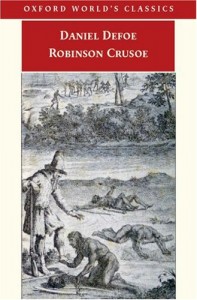
Robinson Crusoe by Daniel Defoe

Posted February 10, 2014 by Michael @ Knowledge Lost in Classic / 0 Comments

Robinson Crusoe by Daniel DefoeTitle: Robinson Crusoe (Goodreads)
Author: Daniel Defoe
Published: Oxford World's Classics, 1719
Pages: 321
Genres: Classic
My Copy: Personal Copy

Buy: AmazonBook DepositoryKindle (or visit your local Indie bookstore)

When Robinson Crusoe gets shipwrecked on an island, everything changes for him. Now stuck on the island of despair, Crusoe has to learn how to survive. Daniel Defoe’s classic survival novel has been the inspiration for many stories to come. Most people know the story so I won’t go into too much detail summarising the book.

Some may disagree but I found that Defoe set out to shatter the misconceptions that Europeans had towards colonialism. When Robinson Crusoe lands on the island he adopts colonialism, as it is familiar to him and the political nature he recognises. You see the progression of this social structure from when Crusoe first found himself on the island. He built his shelter, farmed the lands and hunted. Then when other people were introduced, the social order fell into place, putting himself as lord and master. Others like Friday and his father were slaves, but the Spaniard and the Englishmen were treated completely differently.

Another theme I noticed while reading Robinson Crusoe was the idea of isolation; this was portrayed in a literal sense. Stuck on the island, Crusoe had so much time on his hand he spends it contemplating society, religion, politics and the world. What was interesting to note is the fact that there was no real mention of women in the book; there were some but none played a significant role. This detail is something I spent a lot of time contemplating, it felt like with all his reflections, women never were an important part of the world. I’m not sure what Defoe meant by this but I’m sure it is something worth investigating.

I found Robinson Crusoe fascinating; I was studying it for university so I had to look at what Daniel Defoe was trying to say about colonialism. However there is something that really annoyed me about the book and that is the way the writing style kept changing. It felt like Defoe wasn’t sure how he was writing the novel, switching between diary entries and first person narrative. It didn’t feel intentional just changing whenever it suited him and that, in turn, just felt sloppy.

Robinson Crusoe isn’t a great book; I’m glad I read it but it just isn’t something I can praise. It wasn’t a problem with the themes or the style; it just focused too much on survival and missed opportunities to explore other topics. Sure, this is a classic and you have to give a book credit for staying around so long, but Robinson Crusoe just wasn’t for me.


Tinker, Tailor, Soldier, Spy by John le Carré

Posted January 30, 2014 by Michael @ Knowledge Lost in Book of the Month, Thriller / 0 Comments

Tinker, Tailor, Soldier, Spy by John le CarréTitle: Tinker, Tailor, Soldier, Spy (Goodreads)
Author: John le Carré
Series: George Smiley #5
Published: Sceptre, 2009
Pages: 422
Genres: Thriller
My Copy: Library Book

Buy: AmazonBook DepositoryKindle (or visit your local Indie bookstore)

Tinker, Tailor, Soldier, Spy is my second John le Carré novel, the first being The Spy Who Came in from the Cold (which I may need to read again). I remember never really feeling the need to go out and read some more, which would have been a huge mistake. My reasoning for reading Tinker, Tailor, Soldier, Spy was mainly came from the need to have the book read before seeing the movie adaption. John le Carré does a great job writing complex spy plots, but sometimes it gets too confusing and makes it hard to keep up.

The story follows George Smiley (le Carré’s most famous protagonist), a retired intelligence officer working for MI6 (often referred to as “The Circus”) on a quest to discover a mole within the organisation. The characters in the book are so well written, I had to admire the way they all seem so secretive and full of mystery. This is what I expect from a spy novel and John le Carré does a brilliant job in handling them on paper. There is a fine line in how to handle characters like this; too much one way they feel over the top and cheesy and too much the other the mystery will be gone.

The complexity of a novel like this does cause a bit of an issue but in the end isn’t that what you really want? With the twists and turns, you are left never really sure what everyone’s motivations are. John le Carré has a way of under developing characters but never in a way you are annoyed by it; the idea is to keep so much of someone’s character a mystery, with inconsistences that it makes them feel like a real spy. It’s an interesting technique, one that wouldn’t work in most other genres.

Have to give John le Carré credit for the way he builds atmosphere, in a complex plot with numerous characters he still manages to bring a glimpse of London life. Not being to London before, I couldn’t tell you how realistic his depiction is but it feels real. Another thing he does really well is dialogue, nothing feels forced or fake; it all feels seamless and natural.

Now the movie adaptation of this film was particularly interesting. Having read the book beforehand, I really enjoyed it. I had an idea of what was going on, but my wife didn’t, she struggled with the plot. Personally I think overly complex plots make for better spy movies and books, but I think it really helped to have read the book before seeing this adaptation. It was a faithful and enjoyable movie full of all you expect from the book and Benedict Cumberbatch with bad hair.

I’m not going to rush out and read a John le Carré novel anytime soon, but I will come back to him at a later date. I did enjoy this novel; I just feel that the complexity makes it a very difficult book to read. I will have to take my time with his novels, but I’m excited to see what happens in his other books. I’m not sure where to start, do I just read a recommendation, start at the start of the series or just check out his latest book?