Source: Personal Copy

Ex Libris: Confessions of a Common Reader by Anne Fadiman

Posted November 19, 2014 by Michael @ Knowledge Lost in Non-Fiction / 0 Comments

Ex Libris: Confessions of a Common Reader by Anne FadimanTitle: Ex Libris: Confessions of a Common Reader (Goodreads)
Author: Anne Fadiman
Narrator: Suzanne Toren
Published: Farrar, Straus and Giroux, 1998
Pages: 162
Genres: Non-Fiction
My Copy: Audiobook

Buy: AmazonBook DepositoryKindle (or visit your local Indie bookstore)

Anne Fadiman has often stated that she learned about sex from her father’s copy of Fanny Hill (correct title for this book is Memoirs of a Woman of Pleasure) by John Cleland. Ex Libris (which is Latin for ‘from books’) is a collection of essays that recounts her life and her love affair with books. This collection of personal essays documents her life and those small problems only a fellow book lover would truly understand. Like when Anne and her husband finally decided to merge libraries five years into their marriage in the essay “Marrying Libraries”.

I have to admit, I love Anne Fadiman; she is the embodiment of everything I want to be as a reader. She is smart, witty, a little wry and can talk about books with great passion and intelligence. She does come across as pretentious and throws in some quotes in French just to show off, however her writing is so beautiful and she talks about books, not just as a personal experience but also includes some literary criticism.

This collection recounts a lifelong love affair she had with books; exploring the joys and passion that comes with being a book lover. I love how she talks about books in the form of personal essays; it gives me a whole new concept about writing. I obviously knew about personal essays in the past but something about this book just opened my eyes and made me think “I should be doing this”. The way she talks about her reading journey in a collection of connecting essays is wonderful; it turns the book not into a linear progression but rather focuses each essay on an experience or book.

You might have noticed that when I review books I tend to put a bit of my personal life and journey into the blog post. The style suits me and because I want to think of my book blog as a personal journal into my reading life, I feel it fits that theme. Anne Fadiman has a similar idea but in the form of essays and she puts my writing to shame; I now aspire to write as elegantly as she does with wit and beauty within each essay. I am nowhere near where I want to be but practise makes perfect; right?

This is the kind of collection I plan to read over and over again. I obviously love books and Anne Fadiman has obviously set the bar high for future books. I started reading memoirs from bibliophiles because I wanted to learn different ways to talk about books. Ex Libris has taught me so much more about books and just reminds me how much I love books about books. I have a whole heap of other memoirs to read and to be honest reading about people’s reading life has given me an appreciation for memoirs in general. I want to read more styles; not just readers but writers and then progress to other types of creativity. I remember starting the year struggling through non-fiction but it looks like I am ending this year with a completely new attitude towards them.


Gulliver’s Travels by Jonathan Swift

Posted November 18, 2014 by Michael @ Knowledge Lost in Classic / 0 Comments

Gulliver’s Travels by Jonathan SwiftTitle: Gulliver's Travels (Goodreads)
Author: Jonathan Swift
Published: Oxford World's Classics, 1726
Pages: 362
Genres: Classic
My Copy: Paperback

Buy: AmazonBook DepositoryKindle (or visit your local Indie bookstore)

Jonathan Swift’s classic satire novel Travels into Several Remote Nations of the World. In Four Parts. By Lemuel Gulliver, First a Surgeon, and then a Captain of Several Ships was released in 1726 but in 1735 the title was amended simply to Gulliver’s Travels. The novel was popular not only because it was a parody on the popular “travellers’ tales” genre but as a satire on human nature. It later gained increase popularity in its abridged form as a classic in children’s literature.

It seems a little odd to me that many people have experienced Gulliver’s Travels as a children’s book. Comparing what I know from the abridged children’s book to the version I just read, it feels like a completely different book. The abridged version I believe only focuses on books 1 and 2 and all satire, allegory or symbolism has been stripped from it, which means the bulk of makes Jonathan Swift a great writer has been completely removed and only the fantastical elements remain. Other classics received a similar treatment to turn into a kids book including, Robinson Crusoe, The Thousand and One Nights (known as The Arabian Nights) and to a less extent Alice’s Adventures in Wonderland and Peter Pan.

When reading a book like Gulliver’s Travels it is important to remember that Jonathan Swift deals heavily in irony. Take for example his essay ‘A Modest Proposal’ in which he suggests a solution to the population issue in Ireland. He suggested that we need to “regard people as commodities” and went on to say that “A young healthy child well nursed, is, at a year old, a most delicious nourishing and wholesome food, whether stewed, roasted, baked, or boiled; and I make no doubt that it will equally serve in a fricassee, or a ragout.” This straight-faced proposal is a form of Juvenalian satire where Swift mocks the heartless attitudes the government has towards the poor, as well as Irish policy in general.

Gulliver’s Travels’ satirical themes are very subtle but are typically directed towards moral, political, social and religious ideals. The main satirical themes I found within the novel focused on war, corruption in the laws and politics and the ignorance or arrogance of doctors. There is a lot of irony within the book, for example the term medical malpractice refers to ordinary medical practices and horrific carnage is meant to be extremely fun.

This is a book that comes with more layers than an onion; we could look at the travel novel as a genre, colonialism, and even the changes in Gulliver’s opinions and language over the course of the book. You could even read this as a rebuttal to Defoe’s optimistic account of human capability in Robinson Crusoe which was published seven years earlier. On the surface, you can look at Gulliver’s Travels as four different short stories but if you decide to explore it deeper you are heading down a rabbit hole you may never escape.

I have to admit I didn’t spend as much time as I should have and explored some of the ideas within this classic a little deeper. I was very aware that if I dug deeper I would be stuck reading this book for the rest of the year, maybe the next. I am fascinated by this book, I would love to dig deeper in the future but with the aid of a study guide or something similar. I will be reading this book again and I would like to encourage others to pick it up if they haven’t done it in the past. Swift really has a decent grasp on satire; so much so that we have the term Swiftian to refer to his satirical tone and pessimistic outlook in literature.


The Cold Dish by Craig Johnson

Posted November 16, 2014 by Michael @ Knowledge Lost in Crime, Western / 11 Comments

The Cold Dish by Craig JohnsonTitle: The Cold Dish (Goodreads)
Author: Craig Johnson
Series: Walt Longmire #1
Narrator: George Guidall
Published: Penguin, 2004
Pages: 400
Genres: Crime, Western
My Copy: Audiobook

Buy: AmazonBook DepositoryKindle (or visit your local Indie bookstore)

The Cold Dish is the first book in the Walt Longmire series by Craig Johnson, which is basis of the short lived A&E television show Longmire. While the book and show both have western mystery vibes, they have subtle differences. The book shares similar attributes but does not have the same feel as the television program, which seems to target western fans before adding any mystery or drama. I suspect the reason the show never really took off was the fact that everyone was middle aged.

Walt Longmire is the sheriff of the fictional Wyoming county of Absaroka. His only friend is Henry Standing Bear; together they remind me of a more serious Statler and Waldorf with their self-deprecation. The novel revolves around the death of Cody Pritchard, a man who two years earlier was suspected for raping a Cheyenne girl. Longmire is on the case and Henry helps him by being a liaison between the Sheriff’s office and the Cheyenne reservation in the effort to solve this crime.

I have only watched the first season of Longmire so it is hard to compare between the book and the show. I know Longmire is portrayed as rough and tough in the show but it leaves out a lot of his wit and humour. Deputy Victoria Moretti shows the most change between the book and series; her whole attitude and backstory played out in very different ways. To be honest I do not know why I did not watch any more of this show, I think it was a matter of timing and a busy schedule.

I read this for my Literary Exploration reading challenge and I thought a western with a mystery was the best way to experience this genre. While this novel is full of the typical mystery tropes, this was actually a very entertaining novel. The wry wit and self-deprecation is what worked for me within the novel; it almost makes me want to re-watch the TV show to see what I missed. I am tempted to read more of this series but I fear the formulaic elements will quickly get in the way.


Fanny Hill, or Memoirs of a Woman of Pleasure by John Cleland

Posted November 14, 2014 by Michael @ Knowledge Lost in Classic, Erotica / 8 Comments

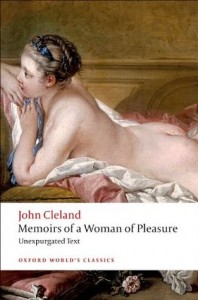
Fanny Hill, or Memoirs of a Woman of Pleasure by John ClelandTitle: Fanny Hill, or Memoirs of a Woman of Pleasure (Goodreads)
Author: John Cleland
Published: Oxford World's Classics, 1748
Pages: 240
Genres: Classic, Erotica
My Copy: Paperback

Buy: AmazonBook DepositoryKindle (or visit your local Indie bookstore)

In 1748 English novelist John Cleland went to debtors’ prison; while he was there he wrote a novel that went on to become the most prosecuted and banned book in history. Memoirs of a Woman of Pleasure is often referred to as Fanny Hill and is considered one of the first pornographic novels in the English language. Due to the release of this book, Cleland and his publisher Ralph Griffiths were both arrested and charged with “corrupting the King’s subjects”. The book went on to become so popular that pirated editions were sold underground. The book’s popularity eventually saw the book being published in 1821 in the United States, where its first known obscenity case convicted publisher Peter Holmes for printing a “lewd and obscene” novel.

Memoirs of a Woman of Pleasure tells the story of an orphaned fifteen year old with no skill and very little education named Fanny Hill. She leaves her village to find employment in London, where she is hired by Mrs. Brown. Fanny believed her employment was legitimate and that she would be working as a maid but she discovered that Mrs. Brown ran a brothel and intended to sell her maidenhead. The prostitute that shared her room opened Fanny’s innocent eyes to the sensuality of sex. She eventually falls in love and runs away with a man named Charles.

I do not want to go into too much detail about the plot of this book; in fact I have only covered the very first part of the story. I started off this review with mentioning that John Cleland wrote this book while in debtors’ prison and I think this is an interesting fact to remember. Cleland plays out all types of sexual fantasies while he is locked away; the novel pretty much covers everything you can think of sexually. The all-important one in this book was losing her maidenhead, which was sold to at least three different clients. However there is something deeper going on within the pages of Memoirs of a Woman of Pleasure.

This novel kept getting banned until 1973 in the United States; it was the introduction of the Miller test which finally lifted its banning. The Miller test is a three prong obscenity tested used in the United States Supreme Court to determine if something should be labelled as obscene. The work is considered obscene if all three conditions are satisfied and I am going to quote the law here so you better understand the Miller test.

(a) Whether “the average person, applying contemporary community standards” would find that the work, taken as a whole, appeals to the prurient interest
(b) Whether the work depicts or describes, in a patently offensive way, sexual conduct specifically defined by the applicable state law
(c) Whether the work, taken as a whole, lacks serious literary, artistic, political, or scientific value.

The ban was lifted because Memoirs of a Woman of Pleasure holds literary and artistic value and rightly so. Memoirs of a Woman of Pleasure is a stunning book to read, the proses are elegant but I also found it fascinating how many erotic fiction tropes comes from this one book. I have not read many erotic novels, but from what I know and read, there is a lot that this genre needs to thank John Cleland. All the cliché scenarios and sex scenes owe a lot to this novel but one I am glad I don’t see any more is the use of the word ‘machine’. The idea of men walking around with machines between their legs bugged me and I just didn’t like that terminology; unfortunately the word ‘weapon’ seems to have survived.

This was a fascinating exploration into the origins of erotic fiction and sex scenes in literature and ultimately I am glad to have read Memoirs of a Woman of Pleasure. It is not that often that I associate steaming sex scenes with literature of the 18th century, so it is good to know that people were deviant back then. Memoirs of a Woman of Pleasure isn’t just about sex; Fanny Hill works as a sex worker but she also finds love. She discovers that sex outside love isn’t as pleasurable and this is the message that I really took away from this novel. Despite all the fantasies, I think John Cleland wanted to look at how important love is when it comes to pleasure seeking.


Colorless Tsukuru Tazaki and His Years of Pilgrimage by Haruki Murakami

Posted November 13, 2014 by Michael @ Knowledge Lost in Contemporary / 13 Comments

Colorless Tsukuru Tazaki and His Years of Pilgrimage by Haruki MurakamiTitle: Colorless Tsukuru Tazaki and His Years of Pilgrimage (Goodreads)
Author: Haruki Murakami
Translator: Philip Gabriel
Published: Harvill Secker, 2014
Pages: 298
Genres: Contemporary
My Copy: Hardcover

Buy: AmazonBook DepositoryKindle (or visit your local Indie bookstore)

Tsukuru Tazaki was lucky enough to have four close friends in high school. They were a tight knit group and they all shared their hopes and dreams with each other. When it came to college Tsukuru went off to Tokyo to pursue his dream career while the others remained in Nagoya at various schools. They vowed to remain close and Tsukuru made an effort to visit as much as possible. That was until one day Tsukuru was told that the other four wanted nothing to do with him anymore.

I am not going to go too much into the plot; I think this is something that needs to be discovered within the book. However I do need to talk a little about it. Tsukuru Tazaki had always felt like an outsider, even though he was accepted into the group for a while. He was always colourless in a group of colours; Akamatsu (which means red pine), Oumi (blue sea), Shirane (white root), and Kurono (black field), while his name means ‘to build’. Essentially this is a novel about friendship, rejection, isolation and the psychological scars that can be caused by others who never took that into account. There is a whole other side that can be explored but that would involve spoilers.

I had a rocky start with Haruki Murakami; the first book I read was 1Q84 and lets face it, this is the worst place to begin. I was exposed to the world of Murakami with the awkward fetishes and magical realism but 1Q84 was ultimately a little clunky and way too big. Luckily I am a bit of a hipster and picked up What I Talk About When I Talk About Running and while I’m not a runner, I found it to be an interesting read. It wasn’t till I read Hard-Boiled Wonderland and the End of the World that I truly understood his brilliance. I still have a lot more to read but Colorless Tsukuru Tazaki and His Years of Pilgrimage was a perfect next choice.

I have often heard people recommending beginning with Norwegian Wood because it is rooted in realism and I would like to think Colorless Tsukuru Tazaki and His Years of Pilgrimage would work as well. I obviously haven’t read Norwegian Wood yet but the idea of beginning with some of his realistic novels before getting into the magical realism and exploring the weirdness of Murakami’s brain is probably a good idea. His style is a little unusual but once you get an understanding of how his mind works you should be readying do dive into something fantastical.

What I have found reading Haruki Murakami is that he has a strong interest in both the conscious and the subconscious. His books explore the complexities of the mind and how different situations have a psychological impact on a person. This is a really interesting theme and one that I am particularly interested in; if I knew that a long time ago, I am sure I would have been more willing to explore his works.  Even What I Talk About When I Talk About Running explored this theme and it was a memoir.

I do wish I didn’t begin with 1Q84 but after a few other books, I finally can say that Haruki Murakami has another fan. I am keen to read all his other books; both fiction and non-fiction. There is something enthralling about the way a mind works and I really like the way that Murakami explores that. While Colorless Tsukuru Tazaki and His Years of Pilgrimage was far from perfect, there are some weird and awkward moments in the writing that I believe is synonymous with his writing style but I found this a captivating read. I have reserved Norwegian Wood at the library and I am hoping to read that one very soon.


Excavation: A Memoir by Wendy C. Ortiz

Posted November 12, 2014 by Michael @ Knowledge Lost in Non-Fiction / 0 Comments

Excavation: A Memoir by Wendy C. OrtizTitle: Excavation: A Memoir (Goodreads)
Author: Wendy C. Ortiz
Published: Future Tense Books, 2014
Pages: 242
Genres: Non-Fiction
My Copy: Paperback

Buy: AmazonBook DepositoryKindle (or visit your local Indie bookstore)

Wendy C. Ortiz was an only child to distant, alcoholic parents growing up in San Fernando Valley in the 1980’s and early 1990’s. She is an insecure and bookish girl with a passion for writing; this memoir is about her relationship with a teacher fifteen years her senior. A deep excavation into a relationship that nurtured Wendy’s writing but also left psychological scars. In a world where we take this victim/perpetrator relationship as a black and white issue, Excavation: A Memoir explores the grey area.

Wendy takes her journal entries from her teenage years, during this relationship and combines it with her memories. Excavation: A Memoir is a disturbing but fascinating look into a destructive teacher/student relationship. Excavation is a wonderful title for this memoir; the idea that this whole situation was buried deep in her own emotions and mind and now she must excavate to get it out. It gives you an idea of just how damaging the situation was for Wendy, even before starting the memoir.

The journal entries capture her teenage years perfectly, that whole feeling of being confused and unsure is something that just feels familiar. There was this constant swing between where she felt like she was in control but then a state confusion and uncertainty. Then there is sections called “Notes of Excavation” which is a reflection on the situation from where Wendy is now. Like an interesting footnote, it not only tells the story of her present day life but a reflection on the situation. There is a powerful and haunting chapter called “Why I didn’t tell” which goes through a list of reason for keeping the secret “I didn’t want to be average, I didn’t want it to end…”

Excavation: A Memoir is not just a memoir about the shocking moments of this relationship but rather exploring the grey area. This teacher essentially made Wendy a better writer and encouraged her in the arts. However he was also telling her not to write anything about their relationship down. This obviously didn’t happen and we are looking at this situation where teenage Wendy thinks she has this power but in reality the teacher is manipulating her.

Wendy C. Ortiz has a MA in Clinical Psychology and an MFA in Creative Writing, co-founder/curator of the Rhapsodomancy Reading Series as well as a contributor to places like The Olympian, Los Angeles Times and McSweeney’s. Excavation: A Memoir could be compared to works like Alissa Nutting’s Tampa or even The Kiss by Kathryn Harrison.

The memoir ends a little rough, it felt like she was just trying to rush something that needed more time. Maybe there is another memoir planned and she is just teasing the reader with what comes next. However the memoir was a trip into a dark hell but also a exploration into a messy relationship. I picked up this book to get a better understanding of abuse and while it isn’t a happy or easy book it is probably important to understand how this kind of situation can be. Thankfully the teacher is now a registered sex offender and Wendy C. Ortiz seems to be in a better place, but will these scars ever heal completely?


Night of the Living Deadpool by Cullen Bunn

Posted November 11, 2014 by Michael @ Knowledge Lost in Graphic Novel / 0 Comments

Night of the Living Deadpool by Cullen BunnTitle: Night of the Living Deadpool (Goodreads)
Author: Cullen Bunn
Artist: Ramon Rosanas
Published: Marvel Comics, 2014
Pages: 96
Genres: Graphic Novel
My Copy: eBook

Buy: AmazonBook Depository (or visit your local Indie bookstore)

Deadpool is a Marvel Comics mutant anti-hero best known for his dark humour (he is sometimes referred to as “Merc with a mouth”) and breaking the fourth wall in his comic. He is a mentally unstable mercenary, weapons expert and has regenerative healing abilities. The perfect hero to put into a zombie apocalypse and in Night of the Living Deadpool this is what happens.

The series begins with a nod to The Walking Dead, which is a homage to that classic opening scene in The Day of the Triffids. Deadpool wakes up from a food coma a few days later and finds that he has awoken to the zombie apocalypse. This four issue series goes on to make multiple references to the genre.

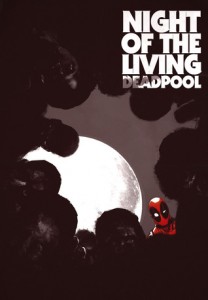
Writer of Deadpool Killogy, Cullen Bunn joins forces with a relative new artist, Ramon Rosanas. The series is a stylised black, white, and red (for Deadpool) with a very warped sense of humour. What stuck with me through this series was not just the references to classic zombie movies or macabre nature but the short, straight to the point approach to the genre. Comic book series can often go for a long time and while that is good, it was nice to start and end a series in one sitting.

I loved the art within this book; I liked how Ramon Rosanas avoided using colours within the comics. It highlights Deadpool as a character not like all the others, while leaving the focus on the drawings rather than the colours. This style is different to what is seen in Sin City but it works; flashbacks are in full colour so really it portrays the apocalypse as a dark time for humanity.

Because this series was only four issues, I find it hard to talk about this comic book. Everything happened so fast and then it was over. I enjoyed the short and sweet experience as stated before but the lasting effects are very small. I was left with memories of the references and art but nothing much more. I think this means that it will be a good series to revisit again; it is just a weird experience.


What We See When We Read by Peter Mendelsund

Posted November 8, 2014 by Michael @ Knowledge Lost in Non-Fiction / 3 Comments

What We See When We Read by Peter MendelsundTitle: What We See When We Read (Goodreads)
Author: Peter Mendelsund
Published: Vintage, 2014
Pages: 419
Genres: Non-Fiction
My Copy: Paperback

Buy: AmazonBook DepositoryKindle (or visit your local Indie bookstore)

When reading Moby Dick, does Ishmael look like Richard Basehart? How about Anna Karenina? Please don’t tell me she looked like Keira Knightley. What We See When We Read takes a look at the activity of reading with such depth and insight. Looking at not only the way our brain fills in the images but also what the author is trying to say. Take for example Karenin in Anna Karenina; his ears are described a few times within the novel but they get bigger. The size of his ears is an artistic simulacrum that changes as Anna Karenina’s feelings toward him change.

Peter Mendelsund is Knopf’s Associate Art Director and has been responsible for some of their most iconic book covers. Just looking at his book cover designs I get the sense that he loves reading and the artistic side of literature. His book covers really capture a feeling; they stand out and often work well with the written word inside. He is major is in Philosophy and Literature and the two work well together in looking at the idea of reading and how our minds interpret the written word.

This is very much like Understanding Comics by Scott McCloud, it explores the idea of reading in different ways and explores different concepts. We all read slightly different and Mendelsund is able to go into different methods. A stand out for me is the way Vladimir Nabokov read Kafka’s Metamorphosis; there is an image of his copy of the book and it looks like he edits and rewrites the book to make it his own. It is an interesting way to get involve with the written word.

What We See When We Read is a combination of written words and images, which allows Mendelsund to illustrate his point and give the reader a better understanding of the feelings. A big bonus is the fact that he references other books, which gives me a huge TBR pile of books that explore this idea further in different ways. I love books about books so I am pleased to have a reading list.

I have to say What We See When We Read is a must for all book lovers. This book will be a joy to read and will look good on the shelf. I own the new Vintage edition, which is a paperback but it also has French flaps so it looks nice. I like how he went for a simple cover design; it stands out and works well with this book. I know this book is rising in popularity and I hope more people get a chance to read this one as soon as possible.


The Canterbury Tales by Geoffrey Chaucer

Posted November 7, 2014 by Michael @ Knowledge Lost in Classic, Short Stories / 11 Comments

The Canterbury Tales by Geoffrey ChaucerTitle: The Canterbury Tales (Goodreads)
Author: Geoffrey Chaucer
Translator: Nevill Coghill
Published: Penguin, 1390
Pages: 504
Genres: Classic, Short Stories
My Copy: Paperback

Buy: AmazonBook DepositoryKindle (or visit your local Indie bookstore)

The Canterbury Tales is a collection of over 20 stories which were written near the end of the Fourteenth Century, just prior to 1400. While this is often referred to as an essential in medieval fiction, it is possible to narrow it down a little further and say this is a glimpse of life during the time of the Hundred Years’ War. The collection of tales helps break up this book a bit but it also contains a loose narrative framework throughout the entire The Canterbury Tales. I could go into deep analysis of each tale without doing a disservice to the quality and diversity of Geoffrey Chaucer’s large work. However in an effort to talk about The Canterbury Tales in its entirety, I may have to resort to broad analysis and generalities.

The Fourteenth Century was a violent and unstable period of time in English history; not only was the Hundred Years War raging with the French (1340-1450) but there was the Black Death (1348), famines and rebellions (the Peasant’s Revolt of 1381). This was an unstable time, things were changing; even the Catholic Church which often had a community-building nature was corrupt and abusing its power. Near the end of the 14th Century the Church was a mess, there was the sale of church offices as well as indulgences and pardons as well as greed and moral corruption. The Western Schism (or Papal Schism) took place from 1378 to 1418 where the Church was divided and several men simultaneously claimed to be the true pope. This should give you an idea of just what kind of instability the people in The Canterbury Tales faced.

However this book explored more than this instability; it is a medieval tapestry exploring the whole feel of this period but it might be easier to narrow it down to three major themes. The political, since The Norman conquest of England  (1066) the country was gradually processing toward political consolidation and unification, a theme that comes through a number of times within this book. Social and economic changes, following the story of many people around England as urbanisation takes affect and London becomes a more modern city. Finally The Canterbury Tales explores the cultural changes of a changing time; social classes are shifting but still play a big role within this country.

I know I am probably looking at this book through modern eyes but this is the best way I found to wrap my head around what is written. Luckily I didn’t have to read this book in Middle English and got to rely on Nevill Coghill’s translation but I am not going to deny that this was a very difficult book to get through. I found trying to understand the situation as if England changed from medieval into a modern society helped me pick up on the social, economical and political changes. I know London didn’t become an urban city like we know it today but it helped me follow the shifting times. I am not sure if viewing the book this way helped me understand it better or sent me down the wrong path but it doesn’t matter, is there a right or wrong way to interpret literature?

Symbolism, imagery and allegory play a huge part in Chaucer’s tales but it is hard to go into details on this topic because they change from story to story. What I found surprising about this book is not the beautiful poetic lines but how real and raw the emotions played out in each tales. I read an exploration into marriage, growing old, morality, rape, sexual pleasure and even anti-social behaviour. I never expected this from the book and it really surprised me. From a general overview The Canterbury Tales looks at a changing time but each tale goes into a personal look into different people’s lives.

As the narrator, Geoffrey Chaucer plays with the narrative from tale to tale; sometimes he comes off as naïve but then he can be very knowledgeable. I picked up on how  heavy he is on the irony, but in all honesty I didn’t have enough knowledge of the times to be able to explore this as much as I would have liked. If it wasn’t for the fact that I read this for a university subject I might have really struggled with this book. A lecture and some reading guides really helped me get something out of this book but like I said, I don’t have enough knowledge of medieval history to fully grasp this book in its entirety.

I mentioned to my dad that I had to read this book and he told me not to bother; he called it crude and vulgar but that only made me excited. I understand now that he had to read this book for high school and found it difficult but I can’t say vulgar is a good word to describe this book. Sure, there are some crude scenes but life is never full of well-mannered moral people. Chaucer explores life at this time and doesn’t shy away from the tough topics; but I think that is what makes this book so great.


Seconds by Bryan Lee O’Malley

Posted November 5, 2014 by Michael @ Knowledge Lost in Graphic Novel, Magical Realism / 0 Comments

Seconds by Bryan Lee O’MalleyTitle: Seconds (Goodreads)
Author: Bryan Lee O'Malley
Artist: Bryan Lee O'Malley
Published: Ballantine Books, 2014
Pages: 336
Genres: Graphic Novel, Magical Realism
My Copy: Hardcover

Buy: AmazonBook DepositoryKindle (or visit your local Indie bookstore)

Katie is a talented young chef running a successful restaurant. However her dreams are to open her own restaurant, a place where she can have more freedom and creativity. She has found the location for this restaurant has a backer (silent partner) and is working on fulfilling her dream. The problem is, everything is moving so slowly and she is starting to get impatient. What she really needs is a second chance, to fix the mistakes she has made and get her new restaurant on track. For Katie, she has the opportunity; a mysterious girl appeared in the middle of the night with some simple instructions for a second chance.

  1. Write your mistake
  2. Ingest one mushroom
  3. Go to sleep
  4. Wake anew

I’ve been a big fan of Bryan Lee O’Malley’s Scott Pilgrim series so I’ve been looking forward to see what will happen with Seconds. Luckily, the same humour and whimsical adventure is present within this new graphic novel. What I like about O’Malley is the way he takes a look at everyday situations in a fun and comical way. The added magical realism thread really helps explore the issues present within this book.

Seconds is full of existential angst and it explores the idea of making mistakes and he does it in a new and unique way. Unlike the Sliding Doors style where life is explored in two different situations, Bryan Lee O’Malley plays with the idea of correcting mistakes while Katie sleeps. Of course this has some humorous effects; Katie isn’t aware what has changed and this leads into a madcap scenario.

Bryan Lee O’Malley returns as the artist for his own books again and he has an interesting art style. There is an Asian influence in his art work; the big eyes and hair are not the only thing he takes from this comic book style. This influence can be found throughout his graphic novels in the characteristics, style and storytelling. What I like about Seconds is that he took his art style as seen in the Scott Pilgrim series and added colour to it. There are not a lot of colours used; the shading is often very simple and one shade but it works really well. The colour is just used to make the art pop; Bryan Lee O’Malley does great artwork, almost simplistic but it remains very expressive.

I am glad to have more Bryan Lee O’Malley graphic novels to experience but I am also reminded that he had another book before the Scott Pilgrim series that I need to check out. I do have Lost at Sea on my phone thanks to comixology; I just haven’t gotten around to reading it yet. I wouldn’t mind checking out The Wonderful World of Kim Pine as well but I know it is short. Bryan Lee O’Malley has become a favourite of mine and I hope he does something new soon.